Galactic Astronomy
 Call Kai
 Learn
Learn Practice Test
 Spaced Repetition
 Match
Match Flashcards
 Knowt Play
1/8

Earn XP
Description and Tags
Name | Mastery | Learn | Test | Matching | Spaced | Call with Kai | Chat |
|---|
No analytics yet
Send a link to your students to track their progress
9 Terms
what is observed in the milkyway at different wavelengths? (optical, UV, IR, NIR, X-ray, radio, gamma?)
NIR - can see stars through dust, so the bulge of the milkyway is quite visible. can see cooler, smaller stars much easier as they are often obscured by dust easier.
IR - able to see the IR emission from the dust itself
Gamma - highly energetic objects are visible here, like supernova remnants, pulsars, active galactic nuclei (AGN)
Radio - more energy detection than visible detection - interstellar medium, snrs, pulsars, and cold gas clouds/stellar nebulae
21cm emission line cold ionized HI gas
X-ray - hot, active objects, supernovae remnants, young stars + clusters
UV - young, hot stellar nebulae, interstellar gas, agns
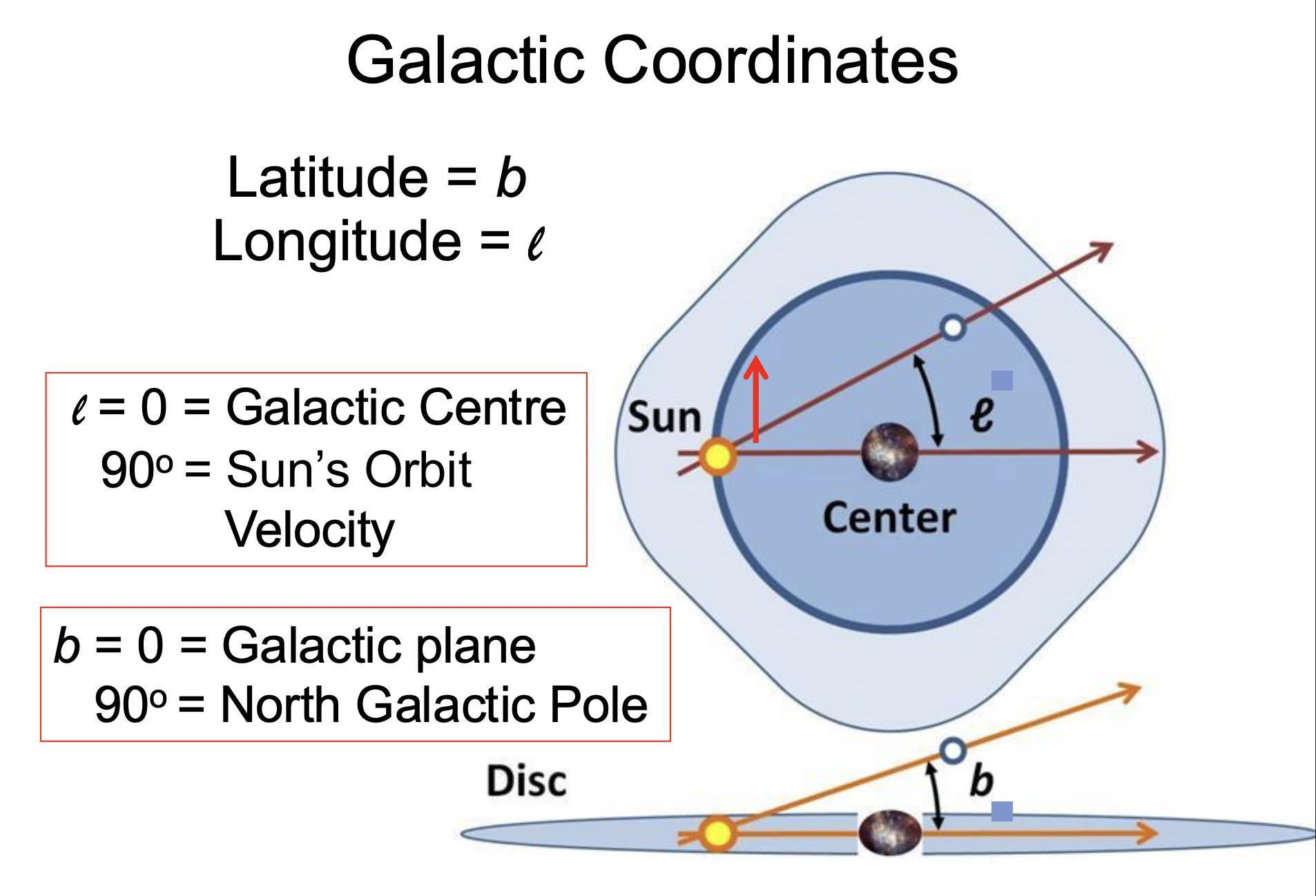
how are the galactic coordinates defined? what are special angles?
galactic latitude (b) - angle above or below the galactic plane
0 - galactic plane
90 - north galactic pole
galactic longitude (l) - angle formed by line connecting the sun and the GC, and another line connecting the sun and object
0 - galactic center
90 - direction of sun’s orbital motion around the gc
what is a rotation curve?
a plot of rotational/circular velocity against radius - shows the movement of stars about a galaxy
formulas associated with the moving cluster method? (transverse and radial velocity, proper motion, space velocity)
vr= vcos𝜃
vt= vsin𝜃 = 4.74𝜇d
d = vrtan𝜃 / 4.74𝜇
v = √vt2 + vr2
what is the stellar distribution function?
a probability density distribution of stars at time t for a position, velocity, and chemical composition.
what is the velocity dispersion?
the dispersion of velocities of stars around a mean velocity - i.e. shows the amount of random motion of stars compared to the average motion.
rotation curve V(r) of a circular orbit relation to enclosed mass M(<r)?
V(r)2 = GM(<r) / R
integral for enclosed mass?
M(<R) = ∫0R 4𝜋𝜌(r)r2 dr
What is the Local Standard of Rest?