Bio II Lab Exam 1
 Call Kai
 Learn
Learn Practice Test
 Spaced Repetition
 Match
Match Flashcards
 Knowt Play
1/54

There's no tags or description
Looks like no tags are added yet.
Name | Mastery | Learn | Test | Matching | Spaced | Call with Kai | Chat |
|---|
No analytics yet
Send a link to your students to track their progress
55 Terms
Leaf tissue function (1)
type of plant tissue
photosynthesis:
conversion of sunlight, water, and carbon dioxide into ATP and oxygen
transpiration:
water travels from roots to stems, and evaporates in air as vapor through tiny pores in leaves (stomata)
Stem tissue function (1)
type of plant tissue
support plant
position leaves
transport materials
photosynthesis
Root tissue function (1)
type of plant tissue
absorption
transport and store materials
anchor plant
Dermal tissue function (1)
type of plant tissue
outermost layer of plant
provides protection
regulates movement of materials
Ground tissue function (1)
type of plant tissue
provides structure, support, and storage
lateral transport
Vascular tissue function (1)
type of plant tissue
transports materials through the plant
Meristematic tissue function (1)
type of plant tissue
contain cells that are rapidly dividing through mitosis
Cuticle function (1)
type of dermal & ground tissue
prevents water loss
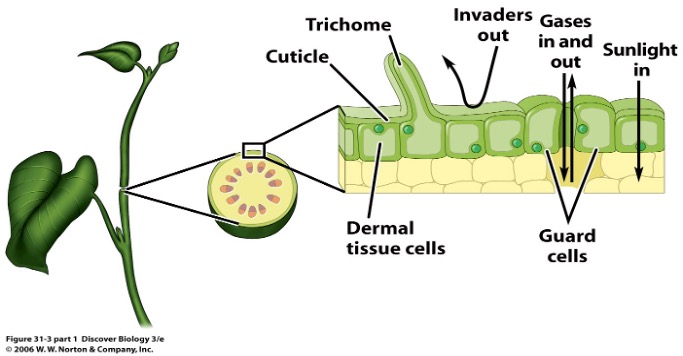
Epidermis (1)
type of dermal & ground tissue
outermost single layer of cells
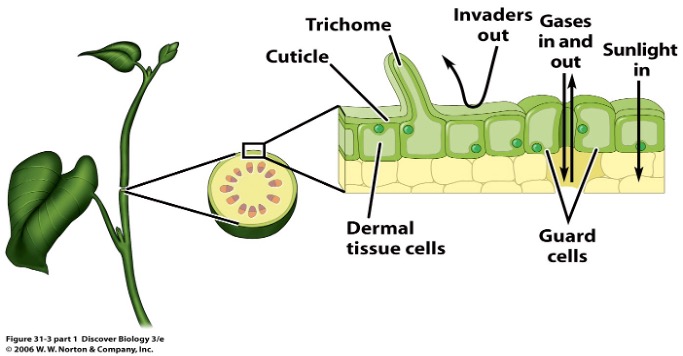
Trichome (1)
type of dermal & ground tissue
hairs that provide protection
root hair:
increases surface area for absorption
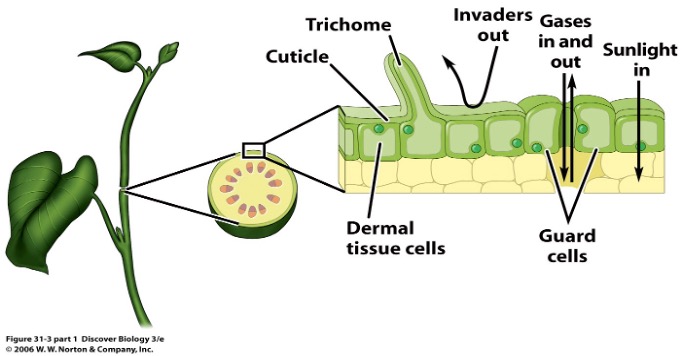
Guard cells (1)
type of dermal & ground tissue
specialized cells surrounding stomata
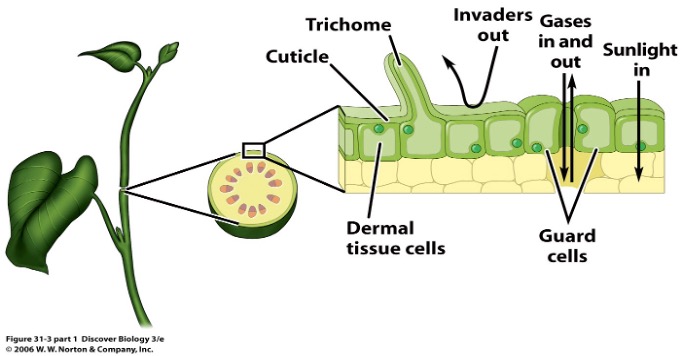
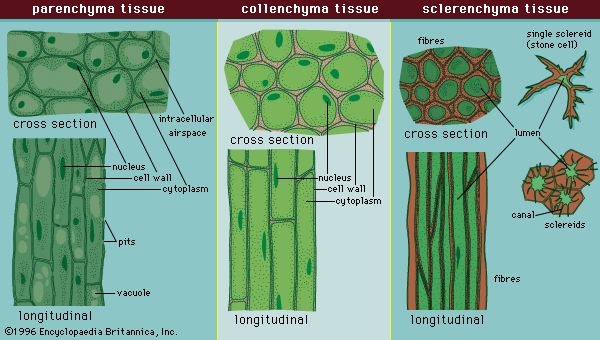
Sclerenchyma (1)
type of dermal & ground tissue
thickened cell walls that may contain lignin
fibers and stone cells are examples
provide structure, support, and protect seeds
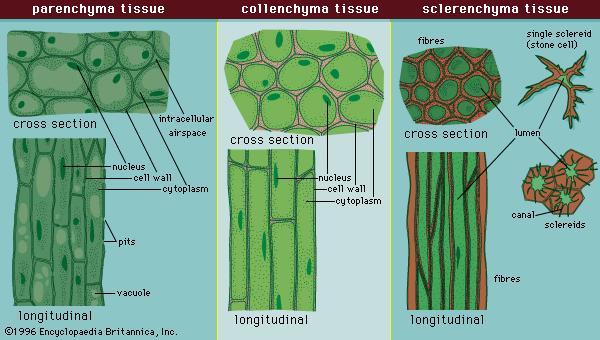
Collenchyma (1)
type of dermal & ground tissue
found near surface of stems, leaf petioles and veins
uneven thickening of cell walls
provide support to young plant organs
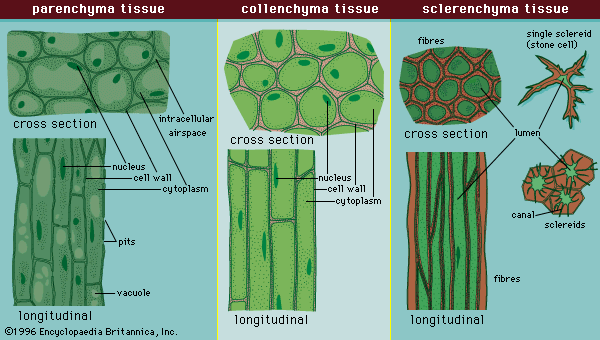
Parenchyma (1)
type of dermal & ground tissue
most common cells in plants
thin cell walls, large vacuoles
used for photosynthesis, support, storage, transport
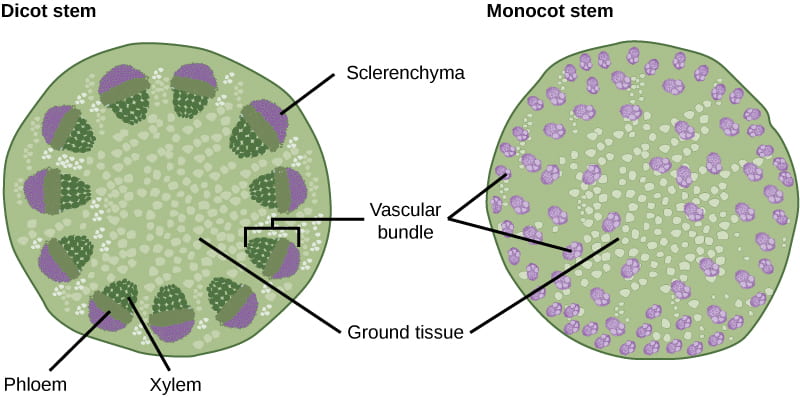
Xylem (1)
type of vascular tissue
transports water and minerals from roots to leaves of plant
dead at maturity
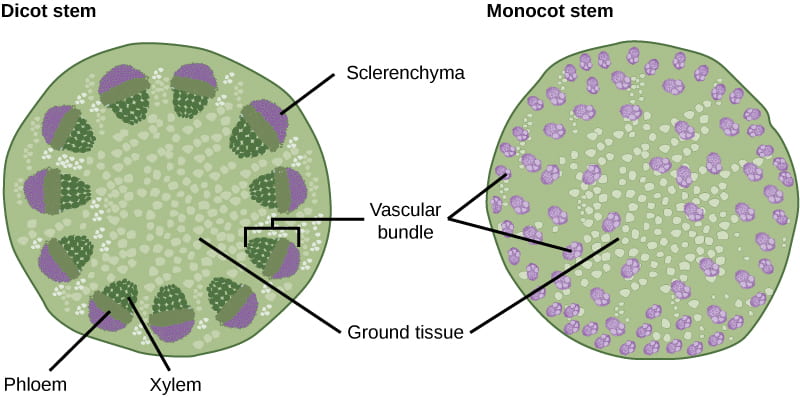
Phloem (1)
type of vascular tissue
transports products of photosynthesis (sugar) throughout plant
alive at maturity
Vessel elements (1)
type of vascular tissue
found in the xylem
they’re shorter and thicker in diameter
they join end-to-end to form vessels
Tracheids (1)
type of vascular tissue
found in the xylem
they’re long, thin, and tapered
they join via angled ends
Sieve-tube elements (1)
type of vascular tissue
found in the phloem
they lack a nucleus and have sieve plates at each end
Companion cell (1)
type of vascular tissue
found in the phloem
these regulate sieve tube function
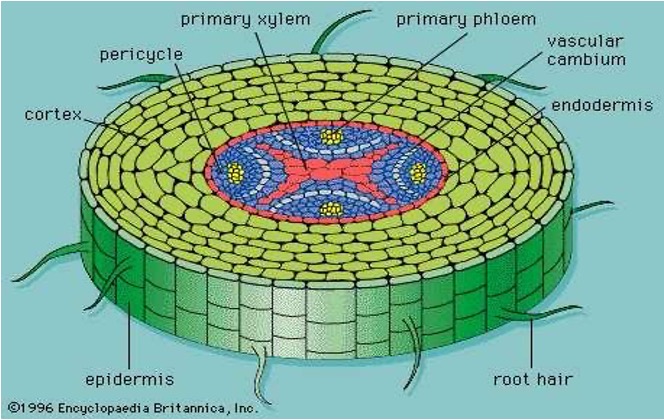
Endodermis (1)
the innermost layer of the cortex in plant roots and some stems
regulates water and substance through the layer
has Casparian Strip, which is made of suberin and forms the barrier
Meristem (1)
tissue found in various locations, such as roots and buds
contains rapidly dividing cells for primary and secondary growth
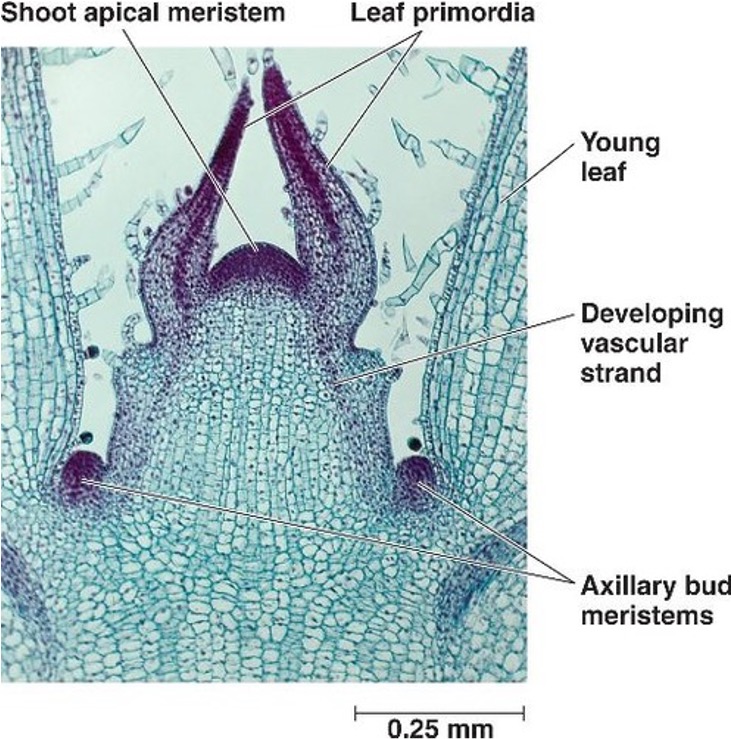
Apical meristem (1)
causes primary growth (i.e., lengthening of plant)
occurs at tips of shoots and roots
produces new leaves and flowers
Lateral meristems (1)
causes secondary growth (i.e., widening of plant)
occurs at the cambium
produces bark on trees
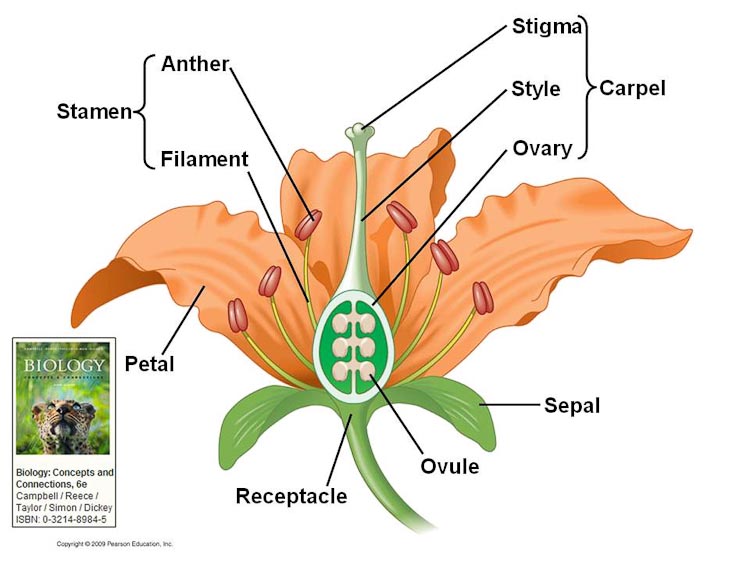
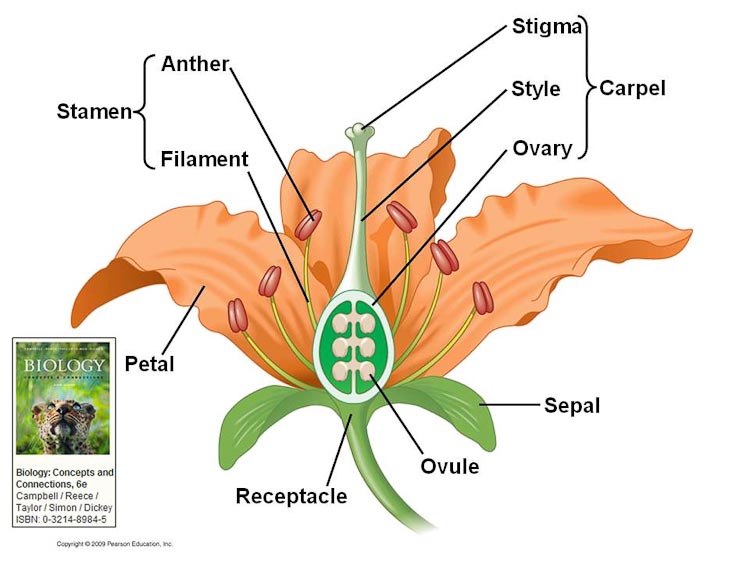
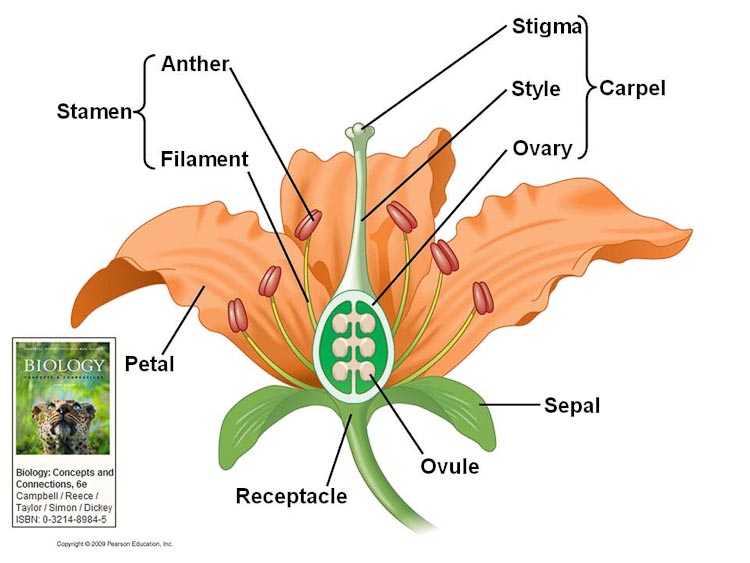
Pedicel (2)
stalk that supports flower
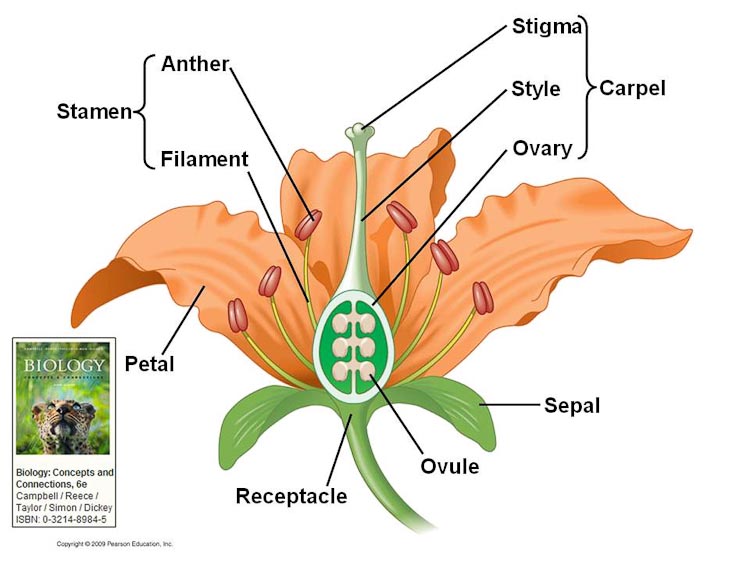
Receptacle (2)
tip of the pedicel where the flower parts attach
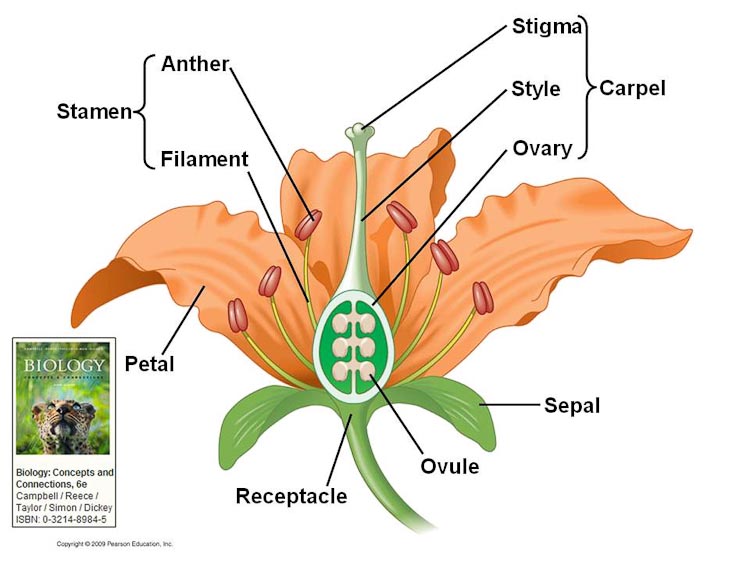
Sepal (2)
outer whorl of bracts, which may be green, brown, or colored like the petals
may appear as small scales or be petal-like
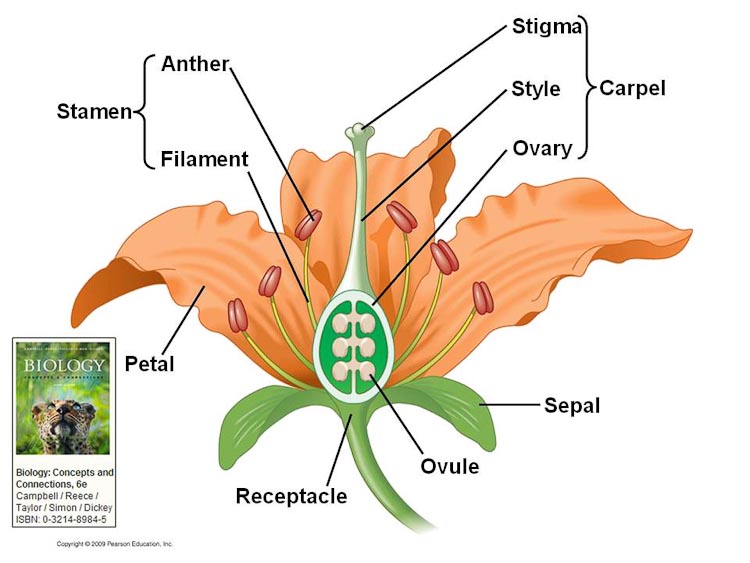
Calyx (2)
all the sepals, collectively
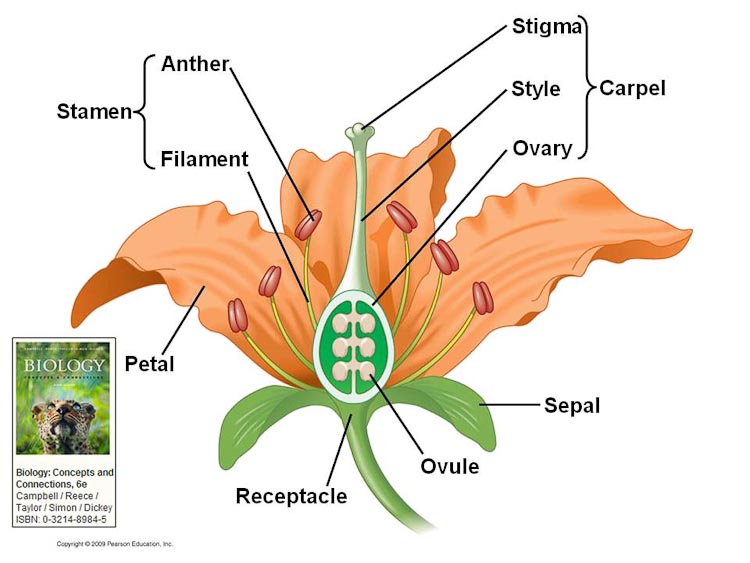
Petal (2)
colored, white, or even greenish whorl of bracts located just inside the sepals
Corolla (2)
all the petals, collectively
Perianth (2)
the corolla (petals) and calyx (sepals) all together
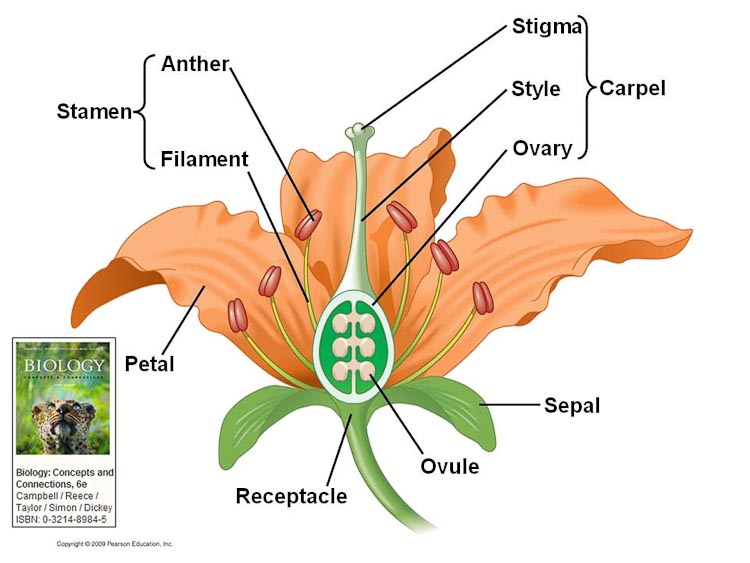
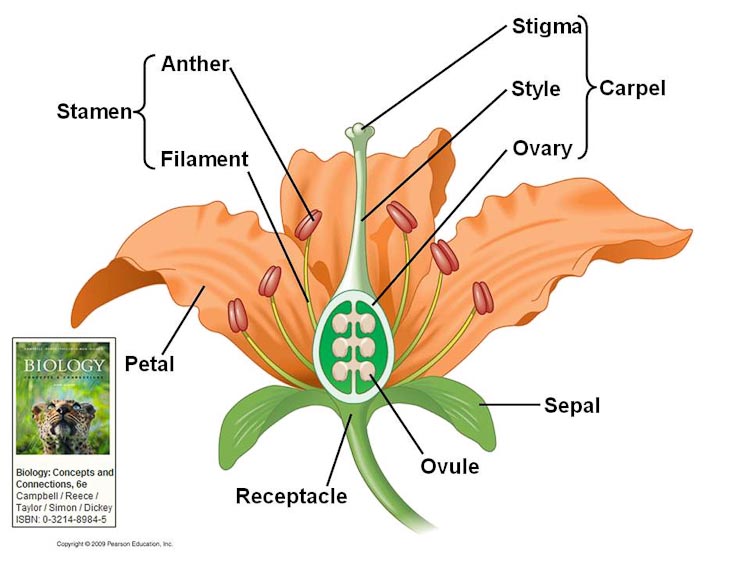
Stamen (2)
pollen-bearing structure, composed of filament and anther
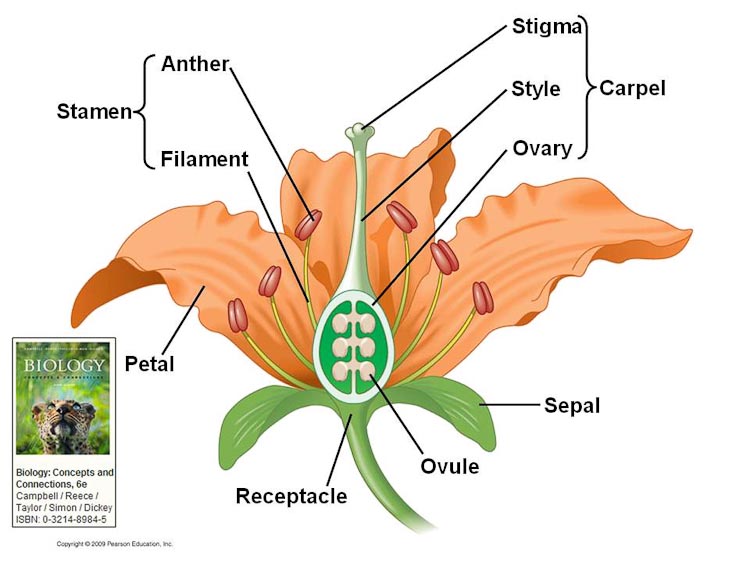
Filament (2)
stalk that supports the anther
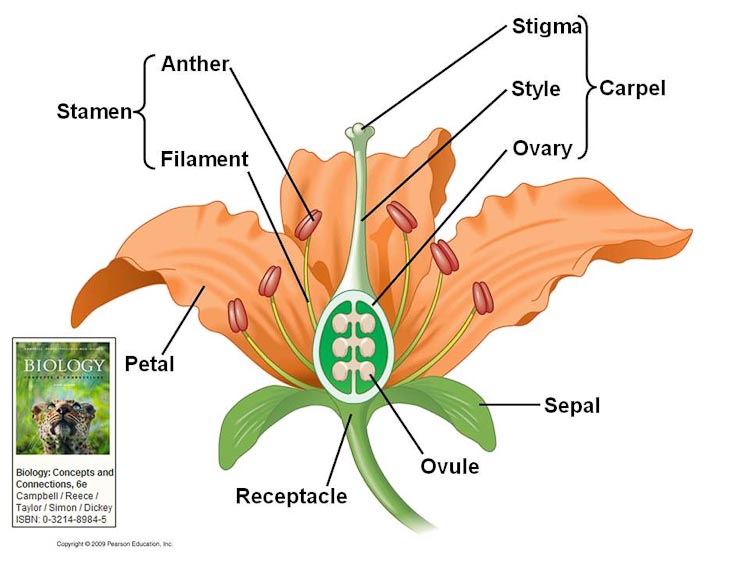
Anther (2)
pollen-producing structures that terminates the stamen
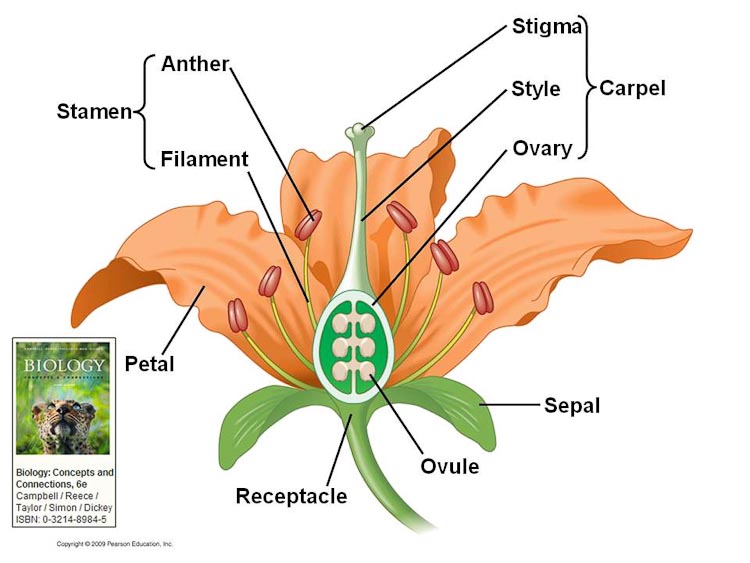
Carpel (2)
female reproductive structure, composed of stigma, style, and ovary, often pear-shaped and located in the center of the flower
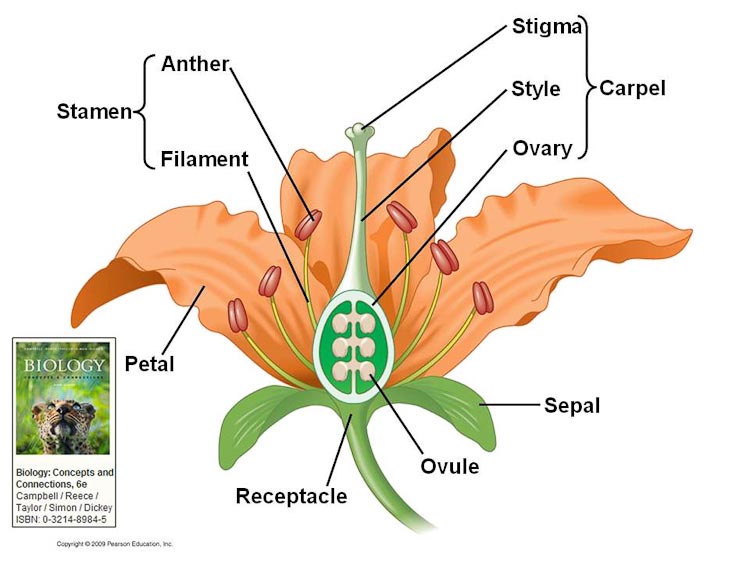
Style (2)
tissue connecting stigma to ovary, often long and narrow, but may be short or absent
pollen must grow through this tissue to fertilize the egg
Ovary (2)
base of carpel
protects ovules inside, matures to form the fruit
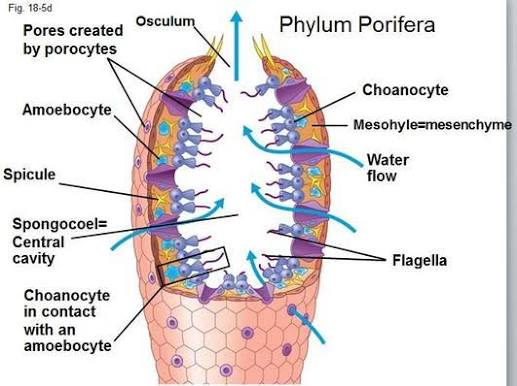
Porifera—Sponges (3)
habitat:
aquatic (fresh & marine)
benthic/sessile
suspension feeders: create water currents and trap floating food particles
tissues:
lack true tissues & organs
symmetry:
lack symmetry
features:
osculum—large opening to body at one end
spicules—needlelike structures protruding from surface of body for support and protection
spongocoel—central cavity of sponge, which serves as a channel for water
choanocyte (collar cell)—unique to sponges; line central cavity and use flagellum to move water through body
spongin—present in some species; supportive proteinaceous material
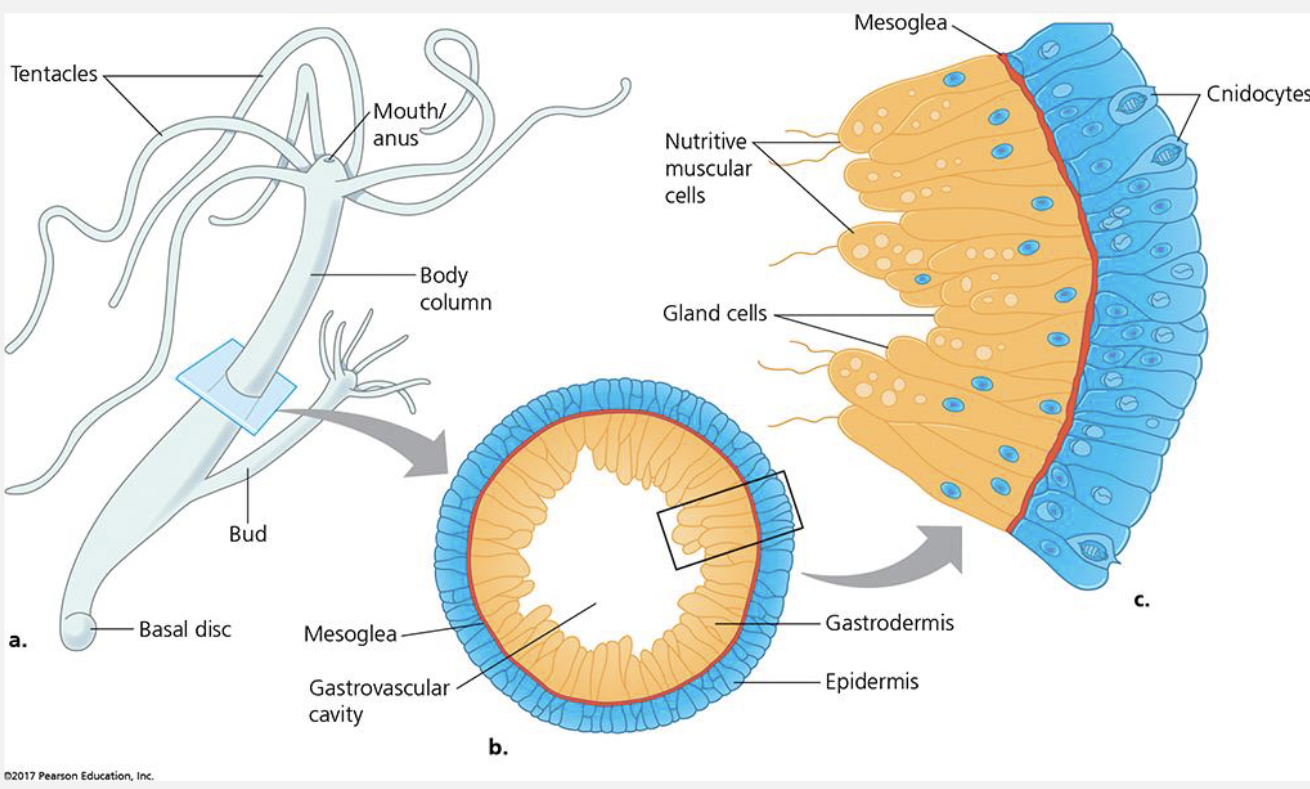
Cnidaria (Hydra) (3)
habitat:
aquatic (fresh & marine)
sessile
sexual & asexual reproducers
tissues:
diploblastic
gastrodermis & epidermis
symmetry:
radial
features:
polyp—stationary form of animal
tentacles—used to capture food and for movement
gastrovascular cavity—central cavity
cnidocytes—located within tentacles, contain nematocyst
reproduction:
asexual—budding
sexual
testes—form near oral end of polyp
ovaries—form near basal end
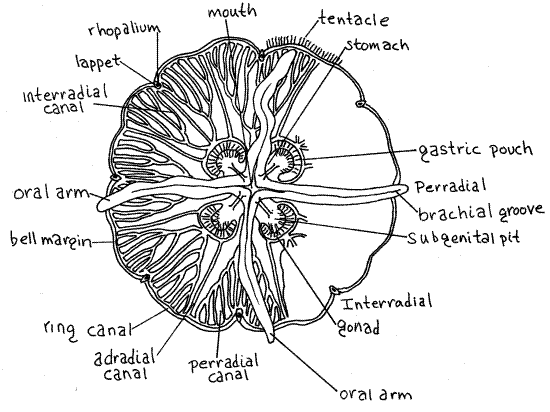
Cnidaria (Aurelia) (3)
habitat:
aquatic (fresh & marine)
sessile
sexual & asexual reproducers
tissues:
diploblastic
gastrodermis & epidermis
symmetry:
radial
features:
medusa—mobile form of animal
tentacles—used to capture food and for movement
central opening: mouth & stomach
four gastric pouches, also containing gonads
gastric filaments contain nematocysts for stinging
ocellus—visual functioning
statocyst—used for balance
reproduction
sexual—gonads release gametes for external fertilization
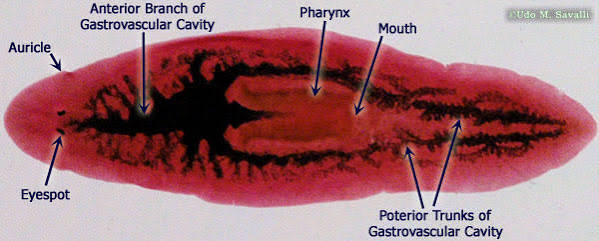
Platyhelminthes (Flatworms) (4)
symmetry:
bilateral
tissues:
triploblastic: have three embryonic tissue layers
inner layer (endoderm) will give rise to gut lining
outer layer (ectoderm) will give rise to outer skin
middle layer (mesoderm) will give rise to muscle, excretory system and reproductive system
may be parasitic or free-living
body cavity:
acoelomate (lacks a body cavity)
reproduction:
many are monoecious
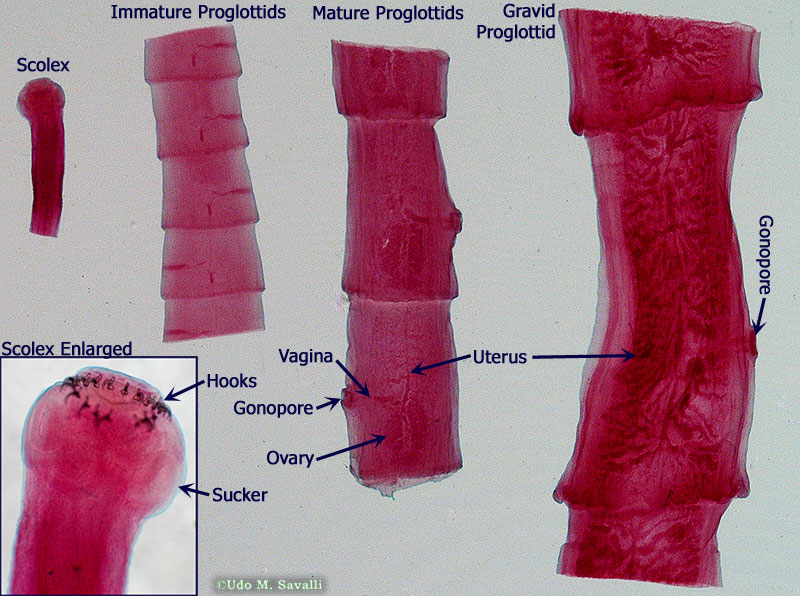
Platyhelminthes (Tapeworms) (4)
symmetry:
bilateral
tissues:
triploblastic: have three embryonic tissue layers
inner layer (endoderm) will give rise to gut lining
outer layer (ectoderm) will give rise to outer skin
middle layer (mesoderm) will give rise to muscle, excretory system and reproductive system
parasitic, lack a digestive system
lifecycle involves two hosts:
definitive host (primary)—usually a predatory mammal
host in which the parasite matures (adult stage) and reproduces (sexually)
normally they’re found in host’s digestive system
intermediate host—usually predator’s prey
hosts in which larval stage develops and undergo asexual reproduction
parasite would be found in muscle tissues or other internal organs of intermediate host
Annelids (4)
tissues:
triploblastic
coelomate (true body cavity)
contain a complete digestive system (separate mouth & anus)
locomotion:
have seate/chaeta (tiny bristles composed of chitin)
some have parapodia (paired lateral appendages)
segmentation:
building of a body from a series of similar segments
metamerism—segmentation that improves the efficiency of locomotion
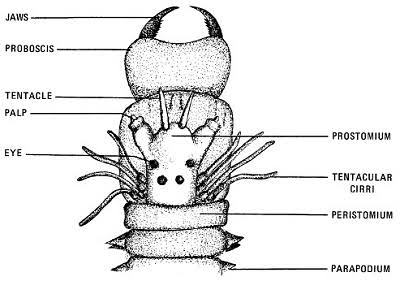
Annelids (Polychaeta—Clamworms) (4)
locomotion:
each segment of the class polychaete has a paid of paddlelike parapodia (almost feet) w/ many citinous setae
respiration:
in many polychaetes, the rich blood vessels in the parapodia function as gills
habitat:
most are marine
many crawl or burrow in seafloor, while a few drift and swim in the plankton
head region containing:
eyespots
tentacles
palps
jaws on an everted pharynx
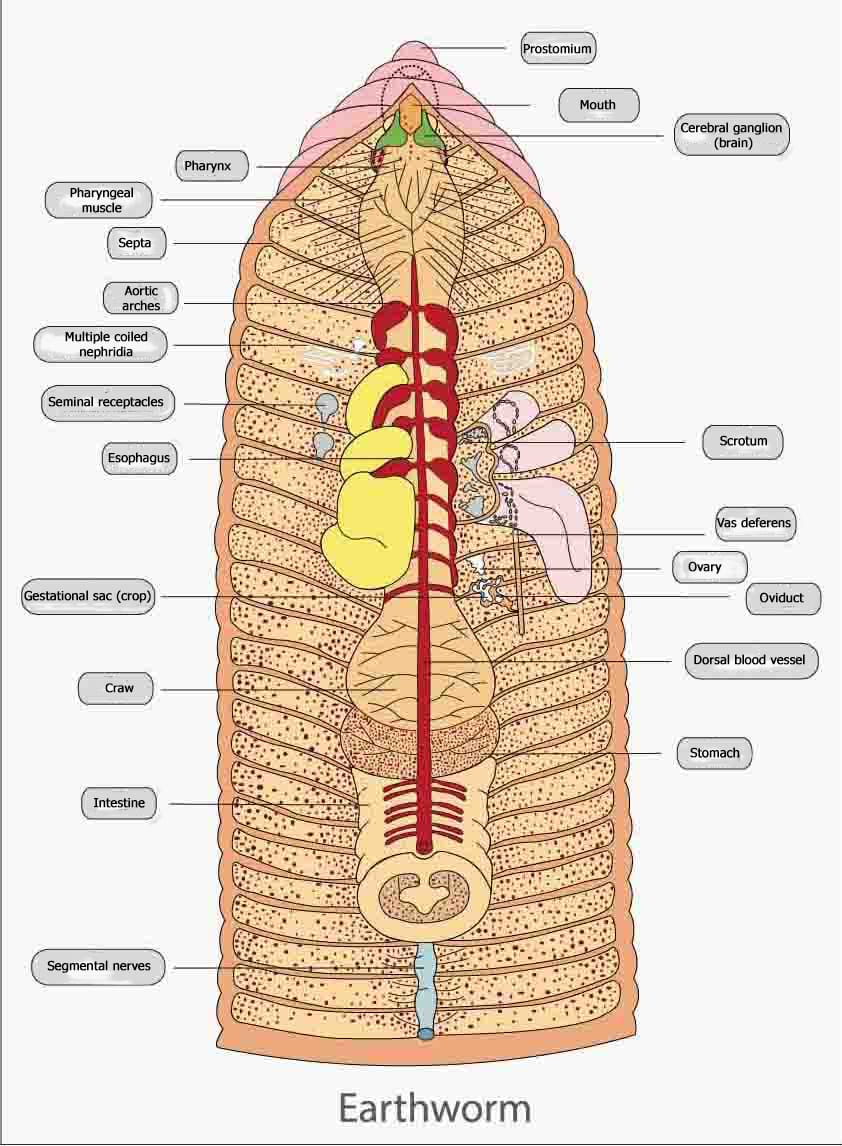
Annelids (Oligochaeta—Earthworms) (4)
lack a conspicuous head
reproduction:
monoecious (cross-fertilizing)
two earthworms exchange sperm and then separate
received sperm is stored in seminal receptacles
clitellum (group of large fused body segments located close to anterior end) secretes a mucous cocoon
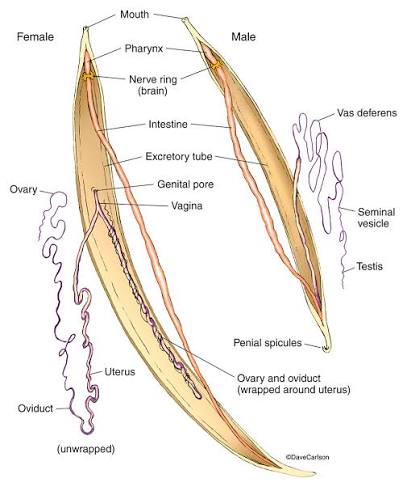
Nematoda (4)
segmentation:
nonsegmented worms
body cavity:
pseudocoelomate—have a body cavity that’s not completely lined with mesodermal tissue
covered by a tough cuticle; must shed cuticle to grow
habitat:
found in most aquatic habitats, free-living or parasitic
reproduction:
usually reproduce sexually (dioecious)
Mollusca (5)
all have 4 common features:
muscular foot—movement
visceral mass—contains internal organs
mantle—covers visceral mass, can produce calcium carbonate shell
hard shell for protection
they’re soft-bodied, but most are protected by a calcium carbonate shell
four most prominent classes:
polyplacophora (chitons)
gastropoda (snails and slugs)
bivalvia (clams, oysters, mussels, scallops…)
cephalopoda (squids, octopuses, cuttlefish, and chambered nautiluses)
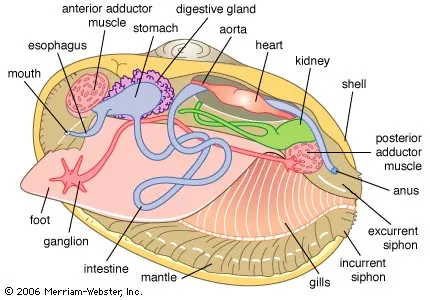
Mollusca (Bivalves) (5)
include many species of clams, oysters, mussels, and scallops
shell divided into two halves:
left and right valves—the two parts are hinged at mid-dorsal line, and powerful abductor muscles close shell tightly
have no distinct head, and the radula has been lost
most are suspension feeders, trapping fine particles in mucus that coats the gills
cilia convey the particles to the mouth
water flows in via the incurrent siphon, passes over the gills, and exits via the excurrent siphon
features:
valves—shells that surround the body
umbo—hump on the valves displaced towards the anterior side
adductor muscles—muscles that hold the valves together
mantle—covers the visceral mass and secretes hard outer valves; contains gills
incurrent siphon—ventral siphon that carries water, food, and oxygen in
excurrent siphon—dorsal siphon that carries water and waste out
visceral mass—houses most of internal organs
muscular foot—used for movement and digging into ground to anchor
gills—function in gas exchange and food trapping
ostia—openings in heart (open circulatory system)
nephridia—function to remove waste from pericardial cavity (kidneys)
Mollusca (Cephalopods) (5)
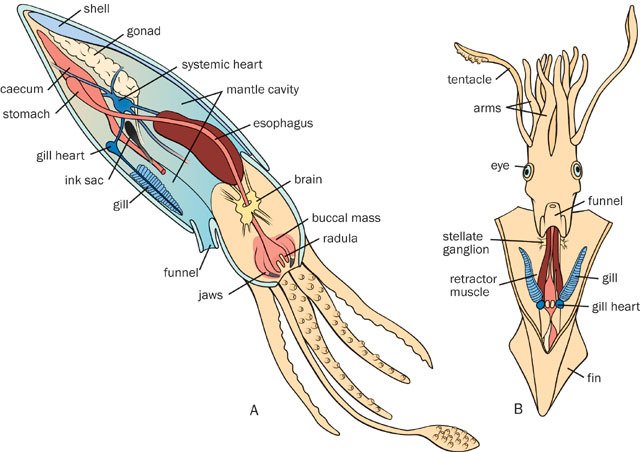
includes squids, octopuses, and cuttlefish
they’re active predators:
have beak-like jaws
surrounded prey with tentacles that contain suckers (modified foot)
use jaws to bite their prey and then inject poison-neurotoxin (secreted by salivary glands) to immobilize the victim
mantle covers the visceral mass, but shell is reduced and internal in squids, missing in many octopuses, and exists externally only in chambered nautiluses
water-jet propulsion:
squids contract mantle cavity and fire a stream of water through the excurrent siphon (funnel)
by pointing siphon in different directions, the squid can rapidly move in diff directions
digestion:
complete digestive system (separate mouth and anus) specialized for its carnivorous lifestyle
circulation:
cephalopods are the only mollusks w/ a closed circulatory system
respiration:
their breathing structures are a pair of gills which are ventilated by muscle movements of the mantle
nervous system:
they also have well-developed sense organs such as single lens eyes and complex brain
chromatophores:
specialized pigmented, light reflecting organelles in their skin cells
these organelles allow the animals to camouflage themselves
features:
funnel—structure used to eject water for movement or wastes, sexual products, and ink
eyes—highly advanced structures that can form very clear images
chromatophores—pigmented organelle on skin that can change color rapidly
funnel retractor muscles—used to control flow out of funnel
ink sac—holds ink
pen—functions as skeletal support
Arthropods (5)
most successful animal phylum in terms of species diversity, distribution, and sheer numbers
body cavity:
coelomate (have true body cavity)
all share three key features:
body segmentation (modified metamerism)
hard exoskeleton
jointed appendages
segments: regions w/ specialized function
head—contains segments w/ feeding and sensory activities
thorax—contains segments w/ locomotor activities
abdomen—contains segments w/ locomotor and/or reproductive activities
some contain the head and thoracic segments fused—cephalothorax
exoskeleton:
body is completely covered by the cuticle, made of protein and chtin
strong, protects the animal, and provides points of attachment for muscles that move appendages
thick and inflexible in some regions, such as crab claws
thin and flexible in others, such as joints
respiration:
most aquatic species have gills with thin, feathery extensions that have an extensive surface area in contact with water
terrestrial arthropods generally have internal surfaces specialized for gas exchange
subphyla of arthropods, and one class of arthropods:
subphylum chelicerata (horseshoe crab)—contain one pair of chelicerae, one pair of pedipalps; antennae, and mandibles are absent
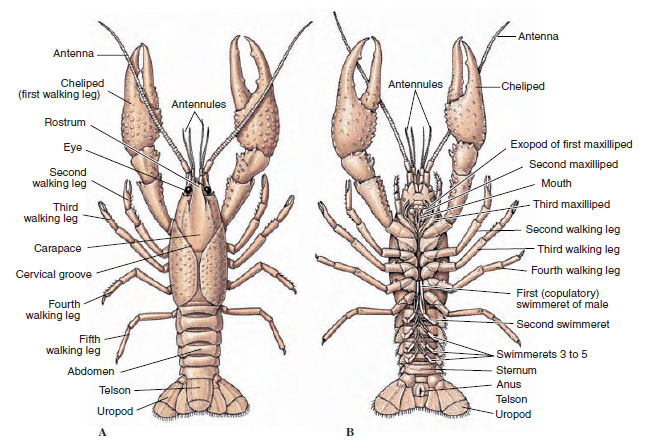
subphylum crustacea (crayfish)—primarily found in aquatic habitats; contain two pairs of antennae, one pair of mandibles
class insecta (grasshopper)—found in terrestrial environments; contain one pair of antennae and one pair of mandibles
Arthropods—Subphylum Crustacea (5)
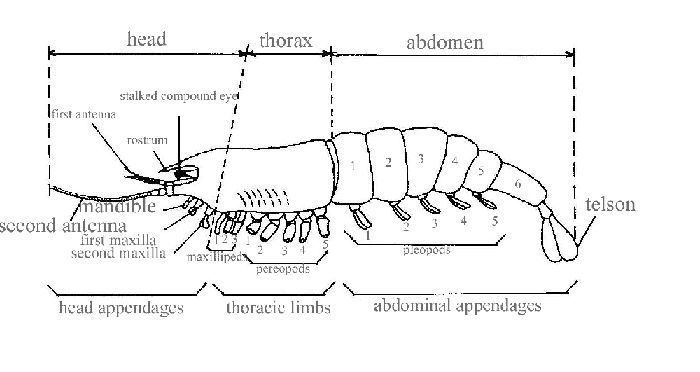
most are marine, some freshwater, a few terrestrial and mostly free-living
their bodies consist of two tagmata:
cephalothorax—covered by a carapace and contains appendages used in sensing, moving and feeding
contains two pairs of antennae, one pair of mandibles, five pairs of walking legs
abdomen—has visceral functions and contains appendages used in moving
distinctions:
all have two pairs of antennae, two pairs of maxillae, pair of mandibles, and a pair of compound eyes
maxila—lie just behind jaws and aid w/ detection and manipulation of food
arthropods evolved from an annelid-like ancestor containing identical appendages
parts:
uropods—1 pair located in abdomen (with telson they make up the tail fan)
swimmerets—5 pairs located in abdomen
walking legs—5 pairs located in thorax (all except last pair contain gills)
anterior—most called chelipeds (have pincers, “chelae”)
maxillipeds—3 pairs located in thorax (second and third have gills); feeding, manipulating food
maxillae—2 pairs located in head (move and manipulate food)
mandibles—1 pair located in head (chew and grind food)
antennae—1 pair located in head (chemical and movement detection)
antennules—1 pair located in head (touch and chemical detection)
Arthropods—Class Insecta (5)
features:
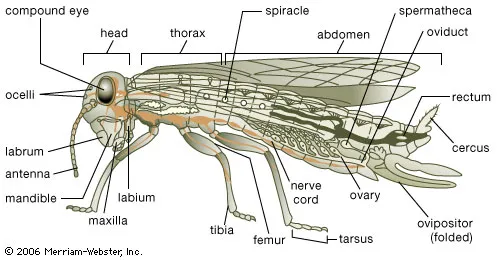
have one pair of mandibles
thorax usually has three pairs of walking legs and one or two pairs of wings
abdomen contains most internal organs and specialized structure for reproduction
three-part gut-ingestion, storage, grinding food
have unbranched appendages
only winged invertebrates
found in terrestrial habitats
bodies divided into three segments:
head containing appendages used in sensing and feeding
thorax containing appendages used in moving
abdomen containing no appendages and having visceral functions
respiration is accomplished using system of internal tubes, tracheae, and sacs delivering oxygen directly to cells
air is taken in through openings called spiracles
excretion is accomplished via Malpighian tubules, tubules remove waste and salts from blood
use tracheal system to deliver oxygen directly to organs
they have wings for flight
ovipositor—tube for egg deposit (females only)
Arthropods—Subphylum Chelicerata (5)
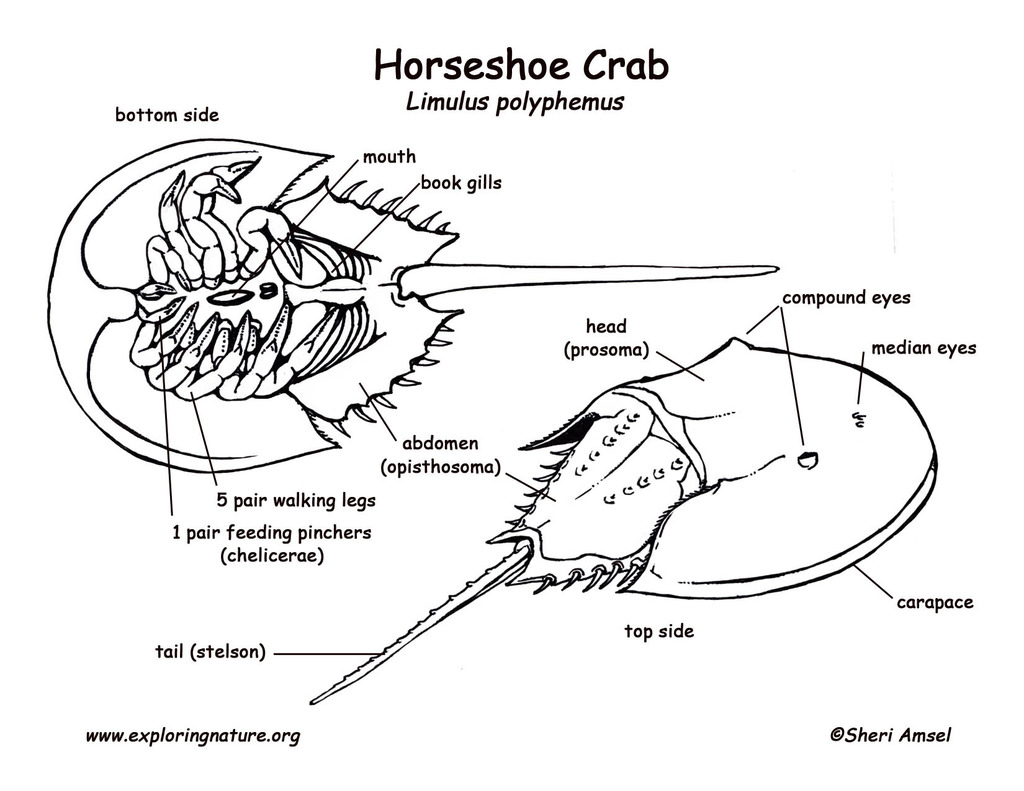
chelicerae—mouthpart found in some arthropods; play a role in feeding and defense
pierce food or manipulate food in the case of horseshoe crab
cephalothorax contain one pair of chelicerae (anterior most appendages)
followed by one pair of pedipalps (in middle)
4 pairs of walking legs (posterior end)
differences:
lack antennae and mandibles instead they use the chelicerae
lack sensory antennae, and most have simple eyes
lack mandibles
their bodies are divided into two tagmata (specialized grouping of arthropod body segments)
cephalothorax—has locomotor, sensory, and feeding appendages at anterior end
abdomen—which has visceral functions at posterior end
most marine chelicerata are extinct
majority of living chelicerata are arachnids, group that includes scorpions, spiders, ticks, and mites
Echinodermata (6)
deuterostomes—first opening during development (blastopore) becomes anus
name means “spiny skin” b/c body wall has spines
adults exhibit radial symmetry
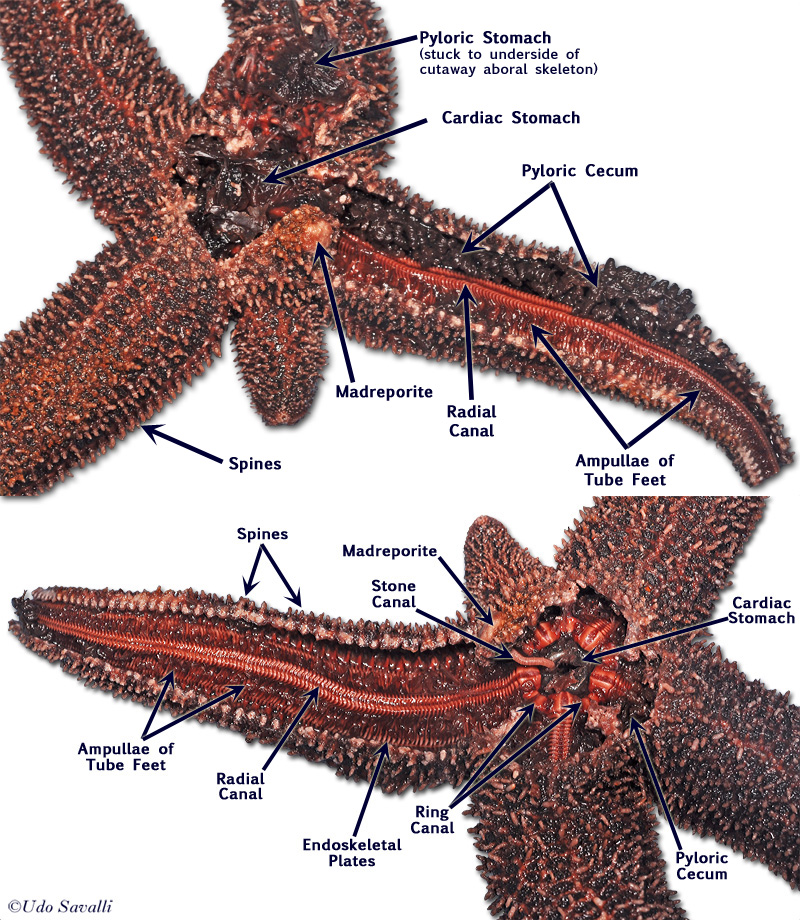
have 5 symmetrical radiating areas called ambulacra
they have pedicellaria (spine modifications on dermis) which are pincers that function in protection
these structures are found surrounding base of spine
skeletal system:
endoskeleton is derived from mesoderm; formed from calcium carbonate plates (ossicles)
water-vascular system—plays role in movement, gas exchange and molecular nutrient uptake
respiration/excretion:
skin gills function both in gas exchange as well as excretion
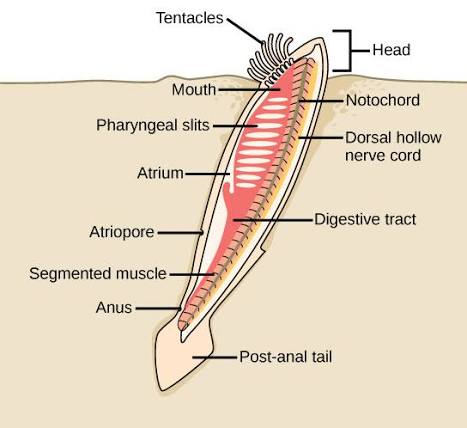
Chordata (6)
approx 56,000 species share 4 principal features:
notochord (flexible longitudinal rodlike structure) on dorsal side of gut and functions as an endoskeleton; precursor to spine
provides physical support as well as signals that help w/ tissue development
dorsal tubular nerve cord—located on dorsal side of notochord (runs parallel)
pharyngeal slits—function in both respiration as well as feeding
muscular postanal tail—source of locomotion such as swimming and balancing of terrestrial species (tail)
subphylum cephalochordata contains lancelets:
have notochord
named for their bladelike shape
they’re marine suspension feeders that retain characteristics of chordate body plan as adults
subphylum vertebrata contains the fetal pig:
vertebrates have a backbone
replaces role of notochord
vertebrates have distinct and well-differentiated head