Physio Lab Exam 1
 Call Kai
 Learn
Learn Practice Test
 Spaced Repetition
 Match
Match Flashcards
 Knowt Play
1/48

There's no tags or description
Looks like no tags are added yet.
Name | Mastery | Learn | Test | Matching | Spaced | Call with Kai | Chat |
|---|
No analytics yet
Send a link to your students to track their progress
49 Terms
anatomy
study of the structure and description of the human body
what does it look like?
physiology
study of biological functions and process of the human body under basal (normal) conditions
how does it work?
pathophysiology
study of abnormal biochemical and biophysical processes that occur in disease
cellular physiology
studies the biochemical and biophysical processes occuring within cells
systemic physiology
studies the regulation of physiological processes within the body
homeostasis
All human body organs and systems interact with each other in an orderly and synergistic manner to maintain ___.
homeostasis
dynamic constancy of the internal physiological environment while buffering the challenges of the external environment
reflects ability of human body to maintain internally constant despite changes to surrounding environment
37 C
7.35 - 7.45
70-100 mg/dl
homeostasis in our bodies:
body temp is maintained at ___
blood pH kept between ___
blood glucose maintained at ___
stimulus
receptor
afferent … CNS
efferent … effector (tissues/glands)
response … magnitude … homeostasis
feedback control mechanisms:
___ produces change in variable (i.e temp as a variable)
change is detected by a ___
input: info is sent along an ___ pathway to the ___
output: info sent along an ___ away towards ___
___ of effector feeds back to influence ___ of stimulus and returns variable to ___
negative feedback system
respone of the control system is negative or opposing to the stimulus
i.e: regulation of blood pressure:
original response → decrease in blood volume/pressure
restoration response → increase in blood volume/pressure
stimulus: decreased room temp
receptor: thermal receptors in skin
control center: hypothalamus
effector: muscles break down ATP to release heat
response: heat gain/increase in temp
stimulus is increase in temp, effector is sweat glands, and response is heat loss and bringing down temp
negative feedback system example: regulation of body temp:
stimulus:
receptor:
control center
effector
response
what happens when outside temp is too high?

positive feedback system
response of the control system is positive or promoting the stimulus
act to amplify the initial response
response stops when the stimulus is removed!
stimulated
sensory
strengthens
more
stops when the baby is birthed
positive feedback examples: childbirth
fetal head pressure → cervix is ___
___ receptors fire neural signals
oxytocin is released from pituitary gland
contraction ___ in the uterus
___ pressure on cervix
positive feedback system example: blood coagulation
injury → clotting → attracts MORE platelets and clotting factors → response accelerated
stop when injury is healed
plasma membrane
external cell barrier that is selectively permeable
has amphiphatic phospholipid bilayers that mark the boundering of the cell
phosphate … fatty acid
each phospholipid molecule has hydrophilic ___ heads and hydrophobic ___ tails
passive transport
when substances move down its conc. gradient from high to low conc. w/o ATP
passive simple diffusion
natural movement of small nonpolar molecules (oxygen and CO2) from high to low conc.
unassisted/doesn’t use integral proteins
example: dies in water!
passive facilitated diffusion
when a substance moves down its conc. gradient w/ help of protein molecule
common w/ large and charged ions like glucose, amino acids, and ions

channel mediated facilitated diffusion
special transport proteins created hydrophillic tunnesl in lipid bilayer to transport small, polar molecules and ions
fast
like a revolving door
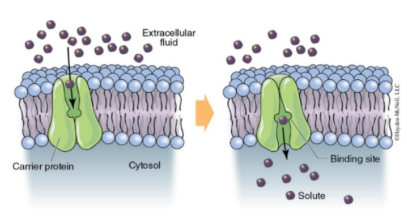
carrier mediated facilitated transport
special transport proteins “carry” large/polar substances across the membrane
protein binds to molecules → changes shap accordingly → pushes it to the other side
active transport
when a substance moves against its concentration gradient from lower to higher conc.
doesnt happen naturyally
need ATP
like swimming against a current
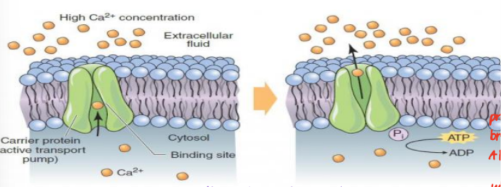
primary active transport
when carrier proteins “pump” the molecules against the conc. gradient
ATP directly used
like carrying smth using your own energy
its used directly by breaking ATP down into ADP and Pi (inorganic phosphate) and using that released energy to push ions against gradients
how is ATP used in primary active transport?


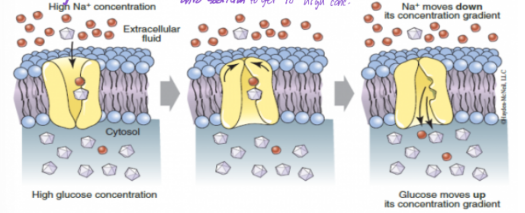
secondary active transport
when the downhill movement of one molecule drives the uphill movement of another by using an est. conc. gradient of molecule A to power the transport of molcule B
like going uphill
indirect use of ATP bc it was already used
its used indirectly, for example: sodium easily goes down bc its/ high to low conc. unlike glucose. → glucose piggybacks onto sodium to get to high conc.
how is ATP used in secondary active transport?
vesicular transport
bulk transport of substance into/out of cell which includes:
endocytosis: phagocytosis and pinocytosis
exocytosis
endocytosis
when substances are taken into the cell by modifying the plasma membrane structure
phagocytosis (cell eating)
when the cell engulfs a large particle by forming/projecting pseudopods (false feet) around it and enclosing it within a membrane sac aka phagosome
pinocytosis (cell drinking)
enfolding of the plasma membrane carries a drop of extracellular fluid containing solutes into the cell in a tiny membrane-bound vesicle
exocytosis
when substances are released from the cell into the extracellular environment
accounts for most secretion processes
osmosis
passive process by which molecules of a solvent try to pass through a semipermeable membrane from a less conc. to more conc. solution, equalizing each side of the membrane
against a gradient
salt build and dries our cells → we need to add water for dilution
what does osmosis have to do w/ getting thirsty after eating salty food?
hypertonic solution
higher solute conc.
lower water/solvent conc.
net movement of water towards this side
hypotonic solution
lower solute conc.
higher water/solvent conc.
net movement of water out of this side
comparitive
tonicity is a ___ term so you have to name them
hypo, hyper, iso
isotonic solution
equal solute and solvent conc. on both sides of selectively permeable membrane
water molecules continue to cross membrane but no further net movement
volume doesn’t have to be the same
goal of osmosis
tonicity
measure of potential difference in osmotic pressure gradient of two solution separated by a semipermeable membrane
only influenced by non-penetrating solutes (i.e solutes that cant cross the membrane and exert an osmotic pressure)
osmotic pressure
pressure created by non-penetrating solutes that causes osmosis movement of water to happen
same
net
isotonic cell:
both solutions have the ___ conc. of solutes
though H2O molecules move back and forth, there is no ___ movement

higher
outside … inside
lose … shrivel up and die
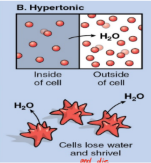
hypertonic cell:
a solution where the conc. of solute is ___ than the solution its being compared to
___ of the cell is hypertonic to the ___ of the cell
cells ___ water and ___
lower
outside … inside
take up water, swell (lyse) and burst/die
hypotonic cell:
a solution where the conc. of a solute is ___than the solution its being compared to
the ___ of the cell is hypotonic to the ___ of the cell
cells ___ water and ___

DNA blueprint and human function/survival
contraction
brain
food
oxygen
med scientist used to think such were controlled by our DNA blueprint. However, DNA isn’t the real business end of physiology → it doesnt carry out lots of activities on the cellular/organ lvl to keep our bodies functional and healthy. such activities are performed by proteins that get expressed by the cell’s DNA
proteins:
cause muscle___
power the ___
turn ___ into nutrients to be absorbed
transport ___ through the circulatory system
epigenetics
studies how lifestyle and environments signals modify and regulate gene activity
link between external environment, genetics, and human function
shows that exercise, nutrition, stress emotions, trauma, substance abuse, and social engagements can modify gene function w/o altering genes themeselves or their geneitc code
how epigenetics can be defined
mechanisms by which genes can be switched off and on, but the genes themselves and their genetic code are not altered
tell us that carrying a gene isnt the same as it actually being expressed
influence activation based on our choices
20%
80%
___ of an individual’s health, diseases, and how he/she ages is bc of genetics
___ is dependent on epigenetic induced alterations in human function via changes in lifestyle and environment
receptor
structure that detects changes in the internal/external environment
control center
structure like the brain that processes signals and coordinates the body’s response
effector
organ/tissue that carries out the control center’s response