BIOS 120 Summer 2026 Exam 2
 Call Kai
 Learn
Learn Practice Test
 Spaced Repetition
 Match
Match Flashcards
 Knowt Play
1/174

Earn XP
Description and Tags
UIC
Name | Mastery | Learn | Test | Matching | Spaced | Call with Kai | Chat |
|---|
No analytics yet
Send a link to your students to track their progress
175 Terms
community
assemblage of plant, animal, fungal, and microbe populations that live in a particular area of habitat
inteaction
characterizes communities
explains the underlying mechanisms that create, maintain, and determine the fate of biological communities
community ecology
patterns
vegetation zonation, species lists, seasonal distribution of activity, and association of certain species
processes
herbivory, competition, predation risk, nutrient availability, patterns of distribution, energy flow, history, and evolution
emergent properties of community
spatial and temporal structure
species richness
species diversity (even-ness)
trophic structure
succession and disturbance
spatial structure
way species are distributed relative to each other
examples of spatial structure
trees in rainforest that are stratified into different levels
epiphytes on trees
temporal structure
timing of appearance and activity of species
species richness
number of species in a community
diversity
number of species in the community and their relative abundances
ecological succession
more or less regular colonization, recovery, and turnover (replacement) of species within a community following a disturbance
examples of ecological succession
bog community —> black spruce forest
forest fire destroying large area of trees —> meadow —> back into the forest
lava —> vegetation —> forest
disturbance
events such as floods, fires, droughts, overgrazing, and human activity that alter communities by eliminating species, reducing population sizes, and altering resource availability, climate, and physical properties
primary succession
disturbance results in a sterile, novel environment. Succession can only proceed through the colonization of species from elsewhere. involves major temporal dynamics in the physical (starts with bare rock)
secondary succession
disturbance may extirpate some species but others survive at low population sizes. involves both recovery and colonization of species. less dramatic temporal dynamics in the physical environment (already have something intact, just beat it back, don’t annihilate it)
lichens
grow on lava, starts the process of primary succession
agents of disturbance for primary succession
volcanoes
asteroids
retreating glaciers
sand dune formation
completely paved by development
agents of disturbance for secondary succession
fire
huricanes & tornadoes
floods
abandoned farmland or other human landscapes (detroit)
clear-cuts in forests
early successional
high intrinsic growth rates, good dispersal and establishers, tolerate physical and climatic stress, poor competitors and/or susceptible to herbivores or predators
late successional
high carrying capacties, often poorer dispersers, less tolerant of physical stress, strong competitors and predators
faciliation
early successional species modify the environment, and create opportunities for subsequent species to invade or establish. tend to speed succession and make succession regular and predictable
inhibition
early species, via priority effects, gain an advantage and slow the establishment of later species, slowing succession and making it less predictable (exception to ecological succession)
disturbance characteristics that succession endpoint depends on
amplitude and frequency
climax communities more likely when disturbances are high amplitude and low frequency
disturbance communities are those with high frequency of low amplitude disturbances
intermediate amplitudes and frequencies may maximize species richness and diversity
climax community
more/less permanent and final stage of a particular succession, often characteristic of a restricted area, characteriezed by slow rates of change, dominated by species tolerant of competition for resources
trophic interaction
transfer of energy (eating, decomposing, obtaining energy via photosynthesis)
trophic structure
hierarchy of feeding in a community
food web
diagram of trophic interactions (energy flows from bottom to top)
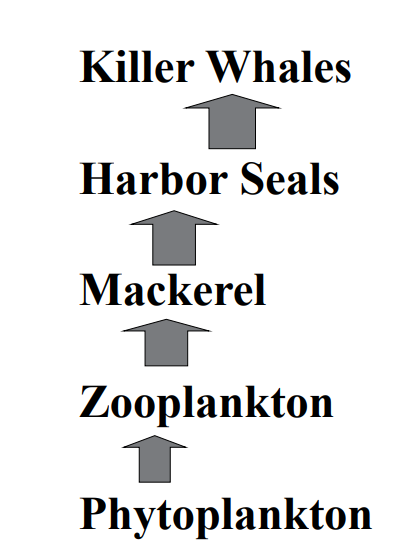
Who is a primary consumer
zooplankton
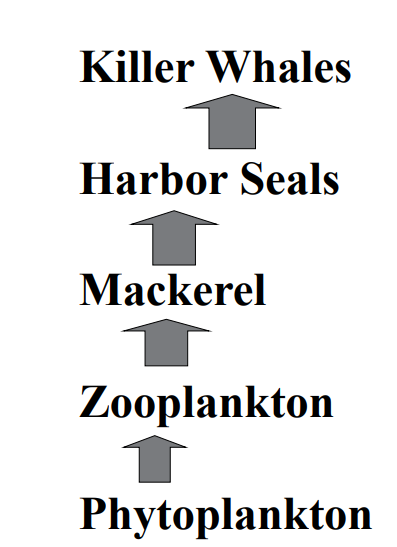
Who is a secondary consumer
mackerel
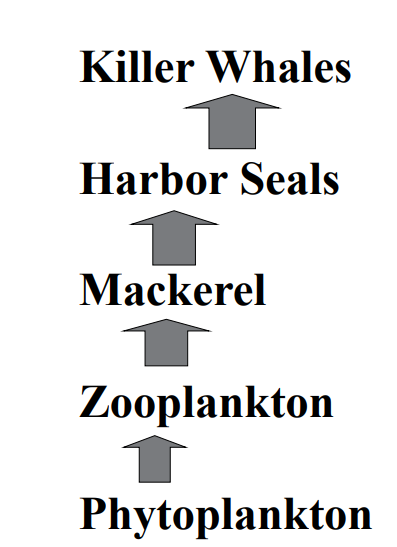
What is phytoplankton
primary producer
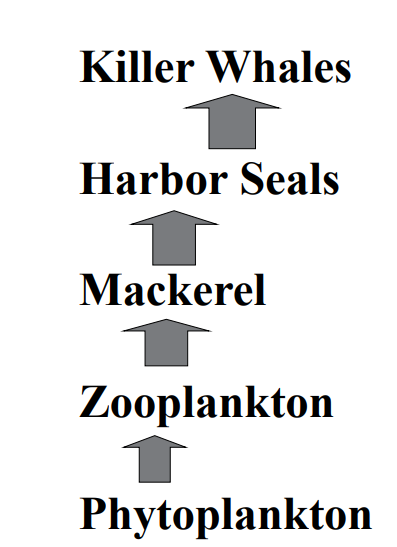
What is harbor seals?
tertiary consumer
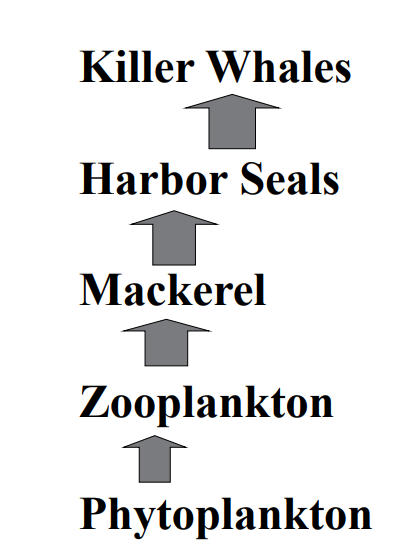
What is killer whales
quantiary consumer
Elton niche
Where does it live? What does it eat? Who eats it?
Hutchinson niche
fundamental niche describes the range of climatic and physical conditions that can support the species in the absence of negative biotic interaction
realized niche
the actual range of conditions that a species can succeed including competition and predation from other species
species often create ___ for other species
niches
keystone species
disproportionately important in communities, act to maintain species diversity, extinction = niches eliminated for many other species, modifies the environment in such a way that other organisms are able to live, or is a predator that maintains diversity at a certain trophic level
examples of keystone species
California Sea Otters: This species preys upon sea urchins, allowing kelp forests to become established.
Pisaster Starfish: Grazing by Pisaster prevents the establishment of dense mussel beds, allowing other species to colonize rocks on the Pacific Coast.
“Mangrove” Trees: Mangrove seeds disperse in salt water. They take root and form a dense forest in saltwater shallows, allowing other species to thrive
The Acorn Banksia: At certain times of year, Banksia prionotes is the sole source of food for honeyeaters, which in turn are the pollinators for many other species of plants in Western Australia.
competition
occurs when individuals of the same or different species restrict each others’ access to limiting resources, may be prey, water, light, nutrients, nest sites, etc.
intraspecfic competition
competition among members of the same species
interspecific competition
competition among individuals of different species
exploitation competition
occurs when individuals permanently or temporarily use up the limiting resource or resources, thus depleting the amount available to others
interference competition
occurs when individuals via antagonistic behaviors or caching behaviors prevent others from accessing the limiting resource (territoriality, dominance hierarchies)
examples of interference competition
flour beetle and red flour beetle canibalize the eggs of their own species, as well as each others, interfering with the survival of potential competitors
can cause exclusion of one species
exploitation competition
How can exploitation create coexisting?
species can coexist with a decrease in their potential for growth by partitioning the resources
A.J. Lotka and V. Volterra
developed model of population growth to predict outcome of competition
competitive exclusion principle
Two species cannot compete for the same limiting resource for long. Even a minute reproductive advantage leads to the replacement of one species by the other
What did G.F Gausse’s experiment demostrate?
Paramecium aurellia outcompetes and displaces Paramecium caudatum in mixed laboratory cultures, apparently confirming the competitive exclusion principle.
resource partitioning
Species that share the same habitat and have similar needs frequently use resources in somewhat different ways - so that they do not come into direct competition for at least part of the limiting resource; evolutionary response to interspecific competition
best known example of resource partioning
As many as five different species of anoles may exist in the same forest, but each stays restricted to a particular space: some occupy tree canopies, some occupy trunks, some forage close to the ground.
When the brown anole was introduced to Florida from Cuba, it excluded the green anole from the trunks of trees and areas near the ground: the green anole is now restricted to the canopies of trees:the resource (space, insects) has been partitioned among the two species
Gausse’s rule
two organisms cannot occupy exactly the same niche
Joseph Connel’s Barnacle experiment
In the early 1960s, ecologist Joseph Connell studied how interspecific competition determines the stratified distribution of two barnacle species on the Scottish coast: Semibalanus balanoides (lower shore) and Chthamalus stellatus (upper shore).
His objective was to determine the extent to which competition imposed this relationship between the two
When Chthamalus was removed from the upper zone, Semibalanus could not replace it due to an inability to survive desiccation at low tides. Its realized niche matches its fundamental niche
When Semibalanus was removed from the lower zone, Chthamalus successfully moved in, revealing it is normally excluded by a stronger competitor. Its realized niche is smaller than its fundamental niche.
commensalism
interspecific interaction where one species benefits and the other is unaffected
examples of commensalism
ant colonies have rove beetles as commensals, beetles mimic ants behavior and pass as ants, eat detritus and dead ants
anemonefish live within anemones tentacules, have specialized mucus membranes that render them immune to anemone’s stings, gain protection by living like this
birds nesting in trees
inquilines
Commensal organisms that frequently live in the nests, or on the bodies, of the other species
mutualism
interspecific interaction between two species that benefits both members; Populations of each species grow, survive, and/or reproduce at a higher rate in the presence of the other species.
examples of mutualism
rooting plants have mutualistic associations with fungal mychorrhizae. Mychorrhizae increase the capability of plant roots to absorb nutrients. In return, the host provides support and a supply of carbohydrates.
Many corals have endosymbiotic organisms called zooxanthellae . These mutualists provide the corals with carbohydrates via photosynthesis. In return, they receive a relatively protected habitat from the body of the coral
Flowering plants and pollinators. (both facultative and obligate)
Parasitoid wasps and polydna viruses. (obligate)
Ants and aphids. (facultative)
Termites and endosymbiotic protozoa. (obligate)
Humans and domestic animals. (mostly facultative, some obligate)
mutualistic symbiosis
type of mutualism in which individuals interact physically, or even live within the body of the other mutualist; essential for survival of at least one member
example of mutualistic symbiosis
lichen is fungal-algal symbiosis, fungal hyphae provides a protected habitat for the algae and takes up water and nutrients for the algae, in return, the algae provide carbs as source of energy for fungus
facultative mutualisms
not essential for the survival of either species. Individuals of each species engage in mutualism when the other species is present.
obligate mutualisms
essential for the survival of one or both species
Predators, parasites, parasitoids, and herbivores
obtain food at the expense of their hosts or prey.
parasties and pathogens
smaller than their host
evidence that parasites may have one or many hosts during their lifetime.
Some even steal parental care or other resources
Parasites consume their host either from the inside (endoparasites) or from the outside (ectoparasites).
Pathogens are parasitic disease-causing microbes.
Parasitoids
hunt their prey like predators, but lay their eggs within the body of a host, where they develop like
introduced species
species that has been intentionally or unintentionally introduced by humans. Exotic species are species that are not native to an area (often used synonymously with introduced, but exotics sometimes arrive on their own).
naturalized species
species that has spread beyond its point of introduction and become established
invasive species
causes ecological harm to communities, usually by changing the community in ways that cause the extinction of other species, or alternately, cause damage to human economic well being
How are earthworms invasive species?
earthworms and others were introduced to many parts of the world by European settlers in the 1600s and 1700s.
They alter forest communities by breaking up a thick layer of detritus that naturally occurs on the floor (exactly what they are valued for in gardens and farms), creating drier soil with fewer leaf litter organisms.
ecosystem
unit composed of all the living things in a single place at a given time, in addition to, the important non-living components of the system; encompasses all aspects of a biological community, in addition to factors such as rates of CO2 uptake, rates of nitrogen fixation from the atmosphere, precipitation, seasonal flooding and its effects on nutrients, etc.
nonliving components of an ecosystem
sunlight, rainfall, silica and clay particles in the soil, the air, the water in the soil,
biosphere
largest and most encompassing ecosytem we know; encompasses all the plants and animals on Earth
ecosystems ecology
concerns itself with the flow of energy and biomass
common to all biological communties
nutrient cycling and energy flow
sun
ultimate energy source for almost every ecosystem on Earth
hydrothermal vent communties
don’t rely on sun for energy, rely on geothermal energy, but still depend upon oxygen fixed by photosynthetic organisms
How does energy enter ecosystems
via photosynthesis or for a few exotic ecosystems chemosynthesis
producers
bring energy into an ecosystem; include green plants, algae, cyanobacteria, etc..anything that can capture energy from nonliving components of the environment.
All metabolic processes consume ___ in some way, and in each reaction, much of it is effectively “wasted
energy
How does biological energy radiate into the environemnt
as infrared light
what happens to energy as it passes through trophic levels
its lost
energy is
transferred, not recycled (must be continually replenished from the sun)
What’s the difference between matter and energy
energy does not recycle, matter recycles through ecosystems
How does matter recycle?
Atoms of every biologically important element constantly recycle through ecosystems, into the abiotic component of the biosphere, and back into living systems.
decomposition
through this process, each element ultimately becomes nonliving, and has the potential to re-enter the biosphere again.
example of matter recycling
in a freshwater pond, green plants and photosynthetic algae fix atmospheric CO2 using sunlight as an energy source, creating biological molecules that serve as carbon skeletons and energy carriers.
They also retrieve other elements, such as iron and calcium, from their environment, and pass them up the food chain as well.
What happens to the biomass created by producers
a significant fraction is eaten by herbivores and passed up the food chain; the rest is stored in temporary biological reservoirs in the tissues of plants, but ultimately decomposes when the plant dies
How is energy liberated/released back into the environment
by living things that consume the living or dead plants, leaves the Earth as heat
matter
cycles between living and non-living things, no new matter leaves/reaches Earth
food web
schematic diagram that describes the trophic interactions in a community; also documents patterns of energy flow
food chain
one path through a food web, from bottom to top; limited number of links
decomposition
trophic interaction that uses up the energy left over in dead bodies of organisms, sometimes depicted in food webs
biomass
weight of living matter; usually measured in dry weight per unit area
pyramid of biomass
figure that quantifies the relative amounts of living biomass found in each trophic level; in most environemnts the amount of biomass decreases as one moves from bottom to top of food chain
wood
oldest fuel that can be burned and converts biomass into CO2, H2O and energy
productivity
rate at which biomass accumulates
primary consumers
eat producers, generally posses significantly less biomass than producers
secondary consumers
consume primary consumers