Service Marketing Exam 1
 Call Kai
 Learn
Learn Practice Test
 Spaced Repetition
 Match
Match Flashcards
 Knowt Play
1/60

There's no tags or description
Looks like no tags are added yet.
Name | Mastery | Learn | Test | Matching | Spaced | Call with Kai | Chat |
|---|
No analytics yet
Send a link to your students to track their progress
61 Terms
tangibility spectrum
determines if products are purlely tangible or not
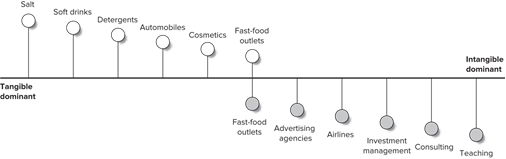
intangibility
Goods are tangible while services are intangible
Results:
Services can’t be inventoried
Services cannot be easily patened
Services cannot be readily displayed/communicated
Pricing is difficult
heterogeneity
Goods are standardized and services are heterogeneous
Results:
Service delivery and customer satisfaction depend on employee/customer actions
service quality depends on many uncontrollable factors
there is no sure knowledge that the service delivered matches what was planned and promoted
Simultaneous Production and Consumption
Goods are Production separate from consumption and Services are simultaneous production and consumption
Results
Customers participate in and affect the transaction
Customers affect each other
Employees affect the service outcome
Decentralization may be essential
Mass production
perishability
Goods are nonperishable and services are perishable
Results
It’s difficult to synchronize supply and demand with services
Services cannot be returned or resold
Services for any given time period cannot be sold or delivered at a later date
Marketing Mix
the elements as organization controls that can be used to satisfy or communicate with customers
7 Ps
product, place, promotion, and price, people, physical evidence, and process
people
all human actors who play a part in service delivery and thus influence the buyer’s perceptions: namely the firm’s personnel, the customer, and other customers in the service environment
physical evidence
the physical and virtual environment in which the service is delivered and where the firm and customer interact, as well as any tangible components that facilitate performance or communication of the service
process
the procedures, mechanisms, and flow of activities by which the service is cocreated, delivered, and/or consumed—the service delivery and operating systems
Product Examples
Physical good features
Quality level
Accessories
Packaging
Warranties
Product lines
Branding
Product support services
place examples
Channel types
Exposeure
Intermediaries
Outlet locations
Transportation
Storage
Managing channels
promotion examples
Promotion blend
Salespeople (selection/training/incentives)
Advertising (media types/types of ads)
Sales promotion
Publicity
Internet/web strategy
price example
Flexibility
Price level
Terms
Differentiation
Discounts
Allowances
people example
employees (recruiting/training/motivation/rewards/team work)
customers (acquisition/education/training/motivation/rewards)
physical evidence example
Facility design
Equipment
Signage
Employee dress
Web pages
Other tangibles (reports/business cards/statements/guarantees)
process example
Flow of activities (standardized/customized)
Number of steps (simple/complex)
Customer involvement (low/medium/high)
Gaps Model Goal
Closing the gap between what customers expect and what they perceive is critical to delivering quality service
customer gap
the difference between customer expectations and perceptions
listening gap
the difference between customer expectations of service and a company’s understanding of those expectations
Inadequate customer research orientation
Lack of upward communication
Insufficient relationship focus
Inadequate service recovery
service performance gap
the difference between company understanding of customer expectations and the development of customer driven service designs and standards to match these customer expectations
Poor service design
Absence of customer driven standards
Inappropriate physical evidence and servicescape
the service performance gap
the discrepancy between the development of customer driven service standards and actual service performance by the company
Deficiencies in human resource policies
Customer not fulfilling roles
Problems with service intermediaries
Failure to match supply and demand
the communication gap
the difference between the actual service delivery and the service provider’s external communications
Lack of integrated services marketing communications
Ineffective management of customer expectations
Overpromising
Inadequate horizontal communications
Inappropriate pricing
desired service
the level of service the customer hopes to receive-the “wished for” level of performance. Blend of what customers believes “can be” and “should be” provided.
adequate service
the minimum level of service the customer will accept
zone of tolerance
the extent to which customers recognize and are willing to accept this variation
different customers possess different zones of tolerance
narrow zone of tolerance requiring a smaller but higher quality range of service from providers, whereas other customers have a wider range of expectations of service
zones of tolerance vary for service dimensions
the more important the dimension the narrower the tolerance
customers are likely to be less tolerant about unreliable service than other service deficiencies, which means they have higher expectations for this dimension
sources of desired service expectations
personal needs, personal service philosophy, derived service expectations
personal needs
those states or conditions essential to the physical or psychological well-being of the customer
personal service philosophy
customer’s underlying generic attitude about the meaning of service and the proper conduct of service providers
derived service expectations
when the customer expectations are driven by another person or group of people
sources of adequate service expectations
percieved service alternatives
situational factors
percieved service alternatives
other providers from whom customers can or perceive they can obtain service
People who believe they can make their own better services v. ppl who don’t think they can find better services outside of primary one
Customers likely to be more tolerant of service performance
situational factors include
uncontrollable situational factors
personal situational factors
predicted service
uncontrollable situational factors
includes service performance conditions that customers view as beyond the control of the service provider
ex. Natural disasters lowering ppls expectations of service provided from hotel staff members
personal situational factors
of short term, individual factors that make a customer more aware of the need for service
Ex. Ppl in accidents being less tolerable to service being provided later than expected
predicted service
level of service customers anticipate they are likely to get
Sources of both adequate and desired service expectations
explicit service promises
implicit service promises
word of mouth communications
past experiences
explicit service promises
personal and nonpersonal statements about the service made by the organization to customers
Personal via. Salesppl
Nonpersonal via. Websites/ads
Has direct effect on desired service expectations
implicit service promises
service related cues other than explicit promises that lead to inferences about what the service should and will be like
quality cues dominated by price and tangibles associated with the service
Word of mouth communication
statements made by partiers other than the organization convey to customers what the service will be like and influence both predicted and desired service
Perceived as unbiased
Important in services difficult for customers to evaluate before purchase and before having direct experience from them
past experiences
the customer’s previous exposure to service that is relevant to the focal service
satisfaction
generally viewed as a broader concept
Perceived service quality is a component of customer satisfaction
Influenced by perceptions of service quality, product quality, and price
service quality
focuses specifically on dimensions of service
focused on evaluation that reflects the customer’s perception of reliability, assurance, responsiveness, empathy, and tangibles
service quality dimensions
reliability
responsiveness
assurance
empathy
tangibles
reliabiltiy
the ability to perform the promised service dependably and accurately
the most important determinant of perceptions
responsiveness
the willingness to help customers and provide prompt service
assurance
the employee’s knowledge and courtesy and their ability to inspire trust and confidence
empathy
the caring, individualized attention given to customers
tangibles
the appearance of physical facilities, equipment, personnel, and communication materials
what determines customer satisfaction
Products and service features
Perceptions of product and service quality
Price
Personal factors
Customer emotions
Attributions for service success of failure
Perceptions of equity or fairness
Other customers, family, coworkers
outcomes of customer satisfaction
Customer satisfaction is an important indicator of national economic health
Important indicator of well being
Correlated to corporate earnings and stock value
Linked to firm’s financial performance metrics
outside in
determining customer expectations and then delivering to them
uses marketing research to understand customer and their requirements fully
customer research must…
focus on what levels of these features customers expect, and what customers think the company can and should do when problems occur in service delivery
Elements in an Effective Services Marketing Research Program
complaint solicitatino
critical incident studies
post transaction surveys
mystery shopping/unique services
lost customer research
complaint solicitation
To identify/attend to dissatisfied customers to identify common service failure points
qualitative
critical incident studies
To identify beset practices at transaction level to identify customer requirements as input for quantitative studies
To identify common service failure points
To identify systemic strengths and weaknesses in customer contact services
qualitative
post transaction surveys
To obtain immediate feedback on performance of service transactions
Measure effectiveness of changes in service delivery
Assess service performance of individuals and teams
Use as input for process improvements
Identify common service failure points
quantitative
mystery shopping/unique to services
Measure individual employee performance for evaluations, recognition, or rewards
Identify systemic strengths and weaknesses in customer contact services
quantitative
lost customer research
Identify reasons for customer defection
Assess gaps between customer expectations and perceptions
qualitative