Genetics Exam 1 Study Guide
 Call Kai
 Learn
Learn Practice Test
 Spaced Repetition
 Match
Match Flashcards
 Knowt Play
1/53

There's no tags or description
Looks like no tags are added yet.
Name | Mastery | Learn | Test | Matching | Spaced | Call with Kai | Chat |
|---|
No analytics yet
Send a link to your students to track their progress
54 Terms
Monohybrid Cross
proved theory of blended inheritance wrong
Po = True Breeding Dominant & Recessive (Homozygous)
F1 = Heterozygotes
F2 = 3:1 Dominant Recessive Phenotypic Ratio
Reciprocal Cross
proves equal parental contribution to progeny
2 crosses with 2 same phenotypes, but each cross has a different sex holding each phenotype
Ex:
Cross 1: male dominant trait & female recessive trait
Cross 2: female dominant trait & male recessive trait
Same F1 & F2 outcomes = equal contribution
Gregor Mendel
Father of Genetics
Conclusions:
male & female parents contribute equally to progeny (reciprocal cross)
inheritance is not blended (monohybrid cross)
Theories:
dominant & recessive traits
Theory of Particulate Inheritance
traits are determined by discrete units that are inherited intact through generations (genes!!)
each individual has 2 particles (alleles) in genotype, but they pass only 1 on to progeny
Mendel’s First Law
Principle of Segregation
during gamete formation, members of a pair of alleles segregate into separate gametes (Tt → T + t) (gametes are haploid)
these gametes form in equal frequencies
Homologous Chromosomes
every gene resides on a chromosome, every individual has 2 copies of every chromosome (homologs)
autosomal: same structure, size, and genetic loci - differ in variation of gene (allele)
sex: x + y chromosomes or x + x (not same size or structure, but code for same gene - can be different alleles)
Test Cross
1) determines unknown genotype of dominant phenotype; cross unknown genotype with heterozygous recessive individual
homozygous dominant genotype = 100% dominant phenotypes in progeny
heterozygous genotype = 50% dominant & 50% recessive phenotypes in progeny
2) cross individual with known genotype (F1) with homozygous recessive to determine if its gametes show deviation from independent assortment
unlinked genes (independent assortment) → 1:1:1:1 phenotypic ratio (1:1 parental to recombinant gene)
any deviation from ratio above indicates linkage
Chromosome
double stranded DNA molecule containing genetic information arranged in a linear sequence
most of the cell cycle, DNA is in a dispersed state in nucleus (chromatin)
distinguished by: size, location of centromere in relation to telomeres, and genes present
Eukaryotic Chromosome Components
linear
unique shape & size
centromere: constricted region that provides binding site for proteins during mitosis & meiosis
telomeres: on ends of chromosomes
centromeres & telomeres have no genes, but have highly repetitive DNA
Chromosome Names Based on Centromere Location Relative to Telomeres
Metacentric: centered centromere
no p/q arms
Sub-Metacentric: centromere is slightly closer to one telomere
p arm (top) is slightly shorter than q arm (bottom)
Acrocentric: centromere is even closer to one telomere
p arm (top) is significantly shorter than q arm (bottom)
Telocentric: centromere is essentially all the way at one end
p arm is essentially nonexistent

Ploidy
Number of sets of chromosomes
N = # of distinct chromosomes
humans: 2n = 46 chromosomes
gametes: n = 23 chromosomes
Mitosis vs Meiosis
Mitosis
1 cell division
product is 2 identical diploid cells
somatic cell formation
Meiosis
2 cell divisions
product is 4 non-identical haploid cells
gamete formation
Cell Cycle
stages 1 cell goes through as it grows & divides
Go → non-dividing phase; cell is in stable state at constant size
Interphase:
G1 → 1st gap/”growth” phase; prep phase; proteins needed for cell division are made
S → DNA synthesis; chromosomes are duplicated (sister chromatids)
G2 → 2nd gap/”growth” phase; any damaged DNA must be repaired
M → mitosis phase; cell division

How to count chromosomes/chromatids
count centromeres for chromosomes
count telomeres on one end for chromatids
Mitosis Sequence
Prophase
chromosomes condense
mitotic spindles form outside nucleus
nuclear envelope breaks down
Metaphase
microtubules from spindle pole attach to each chromosome at centromere
Anaphase
proteins holding sister chromatid centromeres together are degraded
sister chromatids separate (disjoin) & move to opposite spindle poles
# of chromosomes double! (# of chromatids stay the same)
Telophase
nuclear envelope reforms around each daughter cell
chromosomes uncoil
spindle disappears
cytokinesis: cytoplasmic division
Meiosis Sequence
Prophase I
chromosomes condense, spindles form, nuclear envelope breaks down
homologous chromosomes pair (synapse)
crossing over may happen (recombination)
1 sister chromatid from each homolog participates in a single cross-over event
continuous process of 5 stages
leptotene: condensation begins
zygotene: synapsis begins
pachytene: condensation continues & recombination
diplotene: synapsis breaks down & chiasmata keep homologs joined
diakinesis: moving apart
Metaphase I
each pair of homologs takes up a position on metaphase plate
independent assortment: orientation of each pair of homologs with respect to all others is random
Anaphase I
homologous pairs disjoin & move to opposite poles
principle of segregation: separation of particles to create gametes with 1 particle
Telophase I
nuclear envelope reforms
interkinesis occurs (cytokinesis between meiosis I & II)
2 haploid cells form
total number of chromosomes in each cell is half of starting number
Prophase II
chromosomes condense, spindles form, nuclear envelope breaks down
Metaphase II
sister chromatids position themselves on metaphase plate
looks like mitotic metaphase, but each cell has half as many chromosomes
Anaphase II
sister chromatids disjoin & move to opposite poles
chromosome # in celll has now doubled
Telophase II
nuclear envelope reforms
cytokinesis
4 unique haploid gametes
Mendel’s 2nd Law
Principle of Independent Assortment
viewed in metaphase IThe
orientation of each pair of homologs is independent of orientation of other pairs
Dihybrid Cross
can observe inheritance of two traits
Po → true breeding
F1 → heterozygotes
F2 → 9:3:3:1 phenotypic ratio
Probability Rules
Multiplication Rule:
“and”
probability that 2 independent events happen simultaneously or in a particular order
independent = outcome of one has no influence on outcomes of other
multiply probabilities
Addition Rule:
“or”
probability that either 1 or 2 mutually exclusive events happen
sum of independent probabilities
mutually exclusive: cannot happen at same time
if not mutually exclusive: sum of independent probabilities - p(both events occur)
Binomial Expansion Equation
calculates probability of several events when they can happen in any order

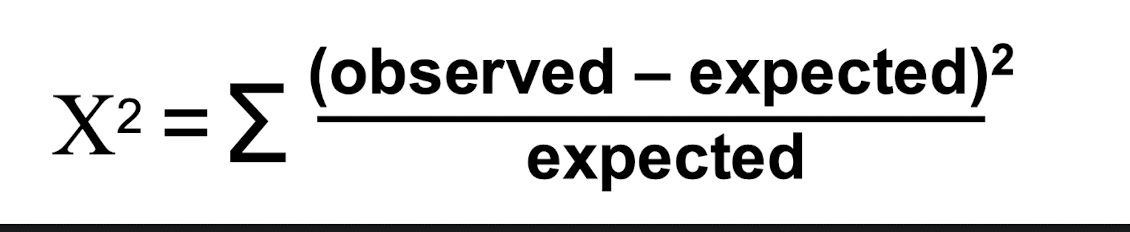
X2 Test
compares observed values (experimental results) with expected values (calculated based on given info)
allows us to evaluate null hypothesis: difference between observed & expected is due to chance
determines p-value → probability difference is due to chance
p < 0.05 → reject null hypothesis ; difference is due to something other than chance
Selecting mode of inheritance of a trait in humans using pedigree
use “best guess” which makes the fewest amount of assumptions for individual genotypes
Pedigree Symbols

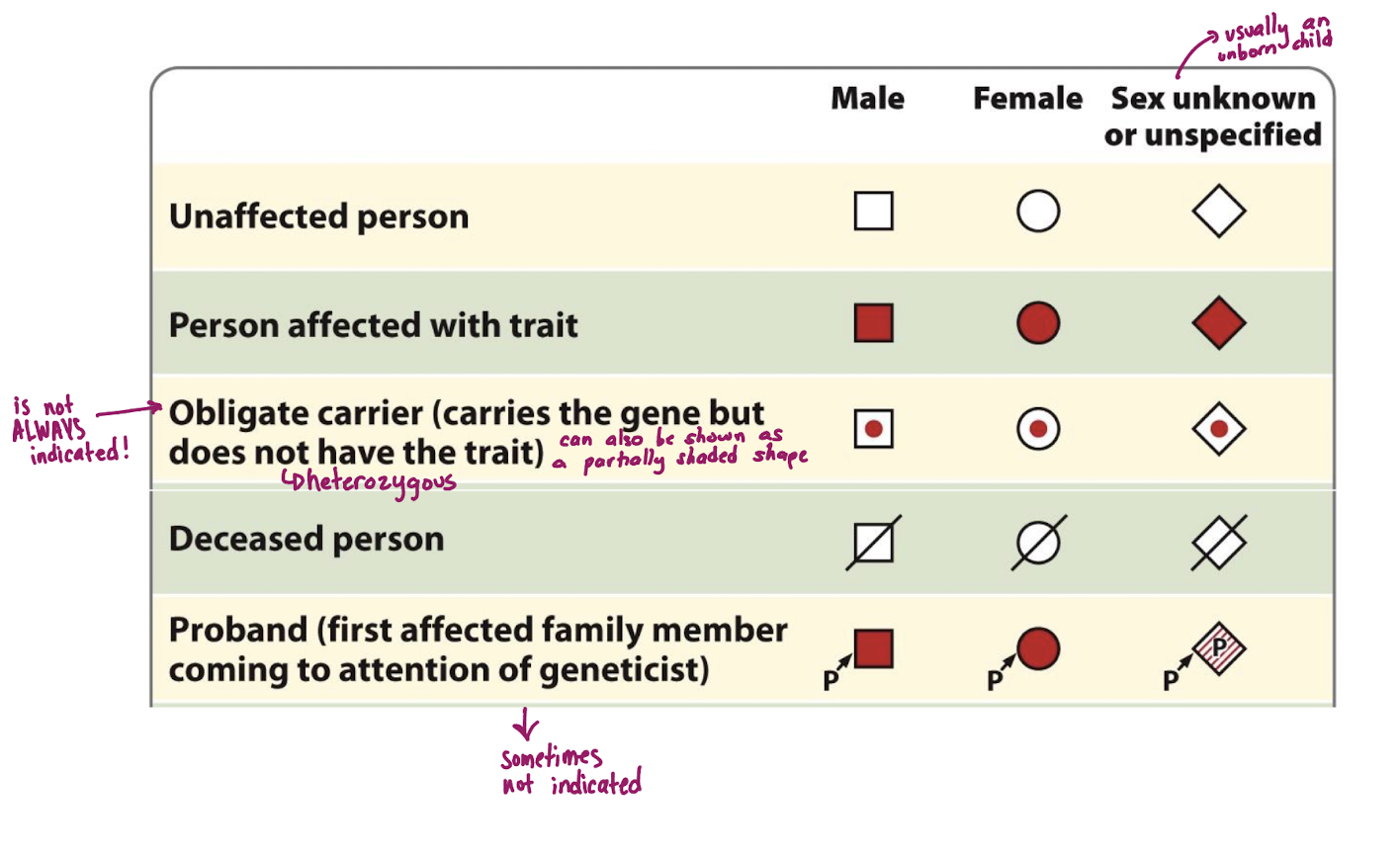
Tricks to Figuring Out Pedigree Diagrams & Mode of Inheritance
if trait is dominant & completely penetrant, each affected child has an affected parent
if trait is autosomal, both sexes are equally affected
if trait is sex linked, on sex is affected more than others (if females are affected it is never Y-linked)
x-linked - affected fathers have 100% affected daughters
assumptions:
never assume individuals marrying into family are carriers!
MOST affected individuals are het (does not count as an assumption)
Sex Influences on Heredity
Genetic Maternal Effect
genotype of progeny is inherited from mom and dad, but phenotype is always determined by genotype of mom
often due to egg providing cytoplasm to zygote, which has proteins synthesized by mom, so progeny starts off using mom’s machinery/proteins
Cytoplasmic Inheritance
chloroplasts & mitochondria are cytoplasmic organelles that contain genetic material
during cell division, mitochondria randomly segregate into progeny cells
in 1 cell, different mitochondria could have distinct mutations that affect overall phenotype (each cell can have diff # of mutant mitochondria)
if there is only mutant DNA in mitochondria, there is expression of mutant gene
from mother because egg provides cytoplasm
can be the reason disease shows later in life because as cells divide, there is more of a chance that a mitochondria with fully mutant DNA occurs
traits are expressed in both males and females
reciprocal crosses give different resulst
Genomic Imprinting
gene expression affected by whether gene comes from mom or dad
allele from one parent is silenced while the other is expressed
due to chemical modifications on chromosome that cause a chromosome to be too tightly packed to expressed
Dominance Relationships
Complete Dominance: phenotype of heterozygote looks like phenotype of homozygote (mendelian)
Incomplete/Partial Dominance: phenotype of heterozygote is an intermediate between phenotypes of different homozygotes (non-mendelian)
Codominance: heterozygote has phenotypes of both homozygotes
in partial/codominance, do not use big letter, little letter because that assumes complete dominance
Allelic Series
any gene has multiple forms/alleles within population, but each individual member can only carry 2 alleles
alleles may form a dominance series, which can result in deviation from mendelian ratios
Lethal Alleles
found in essential genes
can be recessive or dominant
crossing 2 heterozygotes gives 2:1 phenotypic ratio
Pleiotropic Gene
single gene influences multiple phenotypes
Penetrance
proportion of individuals with a particular genotype that display expected phenotype
incomplete penetrance: less than 100% of individuals with a given genotype show expected phenotype
may give a trait an appearance of skipping generations
can allow lethal alleles to persist in populations
due to varying genetic backgrounds and environmental effects
Variable Expressivitiy
phenotype varies among organisms with identical genotypes
variation in severity of trait
due to varying genetic backgrounds and environmental effects
Environmental Modification
environmental conditions can affect phenotype
Gene Interaction
genes at 2 or more loci (non-allelic) influence same trait
can lead to:
novel phenotype
epistasis
complementation
Epistasis
allele(s) at one locus mask effect of genotype at 2nd locus
one of the outcomes of gene interaction
Complementation
crossing 2 recessive mutants generates wild-type progeny (proves mutant genes are non-allelic - diff genes)
one of the outcomes of gene interaction
Complementation Test
cross 2 mutant strains together & look for complementation (wild-type phenotype) in progeny, meaning the two strains are found on two different genes
mutant strains must be recessive
view F1 progeny for wild-type phenotype
Sex-Linkage
sex chromosomes are heteromorphic (diff shapes), but still act homologous during meiosis
they have pseudoautosomal regions that allow chromosomes to pair during prophase (this is where genetic recombination between X & Y occur)
(autosomes = homomorphic)
reciprocal corsses give different results
Sex Determination (humans, other animals, and fruit flies)
Humans → XX/XY System
presence of Y chromosome (which has the SRY gene found close to telomere of p arm) confers maleness
males = heterogametic (XY)
females = homogametic (XX)
Birds, Butterflies, Fish, some Reptiles → ZZ/ZW System
females = heterogametic (ZW)
males = homogametic (ZZ)
Fruit Flies → ratio of # of X chromosomes : # of sets of autosomes
1 → female
0.5 → male
<0.5 → metamale
>1 → metafemale
between 0.5 & 1 = intersex
0.5 & missing Y → sterile male
Y chromosome is necessary for proper sperm development or morphology (Y is required for male fertility, but not sex determination)
Nondisjunction
creates gametes with incorrect # of sets
either an incomplete set or more than one complete set (ex: XO or XXY)
Dosage Compensation
corrects potential imbalance in amount of X-linked gene products present in cells of males vs females
necessary because unequal number of sex chromosomes in males and females
done via x-inactivation
is random (randomly chooses x chromosome to inactivate, can be from mom or dad)
50/50 split between inactive x genes in mom and dad
happens early in development
barr body forms
leads to mosaicism in females
in human females, ~50% of cells in body should have each X chromosome inactivated (50 recessive & 50 dominant) → het for recessive x-linked trait has enough cells expressing “normal” X in every tissue to allow normal phenotype to be expressed
but if x-inactivation is not random, mild phenotypes may be observed
barr bodies passed on through mitosis
Sex-Influence Traits
traits which are more common in 1 sex
genes are autosomal
sex affects whether allele is dominant or recessive
Sex-Limited
extreme example of sex-influenced traits
genes are autosomal
allele has 0 penetrance in 1 sex
traits are often related to 2˚ sex characteristics
Gene Linkage
observed as a deviation from independent assortment toward parental genes
linked genes are on the same chromosome, so they move together during gamete formation
2 Ways to Represent Linkage
Physical Linkage (# base pairs between) - physical proximity of genes on a chromosome; more precise method
Statistical Linkage (map units/centiMorgans) - how we observe physical linkage based on experimental data
Complete Linkage
genes are so close together that they never assort independently
100% parental gametes, no recombinant gametes
Allelic Configurations
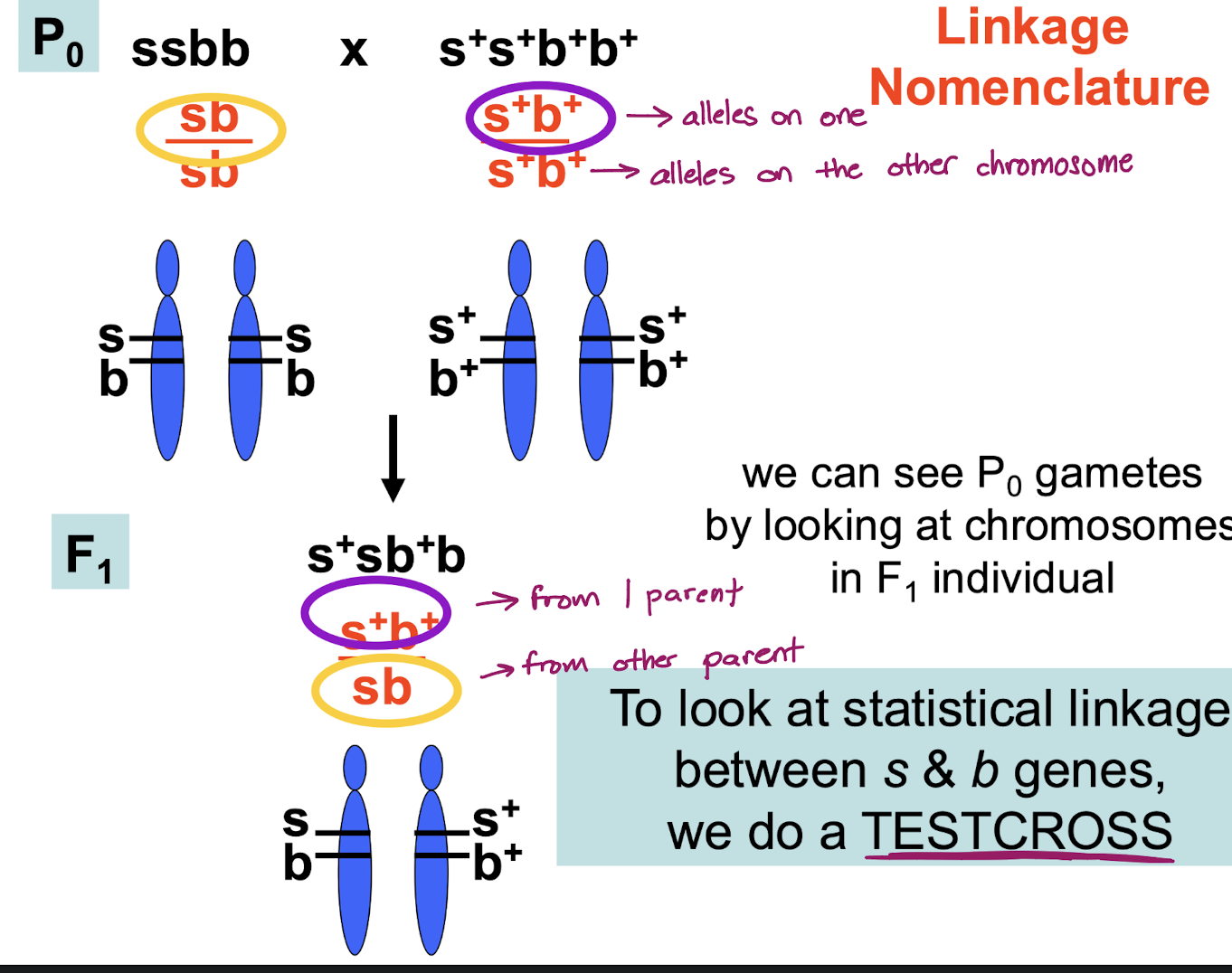
cis/coupling → each chromosome has only dominant or recessive alleles
trans/repulsion → each chromosome has 1 dominant and 1 recessive allele
Linkage Nomenclature
Independent Assortment Parental & Recombinant Gene Ratio
50% parental to 50% recombinant
unlinked genes
Incomplete Linkage
more parental gametes than recombinant gametes (but recombinant genes are present)
Crossing Over
physical exchange of chromosomal material between homologous chromosomes
results in recombination between genes on homologous chromosomes at 2 different loci
more crossing events between genes that are farther apart

RF equation
f(recombination) = RF = # recombinant gametes/total gametes
RF represents the frequency of recombination between genes during prophase I
RF is never greater than 50%!
1% RF = 1 map unit = 1 centimorgan
Triple Test Cross
looks at recombination among 3 genes
2 types of single crossover events are possible
terminal alleles differ
double crossover event (RARE) can happen if both single crossovers happen
middle alleles differ

Coefficient of Coincidence (coc)
how often a double crossover event actually happens when it is expected
coc = observed double crossover events / expected double crossover events
expected double crossover events = p ( one single crossover event occurs AND the other single crossover event occurs) x # of total gametes
# of single crossover events include the times it happens in double crossover (ex: 4 single crossover events & 2 double crossover → single crossover occurred 6 times)
Interference
how often double crossover event is inhibited (doesnt happen when it should happen)
I = 1 - coc
ABO Blood Type
Shows dominance (IA > i, IB > i) & codominance (IA = IB, heterozygotes has phenotypes of both homozygotes)
IAIA or IAi = type A
IBIB or IBi = type B
IAIB = type AB
ii = type O