Biology - cells 2 *
 Studied by 0 people
 Call Kai
 Learn
Learn Practice Test
 Spaced Repetition
 Match
Match Flashcards
 Knowt Play
1/81

There's no tags or description
Looks like no tags are added yet.
Name | Mastery | Learn | Test | Matching | Spaced |
|---|
No study sessions yet.
82 Terms
What is the function of smooth muscles?
involuntary contraction and relaxation to control hollow organs, moving substances like food (digestion), urine (urinary system), and blood (blood vessels)
What are striated cells?
muscle cells that have a characteristic striped (striated) appearance under a microscope
What are the adaptations of skeletal muscle cells?
-long cylindrical shape
-protein filaments
-many mitochondria
-glycogen stores
Why are skeletal muscle cells long?
Cylindrical shape allows them to contract over a long distance, enabling movement.
Why do skeletal muscle cells have protein filaments?
they slide over each other making fibres contract
Why do muscle cells have many mitochondria?
to provide the energy needed for the muscles to contract
Why do muscle cells store glycogen?
as a readily available, quick-access energy reserve for high-intensity activity
it provides energy for muscle contraction during exercise.
Where does anaerobic respiration take place?
cytoplasm
What are neurons?
nerve cells
What is the function of nerve cells?
To carry electrical signals from one part of the body to another
Can the heart muscles store glycogen?
Yes
What are the adaptations of nerve cells?
-long axon
-myelin sheath
-dendrites
-many mitochondria
-synaptic knobs
Why do nerve cells have dendrites?
they increase their surface area to receive chemical signals (neurotransmitters) from other neurons at synapses
Why do nerve cells have a long axon?
to transmit electrical signals quickly over long distances
Why do nerve cells have a myelin sheath?
To provide insulation, speed up transmission, and stop electrical signals leaking out of the nerve cell
Why do nerve cells have synaptic knobs?
to allow for the transmission of nerve impulses from one cell to the next using chemical messengers (neurotransmitters)
Why do nerve cells have many mitochondria?
To transfer the energy needed to make and transmit neurotransmitters across long distances
What are sperm cells?
male gametes
What are the adaptations of sperm cells?
-long tails
-many mitochondria
-acrosome full of digestive enzymes
-a large nucleus
Why do sperm cells have long tails?
To help the cell to move and swim towards the egg
Why do sperm cells have lots of mitochondria?
To allow lots of aerobic respiration to provide energy for swimming
Why do sperm cells have an acrosome filled with digestive enzymes?
to break down the outer layers of the egg
What is the function of root hair cells?
To absorb water and mineral ions from the soil
What are the adaptations of root hair cells?
-long hair-like projections
-A thin cell wall
-A large vacuole
-lots of mitochondria
Why do root hair cells have lots of mitochondria?
Absorbing minerals through active transport requires energy.
Why do root hair cells have hair-like projections?
To increase to surface area for absorption
Why do root hair cells have a thin cell wall?
to reduce the distance for active transport
Why do root hair cells have a large vacuole?
To help store water and create a strong osmotic gradient, speeding up osmosis
What are photosynthetic cells?
cells that can carry out photosynthesis
What are examples of photosynthetic cells?
palisade mesophyll, spongy mesophyll, guard cells
What are adaptations of photosynthetic cells?
-chloroplasts
-a large vacuole
Why do photosynthetic cells have chloroplasts?
to trap the light needed for photosynthesis
Why do photosynthetic cells have a large vacuole?
to keep the cell rigid and the leaf spread out to maximise sunlight capture for photosynthesis.
Where are photosynthetic cells found in plants?
in the mesophyll tissue of the leaf and the outer layers of the stem so the absorb as much light as possible
What is the function of the xylem?
-transports water and soluble mineral nutrients from the roots throughout the plant
-also importing in supporting the plant (found in the vascular tissue
What is the structure of the xylem?
Hollow tubes of dead cells strengthened by lignin. There are no cell walls between cells, except the outside wall, which is thickened. Water flows one way.
What are the adaptations of the xylem cells?
Xylem cells are dead at maturity to create hollow, continuous tubes (vessels) for efficient water transport
allowing water to move freely from roots to leaves without blockage from cytoplasm or organelles
What is the function of the linin?
to support, and waterproofing to the plant's water transport system, preventing the dead, hollow xylem vessels from collapsing under negative pressure as water is pulled up from the roots
How does the xylem form?
Xylem cells are alive when they first form; however, a chemical (lignin) spirals in the cell walls and kills the cell. When the cells die, their cytoplasm and organelles disappear, and the end walls disintegrate, forming long hollow tubes
What is the function of the phloem?
to transport sugars and nutrients made during photosynthesis to the other parts of the plant
How does the phloem work?
1. Photosynthesis in the leaves creates sugars (like glucose, which becomes sucrose).
2. These sugars are loaded into the phloem sieve tubes, often with the help of companion cells, creating a high sugar concentration inside.
3. Water moves into the phloem by osmosis from nearby xylem, increasing pressure at the "source" (e.g., leaves).
4. This pressure pushes the sugary sap through the sieve tubes towards areas with lower sugar concentration
What are the adaptations of the phloem?
-sieve plates with small pores
-fewer organelles
-living cells
-companion cells
How do the sieve plates of the phloem form?
The cell walls between the cells break down to form sieve plates. These allow water carrying dissolved nutrients to move up and down the tubes freely
Why does the phloem have sieve plates?
to allow sugars and nutrients (sap) to move easily from one sieve tube element to the next
Why do phloem cells have fewer organelles?
Phloem sieve tube elements have fewer organelles to maximise the space available for the efficient transport (translocation) of dissolved sugars and amino acids.
What organelles are absent in phloem cells?
nucleus, ribosomes, and large vacuole
What is the structure of the phloem?
tubes made from living cells arranged from end to end
Why do phloem cells have companion cells?
Phloem cells lose a lot of their organelles, so they need to be supported by companion cells to keep them alive
What do companion cells do?
-their mitochondria transfer the energy needed to move dissolved food up and down the plant
-They actively pump sugars (like sucrose) from the leaf into the sieve tube elements, a process requiring energy.
-They act as the control centre, managing the flow of sap through the sieve tubes.
What is the cell cycle?
series of events that cells go through as they grow and divide

What are the stages of the cell cycle?
1. interphase
2. mitosis
3. cytokinesis
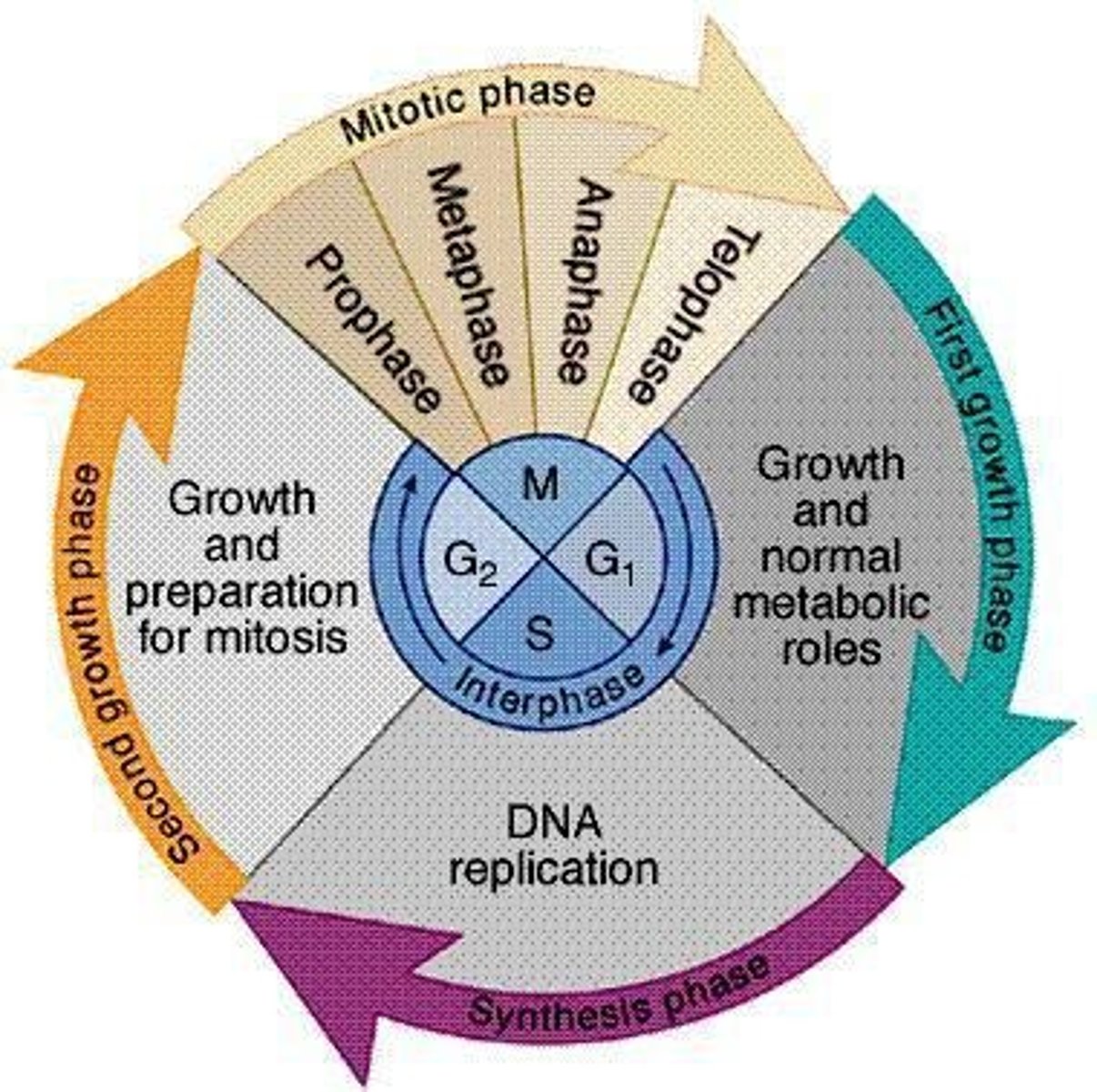
What happens during interphase?
-It is the longest stage of the cell cycle. The cell prepares for division
1. The cell gets bigger and increases its number of organelles
2. The cell copies its DNA so that each new cell will have a full set of genetic material
3. The cell checks for errors and ensures there are no mistakes in the DNA
What are the stages of mitosis?
1. prophase
2. metaphase
3. anaphase
4. telophase
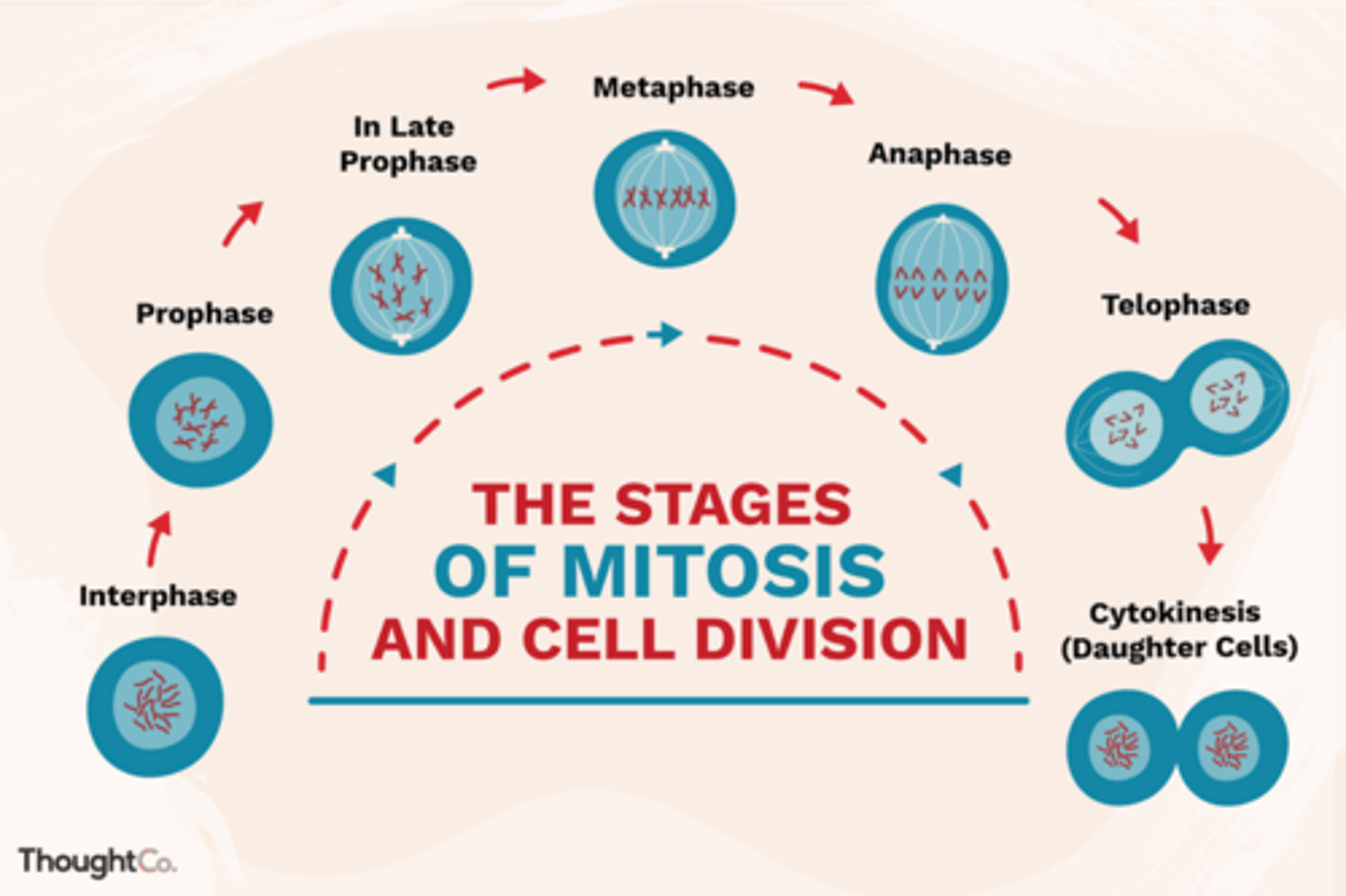
Mitosis summary
1. prophase - chromosomes become visible
2. metaphase - chromosomes line up
3. anaphase - sister chromatids separate
4. telophase - two nuclei form
What happens during mitosis?
This is when division of the nucleus occurs. The chromosomes that have been replicated are distributed to two daughter nuclei.
What happens during prophase?
Chromosomes become visible, and the nuclear membrane starts to break down
What happens during metaphase?
Chromosomes line up in the middle of the cell
What happens during anaphase?
The two chromosomes are pulled apart to opposite sides of the cell
What happens during telophase?
Two nuclei form, and the cell starts to split
What happens during cytoinesis?
The cytoplasm divides, and the cell membrane pinches in to form two identical daughter cells.
Each new cell is genetically identical to the original parent cell
formula for the number of cells
final no of cells = initial no of cell × 2ⁿ
n = number of divisions
formula for the number of cell divisions
n = total time/division time
n = number of divisions
What is a stem cell?
An undifferentiated cell that can differentiate to become any type of specialised cell
What are the two types of stem cells?
embryonic and adult stem cells
What are embryonic stem cells?
stem cells found in embryos, which can differentiate into any type of cell
What are adult stem cells?
found in places like the sink and bone marrow, these can only turn into some types of cell
Why are stem cells important?
-they help heal injuries, like cuts or broken bones
-they are used in medicine to treat diseases like leukaemia
What are the advantages of embryonic stem cells?
-painless technique
-can treat many diseases
-can become any type of cell
-Many embryos can be created in a lab
What are the disadvantages of embryonic stem cells?
-harm/death to the embryo
-ethical issues
-embryo rights/embryo can't consent
-unreliable tequnique/might not work
What are the advantages of adult stem cells?
-no ethical issues
-can treat some diseases
-The procedure is safe
-reliable
-quick recovery
What are the disadvantages of adult stem cells?
-risk of infection from the operation
-can only treat a few diseases
-procedure can be painful
What are plant stem cells used for?
-New shoots/roots
-Differentiation into xylem/phloem tissue
-a clone of the plant
What is differentiation?
The process by which a cell changes to become specialised for its job
When do cells become differentiated in animals?
cell differentiation begins very early, starting from a single-celled zygote and progressing rapidly during embryonic development to form specialized tissues, with most cells becoming fixed in their roles before birth, though adult stem cells retain some differentiation ability for repair.
How do cells become differentiated?
by switching specific genes on or off, making them specialized for a job
What types of cells in humans cannot divide?
red blood cells and neurons
Why can't red blood cells divide?
because they don't have a nucleus
How are red blood cells replaced?
adult stem cells replace them
What happens to dead or damaged nerve cells?
nothing, they don't divide and aren't replaced by stem cells
What is cell division for in mature animals?
repair and replacement since little to no growth takes place
When do plant cells stop differentiating?
never
What are meristems?
The areas in plants where growth occurs, because of unspecialised cells dividing by mitosis, differentiating and becoming specialised.