PSYC2030 - WEEK 1
 Call Kai
 Learn
Learn Practice Test
 Spaced Repetition
 Match
Match Flashcards
 Knowt Play
1/20

There's no tags or description
Looks like no tags are added yet.
Name | Mastery | Learn | Test | Matching | Spaced | Call with Kai | Chat |
|---|
No analytics yet
Send a link to your students to track their progress
21 Terms
MATURATION THEORY - Gesell's Biological Maturation Theory
Development primarily determined by genetics
Development happens in predictable order
Developmental 'norms' (milestones)
Chronological vs developmental age
MATURATION THEORY CATEGORIES
Nature vs nurture
Universal vs individual
Continuous vs discontinuous (depends)
BEHAVIOURIST THEORY - Theory of Learning
Ex. Ivan Pavlov
Learning is shaped by experiences in the environment
BEHAVIOURIST THEORY CATEGORIES
Nature vs nurture
Universal vs individual
Continuous vs discontinuous
CONSTRUCTIVIST THEORY - Piaget's theory of cognitive development
Children construct knowledge and abilities via actively exploring the world
Development is a product of both maturation and learning
4 STAGES
SENSORIMOTOR STAGE
birth – 2 years
Learning through exploration (senses + reflexes)
Absence -> emergence of mental representations
Lack of object permanence (out of sight, out of mind)
Deferred imitation (memory)
Pretend play
PREOPERATIONAL STAGE
2 – 7 years
Can form and utilise mental representations
Use of language
Cannot take into account multiple, conflicting representations
Leads to illogical thinking
CONCRETE OPERATIONAL STAGE
7 – 11 years
Can take into account multiple aspects of problem
Emergence of logical thinking
Can only logic about concrete information
FORMAL OPERATIONAL STAGE
11+ years
Further developments in logical thinking
Can logic through abstract concepts
Thinking is systematic and scientific
CONSTRUCTIVIST THEORY - Vygotsky's Socio-cultural theory
Children construct knowledge and abilities via social interactions
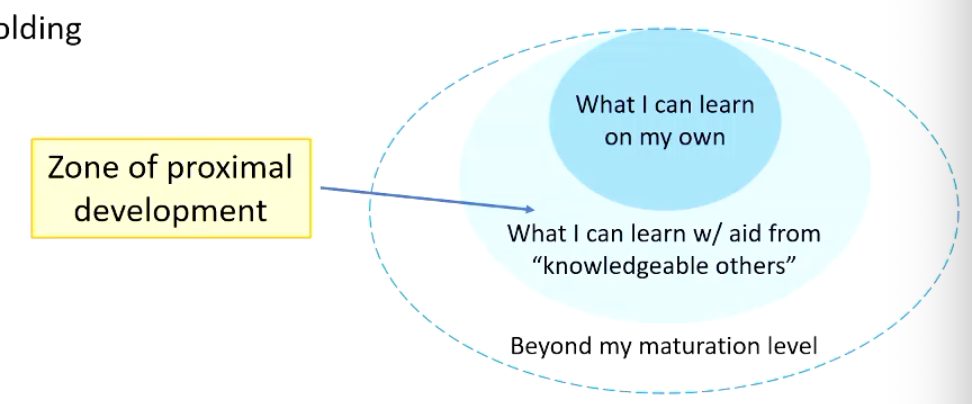
Zone of proximal development
What they can learn on their own and what is beyond their maturation level. It is between these two levels.
Aided by knowledgeable others
Optimised by scaffolding
CONSTRUCTIVIST THEORY CATEGORIES
Nature vs nurture (both)
Universal (Piaget) vs individual (Vygotsky)
Continuous (Vygotsky) vs discontinuous (Piaget)
PSYCHOANALYTICAL THEORY - Erikson's psychosocial theory
Importance of childhood experiences in shaping lifespan development
Each developmental stage is characterised by conflicts about how one's identity fits with social surroundings
Development happens through resolving these conflicts
PSYCHOANALYTIC THEORY STAGES
Infancy
Trust or mistrust
Toddler
Autonomy
Shame and doubt
Preschool
Initiative
Guilt
School age
Industry
Inferiority
Adolescence
Identity
Role confusion
Young adult
Intimacy
Isolation
Middle age
Generativity
Stagnation
Older adult
Ego-integrity
Despair
PSYCHOANALYTIC THEORY CATEGORIES
Nature vs nurture (both)
Universal vs individual
Continuous vs discontinuous
ECOLOGICAL THEORY - Bronfenbrenner's Ecological systems theory
Development happens via individual factors interacting with various factors from direct surroundings and broader environment
Individual (sex, age, health etc.) + 5 other factors
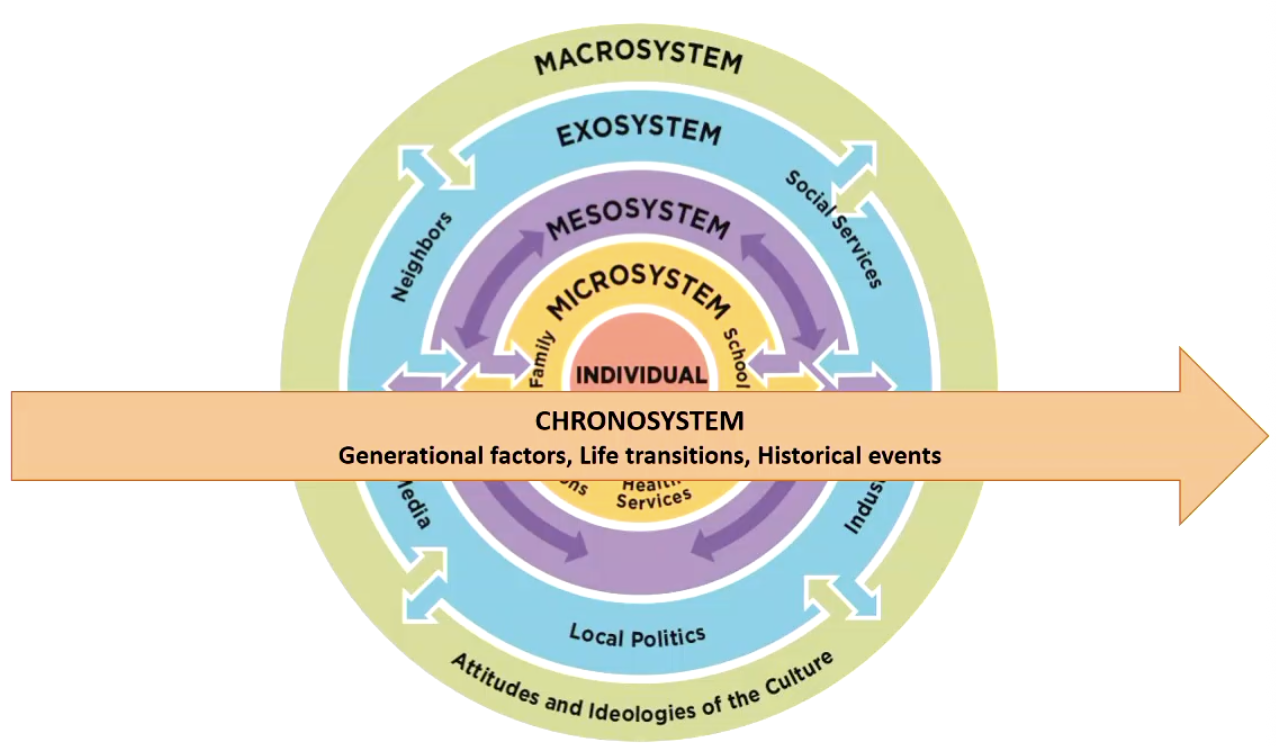
MICROSYSTEM
Family
School/peers
Health services
Religious institutions
MESOSYSTEM
Interactions that people in your microsystem have with each other
EXOSYSTEM
Factors in community affecting your mesosystems and microsystems
Neighbours
Politics
Media
Social systems
MACROSYSTEM
Cultural ideals surrounding community
CHRONOSYSTEM
Generational factors
Life transitions
Historical events
ECOLOGICAL THEORY CATEGORIES
Nature vs nurture (both)
Universal vs individual
Continuous vs discontinuous