Baroque & Rococo: France, Austria & Germany
 Studied by 0 people
 Call Kai
 Learn
Learn Practice Test
 Spaced Repetition
 Match
Match Flashcards
 Knowt Play
1/9

There's no tags or description
Looks like no tags are added yet.
Name | Mastery | Learn | Test | Matching | Spaced | Call with Kai |
|---|
No study sessions yet.
10 Terms
Rococo
Style from early 18th c. Paris, marked by elegance, lightness, curving forms, and shell-like ornamentation (rocaille). A reaction against Versailles’ heaviness.
Rococo Characteristics
Light, elegant, intimate scale
Curving, asymmetrical forms
Pastel colors and gilded decoration
Nature-inspired motifs (shells, vines, flowers)
Designed for private pleasure, not public power
Themes
Love, Romance & Flirtation
Leisure & Aristocratic Pleasure
Nature, elegance, intimacy, performance
Baroque
An artistic and architectural style that developed in Europe during the late 16th and 17th centuries. Its main goal was to evoke emotion, awe, and drama, using art as a powerful tool to communicate religious faith, political authority, and grandeur.
Characteristics of Baroque
Intense emotional expressions
Strong contrasts between light and dark (chiaroscuro and tenebrism)
Light used to guide attention and heighten emotion
Themes:
Religion & Faith
Power, Authority & Glory
Drama, Violence, Conflict
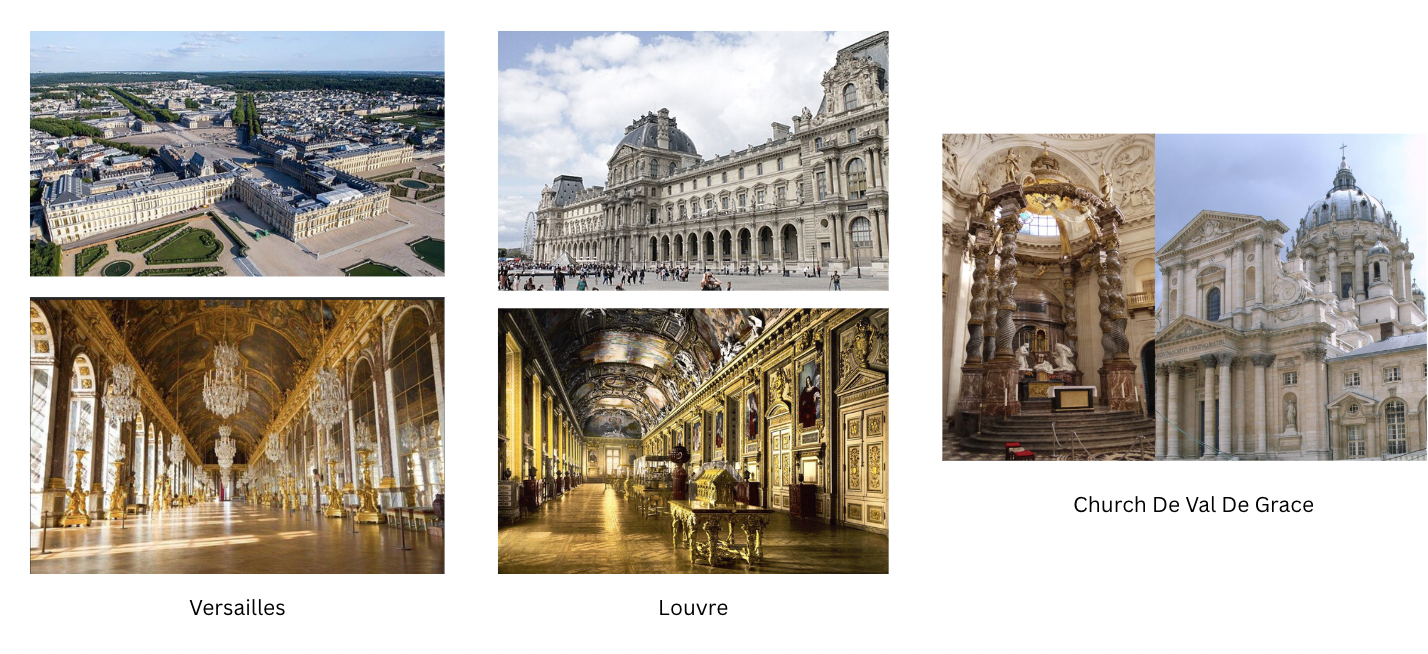
Baroque Architecture in France
Louis XIV, Palace of Versailles & Palace of the Louvre
Grand scale, symbol of absolutism, Hall of Mirrors, Salon de la Guerre. Louvre: Galerie d’Apollon, richly decorated interiors
Church of Val-de-Grace, Paris
Baroque church with a domed structure; Bernini-inspired baldacchino by Gabriel Le Duc. Commissioned by Queen Anne of Austria.
Rococo Architecture in France
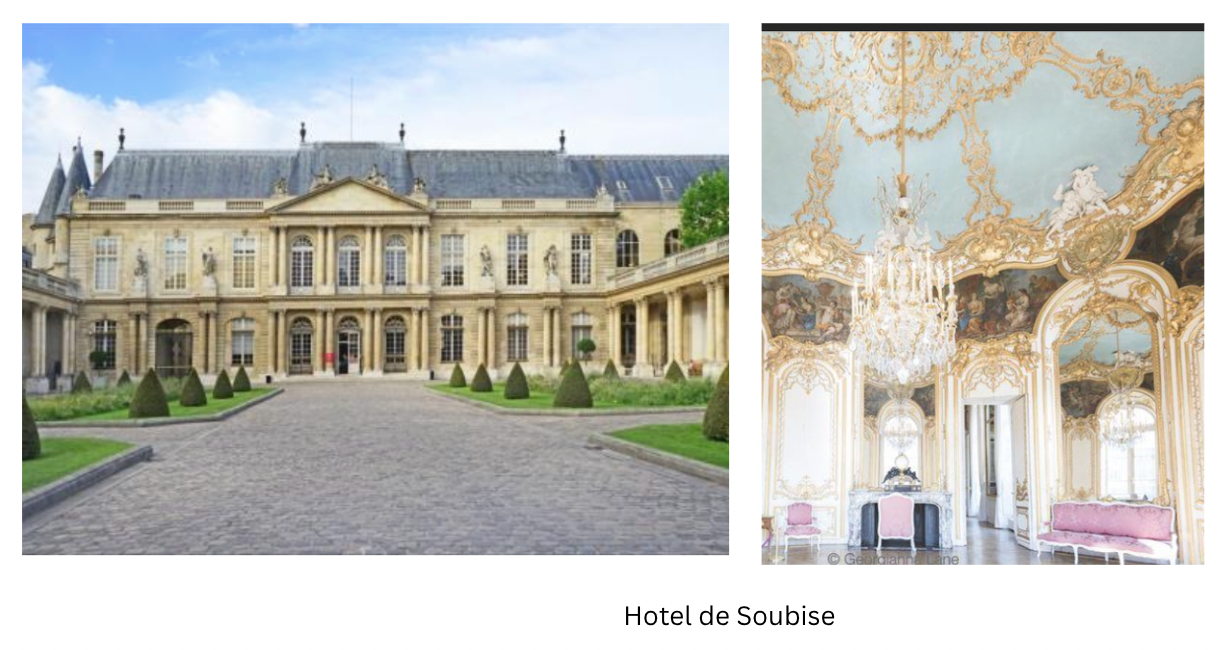
Hôtel de Soubise, Paris
Designed by Germain Boffrand, with interiors by Charles-Joseph Natoire. Salon de la Princesse epitomizes Rococo—delicate stuccoes, pastel colors, curved lines.
Molding: A long, narrow, decorative strip in relief; generally used to cover transitions between surfaces in aesthetically pleasing ways.
Baroque & Rococo Architecture in Austria & Germany
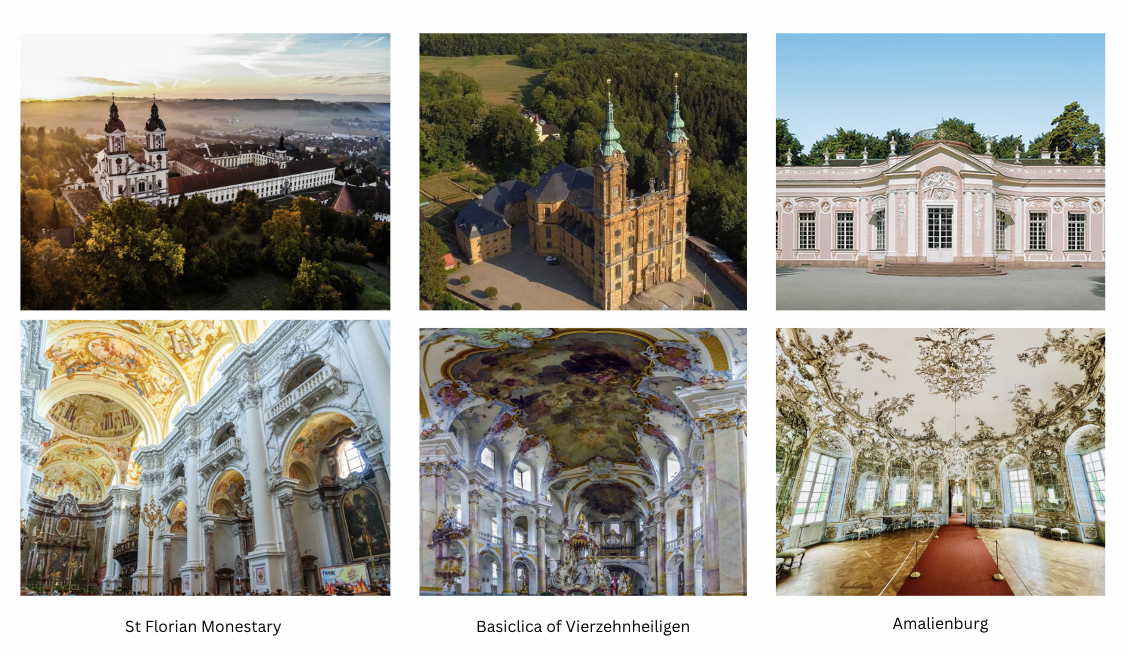
St. Florian Monastery (Austria) BAROQUE
A monumental Baroque monastic complex blending architecture, painting, and sculpture into a unified spiritual experience
Basilica of Vierzehnheiligen (Germany) BAROQUE-ROCOCO
A pilgrimage church, known for its complex spatial geometry.
Amalienburg (Munich, Germany) ROCOCO
A Rococo pleasure pavilion built as a hunting lodge, representing the peak of Rococo luxury.
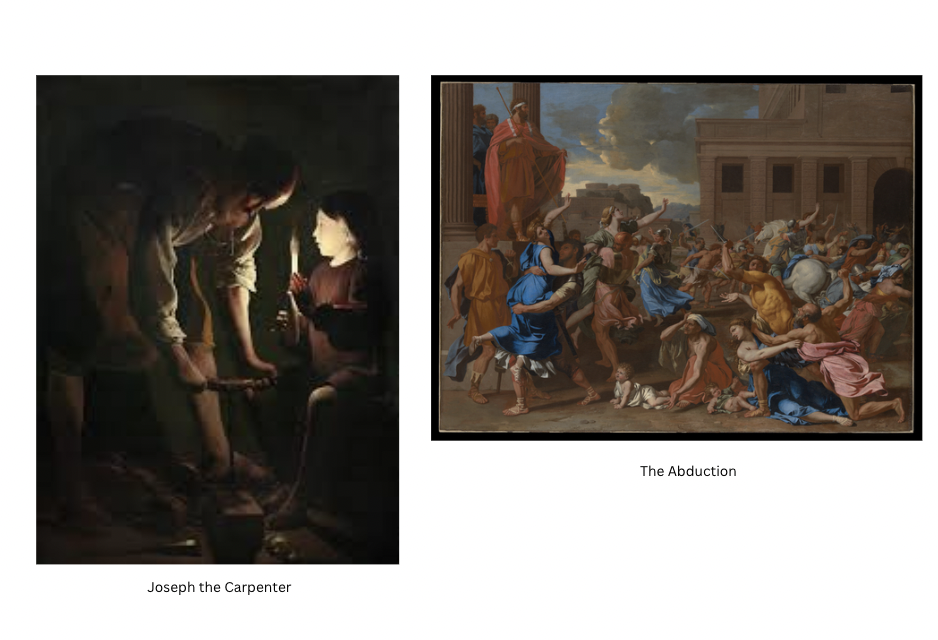
Baroque Painting in France
Georges de La Tour – Joseph the Carpenter
A quiet, spiritual Baroque painting focused on candlelight and human emotion. Known for its strong chiaroscuro and realism.
Nicolas Poussin – The Abduction of the Sabine Women
A classical Baroque painting inspired by ancient Rome, emphasizing reason and order.
Rococo Painting in France
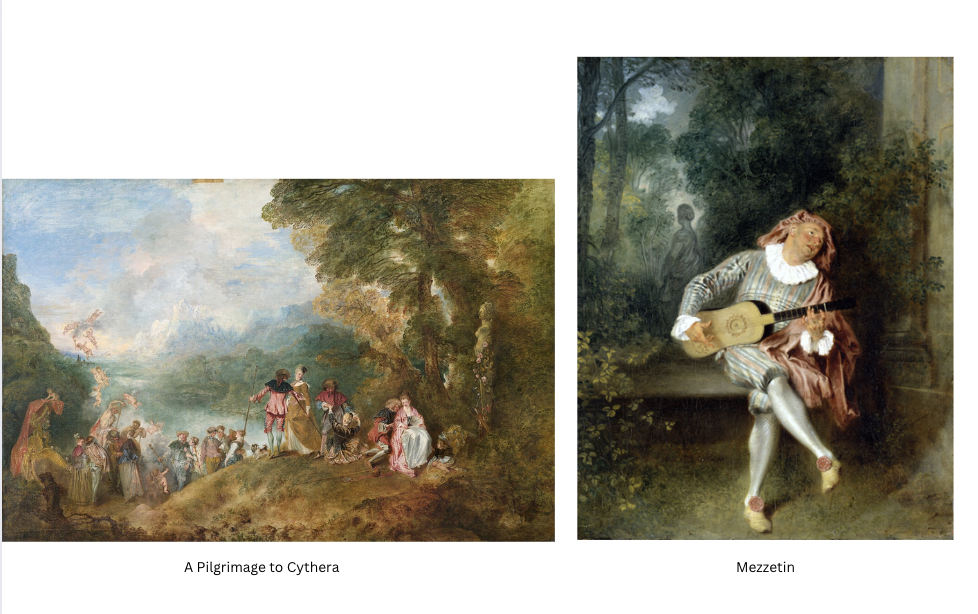
Jean-Antoine Watteau – A Pilgrimage to Cythera
A defining Rococo painting showing aristocrats in a dreamlike landscape of love.
Jean-Antoine Watteau – Mezzetin
A melancholic Rococo portrait blending theatrical costume with emotional vulnerability.
Rococo Painting in France pt.3
François Boucher, Portrait of Madame de Pompadour
A portrait glorifying Louis XV’s mistress as cultured, refined, and powerful.
Jean-Honoré Fragonard, The Swing
An iconic Rococo painting celebrating flirtation, pleasure, and aristocratic excess.