Microeconomics ch 3
 Call Kai
 Learn
Learn Practice Test
 Spaced Repetition
 Match
Match Flashcards
 Knowt Play
1/21

There's no tags or description
Looks like no tags are added yet.
Name | Mastery | Learn | Test | Matching | Spaced | Call with Kai | Chat |
|---|
No analytics yet
Send a link to your students to track their progress
22 Terms
absolute advantage
_____ ______: the ability to produce a good using fewer inputs than another producer
opportunity cost
_____ ______: whatever must be given up to obtain some item
whatever must be given up to obtain some item (What must be given up to obtain something.)
comparative advantage
_____ ______: the ability to produce a good at a lower opportunity cost than another producer
imports
_____: goods produced abroad and sold domestically
export
_____: goods produced domestically and sold abroad
Interdependence, Specialization, variety, efficiency
________: People rely on others for goods and services they do not produce themselves.
________: Individuals focus on producing goods they make most efficiently and trade for other goods.
Trade increases ________ and ________ by allowing people to specialize.
Trade can benefit both parties, even when one person is better at producing everything (comparative advantage).
Benefits of trade:
Increases the variety of goods available.
Allows people to focus on their strengths.
Makes everyone better off through specialization and exchange.
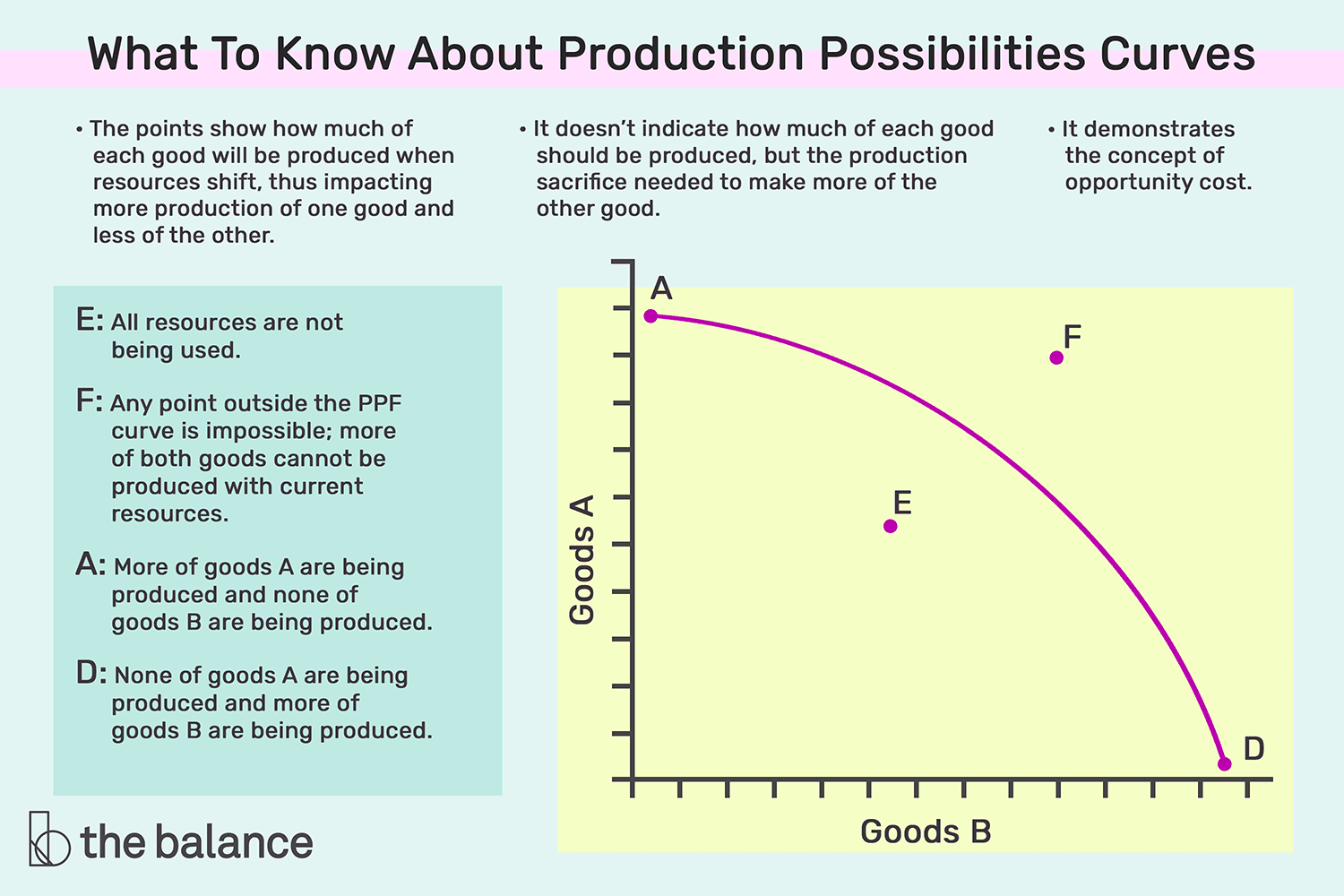
Production Possibilities Frontier (PPF)
______ _______ ______ (___): a graph that shows the combinations of output that the economy can possibly produce with the available factors of production and production technology (Shows all possible combinations of two goods that can be produced with available resources.)
Shows the maximum possible combinations of two goods that can be produced with available resources and technology.
Illustrates trade-offs because producing more of one good requires producing less of another.
The slope of the PPF reflects opportunity cost.
The PPF shows the maximum possible production combinations.
efficiency is determined by where a point lies relative to the Production Possibilities Frontier (PPF) curve
the slope tells you the rate of trade-off between the two goods
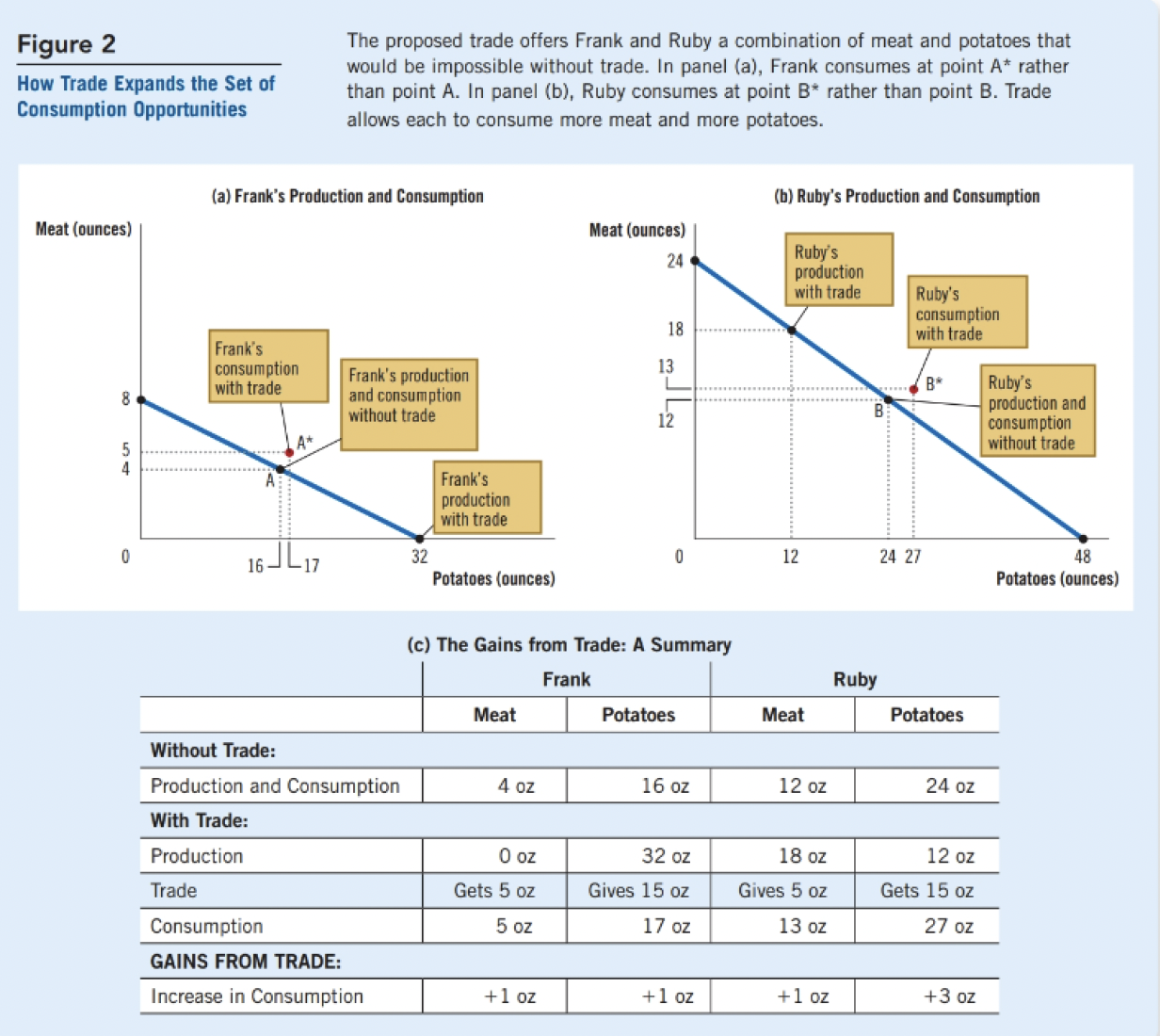
Example: Frank's PPF is a straight line because he gives up the same amount of one good to produce more of the other (constant opportunity cost). Ruby's PPF is also a straight line for the same reason.
Increasing, specialized, Constant, equally
Constant vs. Increasing Cost: A straight-line PPF shows a constant opportunity cost, while a bowed-out (curved) PPF shows an increasing opportunity cost as you produce more of a good
Straight-Line vs. Bowed-Out PPF
Bowed Outward PPF (Curved)
_______ opportunity cost.
Resources are _______, so shifting them becomes less efficient.
Reason: Resources (like workers or land) are specialized. They are better at making one specific product than another.
Opportunity Cost: Increasing. As you try to make more and more of one item, you have to use resources that are terrible at making it.
Real-World Example: Moving a worker from making computers to making cars means you give up a lot of computer output for very little extra car output because skills do not match.
Straight-Line PPF
_______ opportunity cost.
Resources are _______ productive at making either good.
Reason: Resources are not specialized. They are equally good at making both products.
Opportunity Cost: Constant. You always give up the exact same amount of one product to get one more unit of the other product, no matter where you are on the line.
Real-World Example: Workers who can make plain notebooks or sketchbooks with the exact same speed and skill.
Self-sufficiency
_____-_________: Producing and consuming your own goods without trade.
Without trade, consumption is limited to what an individual can produce
Production = Consumption.
why? Without trade, people consume only what they produce → thus PPF is also the consumption possibilities frontier because production equals consumption.
The PPF is also the consumption possibilities frontier.
production limit, trade-offs, opportunity cost, constant, increasing
The PPF shows:
_____ _____.
_____-_____.
_____ _____.
Straight-line PPF = _____ opportunity cost.
Bowed-out PPF = _____ opportunity cost.
Graph of PPF → face trade off between producing meat and producing potatoes
Why no bowed-out? PPF was bowed outward (concave) because the opportunity cost was increasing. In this chapter, the PPF is a straight line because the opportunity cost is constant.
Frank: (0,8) (0,24) for 8 hours
8 oz meat (over 8 hours) OR 31 oz potatoes (over 8 hours)
60 mins —> 1 oz of meet X 8 hours = 8 oz of meat
60mins / 15 = 4 oz of potatoes X 8 hours = 32 oz of potatoes
Ruby: (32,0) (48, 0)for 8 hours
24 oz meat (over 8 hours) OR 48 oz potatoes (over 8 hours)
60/20= 3 oz of meat X 8 hours = 24 oz of meat
60 / 10 = 6 oz of potatoes X 8 hours = 48 oz of potatoes
Comparative Advantage = Lower opportunity cost
opportunity cost of Good A = Good B/ Good A
Memory Trick: Put the Other good Over the good you are solving for.
Interpretation: The result is how many units of Good B you lose to make 1 unit of Good A
EXAMPLE:
1. Opportunity Cost of 1 oz Meat
Frank: 60 mins (meat) / 15mins (potatoes) = 4 oz Potatoes for 1 oz of meat
Ruby: 20 mins (meat) / 10mins (potatoes) = 2 oz Potatoes for 1 oz of meat
Result: Ruby gives up less potato (2 oz vs 4 oz). Ruby has the comparative advantage in Meat.
2. Opportunity Cost of 1 oz Potatoes
Frank 15mins (potatoes) / 60 mins (meat) = 0.25 oz Meat (1/4) for 1 potatoes
Ruby: 10mins (potatoes) / 20 mins (meat) = 0.5 oz Meat (\1/2) for 1 potato
Result: Frank gives up less meat (0.25 oz vs 0.5 oz). Frank has the comparative advantage in Potatoes.
Key idea: Specialization + trade increases total production and makes both people better off, even without working more hours.
efficiently, trade, total production
Specialization and Trade = Trade benefits both parties because specialization increases total production.
Specialization is producing the good you make most _____.
People (or countries) specialize in producing certain goods and _____ for others.
Trade allows people to consume beyond their own production possibilities frontier (PPF).
By specializing and trading, _____ _____ increases, allowing both parties to consume more than if they remained self-sufficient.
Key idea: Specialization and trade make both parties better off, even without increasing the amount of resources or hours worked.
Why Trade Works
Each person spends more time producing what they do best.
They exchange some of their production for what the other produces.
Total production increases, allowing both to be better off.
Specialization, lower, Opportunity cost, efficiently
Comparative Advantage: The Driving Force of _______
Comparative advantage explains why people and countries specialize and trade, even when one producer is better at producing everything.
A producer has a comparative advantage when they can produce a good at a _____ opportunity cost than another producer.
_______ _______ determines comparative advantage, not productivity or absolute advantage.
Specialization based on comparative advantage creates gains from trade by using resources more _______.
productivity, inputs, efficiently, absolute, Comparative, not
Absolute Advantage
Absolute advantage compares the _______ of one person, firm, or nation to another.
A producer has an absolute advantage if they can produce a good using fewer ____ than another producer.
Absolute advantage: The ability to produce a good using fewer inputs than another producer.
Compares the productivity of people, firms, or countries.
The producer with fewer inputs has the lower production cost.
Absolute advantage focuses on who produces more _________, not opportunity cost.
A producer can have an _________ advantage in both goods, but CANNOT have a _________ advantage in both goods.
Absolute advantage does ___ determine specialization
trade-off, lower, comparative, specialization, trade, inverses
Opportunity Cost and Comparative Advantage
Opportunity cost: What must be given up to obtain or produce something. It measures the ____-_____ between producing two goods.
When producers reallocate time between goods, producing more of one good means producing less of another.
Comparative advantage: The ability to produce a good at a _______ opportunity cost than another producer.
The producer who gives up less of another good has the _________ advantage.
Comparative advantage determines ______ and ______.
Important Relationship
A person can have an absolute advantage in both goods, but cannot have a comparative advantage in both goods.
This is because opportunity costs are ______: A lower opportunity cost for one good means a higher opportunity cost for the other.
Example
Ruby:
Better at producing both meat and potatoes BUT…
Lower opportunity cost of meat → comparative advantage in meat.
Frank:
Lower opportunity cost of potatoes → comparative advantage in potatoes.
Key Idea
Absolute advantage = fewer inputs.
Comparative advantage = lower opportunity cost.
Specialize in the good where you have the comparative advantage and trade for the rest.
total production, less
Comparative Advantage and Trade
Gains from specialization and trade are based on comparative advantage, not absolute advantage.
Specialization increases ______ ______, making the economic “pie” larger.
Trade allows both parties to obtain goods for ___ than their own opportunity cost. (thus beneficial)
Key idea: Trade benefits everyone because specialization based on comparative advantage increases efficiency and allows people to consume more.
between, specialize, benefits
The Price of Trade
For both parties to benefit from trade, the trade price must fall ______ their opportunity costs.
A trade price within this range allows both producers to:
Buy goods for less than their opportunity cost.
Gain from specialization and trade.
The trade price determines how the gains from trade are divided between the parties.
If the price is outside the range of opportunity costs, trade will not be mutually beneficial.
Range of trade: Must lie between the opportunity cost ratios of the two trading partners.
No gain point: If the price matches a country's domestic opportunity cost, that country gets no extra benefit from trade.
Outside limits: If the price falls outside this range, one country will lose out and refuse to trade.
Key Idea
A mutually beneficial trade price is between each producer’s opportunity costs.
Comparative advantage determines what people ______ in; the trade price determines how the ______ are shared.
interdependence, gains, efficiently
Applications of Comparative Advantage
principle of comparative advantage ______ and the ______ from trade.
Comparative advantage applies to many situations where people, businesses, or countries specialize and trade.
Specialization based on comparative advantage allows resources to be used more ______ and creates benefits from trade.
Example: Comparative Advantage in International Trade
The U.S. and Japan are equally productive at producing cars.
The U.S. has a comparative advantage in food because its opportunity cost of producing cars is higher:
U.S.: 1 car = 2 tons of food given up.
Japan: 1 car = 1 ton of food given up.
Japan gives up less food to produce cars → Japan has the comparative advantage in cars.
Japan specializes in cars and exports cars to the U.S.
The U.S. specializes in food and exports food to Japan.
Result: Both countries can consume more cars and food through specialization and trade (imports).
NOTE: trade can harm some individuals and benefit other
USA farmers —> benefit
USA autoworkers —> harmed
lower, more, individuals, harmed
Comparative Advantage and International Trade
Countries benefit from specialization and trade just like individuals.
The principle of comparative advantage states that each country should produce goods with the ____ opportunity cost.
A country can benefit from trade even if another country is more productive at producing all goods.
Effects of International Trade
Specialization and trade allow countries to consume more goods and services than they could produce alone.
Trade can make a country better off overall, but it may affect individuals differently:
Some benefit from trade.
Others may be _____ by increased competition.
Key Idea
International trade is not a competition where one country wins and another loses.
Trade allows countries to achieve greater prosperity through specialization and exchange.
Trade is not a competition where one country wins and another loses; trade allows countries to achieve greater prosperity.
Interdependence, comparative advantage
__________ allows people, businesses, and countries to benefit from specialization and trade.
The principle of __________ __________ shows that trade can make everyone better off.
In simple economies, people can directly bargain and allocate resources.
In larger economies, market forces of supply and demand coordinate the activities of producers and consumers.
Markets help determine how goods and services are produced, distributed, and consumed.