Trig/Math Analysis Important Formulas and Info
 Multiple Choice & FRQ
 Call Kai
1/15

Earn XP
Description and Tags
key concepts to memorize for trigonometry and precalculus !!
Name | Mastery | Learn | Test | Matching | Spaced | Call with Kai | Chat |
|---|
No analytics yet
Send a link to your students to track their progress
16 Terms
Set Notation
D={x|xɛR} or R={y|yɛR}
DOMAIN is x-values, remember to use x as variable
RANGE is y-values, remember to use y as variable
Interval Notation
(-infinity, 5] or [7, 6] or (-infinity, infinity)
Parentheses () for open points
Brackets [] for closed points
Inequality Notation
-infinity < y < infinity and 5<=y<=9
<= or >= for closed points
< or > for open points
Difference Quotient
f(x+h)-f(x)/h
h cannot equal 0
same as slope (secant line on a graph, AROC) EXAMPLE: Find the difference quotient of f(x)=2x-1
1.) Replace x in the original function with (x+h), so 2(x+h)-1
2.) Take substituted function and subtract from original given function, so [2(x+h)-1]-(2x-1)/h
3.) Distribute, so [(2x+2h)-1]-2x+1/h
4.) Cancel out, and divide remaining h-terms by h; 2x and -2x cancel, -1 and 1 cancel, leaving (2h)/h ——— (2h)/h=2
FINAL ANSWER: 2 — if you want to find the function of the secant line, then plug in resulting slope to point-slope form [y-y¹=m(x-x¹)]
![<p>f(x+h)-f(x)/h</p><ul><li><p class="has-focus">h cannot equal 0</p></li><li><p class="has-focus">same as slope (secant line on a graph, AROC) EXAMPLE: Find the difference quotient of f(x)=2x-1</p></li><li><p class="has-focus">1.) Replace x in the original function with (x+h), so 2(x+h)-1</p></li><li><p class="has-focus">2.) Take substituted function and subtract from original given function, so [2(x+h)-1]-(2x-1)/h</p></li><li><p class="has-focus">3.) Distribute, so [(2x+2h)-1]-2x+1/h</p></li><li><p class="has-focus">4.) Cancel out, and divide remaining h-terms by h; 2x and -2x cancel, -1 and 1 cancel, leaving (2h)/h ——— (2h)/h=2</p></li><li><p class="has-focus">FINAL ANSWER: 2 — if you want to find the function of the secant line, then plug in resulting slope to point-slope form [y-y¹=m(x-x¹)]<br></p></li></ul><p></p>](https://assets.knowt.com/user-attachments/9fc8c3ba-6475-49d1-8751-9a0d4566461c.jpg)
Point-Slope Form
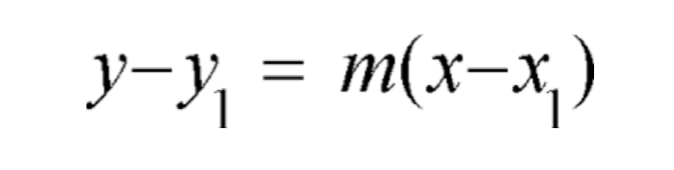
y-y¹=m(x-x¹)
where m = slope and a known point = (x¹, y¹)
When listing multiple intervals demonstrating the same behavior (e.g. increasing, decreasing, constant), use…
u (symbol between intervals, meaning in unison)
EXAMPLE: Increasing from [-10, -4) u (5, 8)
Equation to determine if a function is an EVEN function
f(-x)=f(x)
A function CANNOT be both even and odd; if passes even test, then there is no need to test for odd
If it fails the even test, go on to test for odd
Test even first! EXAMPLE: Determine if f(x)=-2x/x²-1 is even, odd, or neither
1.) Substitute (-x) for each x in the function; -2(-x)/(-x)²-1
2.) Distribute and simplify; 2x/x²-1
3.) Compare resulting function to the original; 2x/x²-1 ≠ -2x/x²-1, so NOT even
4.) Test for odd, substituting -f(x) into the original function; -(-2x/x²-1) — REMEMBER: An outside negative to a fraction will go to EITHER the numerator or denominator, NOT both (both would turn it positive)
5.) Distribute and simplify; 2x/x²-1
6.) Compare resulting function to your already-simplified f(-x) function from the even test; 2x/x²-1 = 2x/x²-1, so ODD function

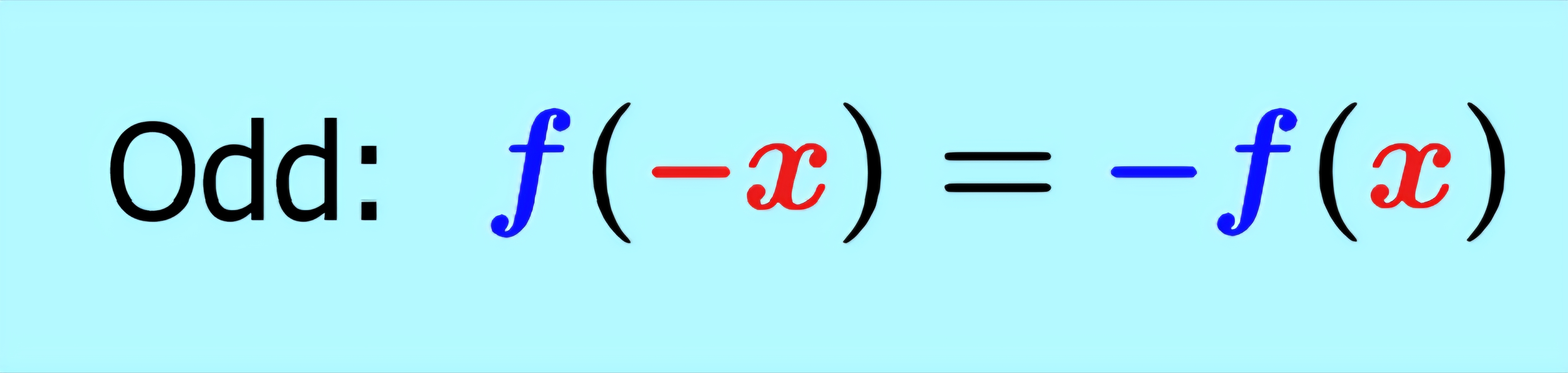
Equation to determine if a function is an ODD function
-f(x)=f(-x)
A function CANNOT be both even and odd; if passes odd test, then it is an odd function only
If fails odd test, then it is NEITHER odd nor even
See even function example
Average rate of change (AROC)
f(b)-f(a)/b-a
a ≠ b
usually given two x-values; plug x values into original function for both b AND a, simplify both functions, subtract b from a, and then divide by b plus a to find AROC
Plug in one of the given x-values to original function to find y-value ——> (x, y)
Once you have your AROC value and at least one point (x, y), plug into point-slope form for the equation of the secant line [y-y¹=m(x-x¹)]
![<p>f(b)-f(a)/b-a</p><ul><li><p class="has-focus">a ≠ b</p></li><li><p class="has-focus">usually given two x-values; plug x values into original function for both b AND a, simplify both functions, subtract b from a, and then divide by b plus a to find AROC</p></li><li><p class="has-focus">Plug in one of the given x-values to original function to find y-value ——> (x, y)</p></li><li><p class="has-focus">Once you have your AROC value and at least one point (x, y), plug into point-slope form for the equation of the secant line [y-y¹=m(x-x¹)]<br></p></li></ul><p></p>](https://assets.knowt.com/user-attachments/2da21700-9cf6-497c-9eec-2749b6b1e93d.png)
Determine if an equation represents a function by…
Testing to see if an x-value will give you two different y-values (if yes, then NOT a function)
Given a function, isolate y on one side (no degrees/powers on it)
Using the isolated y function, substitute a number for x (usually 0) and solve
If one answer, then yes a function; if multiple y answers, then not a function
A domain includes all real numbers, unless:
There is an even index radical (e.g. square root, fourth root, sixth root) —> Expression inside radical must be GREATER THAN OR EQUAL TO ZERO (>=) EXAMPLE: fourth root of x+7 ; set x+7>=0 ; isolate variable x>=-7 ; D={x|xɛR, x>=-7}
The equation has a denominator —> Denominator then must NOT be EQUAL TO ZERO (≠)
If both a RADICAL and DENOMINATOR, with the RADICAL in the denominator, the bottom must be strictly set to greater than zero, NOT >=
EXAMPLE: 2x/x²-9 ; x²-9≠0 ; x²≠9 ; x≠±3
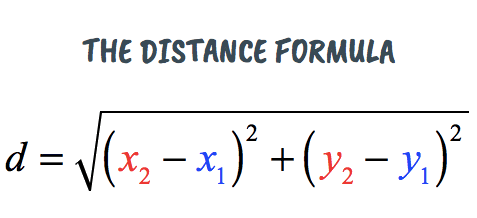
Distance formula
D = square root of (x²-x¹)²+(y²-y¹)²
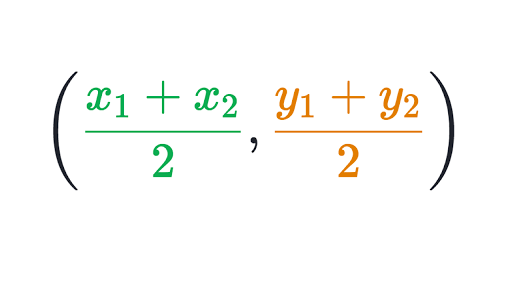
Midpoint formula
M = (x²+x¹/2, y²+y¹/2)
Standard form of a line
Ax+By=C
No fractions (if fractions, eliminate them)
STANDARD stays on 0's side
General form of a line
Ax+By+C=0
No fractions (if fractions, eliminate them)
GENERAL runs from 0
Slope intercept form of a line
y=mx+b
Fractions OKAY !!
General form —> Standard form —> Slope intercept
Slope intercept —> Standard form —> General form