Homeostasis
 Call Kai
 Learn
Learn Practice Test
 Spaced Repetition
 Match
Match Flashcards
 Knowt Play
1/32

There's no tags or description
Looks like no tags are added yet.
Name | Mastery | Learn | Test | Matching | Spaced | Call with Kai | Chat |
|---|
No analytics yet
Send a link to your students to track their progress
33 Terms
What is homeostasis? (4)
A state of balance and stability
The ability to maintain a stable internal environment within an organism, regardless of internal or external stresses or conditions
Homeostasis is a dynamic equilibrium
The fluctuations are kept within an acceptable range by the use of feedback systems.
Why must homeostasis be maintained?
So organs systems can function optimally.
Allows for responses to constant stresses and stimuli
What are 6 examples of homeostasis?
Body temperature
pH
Water levels
O2/CO2 levels
Nutrient levels (glucose in blood), vitamins and minerals
Electrolytes (dissolved ions
What are the 3 essential parts of all homeostatic systems?
Monitor/ sensor
Coordinating/ integrating centre
Regulator/ effector
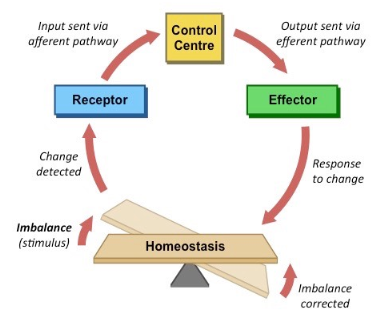
What is a negative feedback loop?
Back to equilibrium
External stimuli are combated by a counterreaction
A process by which a mechanism is activated to restore the conditions of its original state
Does the opposite of the stimulus
Most body functions rely on negative feedback
e.g. body temperature, blood pressure, volume, and pH, glucose in blood
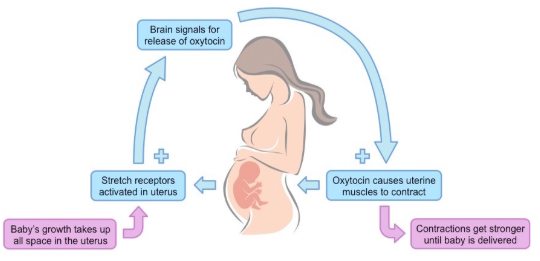
What is a positive feedback loop?
More, more, more!
External stimuli are increased
Acts to increase the strength of stimuli even further away from the equilibrium
Considered non-homeostatic
Relatively rare in natural systems
e.g. childbirth, baby’s growth in pregnancy, breastfeeding (all relate to oxytocin)
How is baby growth a positive feedback loop?
Baby’s growth takes ups all the space in the uterus
Resulting in stretch receptors activated in uterus
Brain signals for the release of oxytocin
Oxytocin cause uterine muscles to contract
Contraction gets stringer until baby is delivered
What is thermoregulation?
The regulation of body temperature
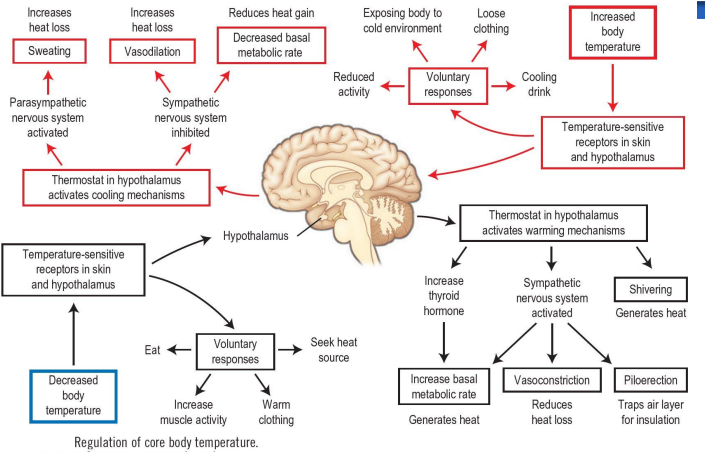
What region of the brain is thermoregulation controlled by and how?
Hypothalamus
Triggers heat loss or heat generating mechanisms
What is a fever result of?
The system’s set point is altered
A temporary form of positive feedback
What are endotherms?
Animals that can regulate their own body temperature regardless of external conditions
Able to generate most of their heat
through metabolism
(e.g. mammals and birds)
What are ectotherms?
Gain heat from external sources
(e.g. invertebrates, most fish, and reptiles)
What are poikilotherm?
Animals whose internal temperature varies
How do animals regulate their temperature?
Behavioural responses
What is Torpor, Esivation, and hibernation?
Animals sleep for a long duration of time
Torpor - 24 hours
Estivation - summer
Hibernation - winter
Act of slowing metabolic rate to reduce demand for energy in times where food is less available
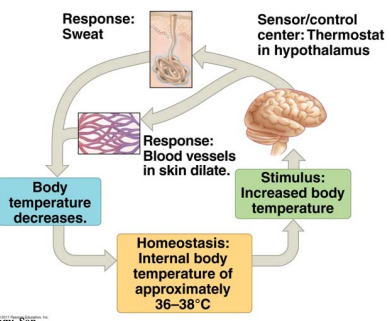
What are physiological responses to excessive heating?
Sensors in the brain detect increase in body
temperature
Message is sent to sweat glands to secrete
sweat (evaporative cooling).
Another message is sent to blood vessels
in skin; the skin blood vessels dilate,
increasing blood flow to skin (promoting
heat loss).
Cooler body temperature turns off
mechanism.
Example of a negative feedback loop
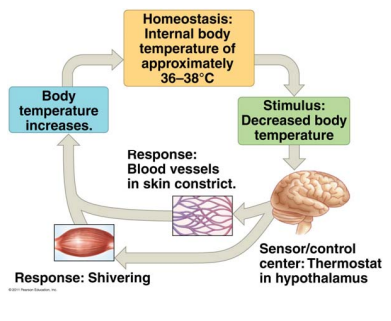
What are physiological response to excessive cooling?
Temperature receptors in skin detect drop in temperature → message is sent to brain
Message is sent to organs and tissues; blood vessels in skin constrict limiting blood
flow to skin minimizing heat loss.
Message is sent to skeletal muscles; series
of rapid contractions (shivering)
generates heat by increasing metabolism.
Muscles around hair follicles contract
causing the hair to stand up (air is
trapped within the animal’s fur to help
insulate the body).
Note: this occurs in humans as well,
but since we have no fur it causes
“goosebumps”.
Warmer body temperature turns off
mechanism.
What does a lack of control of body temperature result in?
Heat exhaustion, heat stroke, and hypothermia
What are the symptoms of heat exhaustion?
Faint or dizzy
Excessive sweating
Cool, pale, clammy skin
Nausea or vomiting
Rapid, weak pulse
Muscle cramps
What are the symptoms of heat stroke?
Throbbing headache
No sweating
Body temperature above 103 degrees
Red, hot, dry skin
Nausea or vomiting
Rapid, strong pulse
May lose consciousness
What are the symptoms of hypothermia?
Confusion
Shivering
Difficulty speaking
Sleepiness
Stiff muscles
How is blood sugar regulated?
By pancreatic hormones are produced in the islets of langerhans
Beta cells produce insulin
Alpha cells produce glucagon
What does insulin do?
Lowers blood sugar
Released when blood sugar is high
Allows cells to take in glucose and produce ATP
Tells the liver to store extra sugar as a substance called glucagon
What does glucagon do?
Raises blood sugar
Tells the liver to break down stored glycogen back into glucose
Releases glucose into blood stream
What is hypoglycemia?
Deficient in glucose/ low blood sugar (3,3 mmol/l)
What are normal levels of glucose in blood?
3,3-5,5-mmol/l
What is hyperglycemia?
A lot of of glucose in blood/ high blood sugar (5,5-8,3 mmol/l)
What are the levels of glucose in diabetes?
8,3-21,1 mmol/l
What occurs in type 1 and type 2 diabetes?
Type 1
Insulin dependent
Early degradation of beta cells
Cannot produce insulin
Type 2
Non-insulin dependent
Decreased insulin or ineffective use
Controlled with diet, exercise, oral drugs
Absence of insulin → little/no glucose in cells → cells metabolize fats and proteins for energy
Kidney unable to reabsorb all blood glucose → excess glucose in urine
High glucose concentration in nephrons draws water out of blood
Excessive urination