Laws week 2
 Call Kai
 Learn
Learn Practice Test
 Spaced Repetition
 Match
Match Flashcards
 Knowt Play
1/30

There's no tags or description
Looks like no tags are added yet.
Name | Mastery | Learn | Test | Matching | Spaced | Call with Kai | Chat |
|---|
No analytics yet
Send a link to your students to track their progress
31 Terms
Why is crime so variable and hard to measure?
Interpretation and reaction is influence by various factors.
legislators define certain events to be criminal
up to the individual to report behaviour to crime, and people may have different classifications
arbitrary.
Reporting behaviours
reporting behaviours may go up if police changes reporting process to be easier/harder.
affected by perceived social obligation, perception of culpability, and victim/offender relationship.
e.g. Queensland popos added an option to report online, so it increases reporting.
How should we interpret crime then?
essential but imperfect, but we can tentatively compare it over time place and demographics.
be critical of stats
assess adequacy and reliability of stats.
are absolute levels of crime possible to determine?
Ways to measure crime
1) Police data
2) Crime surveys/victimisation surveys
3) Self report offending research
4) Service data: Calls to police
5) Who gets arrested
6) Drug use as a proxy
7) Hospitalisation rates
Police data advantages
Voluminous and detailed, highlights relative trends over time and between areas
standardised against populations, info collected lives in the record management system.
Police data disadvantages
variance in jurisdiction across diff places
rate of reporting differs depending on estimated gravity and diff people
presence of external ‘neutral’ factors that give the illusion of crime change liek covid
longitudinal variations in record management.
Why do people tend to report theft of vehicles and burglary the most?
because you can get insured only if you report to popo
Why dont the police record everything!?
multivictimed crimes- may not be regarded as a single incident
smth deemed not serious enough
incident was handled through unofficial channels
recorded as different category of crime.
but observed change is still useful and doesnt void police data,
Advantages of Crime/Victimisation surveys.
argued by realists to be a better way to measure
Valid regardless of definition of crime
Bypasses jurisdictional variations
insight into prevalence + incidence rates, risk factors, and changes in reporting temporally.
random representative sample, and common language.
Disadvantages of surveys
immense variation across surveys
covers a small selection of offence
dubious recall of respondent
level of education in participant
biases
incorrect classification of crime
TELESCOPING
Telescoping
tendency of respondent to be like. “my house got broken into 18 months ago even when the survey asks what happened TWELVE months ago”, you illiterate freak.
Advantages of Self-report offending research. (2% of people who commit 80% of the crime)
primary source of info
unbiased
avoid problems of non-reporting and non-recording and TELESCOPING
longitudinal changes in offending behaviour
Disadvantages of self-report offending research.
issue of telescoping and general problems associated with surveys.
memory issue
confabulation
estimates are more conservative as frequent offenders might wanna gatekeep.
Disadvantages of Police data: calls to police
Usually calls are a mixed bag. theres people who call up for welfare checks, sussy people, and stray cats. usually not emergencies.
Advantages of Measuring who gets arrested
greatly influenced by police who arrest
reveals police attitudes towards minorities/political agendas.
disadvantages of measuring who gets arrested
influenced by police:population ratios. more police may result in more arrests
Measuring drug use as a proxy explained
DUMA Drug use monitoring in australia survey was an annual census of police detention lock-ups where drug screening was undertaken.
Advantages of measuring drug use as a proxy.
longitudinal assessments of drug use
gauging correlation between drug use and crime (meth is the most commonly associated with crime.)
Hospitalisation
estimates the range of violent events that may not have been reported to popo
hm, interesting, young men are quite overrepresented in this, coupled with a general lack of education, unemployment and poverty.
What do we do with these crime measurements?
Once triangulated, reveals that
repeat victimisation is a huge problem
refers to total no. of offences experienced by a victim/target.
Repeat Victimisation
Previous victimisation os the best predictor of future victimisation.
10% of the population experience 74% of the victimisation (prevalence)
10 % most victimised experienced 35% of victimisation (frequency)
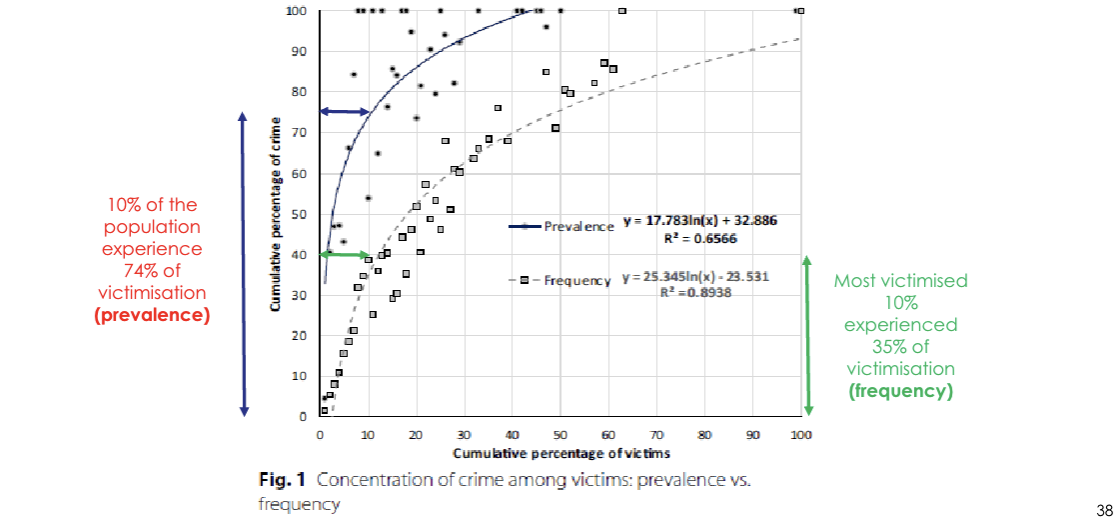
Victimisation frequency
We know it doesnt happen randomly in time. When england plays footy, domestic violence increases.
e.g. DV 26% increase when England
play
- 38% increase when England lose
- 41% increase in NSW on State of
Origin days
Extent of crime
1) mindfulness when interpreting trends.
2) comparison across areas
3) crime rates matter
4) triangulation of multiple sources
5) correlation does not imply causation
Interpretation of trends
Coverage can change
counting rules can change
actions can change
behaviour could be different
recording decisions may change
reporting rates may change,
Coverage
what crime types are counted
Counting rules
no. offenders, no. offences/incident
Actions can be redefined
whats a theft and a burglary
Behaviour
is fraud the same as it was in 1962 vs 2015?
Recording decisions may change
manipulation of recording up and down
reporting rates may change
public consensus on why we should report.
Emerging tech and crime
current ways of measuring crime, such as victim surveys may elude such contemporary crimes.
what do we consider to be crime changes?
how do wwe measure to keep up to date!
policies and law may lag behind,
so keeping up is hard,