FUNCTIONALIST VIEW OF CRIME & DEVIANCE BOOKLET 5 (evalution of Cloward and Ohlin)
 Call Kai
 Learn
Learn Practice Test
 Spaced Repetition
 Match
Match Flashcards
 Knowt Play
1/37

There's no tags or description
Looks like no tags are added yet.
Name | Mastery | Learn | Test | Matching | Spaced | Call with Kai | Chat |
|---|
No analytics yet
Send a link to your students to track their progress
38 Terms
STARTER - When a crime has been committed, society comes to never condemn the wrong doer, and this reinforces society's moral code. What is this called?
Boundary maintenance
STARTER - Acts of deviance can lead to society doing what for the greater good?
Changing and adapting
STARTER - Who supports the idea that prostitution is a positive function for males?
Kingsley Davis
STARTER - Merton's theory that society wants to achieve the American dream, but some are unable to do this legitimately is known as what?
Strain theory
STARTER - Who explained that working class boys suffer from status frustration?
Cohen
What do Cloward and Ohlin agree with Merton and Cohen on?
That crime is a working class phenomenon and therefore they also ignore the crimes of the wealthy and women
Although they agree with Cohen, that delinquent subcultures are the source of much deviant, how do they explain subcultures?
Separate them into 3 different subcultures (conflict, crime, retreatists)
Why do the crimes of the wealthy go undetected?
They have the power wealth of money to pay them to ignore it, corruption in the justice system, they have the means to make people blow them, commit the crimes, they also are very well educated so they know the system
Why is crime seen as a working class problem?
The only way someone working past people may make a living is to commit crimes for example they are unable to gain employment, fitting into the stereotypes/what is expected, the media also only tends to document working class crimes
How many subcultures does Cloward and Ohlin say you can belong to?
1
In theory have been criticized for being too reactive, why is this?
They explain criminal coaches as a reaction to failure of achieving the mainstream goals
They assume that everyone starts off with the same goals, is this a criticism?
Yes, and yes
An example of someone with a different goal to another person
One person may have a goal to be happy where is another person? May have a goal to be healthy
Miller argues that the lower class has its own independent subculture separate from mainstream subculture, what is this called?
Rebellion (they would jack the means and goals of society and set up their own)
This subculture value success?
No, they don't place any value unsuccess in the first place, so their members are not frustrated by failure
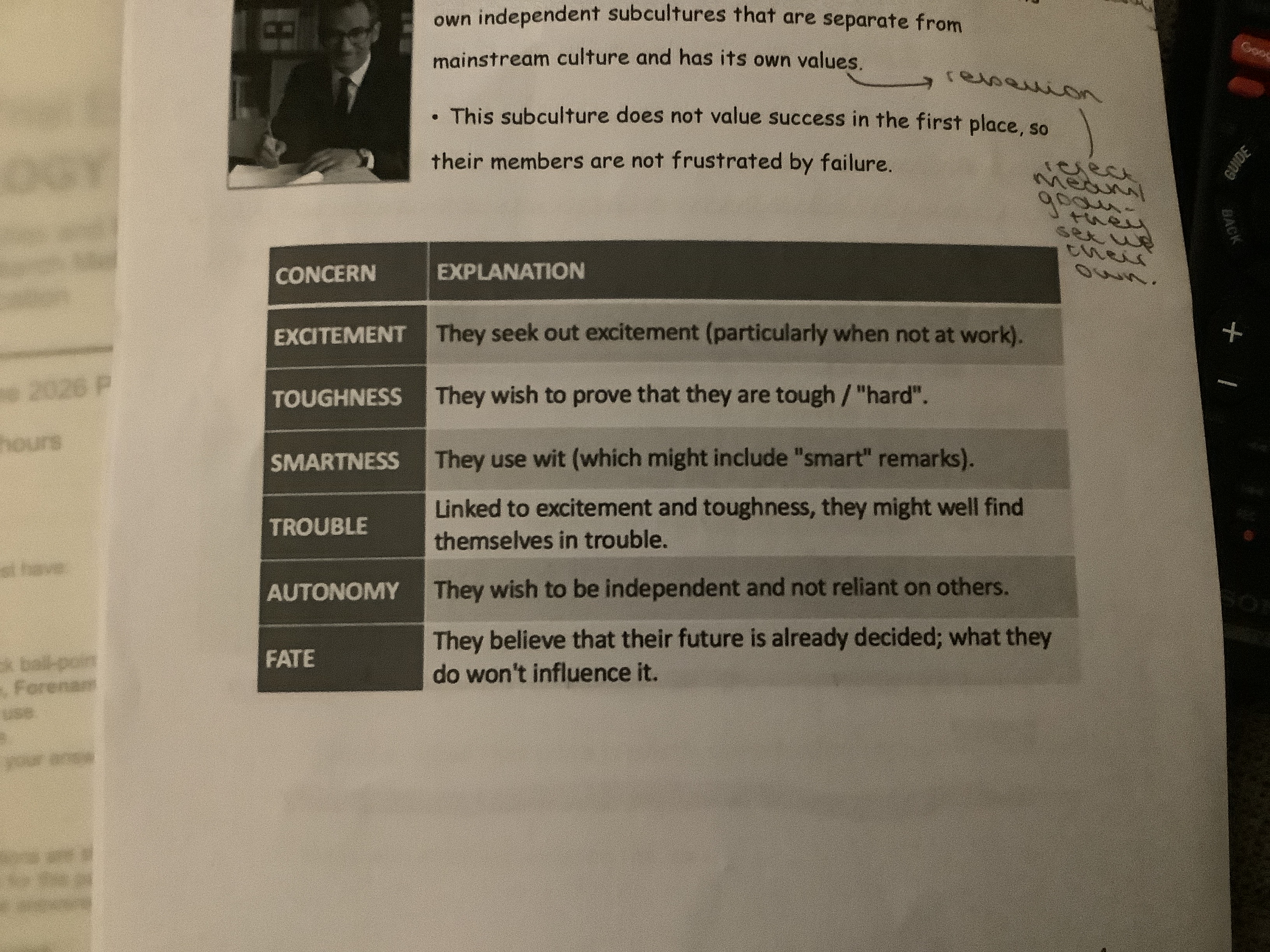
Miller suggest that working class boys were socialized into a number of distinct values, he called these " focal concerns", what did these consist of?
seeking excitement might lead to non-utilitarian crime
toughness, smartness and trouble might result in fighting
autonomy Might lead to people, taking matters into their own hand, rather than asking for help
fatalism Might mean that they do not consider the consequences of their actions as a future is already written
When are these boys socialize with these values (that differ to mainstream values)?
Primary socialization
How does Miller's view go against the functionalist view?
Functionalist agree on the idea of social solidarity and value consensus, the idea of "focal concerns" goes against this
Which gender does Miller only focus on?
Boys
Are Miller's views seen as deterministic?
Yes, as they assume that all males adopt these patterns of behavior
What else does Miller ignore? (Crimes of what class?)
Doesn’t explain why some upper/middle class people commit crimes
Who was the functionalist who said people drift in and out of delinquency?
Matza
What does Matza believe?
He believes that just because someone committed a crime once or twice, doesn’t mean this paves their whole life/future
Give reasons why people can drift in and out of delinquency?
Grow up/mature, can get therapy/rehab
Give reasons why people can’t drift in and out of delinquency?
If someone is labeled, this may force them to restore back
Does Matza believe that everyone has delinquent values?
Yes, but some members of society suppresses the urges and some don’t
Who will struggle to suppress their urges to commit crimes?
upper classes
religious groups
mental illnesses
learning difficulties
dementia/alzheimer
men
addicts
What are the 2 values that Matza argues society has?
Conventional values
Subterranean values
Write a definition of conventional values
These are values we hold when performing conventional roles in society
Write a definition of subterranean values
Greed, power, lust, hatred, prejudice, aggression, and malice
Matza argues that delinquents are more or less likely to be able to control subterranean values?
Less likely
Which age group is this most common on?
Young adults
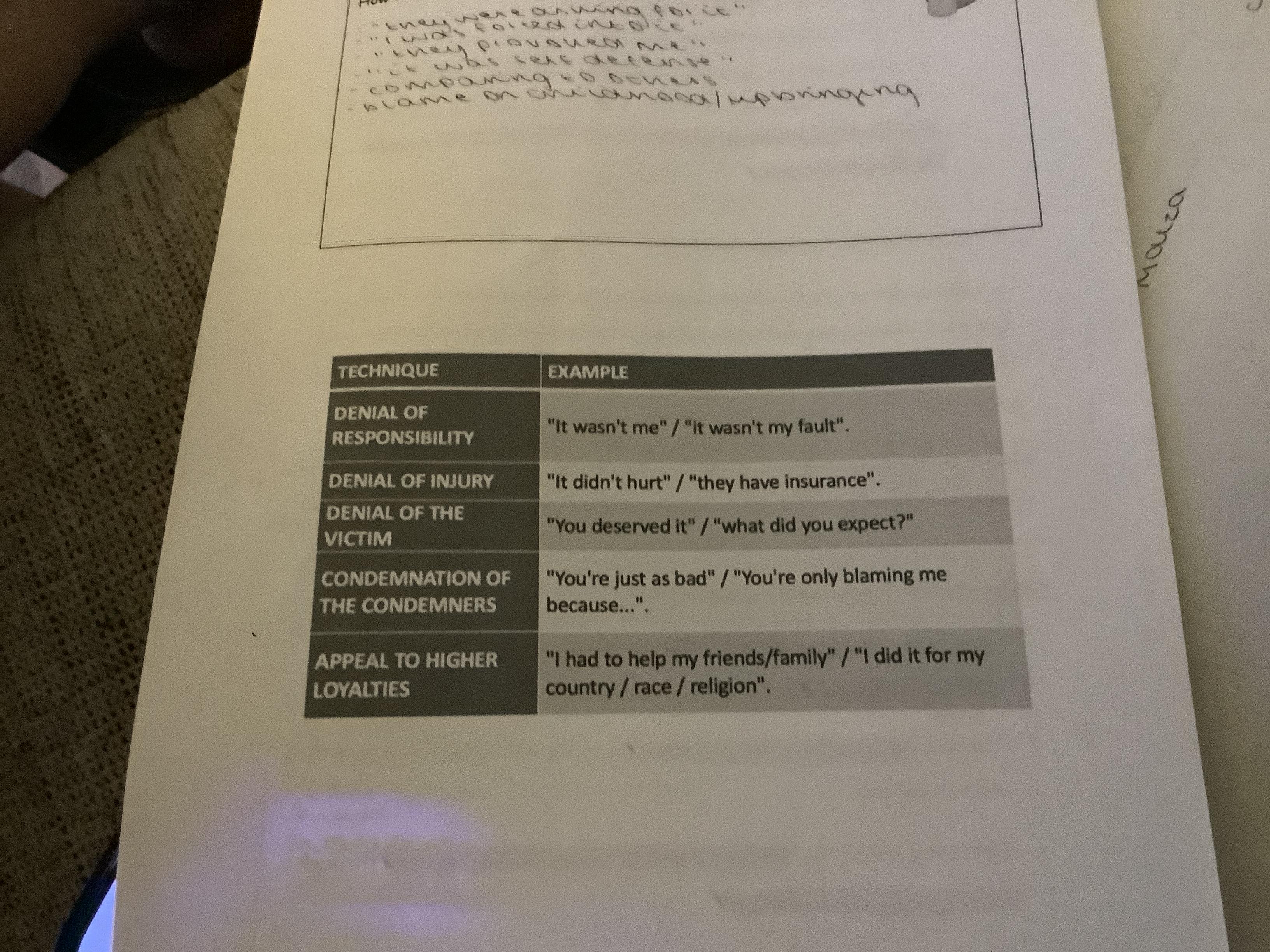
Matza argues that delinquents look to justify their actions, what does he says they do they do this through?
Techniques of neutralization (trying to make excuses)
Exmaples of how delinquents justify their actions?
They were asking for it, i was forced into it, they provoked me, it was self defense, comparing to others, blaming on childhood and upbringing
Techniques of neutralization
What are some criticisms of Matza?
he excuses bad behavior
the techniques of neutralization blame the victim
justify crimes
could give people ideas of committing crimes and avoiding punishments
ignores crime of the rich and powerful
ignores crimes of women
Examples of people who have reformed and turn their lives around after being delinquent
Paris Hilton - DUI
Lindsey Lohan - DUI/drugs/GTA/theft
Tom Hardy - burglary/assault
R.D.J - drugs/alcohol
Mark Walkberg - white supremacist (assault/racism)