A&P - Tissues
 Call Kai
 Learn
Learn Practice Test
 Spaced Repetition
 Match
Match Flashcards
 Knowt Play
1/68

There's no tags or description
Looks like no tags are added yet.
Name | Mastery | Learn | Test | Matching | Spaced | Call with Kai | Chat |
|---|
No analytics yet
Send a link to your students to track their progress
69 Terms
Histology
Study of tissues
Cell type, cell function, cell matrix ratio
Types of tissues differ by:
Connective, epithelial, muscle, nervous
Four main types of tissues include:
Epithelial Tissue
Either cover or line - set boundary between body compartments or between body and outside environment
Line all body’s surfaces (external/cavities/tracts (tubing)/blood vessels/ducts) & cells tightly packed (very little matrix)
Features of epithelial tissue include:
Avascular (no blood cells)
Simple epithelium is:
Number of cell layers & cell shape
Classification of epithelial issues include:
Simple Squamous Epithelium
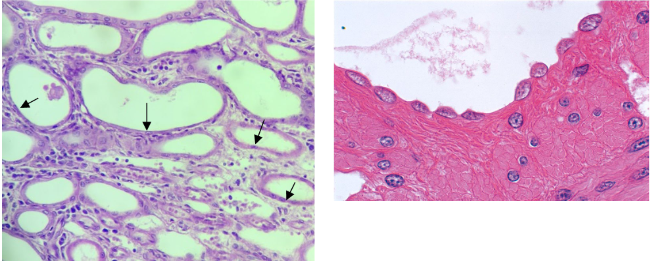
Simple Cuboidal Epithelium

Simple Columnar Epithelium

Allow for rapid diffusion & alveoli of lungs & is very thin
Simple Squamous Epithelium function and location is:
Absorption + secretion & sweat glands + kidney tubules
Simple Cuboidal Epithelium function and location is:
Absorption + secretion & GI tract (stomach, intestines)
Simple Columnar Epithelium function and location is:
Pseudostratified Columnar Epithelium
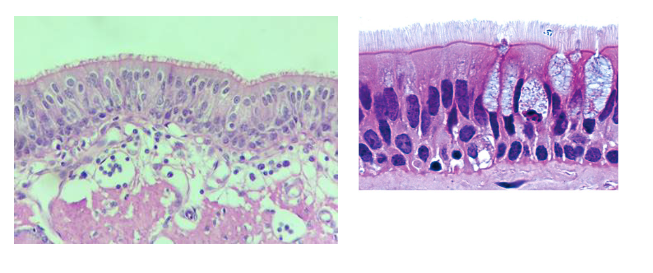
Keratinized Stratified Squamous Epithelium
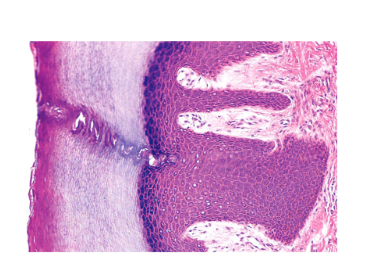
Non-Keratinized Stratified Squamous Epithelium

Secrete + move mucous & respiratory tract
Pseudostratified Columnar Epithelium function and location is:
Protection + resists abrasion & epidermis
Keratinized Stratified Squamous Epithelium function and location is:
Protection + resists abrasion & Openings to exterior (Mouth, nose, anal canal, vaginal canal)
Non-Keratinized Stratified Squamous Epithelium function and location is:
Non-keratinized Stratified Squamous Epithelium
Passage of food (Esophagus)
Simple Columnar Epithelium
Secrete acid & digestive enzymes (stomach)
Connective Tissue
Support, protect, bind tissues together
Fewer cells & lots of matrix
Features of connective tissue include:
Fibrous connective tissue (dense or loose), Adipose Cartilage (Hyaline, elastic, or fibrocartilage), Bone, Blood
Types of connective tissues include:
Loose/Areolar Connective Tissue

Collagen, elastic, reticular (highly vascular)
Loose/Areolar Connective Tissue has what three fiber types?
Bind epithelial tissues to deeper tissues, passageways blood vessels/nerves/nutrients/wastes & underneath all epithelia + dermis
Loose/Areolar Connective Tissue function and location is:
Adipose Tissue
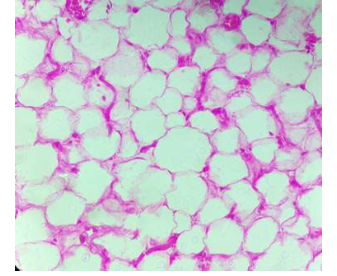
Provides energy storage, insulation, cushioning (lots of adipocytes/blood vessels) & hypodermis, breast, surrounding organs
Adipose tissue function and location is:
Chondrocytes (cartilage cells) in lacunae (cavities) & fibers and semi-rigid matrix & avascular
Cartilage features include:
Hyaline Cartilage

Most common/most flexible, lacunae often in pairs, smooth/shiny appearance (collagen)
Features of hyaline cartilage include:
Flexible support & Nose, respiratory tract (trachea/broncil), rib cage (costal cartilage), synovial joints (articular cartilage)
Hyaline cartilage function and location is:
Elastic Cartilage

Elastic fibers, random lacunae
Features of elastic cartilage include:
Elastic Support & external ear + epigotis
Elastic cartilage function and location is:
Fibrocartilage
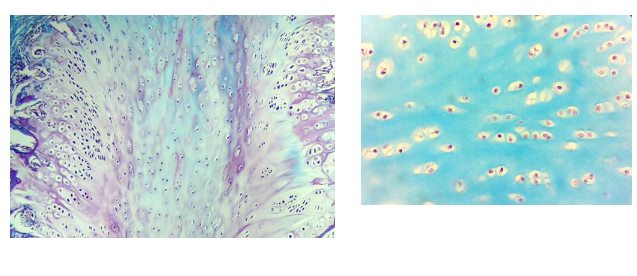
Strongest/most rigid cartilage, lacunae in rows, parallel collagen fibers
Features of fibrocartilage:
Resist compression/absorb shock & Intervertebral discs, pubic symphysis, menisci of knee
Fibrocartilage function and location is:
Bone Tissue

Most rigid tissue, collagen and calcified matrix, arranged in concentric rings (lamellae)
Features of bone tissue include:
Structural support, protection, calcium storage & bone
Bone tissue function and location is:
Blood Tissue

Liquid matrix (plasma) & cells (RBC, WBC, platelets), NO fibers
Features of blood tissue include:
Transport + immune defense & blood vessels + heart
Blood tissue function and location is:
Nervous Tissue

Excitable Tissue & lots of matrix
Features of nervous tissue include:
Rapid Communication & brain, spinal cord, nerves
Nervous tissue function and location is:
Neurons & Glial cells (support, protect, assist neurons)
Nervous tissue cell types are:
Excitable, cells tightly packed, little matrix
Muscle Tissue features are:
Movement & produce body heat
Muscle tissue functions are:
Skeletal Muscle

Parallel muscle fibers, multinucleate, striated
Skeletal muscle charicteristics include:
Voluntary movement & attached to bones/tongue
Skeletal muscle function and location is:
Cardiac Muscle

Short, branched cells, uninucleate, striated
Cardiac muscle characteristics include:
Pump blood & heart
Cardiac muscle function and location is:
Smooth Muscle

Short, tapered cells, uninucleate, no striations
Smooth muscle characteristics include:
Involuntary movements & viscera + blood vessels (internal organs)
Smooth muscle function and location is:
Glycoprotein layer that anchors every epithelium to the connective tissue beneath it
Basement Membrane is a:
Hold cells together, resist mechanical stress, intercellular communication
Intercellular junctions functions include:
Tight junctions, desmosomes, gap junctions
Types of intercellular junctions include:
Fusion of plasma membrane (zipper) & prevent molecules from passing between cells (GI tract, kidney)
Tight Junctions
Cytoskeleton + proteins & resist mechanical stress/hold cells together (skin, heart)
Desmosomes
Pore of proteins connects cytoplasm of cells “tube” & rapid electrical communication (Cardiac muscle) + nutrient distribution (embryo)
Gap Junctions
Dense Connective Tissue

Densely packed collagen fibers (appear shiny/wavy/smooth) & few blood vessels
Features of dense connective tissue include:
Bind tissues together + resist mechanical stress & Regular: Tendons + ligaments; Irregular: Dermis
Dense connective tissue function and location is: