Transfers
 Call Kai
 Learn
Learn Practice Test
 Spaced Repetition
 Match
Match Flashcards
 Knowt Play
1/115

There's no tags or description
Looks like no tags are added yet.
Name | Mastery | Learn | Test | Matching | Spaced | Call with Kai | Chat |
|---|
No analytics yet
Send a link to your students to track their progress
116 Terms
What is the purpose of transfers?
permit patients to function in different environments or use difference pieces of equipment
What is generalizability?
some skills learned for one transfer can be used for other transfers
What are some things you should keep in mind during transfers?
-appropriate number of personnel
-wheel locks are secure
-body mechanics
What are the levels of transfers?
independent, assisted, dependent
What is stand-by-assist (SBA)?
no physical assistance needed; supervision; may used verbal cues
What is contact guarding (CG)?
hands-on-support for stability not physical effort
What is minimal assist (Min A)?
patient performs at least 75% of activity
What is moderate assist (Mod A)?
patient performs 50% of activity
What is maximum assist (Max A)?
patient performs 25% of activity
What is total assist/dependent (D)?
patient performs less than 25% of activity
How do you document levels of assistance?
indicate the level of assistance X the number of personnel needed (Ex: Max A X 2)
What are types of assistance a therapist can provide?
-verbal cues
-balance control
-physical assistance for lifting or supporting
What is the goal of assistance?
for the patient to achieve the maximum level of independent performance of a transfer that is consistent, safe, and efficient
What is considered good body mechanics for transfers?
-maintain the safest position possible for pt and therapist
-maintain pt close to you
-use appropriate BoS
-ensure BoS can move with you
-maintain static posture of pelvis & spine
-lift using legs
-do not cross feet as you move
-assist pt to front of seat prior to moving
What do you use to help control the patient?
gait/transfer belt
How do you prepare the environment?
ensure proper direction of movement and go toward the strongest side initially
What kind of instruction and verbal cues should you give the patient before transfering them?
let pt know what is about to happen and what he/she should do
Who makes the call during a transfer?
person at the pt's head
What is FWB?
full weight bearing (100%)
What is WBAT?
weight bearing as tolerated
What is PWB?
partial weight bearing
What is TDWB?
touch down weight bearing
What is TTWB?
toe touch weight bearing (same as TDWB)
What is NWB?
non weight bearing
The risk of musculoskeletal disorder from lifting/moving patients are affected by what?
-force requirement
-repetitions
-awkward postures
What patient-care activity puts the most stress on the body?
transferring a patient between bed and chair
What patient-care activity puts the least stress on the body?
repositioning a patient laterally in bed
After moving a hospital bed, even slightly, what should you do?
check to be sure the bed controls are still functioning and plugged in
When comes to hospital beds and wheelchairs, what should you do before a transfer?
familiarize yourself with the controls, movable parts, and locks of the equipment
What is SPHM?
safe patient handling and mobility
What should be worn during all transfer activities in which the clinician may come in contact with a patient's body fluids?
gloves
What are the safe patient handling and mobility policies?
-minimize manual patient lifting and repositioning
-the more dependent the patient, the greater the need for mechanical devices
-legal requirement in many states
-clinicians may manually assist in mobility as part of rehabilitation interventions
What is a total body lift?
mechanical devices for lifting patients
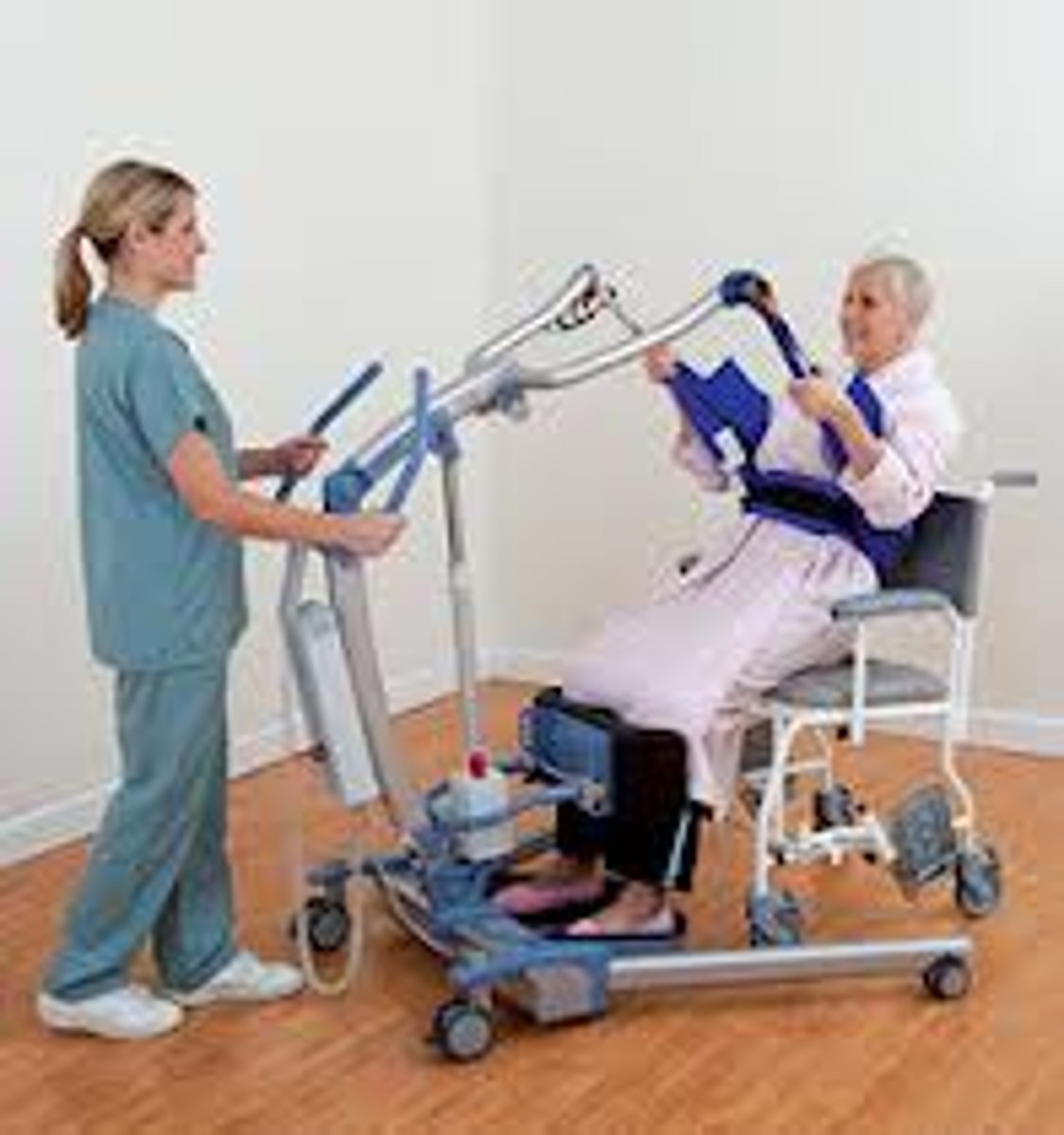
What is a sling lift?
a total body lift
What are hybrid lifts?
freestanding with overhead frame and tracking system
What is imperative for reducing the risk of injury during a mechanical lift?
maintaining core stability and decreasing reaching distances
What limit should you check of lift equipment before using it?
weight limits
What should you never do while a patient is in a mechanical lift?
leave them unattended
What should you do before initiating a lift after a patient has suffered a fall?
be sure that the patient has not sustained an injury from the fall
Who are sit-to-stand lifts usually for?
pts with moderate to maximum assistance for mobility but can flex their hips, knees, and ankles while maintaining balanced sitting
When do you usually use a sit-to-stand lift?
-moving from one seated position to another through standing
-standing for therapeutic purposes
-toileting and perineal hygiene
You should never attempt to lift a patient using what kind of device vertically?
lateral transfer device
What are the most common devices used for lateral transfers?
-air assisted devices
-slippery sheet
-rigid and semirigid full body transfer boards
If additional adjustment is needed to center the patient on a transfer board, what can you use?
drawsheet, slippery sheet, or similar items
Kneeling on the bed or gurney to minimize the clinicians reach during a lateral transfer creates a risk of what?
contact transmission of infectious materials
What grip is recommended for grasping the sides of a drawsheet during repositioning?
supinated "power grip"
What grip is not recommended for grasping the sides of a drawsheet during repositioning?
pinch grip
Why should you never leave a slippery sheet underneath a patient unattended?
it creates a serious fall risk
What are some ways of supine repositioning?
-overhead trapeze bar
-slippery sheet
-vertical lift equipment
What are some ways of seated repositioning?
-total body lift
-sit to stand lift
-friction reducing lateral transfer device
What are bariatrics?
branch of medicine dealing with obesity
What should you keep in mind when transferring a bariatric patient?
-use equipment rated for a higher maximum weight
-transfer or reposition may require assistance of more people
-good body mechanics are very important
When should you use manual lifts?
only when the patient is participating as a learner or in an emergency
When should you use mechanical lifts (vertical or lateral)?
for improved safety of the patient and the clinician
What are the general procedures for lateral transfers?
-plan ahead
-explain procedure and obtain consent
-secure surfaces
-transfer with good body mechanics and appropriate safety equipment
-transfer is only complete when patient is comfortable and safe
What is another name for gait belt?
transfer belt or walking belt
What is the goal of seated-dependent repositioning?
patient's hips are fully back and centered
If you need to reposition a patient in a wheelchair, how do you do it?
grasp patient's crossed arms and lift patient's hips up and back
If you do not a have gait belt large enough for you patient, what should you do?
join to gait belts together
What are the 3 steps when laterally lifting/transferring a dependent patient
lift, shift, lower
What does grasping the patient's crossed forearms do?
locks the patient's upper body and arms in position
What is a transfer (sliding) board?
an assistive device that allows patients to perform a transfer without having to bear weight through LEs
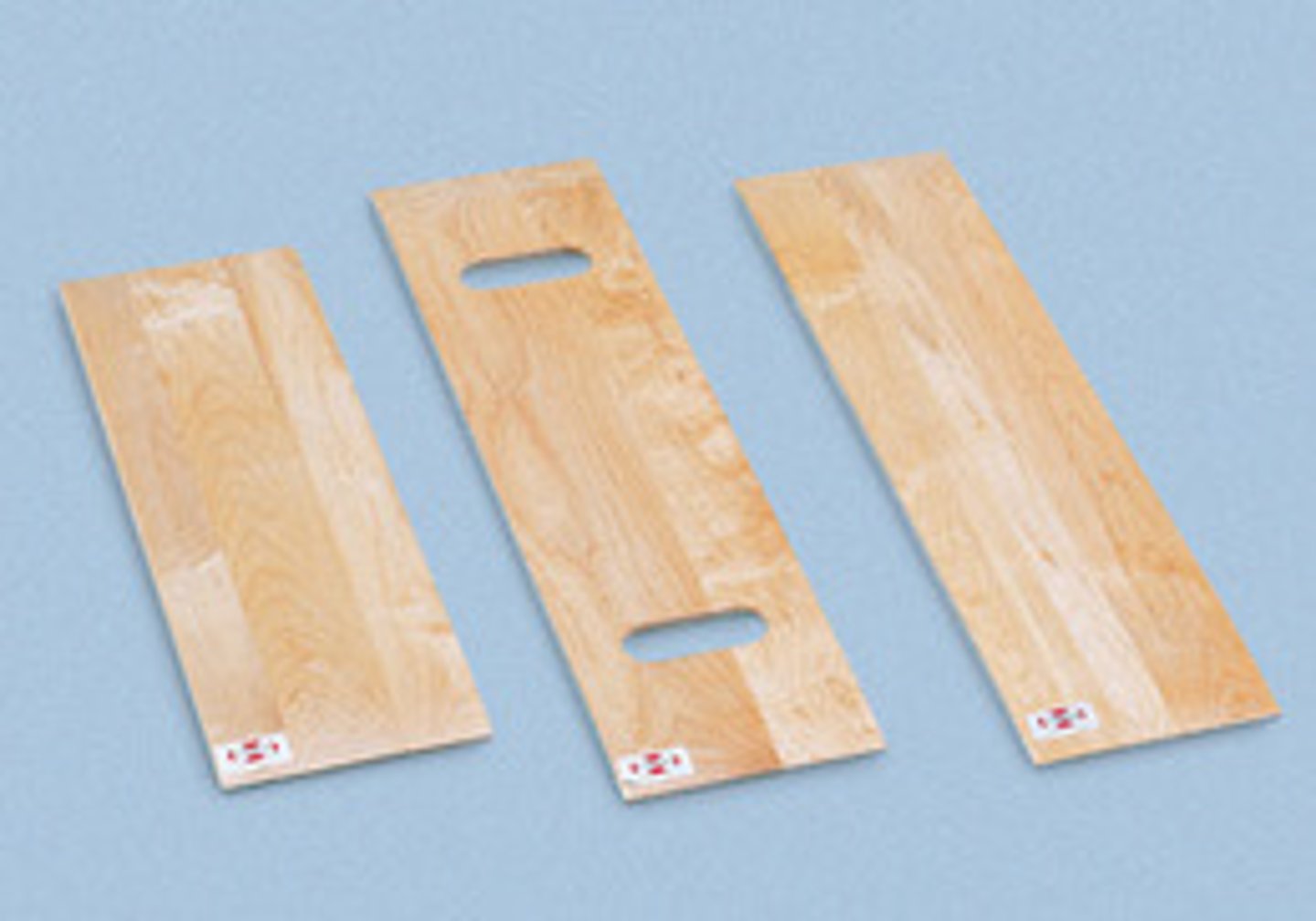
Why do some healthcare professionals prefer the term transfer board over sliding board?
because of the risk of skin breakdown caused by sliding, healthcare professional prefer to avoid the term sliding and encourage the image of a transfer instead
When a patient independently transfers themself using a transfer board, what should you warn them of?
incorrect hand placement can result in pinch fingers or a trapped hand; the patient should not grasp the end of the board or place fingers through the handle during a lateral shift
How does a patient independently move from the bed to wheelchair with a transfer board?
-angle wheelchair close to bed; secure surfaces
-place one end of board under hip and other end over wheelchair seat
-place hand on board and press down with both hands
-lift, shift, and lower hips; repeat as needed
-remove board
How does a patient independently move from the wheelchair to mat without a transfer board?
independent squat-pivot transfer
How does the clinician assist a patient with moving from the bed to wheelchair with a transfer board?
-guard from the front
-assist with hip movement as needed
-may need to make several small moves to complete transfer
Longer transfer boards are typically used when?
doing car transfers
What is another name for a seated anterior-posterior transfer?
straight-on or front-to-back transfer
Seated anterior-posterior transfers are often used with which kinds of patients?
spinal cord injuries or bilateral LE transfemoral amputations
Which kind of transfer requires good upper body strength to perform independently?
seated anterior-posterior transfer
How does a patient independently transfer anterior-posterior from bed to wheelchair?
-position wheelchair towards the bed
-position back and hips on edge of bed in line with the wheelchair
-reach for armrest of locked chair to lift hips onto the seat until patient is fully sitting on the seat
-move wheelchair slightly back and away from bed
-place feet onto footrests
-reverse steps to return back to bed
What dangers should you avoid during anterior-posterior transfers?
-separation of wheelchair and bed/mat
-wheelchair pivoting over drive wheels and tipping backwards
-movement of the wheelchair cushion out from under the patient or into the path of the transfer
-legs catching on mattress when patient is moving from the wheelchair to the bed
What is a pivot transfer?
for patient who are WB on at least one LE; primary action occurs at the feet
What are the types of pivot transfers?
squat-pivot and stand-pivot
For an assisted pivot transfer, how do you set up the environment?
-ensure appropriate footwear
-remove obstacles
-equalize surface heights
-secure both surfaces
-use a gait belt
For an assisted pivot transfer from wheelchair to bed, how do you get the patient ready?
-scoot pts hips forward
-scoot pts feet back with inner foot slightly forward
-flex pts hips (nose over toes)
-place pts hand on armrest
For an assisted pivot transfer, how should the clinician be positioned?
-in front of patient
-hips/knees flexed
-wide BoS
-staggered foot position
-supinated grip on gait belt
-block the pts knees
How does the clinician block the patients knees during a transfer?
contact at the patients proximal tibia
Before assisting with any transfer that might create contamination, what should you remember to do?
put on gloves
What is a way to facilitate forward trunk leaning in preparation for transfer training?
have the pt slide a hand down the shin
How is a gait belt not to be used?
as a handle to pull the patient into position or to lift a patient
Under no circumstances should a patient place their hands around the clinician's what?
neck
Do you need to black a patient's knee if both LE are reliably strong?
no
What is the difference between the squat-pivot transfer and the stand-pivot transfer?
differ in the amount of uprightness the patient achieves; patient may pause when upright in the stand-pivot transfer
No transfer is complete until what?
the patient is safely and comfortable positioned and has a way to call for assistance
What are some assistive devices for stand-pivot transfers?
-walkers
-pivot disks
-pivot poles
During a pivot transfer, if a patient is NWB on one side what should you do?
keep NWB limb off the ground during transfer
During a pivot transfer, if a patient has had a hip arthroplasty what should you do?
-have pt extend at the knee of the affected leg to decrease the hip angle
-avoid hip flexion beyond 90 degrees when rising and sitting
-avoid internal rotation of affected leg when rising and sitting
When should you never block the knee during a transfer?
when the LE is NWB
What is hemiparesis?
weakness on one side of the body
If you are transferring a patient with hemiparesis, what should you do?
-transfer towards the stronger side
-support hemiparetic UE (do not pull on it)
Spinal cord injuries at C7 or lower typically have the potential to do what?
perform transfers independently
For a patient with a total hip arthroplasty who is being transferred from a bed to a chair, what can help prevent internal rotation of the involved hip?
reaching back to the armrest on the uninvolved side first
What is a significant difference between toilet transfers and bed/mat transfers?
pants and underwear are slid down to the ankles before the transfer
What is the transfer procedure for wheelchair to car?
-slide seat back and recline back rest
-remove armrest and legrest on car side
-position wheelchair in door opening and apply locks
-scoot to edge of chair and position feet
-grasp secure item in car and lean trunk foward
-pivot hips onto car seat whil pulling with arm
-bring LEs into car and adjust as needed
When a patient is transfering from a wheelchair to the car what should they not grab?
the door by the frame or window
What are some questions to consider before doing a dependent manual transfer?
-Will I need help?
-What is the patient capable of doing?
-Are there special biomechanical challenges?
-What equipment is available?
-What do I need to have nearby before I begin the transfer?
-What going to happen after the transfer?
-What biomechanical principles can you use to make this task easier and safer?
-What other techniques can I use?
Before proceeding with a transfer what should you always do?
check for presence of lines, leads, and tubes connected to the patient
When should a patient do lateral transfers in a seated position?
when WB through the LE is not advised