Periodic Table Trends
 Call Kai
 Learn
Learn Practice Test
 Spaced Repetition
 Match
Match Flashcards
 Knowt Play
1/23

There's no tags or description
Looks like no tags are added yet.
Name | Mastery | Learn | Test | Matching | Spaced | Call with Kai | Chat |
|---|
No analytics yet
Send a link to your students to track their progress
24 Terms
Periods
Rows that are based on the same principal energy level, n
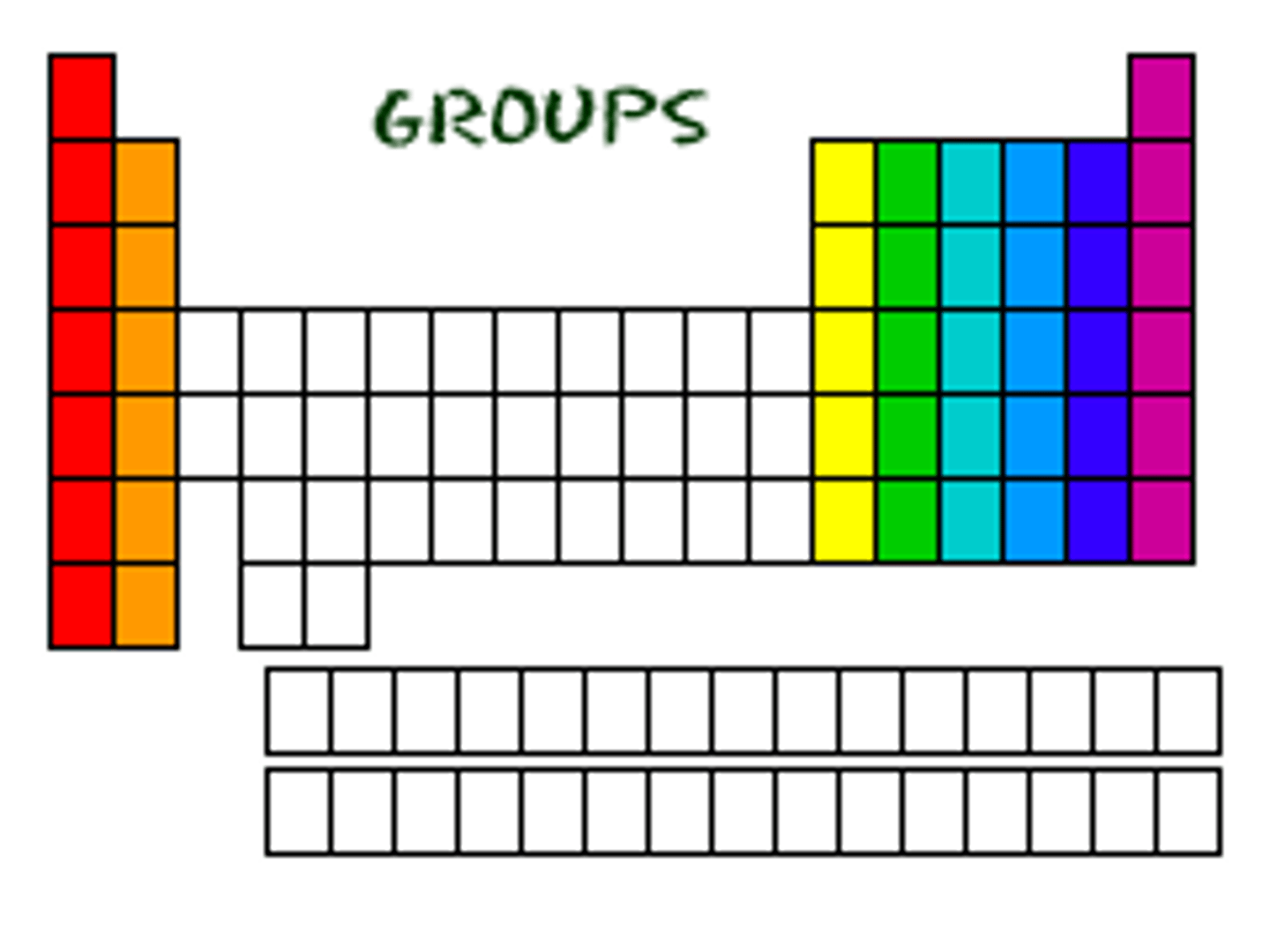
Groups
The columns of the periodic table and are based all elements having the same valance shell electron configuration.
Groups have elements that share chemical properties.
Periodic law
the chemical and physical properties of the elements are dependent upon their atomic numbers
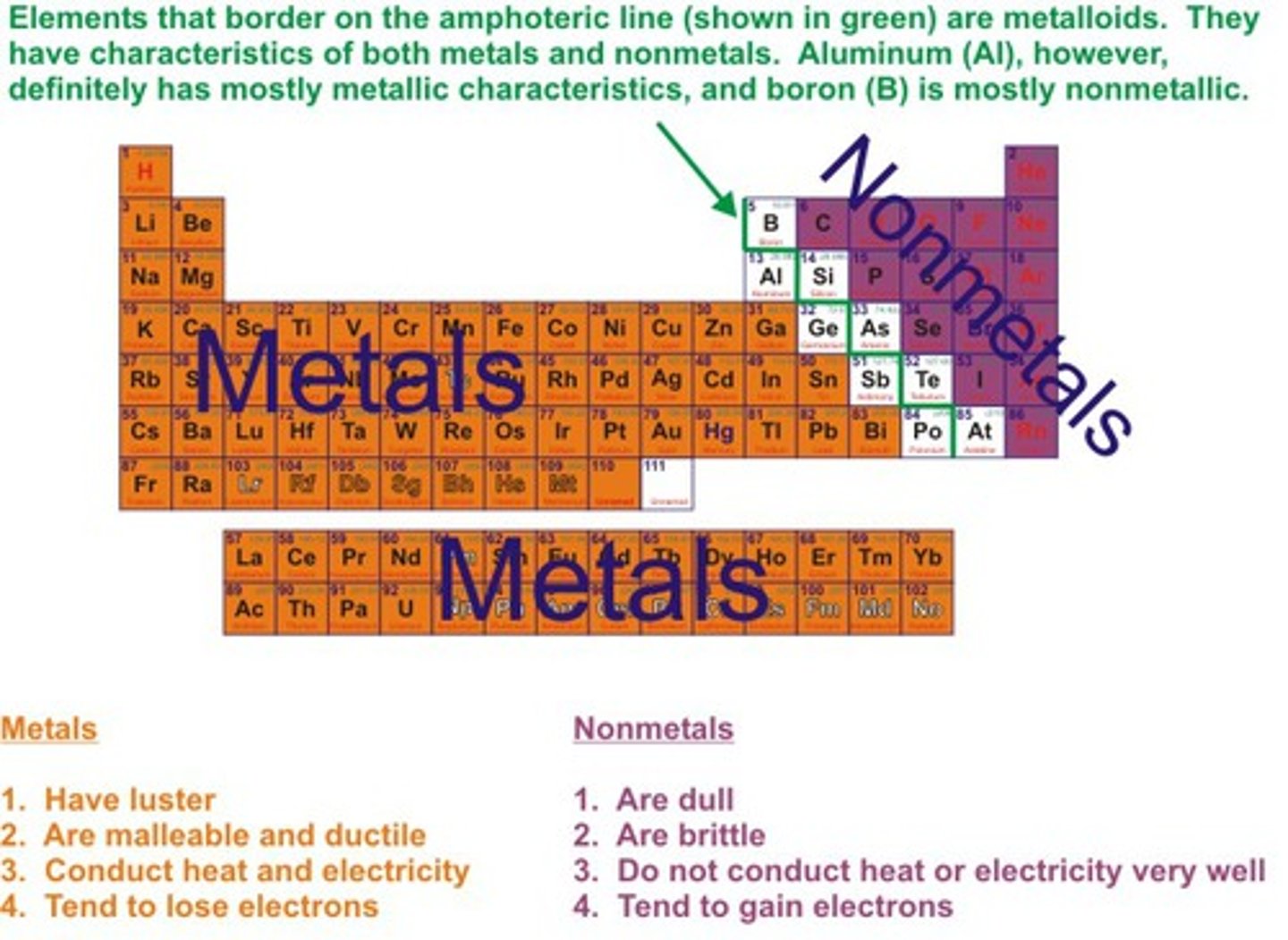
Metals
left side & middle of periodic table
1) Active metals, transition metals, lanthanide and actinide series
2) Shiny (lustrous)
3) High melting points and high densities (except lithium - density = 1/2 of water)
4) conduct electricity well
5) Malleable: hammered into shape
6) Ductile: Drawn/pulled into wires
7) Low effective nuclear charge
8) Low electronegativity
9) Low ionization energy
10) Easily give up electrons
Nonmetals
Right side of periodic table
1) Dull
2) Poor conductors of electricity
3) brittle (in solid state)
4) High ionization energy
5) High electronegativity
6) Small atomic radii, large ionic radii
7) Inability to easily give up electrons
Metalloids
Semimetals
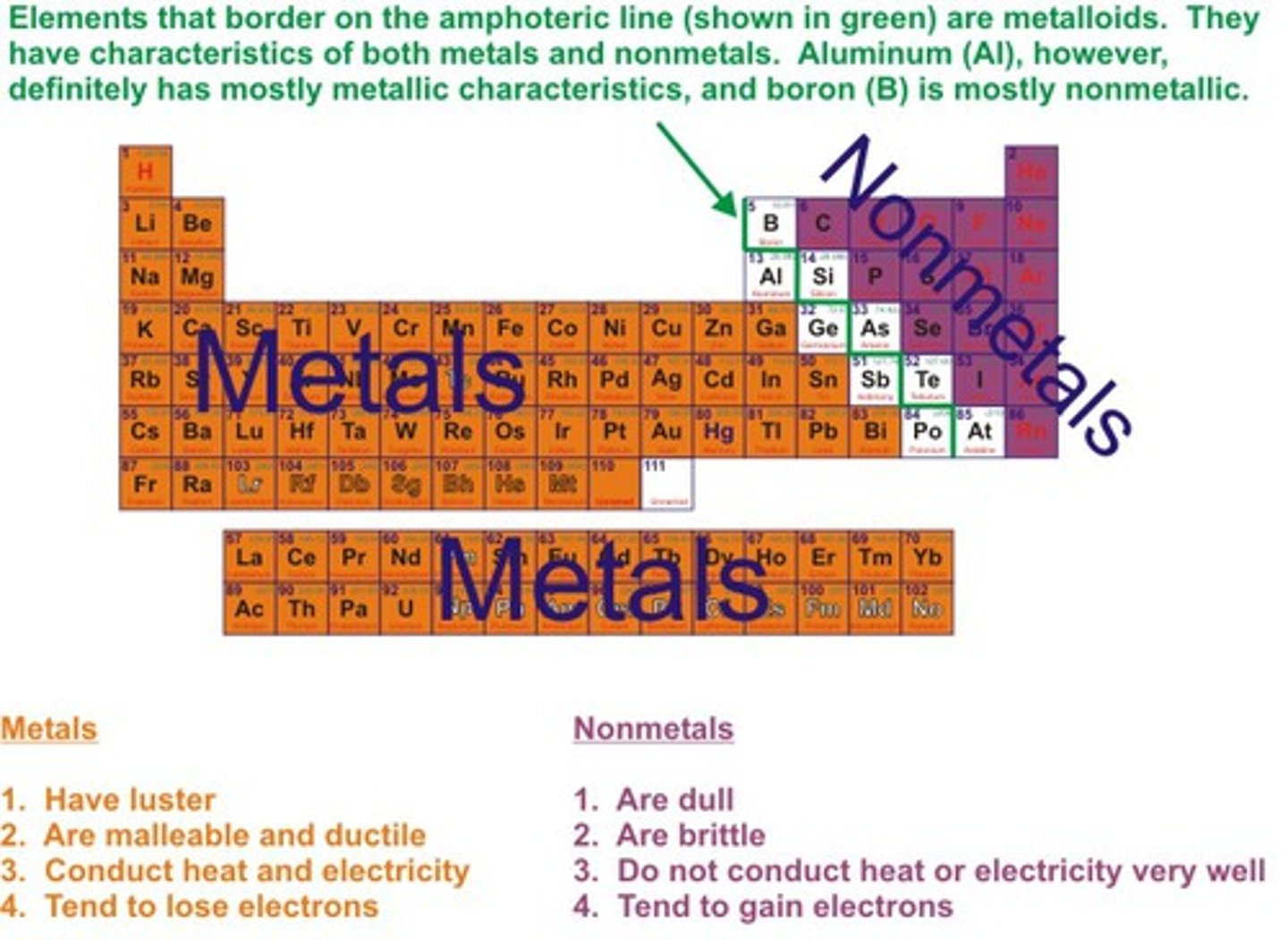
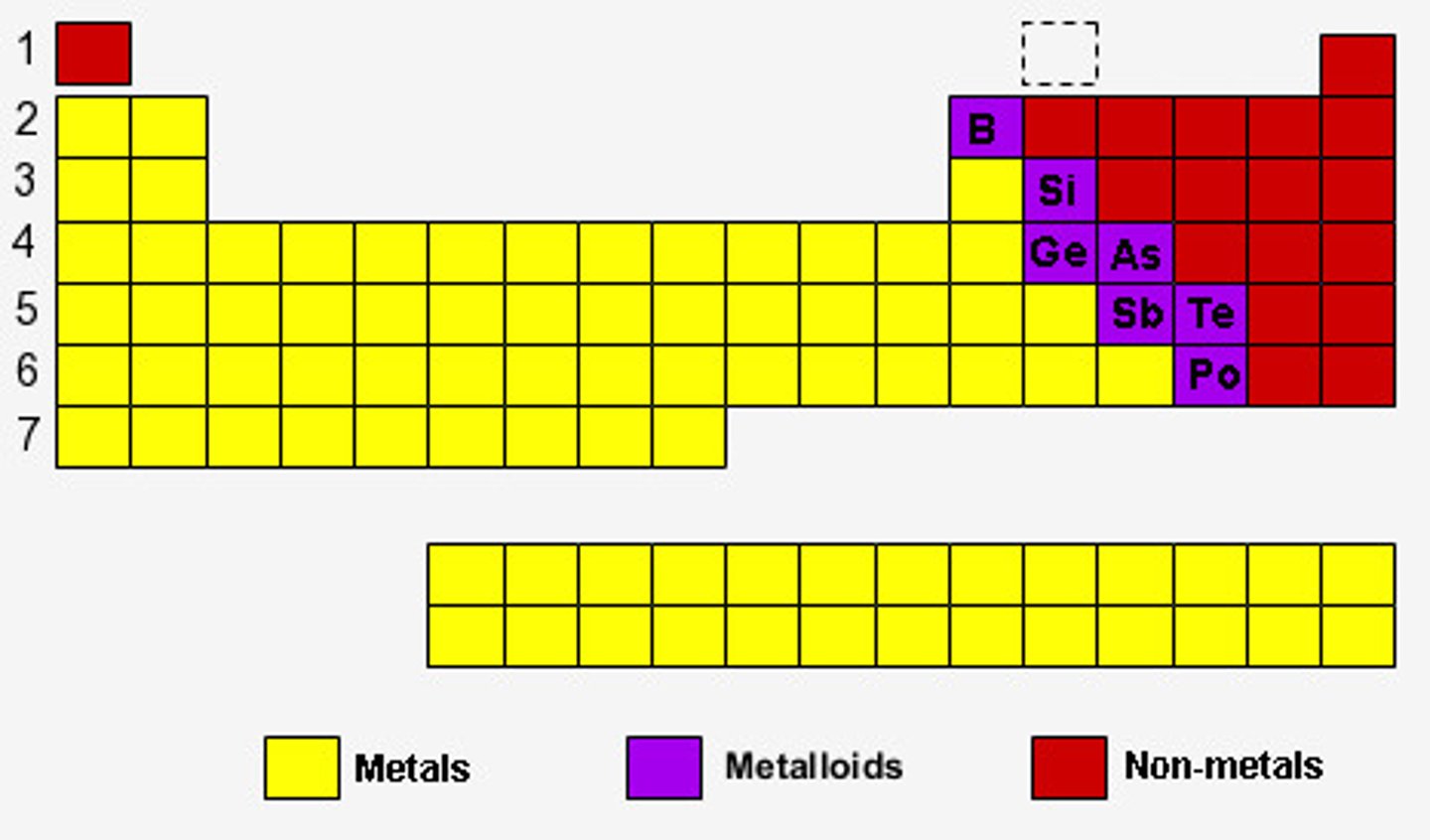
1) Characteristics of both metals and nonmetals and found in stairs-step pattern starting with Boron (B)
Boron (B)
Silicon (Si)
Polonium (Po)
Germanium (Ge)
Arsenic (As)
Antimony (Sb)
Tellenium (Te)
Astatine (At)
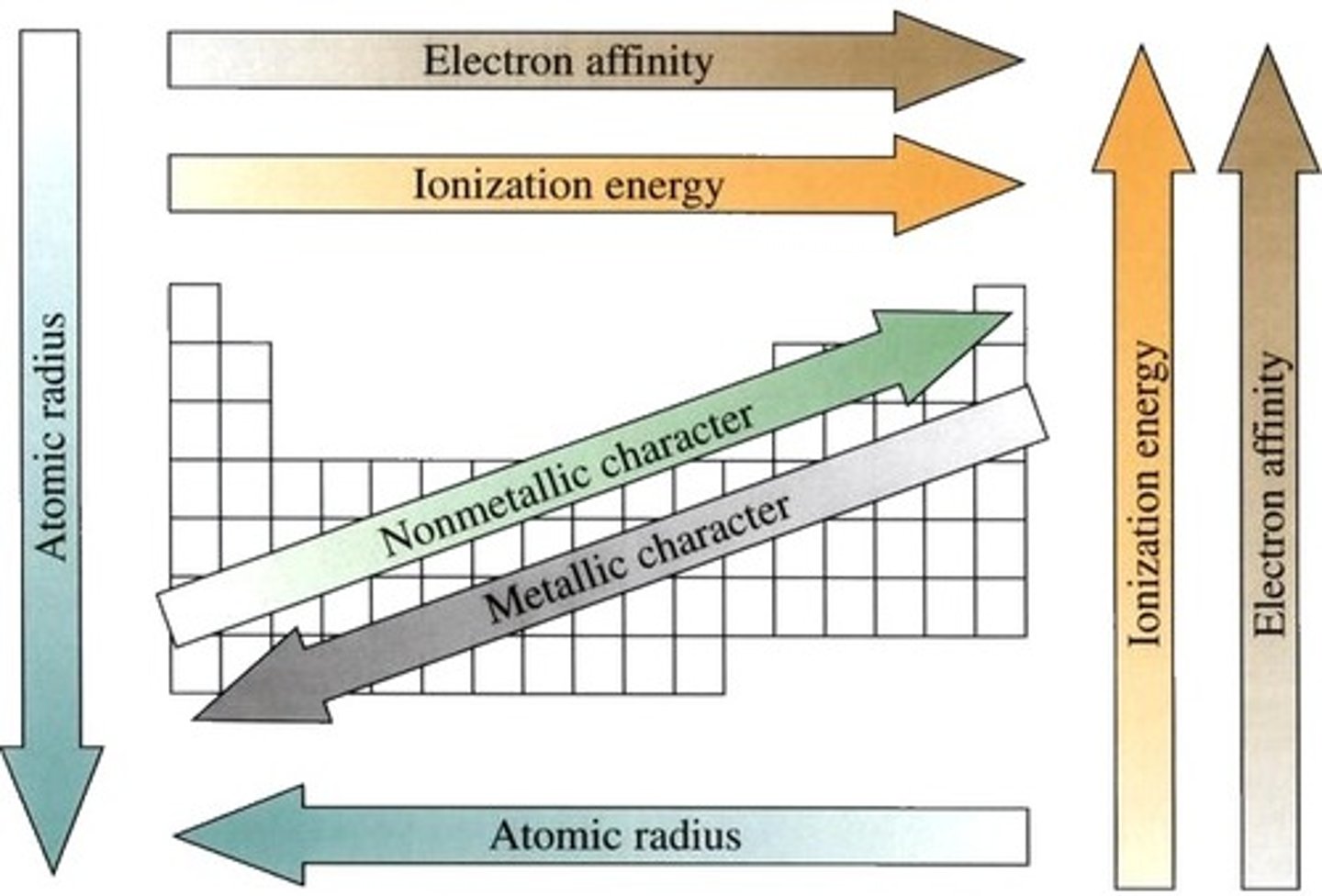
Periodic Table Trends
(TOP AND RIGHT)
1) increasingEffective nuclear charge
2) increasing Ionization energy
3) increasing Electron affinity
4) increasing Electronegativity
5) Atomic radius (DOWN AND LEFT)
Electrostatic pull (PT trend)
As positivity increase (moving left to right on PT), strong electrostatic pull to nucleus increases. This causes electron cloud (valence shell electrons) to move closer to bind more tightly to nucleus
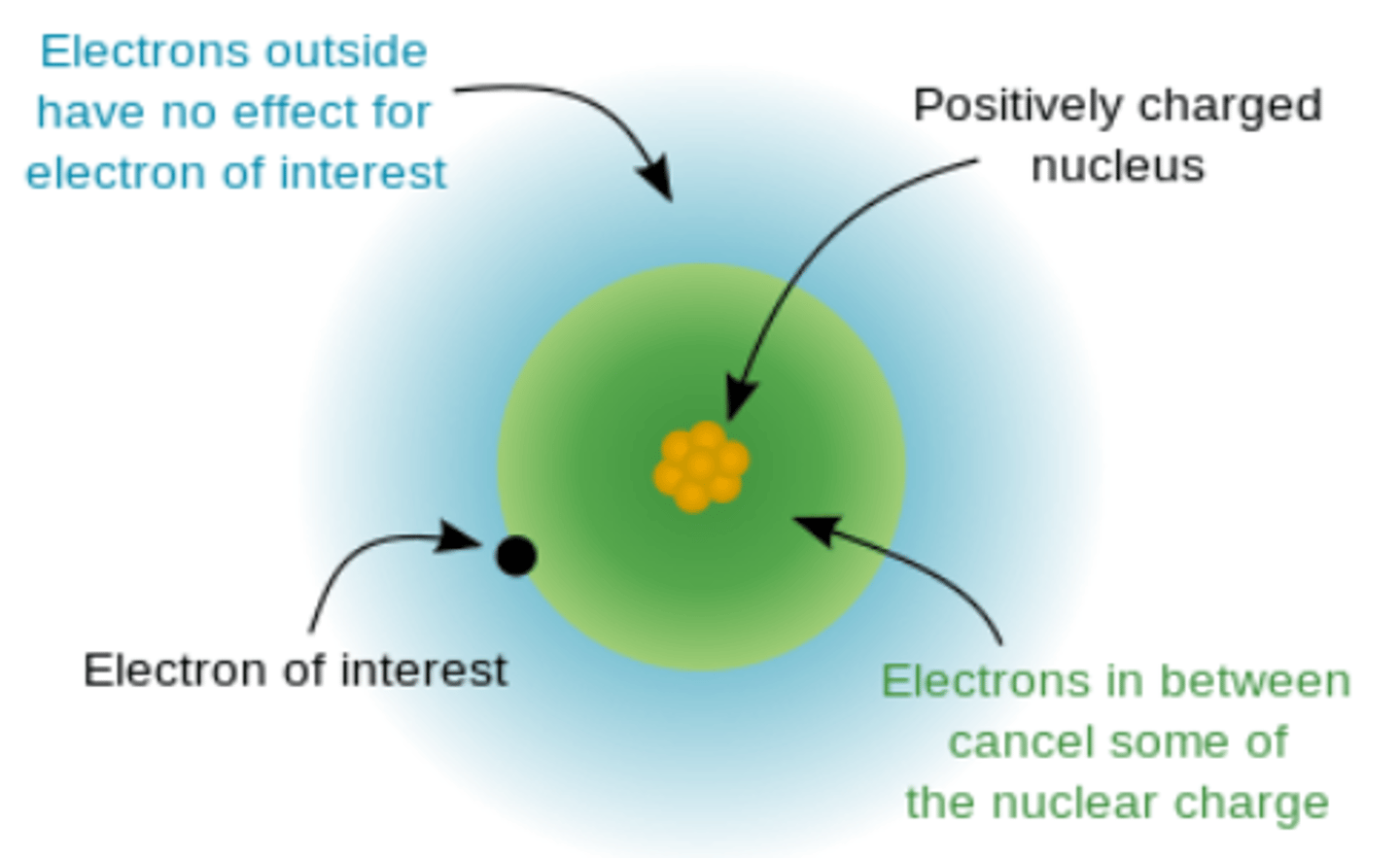
Effective nuclear charge (Zeff)
The net positive charge experienced by electrons in the valance shell (shielding)
Forms the foundation for all periodic trends.
1) Zeff increases from left to right across period, with little change in value from top to bottom in a group.
2) Valance electrons become increasingly separated from the nucleus as the principal energy level, n, increases from top to bottom in a group.
3) Shielding from inner shells electrons cancel increased positivity in nucleus.
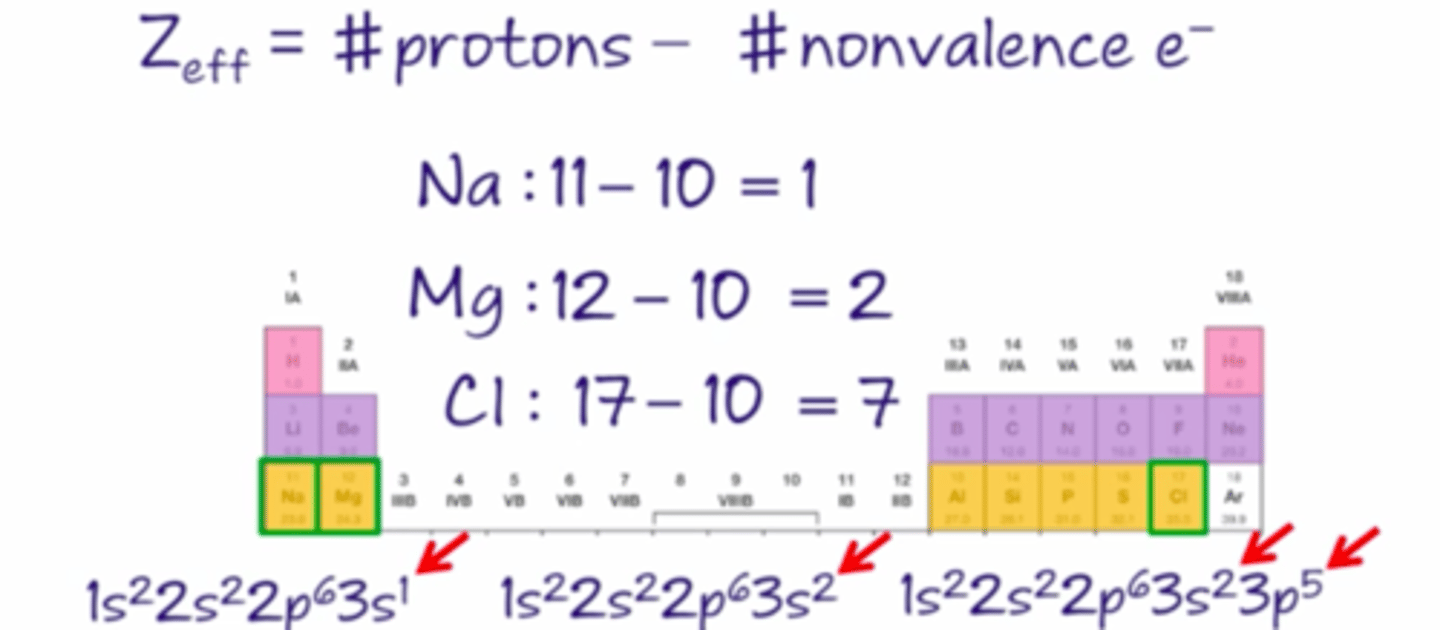
Effective nuclear charge (Zeff) equation
# protons - #nonvalance e-
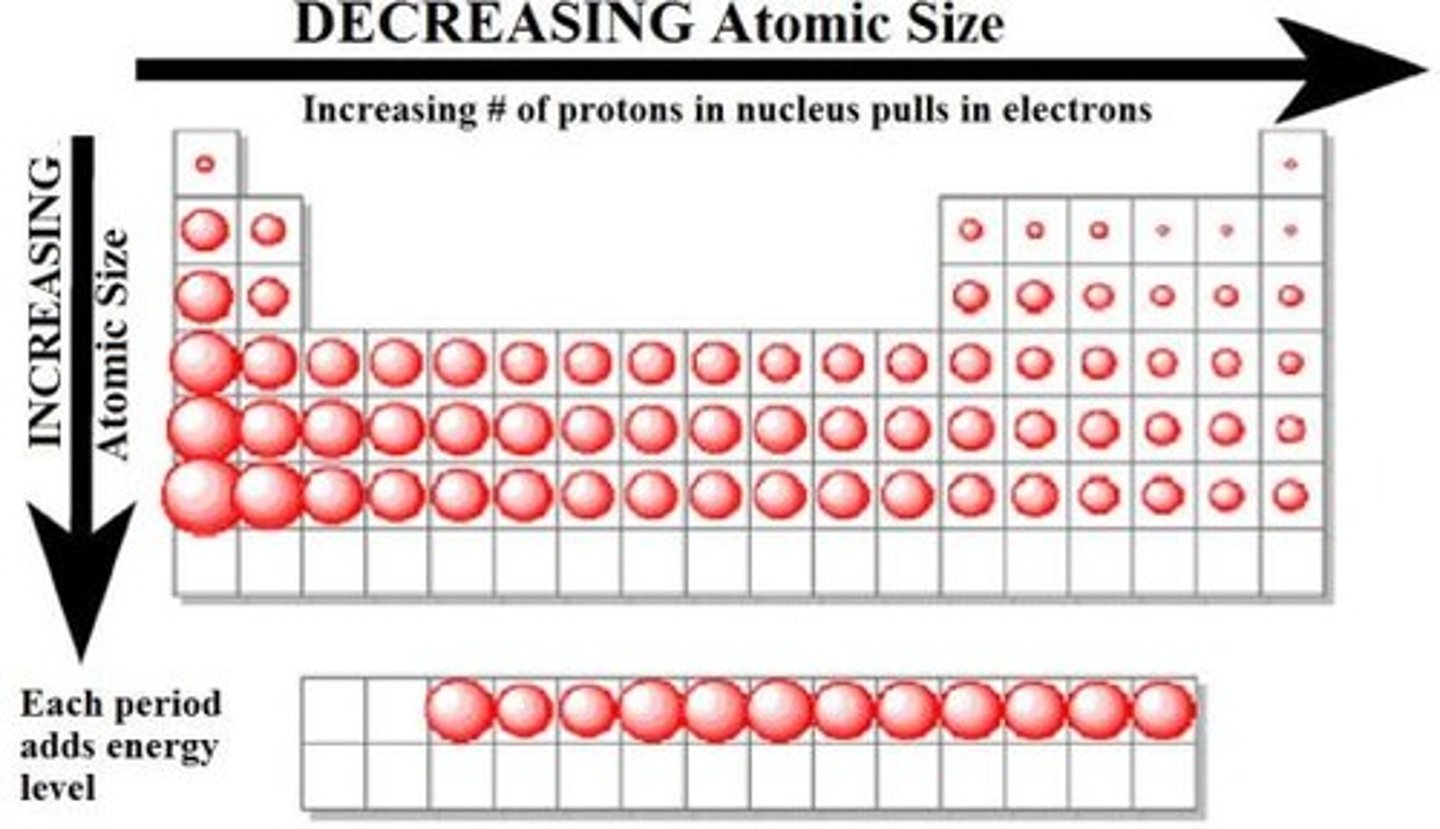
Atomic radius
Decreases from left to right across a period and increases from top to bottom in a group.
It is 1/2 of distance between centers of 2 atoms of that element that are in brief contact.
One cannot measure radius of single atom because electrons are constatnly moving.
Largest atomic radius: Cesium (Cs)
Smallest atomic radius: Helium (He)
Ionic radius
The size of a charged species.
1) Cation size = smaller than neutral atom
2) Anion size = larger than neutral atom
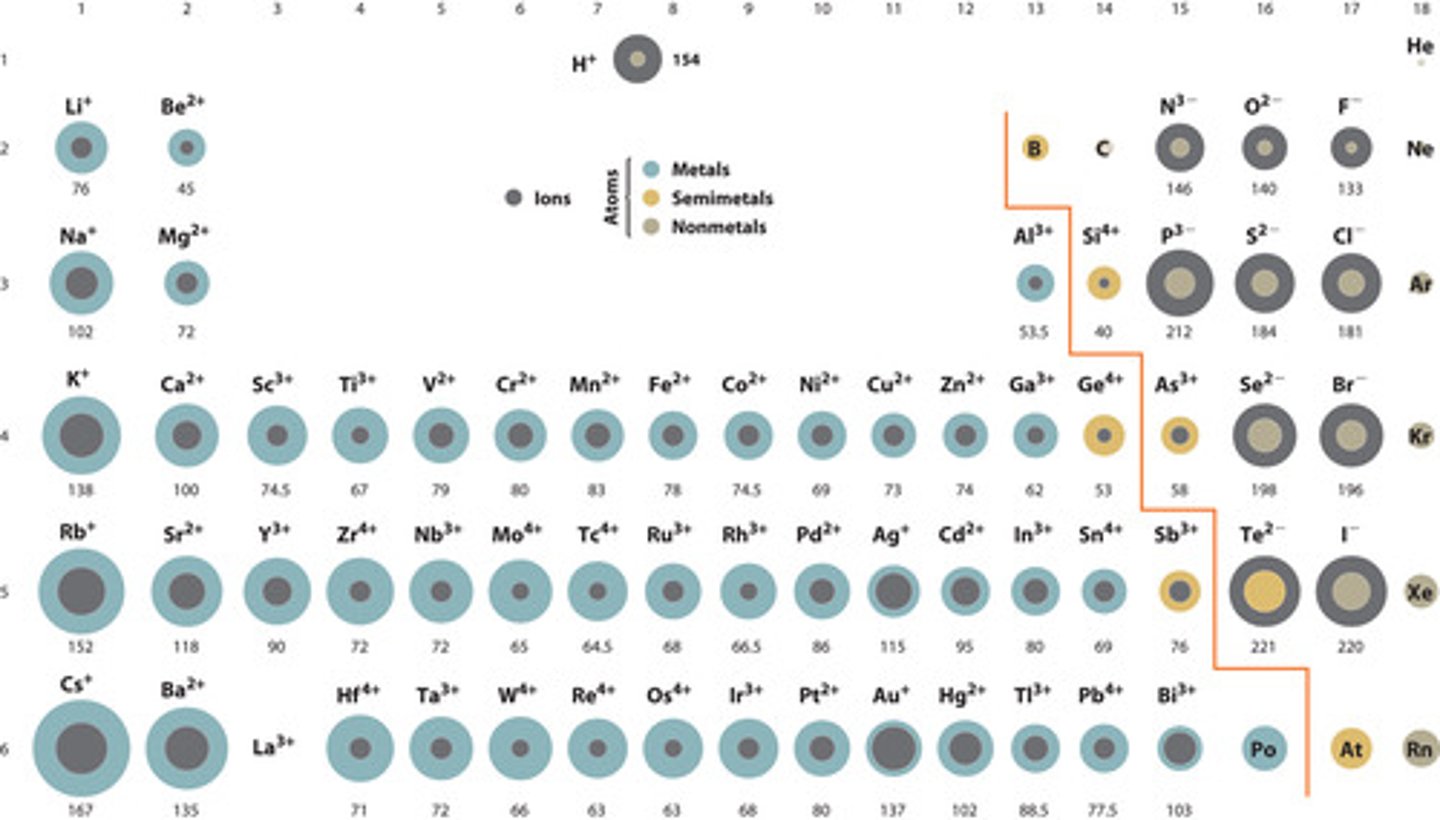
Ionic radius of nonmetals
Nonmetals closer to metalloids have larger ionic radius than nonmetals closer to group 8 (noble gases). This is because they need to gain more electrons to reach noble gas status.
Ionization energy
The amount of energy necessary to remove and electron from the valance shell of a gaseous species.
1) It increases from left to right across a period
2) Increases from bottom to top in a group
It is increasingly harder to remove another electron after removing first electron. (first ionization energy - remove 1st e-, second ionization energy - remove 2nd e-). first IE is always smaller than second IE
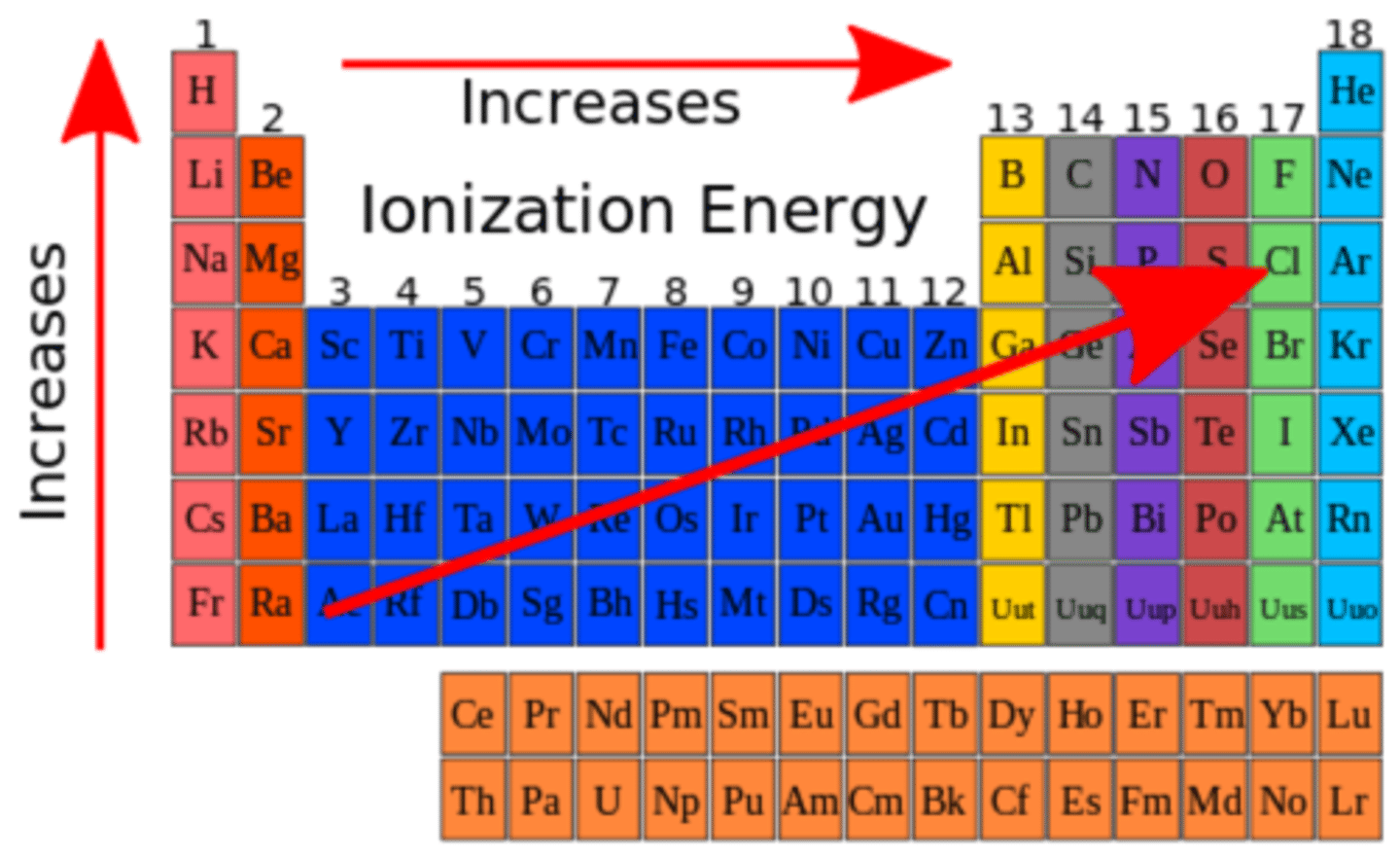
Which group of elements have the highest ionization energies?
Noble gasses (Group 18 - VIIIA).
Least likely to give up e's
Electron affinity
The amount of energy released when a gaseous species gains an electron in its valance shell.
Exothermic process (getting more electrons)
ΔH is negative , but electron affinity is a positive number.
Noble gases have close to zero electron affinity
1) Increases from left to right across a period
2) Decreases from top to bottom in a group
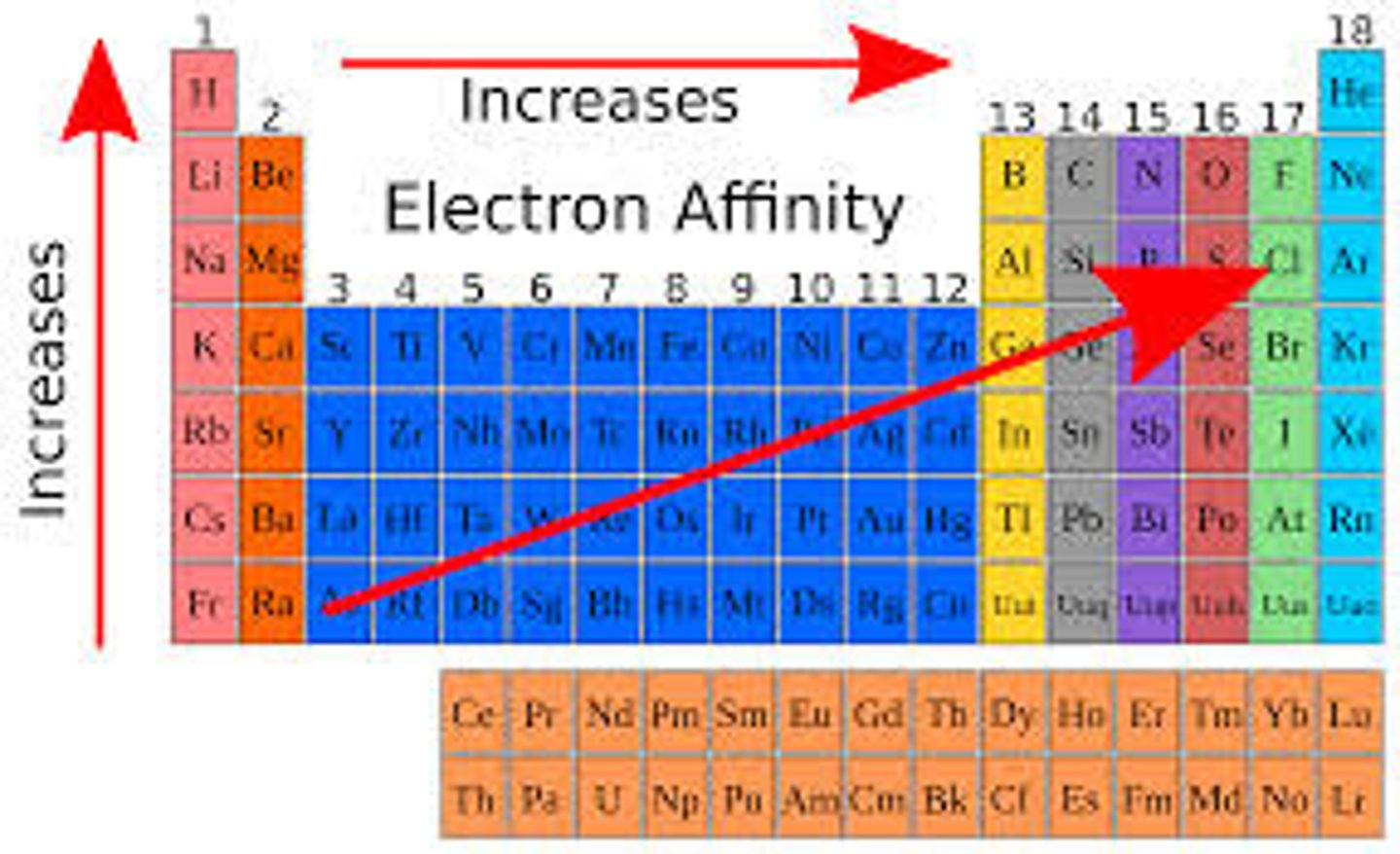
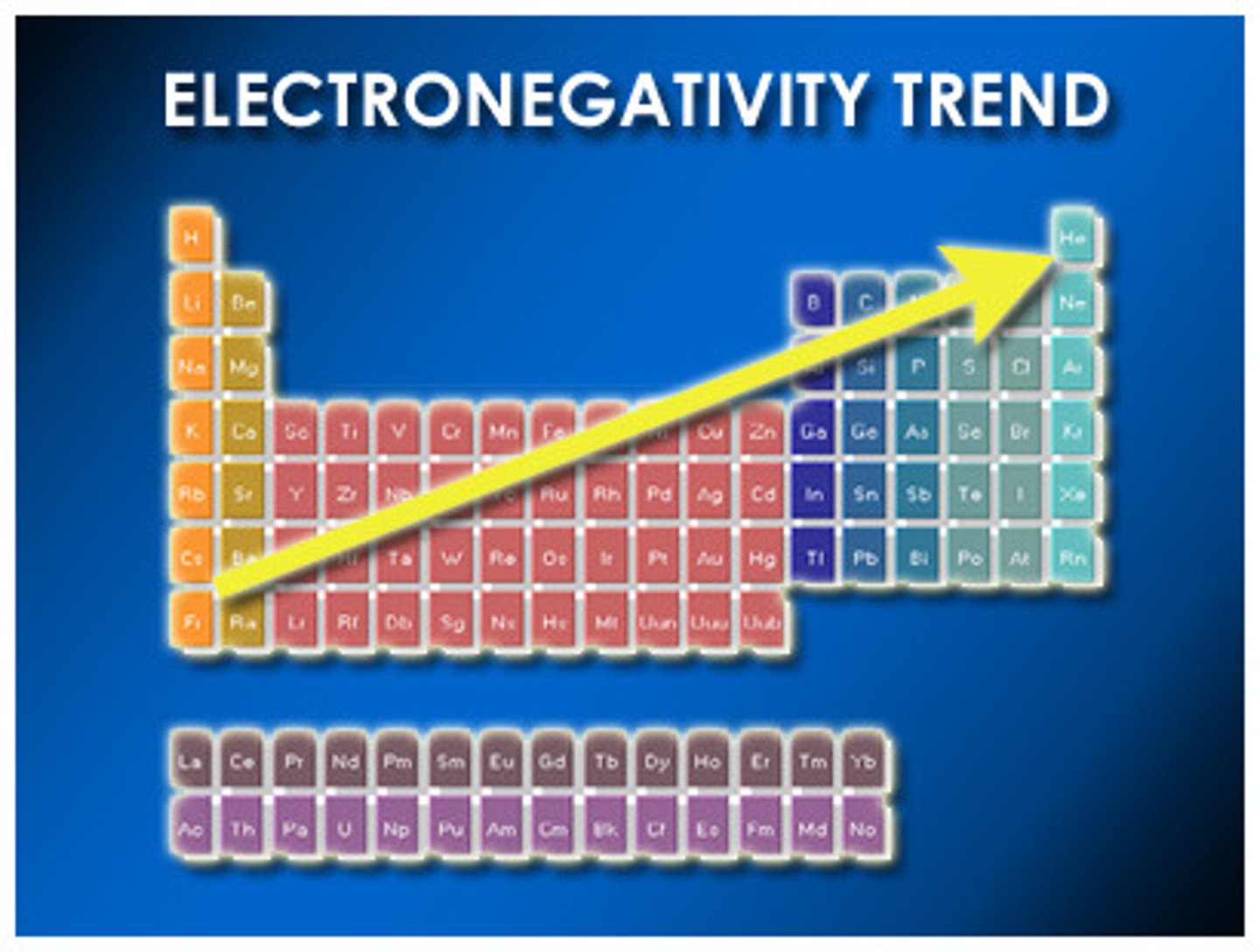
Electronegativity
A measure of attractive force of the nucleus for the electrons within a chemical bond.
Electronegativity is a relative value
1) It increases from left to right across a period and decreases from top to bottom in a group.
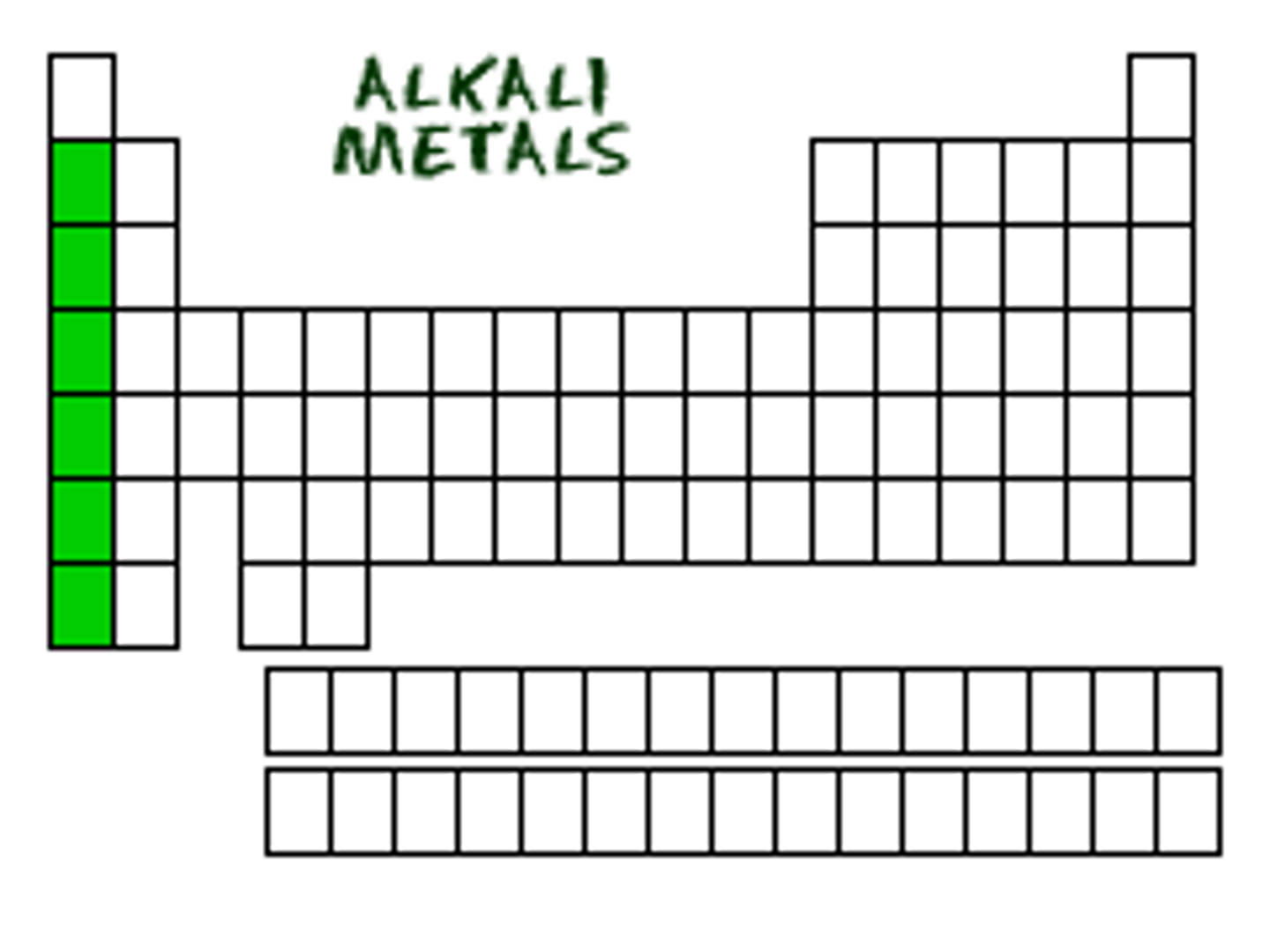
Alkali metals
1) Typically take an oxidation state of +1
2) Prefer to lose electron
3) Most reactive of all metals
4) React readily with univalent nonmetals (esp halogens)
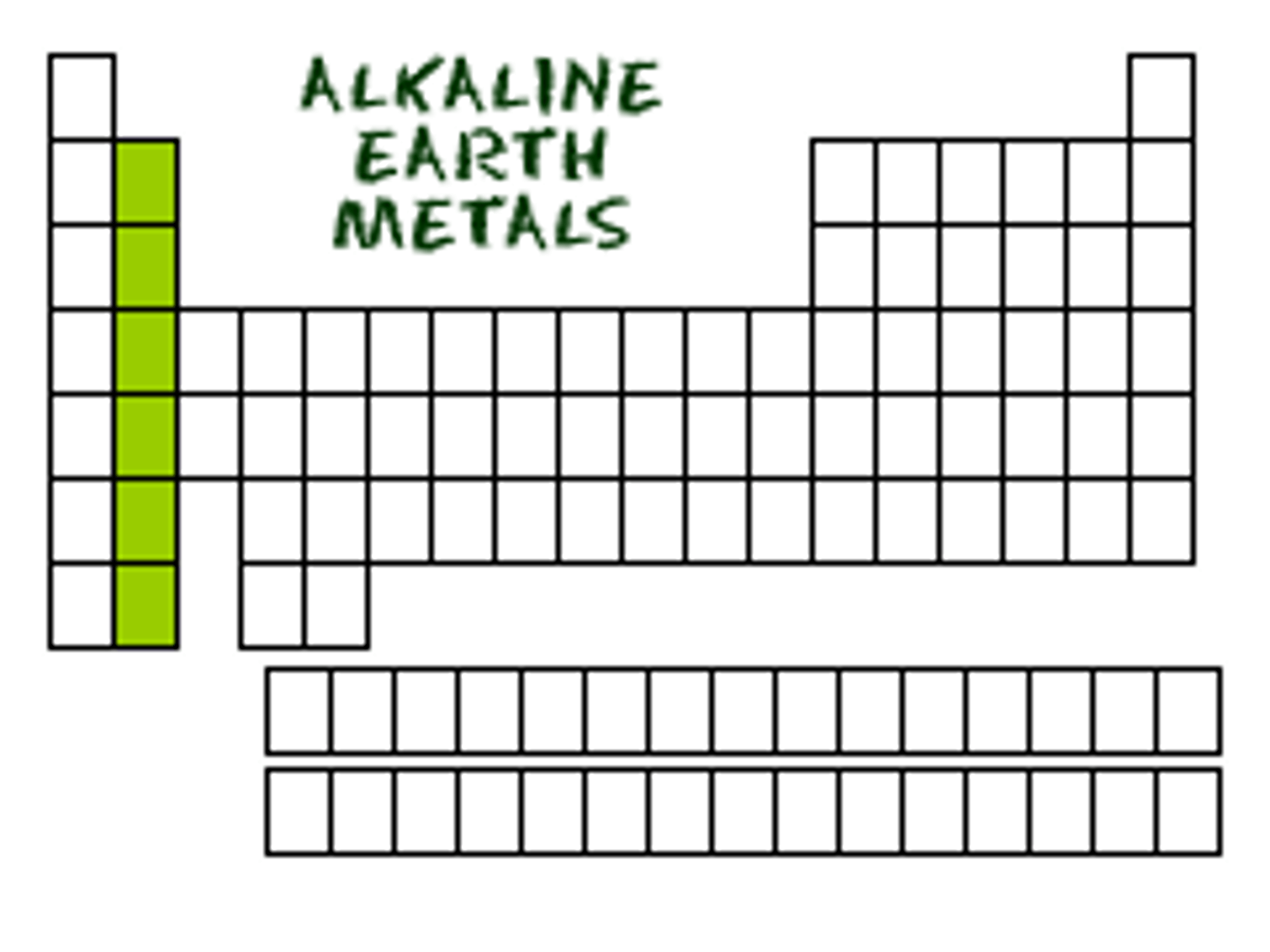
Alkaline earth metals
1) Oxidation state of +2
2) lose two electrons for noble gas-like configuration
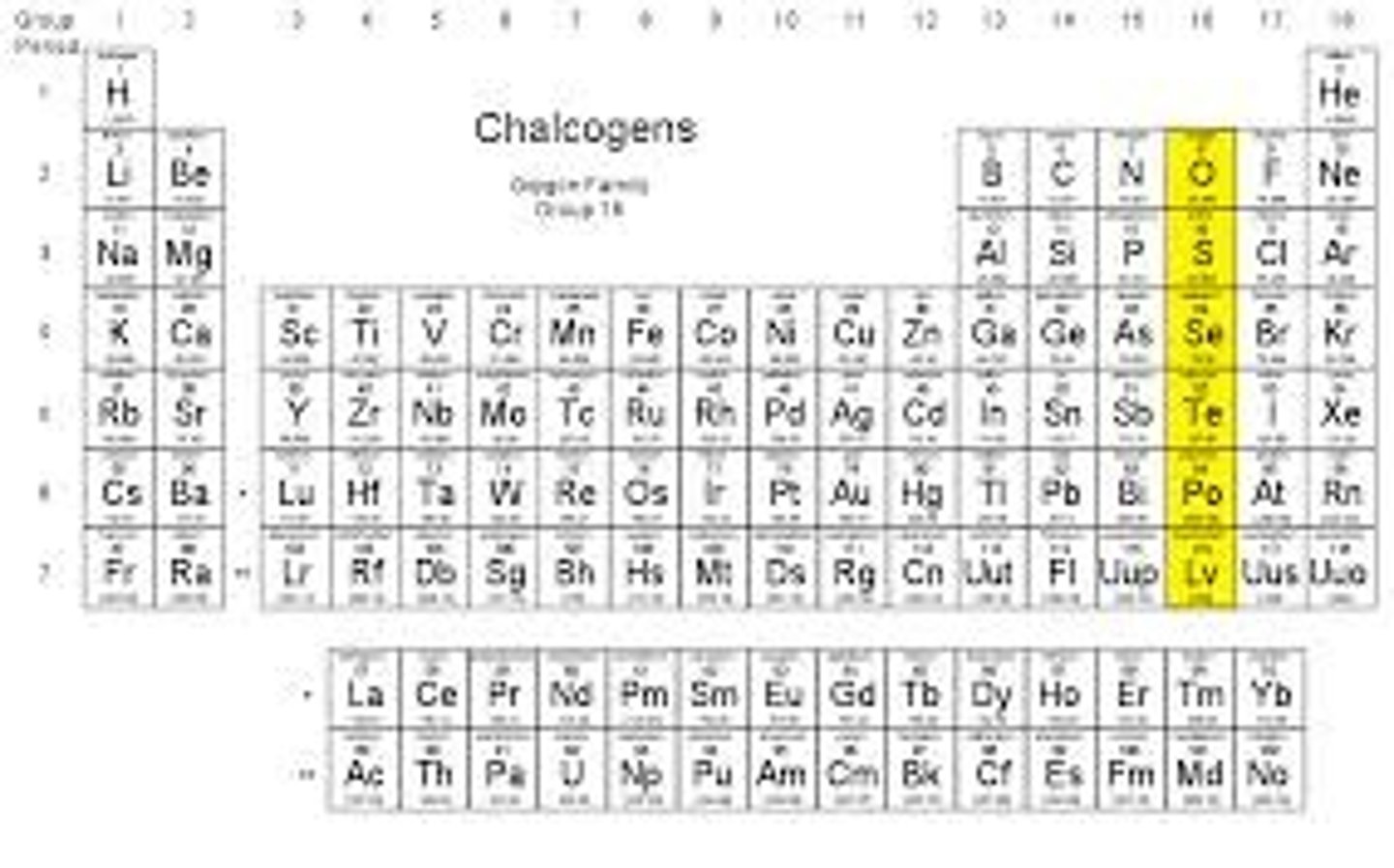
Chalcogens
1) Oxidation state of -2 or +6 (depending on nonmetal vs metal, respectively)
2) biologically important
3) Sulfur - In amino acids and vitamins
Selenium: In microorganisms, help with protection from oxidative stress
Halogens
1) -1 oxidation state
2) Prefer to gain an electron
3) these nonmetals have highest electronegativity
Noble gases
1) Fully filled valance shell
2) Inert (minimal chemical reactivity)
3) Very high ionization energy
4) Low boiling points
5) Lighting sources
Transition metals
1) Take on multiple oxidation states:
- Copper (Cu): +1 or +2
- Manganese (Mn): +2, +3, +4, +6, +7
2) Have high melting and boiling points
3) Form compolex ions with hydration complexes -> CuSO4 . 5H2O
Complex ions
- Transition metals form complex ions with hydration complexes.
- Formation of complexes causes d orbitals to split to 2 energy sublevels
- Complexes can absorb certain light frequencies.
- Frequencies not absorbed = Subtraction frequencies - give complexes their characteristic colors.