AT II effects
 Call Kai
 Learn
Learn Practice Test
 Spaced Repetition
 Match
Match Flashcards
 Knowt Play
1/17

There's no tags or description
Looks like no tags are added yet.
Name | Mastery | Learn | Test | Matching | Spaced | Call with Kai | Chat |
|---|
No analytics yet
Send a link to your students to track their progress
18 Terms
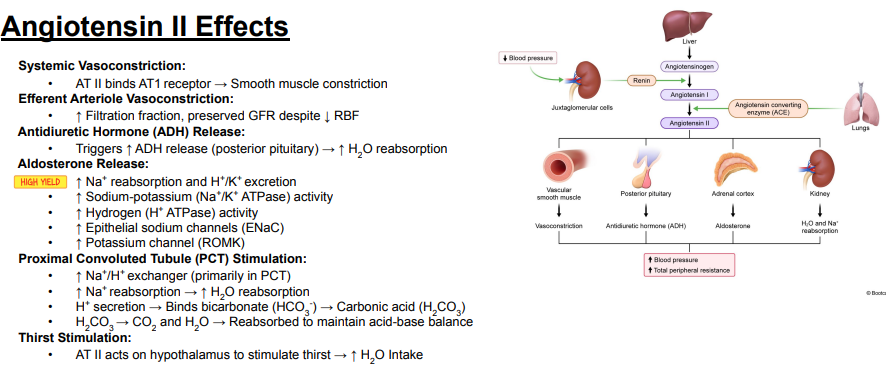
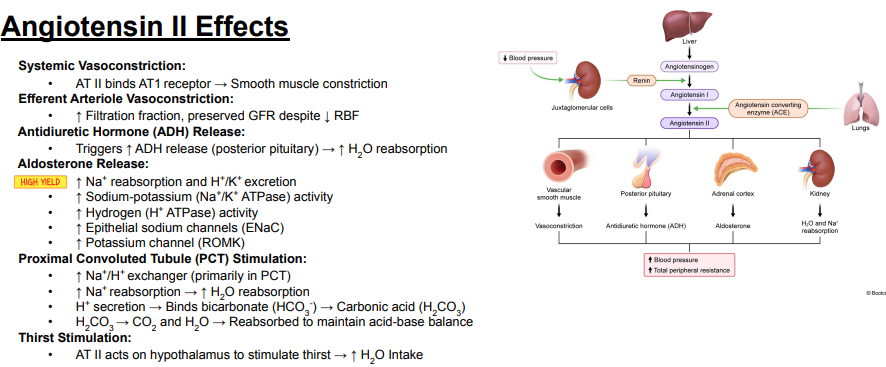
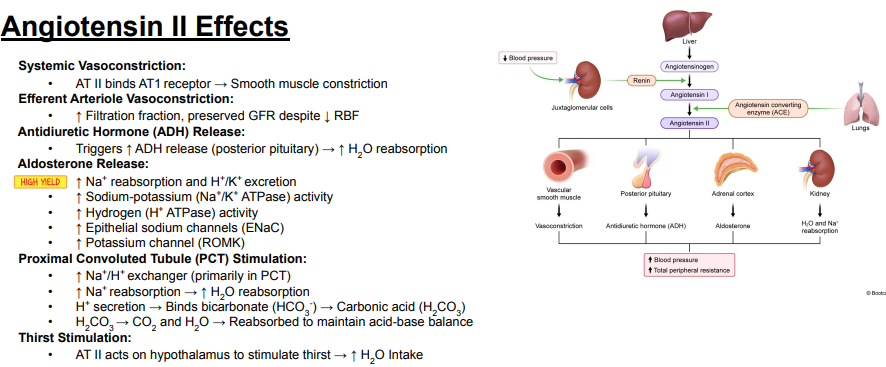
Through which receptor does angiotensin II cause systemic vasoconstriction?
Answer: The AT1 receptor.
Extra Information:
Angiotensin II binding to the AT1 receptor causes smooth muscle constriction.
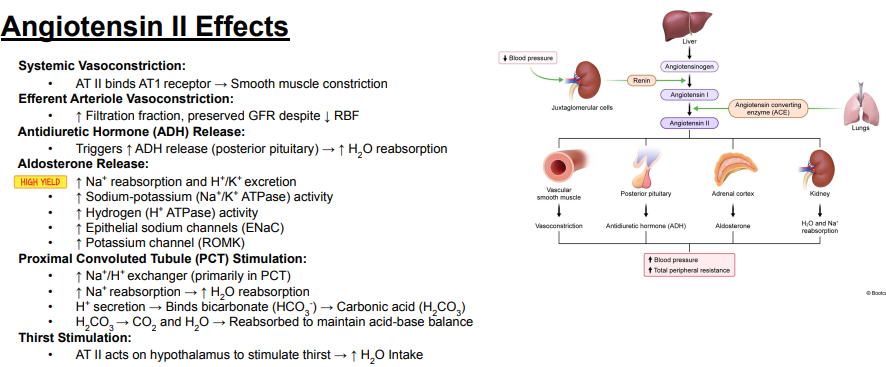
How does angiotensin II produce systemic vasoconstriction?
Answer: Angiotensin II binds the AT1 receptor → smooth muscle constriction.
Extra Information:
Systemic vasoconstriction is one of the major effects of angiotensin II.
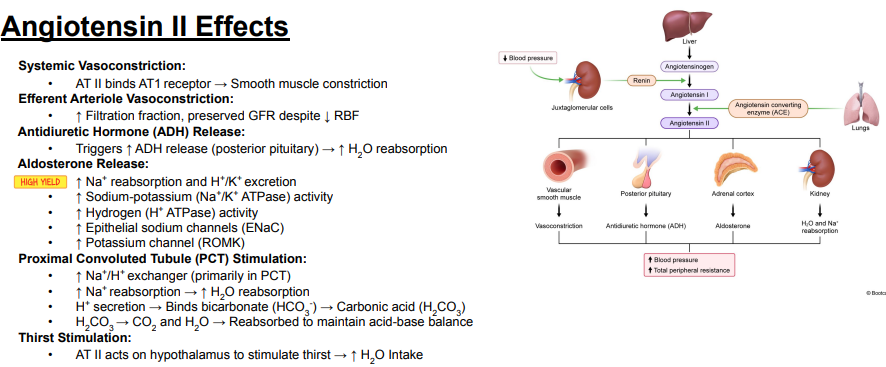
Which renal arteriole does angiotensin II constrict according to the slide?
Answer: The efferent arteriole.
Extra Information:
This affects filtration fraction, glomerular filtration rate, and renal blood flow.

How does angiotensin II-mediated efferent arteriole vasoconstriction affect filtration fraction, glomerular filtration rate, and renal blood flow?
Answer: It increases filtration fraction, preserves glomerular filtration rate, and decreases renal blood flow.
Extra Information:
The slide emphasizes preservation of glomerular filtration rate despite decreased renal blood flow.
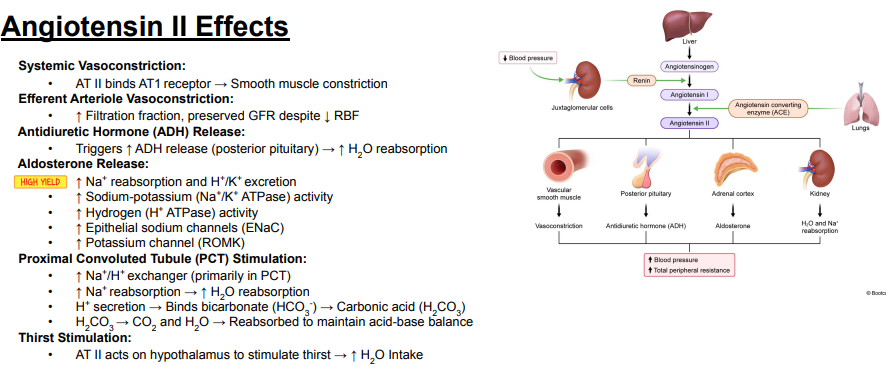
How does angiotensin II affect antidiuretic hormone release?
Answer: Angiotensin II increases antidiuretic hormone release from the posterior pituitary.
Extra Information:
Increased antidiuretic hormone increases water reabsorption.

What is the effect of angiotensin II-induced antidiuretic hormone release on water handling?
Answer: It increases water reabsorption.
Extra Information:
Angiotensin II triggers increased antidiuretic hormone release from the posterior pituitary.

How does angiotensin II-induced aldosterone release affect sodium, hydrogen, and potassium handling?
Answer: It increases sodium reabsorption and increases hydrogen and potassium excretion.
Extra Information:
These aldosterone effects are marked as high yield on the slide.

Which sodium-potassium pump is increased by aldosterone according to the slide?
Answer: The sodium-potassium ATPase.
Extra Information:
Aldosterone increases sodium-potassium ATPase activity.

Which hydrogen pump is increased by aldosterone according to the slide?
Answer: The hydrogen ATPase.
Extra Information:
Aldosterone increases hydrogen ATPase activity.

Which epithelial sodium channel is increased by aldosterone?
Answer: ENaC.
Extra Information:
ENaC stands for epithelial sodium channel.
Aldosterone increases its activity.

Which potassium channel is increased by aldosterone?
Answer: ROMK.
Extra Information:
ROMK is one of the channels increased during the aldosterone response shown on the slide.

What transporter does angiotensin II increase primarily in the proximal convoluted tubule?
Answer: The sodium/hydrogen exchanger.
Extra Information:
The slide identifies the proximal convoluted tubule as the primary location of this effect.

How does angiotensin II stimulation of the proximal convoluted tubule affect sodium and water reabsorption?
Answer: It increases sodium reabsorption, which increases water reabsorption.
Extra Information:
This is linked to increased sodium/hydrogen exchanger activity.

What happens to hydrogen secretion when angiotensin II stimulates the sodium/hydrogen exchanger in the proximal convoluted tubule?
Answer: Hydrogen secretion increases.
Extra Information:
The secreted hydrogen then participates in bicarbonate handling.
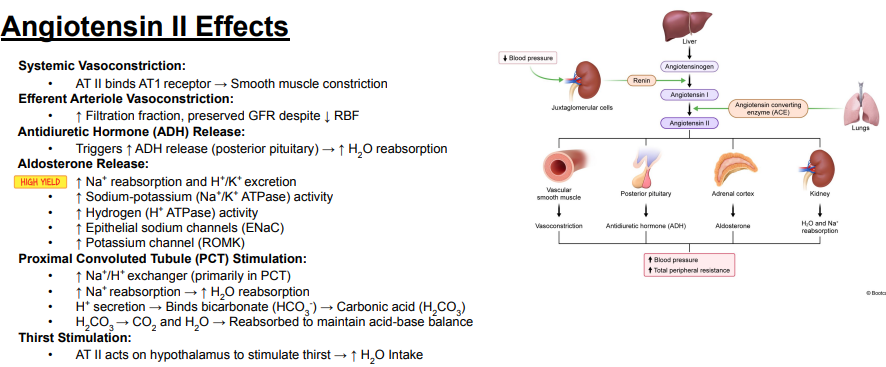
What happens when secreted hydrogen binds bicarbonate in the proximal convoluted tubule?
Answer: Hydrogen binds bicarbonate to form carbonic acid.
Extra Information:
The pathway is H+ + HCO3− → H2CO3.
What happens to carbonic acid during proximal convoluted tubule bicarbonate handling?
Answer: Carbonic acid is converted to carbon dioxide and water.
Extra Information:
The carbon dioxide and water are then reabsorbed.
The slide connects this process with maintenance of acid-base balance.
Trace the proximal convoluted tubule mechanism stimulated by angiotensin II.
Answer: Angiotensin II → increased sodium/hydrogen exchanger → increased sodium reabsorption and hydrogen secretion → increased water reabsorption, while hydrogen binds bicarbonate → carbonic acid → carbon dioxide and water → reabsorption.
Extra Information:
The slide connects this process with maintenance of acid-base balance.
How does angiotensin II stimulate thirst?
Answer: Angiotensin II acts on the hypothalamus to stimulate thirst, increasing water intake.
Extra Information:
Increased water intake is one of the mechanisms by which angiotensin II supports fluid balance.
