Biochem: Chapter 1 - Exam 1
 Call Kai
 Learn
Learn Practice Test
 Spaced Repetition
 Match
Match Flashcards
 Knowt Play
1/73

There's no tags or description
Looks like no tags are added yet.
Name | Mastery | Learn | Test | Matching | Spaced | Call with Kai | Chat |
|---|
No analytics yet
Send a link to your students to track their progress
74 Terms
If the pH > pKa = pronation or depronation?
depronation
If the pH < pKa = pronation or depronation?
pronation
What are the major acidic groups of biomolecules?
Carboxyl, phosphate ester, phodiester, sulhydryl, phenolic hydroxyl
Which of the major acidic groups would you expect to depronante (neg charge) at pH 7?
Carboxyl, phosphate ester, phosphodiester
Which of the major acidic groups would you expect to depronante (neg charge) at pH well above 7?
sulfhydryl and phenolic hydroxyl
(carboxyl, phosphate ester, phosphodiester) tend to be deprotonated at pH 7 because their relevant pKa values are?
below 7
What are the most Important Basic Groups in Biomolecules
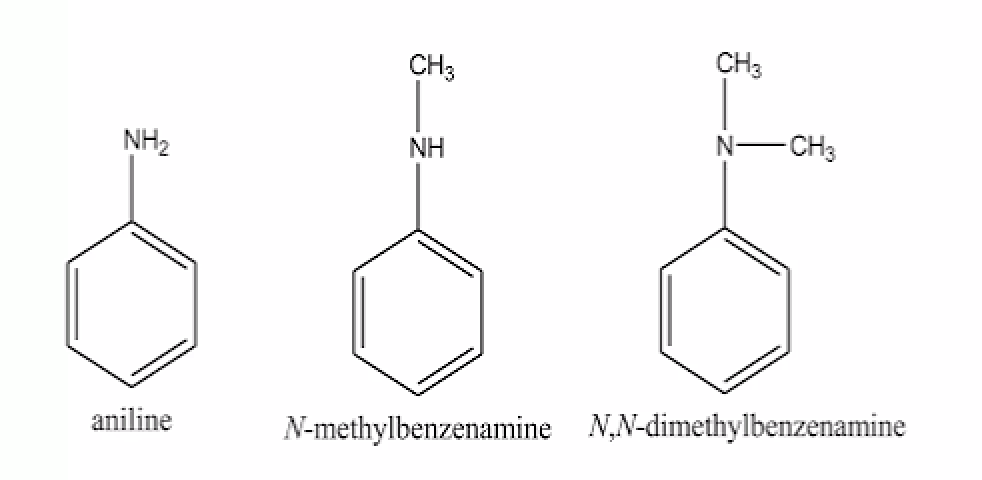
aliphatic amino, guanidino (in argine) and aromatic amines
What are the types of aliphatic aminos?
primary, secondary, and tertiary
of the basic groups of biomeolcules, which are pronated (+ charge) at a pH 7?
Aliphatic amino (primary, secondary, and tertiary) and Guanidino (in arginine)
of the basic groups of biomeolcules, which are pronated (+ charge) at a pH well below 7?
aromatic amines
in the blood plasma (outside the cell), what is the major cation?
Na+
in the blood plasma (outside the cell), what is the major anion?
Cl- (primarily)
HCO3- is also important
in the interstitial (extracellular) fluid (outside the cell), what is the major cation?
Na+
in the interstitial (extracellular) fluid (outside the cell), what is the major anion?
Cl- (primarily)
HCO3- is also important
in the intracellular fluid (inside the cell), what is the major cation?
K+
in the intracellular fluid (inside the cell), what is the major anion?
phosphates and proteins
Respiratory acidosis is caused by abnormal ______ of CO2 aka ______?
retention (too much stays in)
HYPOventelation
Respiratory alkalosis is caused by abnormal ______ of CO2 aka ______?
expulsion (too much comes out)
HYPERventilation
If there was an increase in alveolar ventilation, what would happen to the CO2? pH? What is this also called? Is this acidosis or alkalosis?
CO2 - too much would leave the body
pH - would increase
This is called hyperventilation
This is alkalosis (the blood is becoming more alkaline or basic)
If there was an decrease in alveolar ventilation, what would happen to the CO2? pH? What is this also called? Is this acidosis or alkalosis?
CO2 - too much would accumulate the body
pH - would decrease
This is called hypoventilation
This is acidosis (the blood is becoming more acidic)
metabolic ____ is caused by the abnormal loss of acids from the body. What would be the cause of this?
alkalosis; abnormal loss of acids from the body (like in excessive vomiting).
metabolic _____ is caused by the abnormal gain of acids from the body. What would be the cause of this
acidosis; overproduction/accumulation of organic salts
What are the three lines of defense when blood pH is abnormal?
The buffer systems act immediately to prevent excessive fluctuations of the blood pH.
Alveolar ventilation increases in acidosis and decreases in alkalosis.
The kidneys excrete excess H+ in acidosis and excess HCO3– in alkalosis.
of the three lines of defense to restore a normal pH, which is the long term mechanism that acts on a time scale of hours to days?
The kidneys excrete excess H+ in acidosis and excess HCO3– in alkalosis.
How can you distinguish respiratory acidosis and metabolic acidosis?
Measure total carbon dioxide (CO2 + H2CO3 + HCO3– ) in the plasma
Respiratory _______ → ↑ total CO₂ → CO₂ retention from hypoventilation
As CO2 goes up, what happens to the pH?
acidosis
As CO2 goes up, pH goes down - inverse relation (opposite)
Respiratory _____ → ↓ total CO₂ → excessive CO₂ loss from hyperventilation
As CO2 goes down, what happens to the pH?
alkalosis
As CO2 goes down, pH goes up - inverse relation (opposite)
Metabolic _______ → ↓ total CO₂ → ↓ HCO₃⁻ from bicarbonate loss or acid gain
As total CO2 and HCO3- goes down, what happens to the pH?
acidosis
As total CO2 and HCO3- goes down, the pH also decreases (same direction)
Metabolic _______ → ↑ total CO₂ → ↑ HCO₃⁻ from bicarbonate gain or acid loss
As total CO2 and HCO3- goes up, what happens to the pH?
alkalosis
As total CO2 and HCO3- goes up, the pH also increases (same direction)
_________: CO₂ causes the problem.
Respiratory
________: HCO₃⁻ causes the problem.
Metabolic
what are the major types of isomers?
constitutional, geometric, and optical
________ Isomers - Isomerism between structures differing in constitution and described by different line formulae
Constitutional
Constitutional isomers vs structural isomers vs Positional isomers
Constitutional = structural: same molecular formula, different connectivity
Positional: same molecular formula, but a functional group/substituent is located at a different position on the same basic carbon skeleton:
All positional isomers are constitutional isomers, but not all constitutional isomers are positional isomers.
________ Isomers Are Specific Cases of Constitutional Isomerism
Positional
CH3OCH3 and CH3CH2OH are examples of ___________ isomers
constitutional
what kind of isomers are the following?
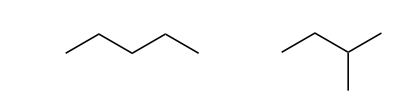
constitutional - Both have the same molecular formula but their atoms are connected differently.
Which pair of molecules are constitutional isomers?
A. CH₃CH₂OH and CH₃OCH₃
B. CH₃CH₂OH and CH₃CH₂OH
C. CH₄ and C₂H₆
D. H₂O and H₂O₂
Answer: A. CH₃CH₂OH and CH₃OCH₃
Why: Both have the same molecular formula (C₂H₆O), but their atoms are connected differently.
What kind of isomers are the following?
Molecule 1:
CH₃—CH₂—OH
Molecule 2:
CH₃—O—CH₃
constitutional isomers
Why: Both have the molecular formula C₂H₆O, but the atoms are connected differently.
what kind of isomers are the following:
Molecule 1:
CH₃—CH₂—CH₂—CH₃
Molecule 2:
CH₃
|
CH₃—CH—CH₃
constitutional isomers
Both have the molecular formula C₄H₁₀, but the atoms are connected differently.
Molecule 1 → straight carbon chain
Molecule 2 → branched carbon chain
Same molecular formula + different connectivity = constitutional isomers.
what kind of isomers are the following:

2-phosphoglycerate and 3-phosphoglycerate are positional isomers — which means they are also constitutional/structural isomers.
2-phosphoglycerate: phosphate group is attached to carbon 2
3-phosphoglycerate: phosphate group is attached to carbon 3
The molecules have the same molecular formula and the same basic carbon skeleton, but the phosphate group is connected at a different position.
what kind of isomers are the following:

Glyceraldehyde and dihydroxyacetone are constitutional (structural) isomers, but they are not usually classified as positional isomers.
They have the same molecular formula: C₃H₆O₃, but they have different functional groups:
what kind of isomers are the following:
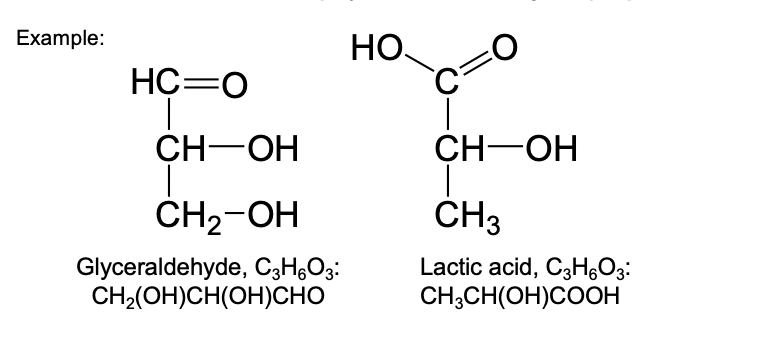
constitutional isomers
what properties differ in constitutional isomers?
Have different chemical, physical and biological properties
________ isomers differ in the positions of functional groups within the molecule
Positional
_______ isomers differ in the arrangement of substituents at a rigid portion of the molecule. (Functional groups identical, differ in arrangement of substituents at a rigid portion of the molecule) A typical example involves the cis-trans isomers of carbon-carbon double bonds
Geometric
what type of isomer is the following?
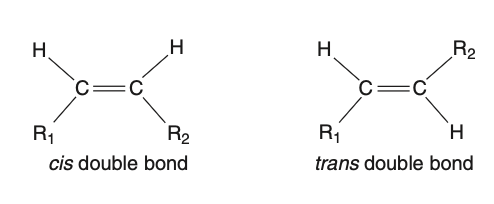
geometric isomers
what type of isomer is the following?
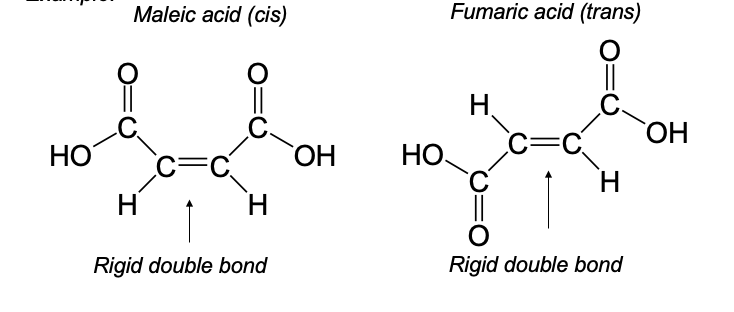
geometric isomers
Which pair represents geometric isomers?
A. cis-2-butene and trans-2-butene
B. 1-butene and 2-butene
C. butane and isobutane
D. ethanol and dimethyl ether
A. cis-2-butene and trans-2-butene
Why: Geometric isomers have the same molecular formula and same connectivity, but differ in the arrangement of groups around a double bond.
cis = similar groups are on the same side
trans = similar groups are on opposite sides
Which structure pair can exist as cis/trans geometric isomers?
A. CH₂=CH₂
B. CH₃—CH=CH—CH₃
C. CH₃—CH₂—CH₃
D. CH₂=CH—CH₃
B. CH₃—CH=CH—CH₃
Why: Each carbon of the double bond must have two different groups attached.
Why does this molecule not have geometric isomers?
CH₂=CH—CH₃
A. It does not contain carbon
B. It has only single bonds
C. One carbon of the double bond has two identical groups
D. The molecule is too small
C. One carbon of the double bond has two identical groups
what properties differ in geometric isomers?
Have different chemical, physical and biological properties
______ Isomers - Enantiomers → chirality
Functional groups identical, differ in the orientation of substituents around an asymmetrical carbon (a carbon with
four different substituents.)
Optical
If the molecule has only one asymmetric carbon, the isomers are ______ images (called enantiomers)
They are related to each other in the same way as the left hand and the right hand; therefore optical isomerism is also called ____
mirror; chirality