Adaptive Immunity: B Cells, T Cells, and Antigen Recognition, Microbial Interactions and Human Microbiome: Key Concepts and Applications, Epidemiology and Pathogenicity: Disease Patterns, Transmission, and Vaccines
 Call Kai
 Learn
Learn Practice Test
 Spaced Repetition
 Match
Match Flashcards
 Knowt Play
1/371

There's no tags or description
Looks like no tags are added yet.
Name | Mastery | Learn | Test | Matching | Spaced | Call with Kai | Chat |
|---|
No analytics yet
Send a link to your students to track their progress
372 Terms
What are the two main types of immunity?
Innate immunity and adaptive immunity.
What is the primary function of the adaptive immune system?
To recognize, respond to, and remember non-self antigens.
What are the three major functions of the adaptive immune system?
1. Recognize Non-Self, 2. Respond to Non-Self, 3. Remember Non-Self.
What cells are primarily involved in the effector response of adaptive immunity?
B cells and T cells.
What is the anamnestic response?
It is part of the secondary immune response.
Where do B cells originate?
From stem cells (CD34+) in the bone marrow.
What do B cells become after activation?
Plasma cells that secrete antibodies.
What type of immunity is mediated by antibodies?
Humoral immunity.
Where do T cells mature?
In the thymus.
What must occur for T cells to mature?
Antigen must bind to their receptors.
What are the two main types of T cells?
Helper T cells and cytotoxic T lymphocytes (CTLs).
What is the role of helper T cells?
To direct CTLs to target cell lysis and stimulate antibody production.
What are antigens?
Any self or non-self substance that elicits an immune response.
What is the difference between affinity and avidity in immunology?
Affinity is the strength of binding at a single site; avidity is the overall strength of binding at all sites.
What are haptens?
Small molecules that become immunogenic when combined with a carrier protein.
What is the Major Histocompatibility Complex (MHC)?
A collection of genes that encode proteins enabling the host to distinguish between self and non-self.
What are the two classes of MHC?
MHC Class I and MHC Class II.
What is natural immunity?
Immunity acquired through normal life experiences, not induced by medical means.
What is active immunity?
Immunity resulting from the production of one's own immune cells after exposure to an antigen.
What is passive immunity?
Immunity acquired by receiving preformed antibodies from another person.
What is artificial immunity?
Immunity produced purposefully through medical procedures like vaccinations.
What is the role of cytokines in T cells?
To mediate and regulate immune responses.
What is the significance of memory cells in the immune system?
They provide long-lasting immunity by remembering past infections.
What is the difference in production between B and T cells?
B cells are continuously produced, while T cell production is limited to the thymus and decreases with age.
What are epitopes?
Regions of an antigen that a specific antibody binds to.
What is valence in the context of antigens?
The number of antibody molecules that can combine with an antigen at one time.
What receptor do CD8+ T cells recognize?
Class I MHC molecules presenting antigen.
What are the structural components of Class I MHC molecules?
Two protein chains: an alpha chain and a beta chain.
Where are Class I MHC molecules found?
On all human cells with a nucleus.
What is the role of the pocket in Class I MHC molecules?
It can bind self antigens to mark the cell as host or bind peptides from intracellular pathogens to signal infection.
Where does endogenous antigen processing occur for Class I MHC?
In the cytoplasm of the cell.
What type of T cells do Class II MHC molecules interact with?
CD4+ T helper cells.
What is the function of Class II MHC molecules?
They handle exogenous antigen processing and trigger other parts of the immune system.
Where are Class II MHC molecules found?
On certain immune cells, specifically antigen-presenting cells (APCs).
What are the three types of T cells mentioned?
T helper cells, cytotoxic T lymphocytes, and regulatory T cells.
What is the role of T helper cells?
They are activated by antigens presented on MHC class II and help regulate the immune response.
What activates cytotoxic T lymphocytes?
Presentation of non-self antigens by dendritic cells on MHC class I molecules.
What pathways do cytotoxic T cells use to kill target cells?
Perforin pathway (cytolytic pathway) and CD95/apoptotic pathway.
What are regulatory T cells derived from?
Approximately 10% of CD4+ T cells and 2% of CD8+ T cells.
What do T cell receptors (TCRs) recognize?
Fragments of antigens presented by MHC molecules on the surface of other cells.
What is the first signal required for T cell activation?
Antigen presentation by MHC class II to TCR.
What is the second signal necessary for T cell activation?
Binding of B7 protein on APC to CD28 receptor on T cells.
What happens if the second signal for T cell activation does not occur?
The T cell becomes anergic and cannot respond to the antigen.
What is the third signal in T cell activation?
Cytokine release that differentiates naive T cells into effector cells.
What are superantigens (SAgs)?
Antigens that overstimulate T cells, potentially causing a cytokine storm.
What is the primary function of B cells?
To produce antibodies (immunoglobulins).
What differentiates B cells from T cells in terms of antigen presentation?
B cells do not require APCs for antigen presentation.
What is the role of B cell receptors (BCRs)?
BCRs bind to specific epitopes, leading to B cell activation.
What happens when a BCR binds to its epitope?
It causes endocytosis and a cascade towards activation of T helper 2 cells.
What are antigen-presenting cells (APCs)?
Cells that present non-self antigens on MHC class II molecules to T lymphocytes.
What types of cells are considered APCs?
Macrophages, B cells, and dendritic cells.
What is the significance of memory T cells?
They are activated later on and provide a faster immune response upon re-exposure to the same antigen.
What is the function of cytokines in T cell activation?
They help differentiate naive T cells into effector cells and regulate immune responses.
What is required for B cell activation?
A surface receptor that recognizes and binds specific antigens.
What are B cell receptors made of?
Membrane-bound antibodies.
What do B cells differentiate into upon activation?
Plasma cells that secrete antibodies.
What are the two mechanisms for antigen-specific activation of B cells?
T-cell dependent activation and T-cell independent activation.
What is required for T-cell dependent activation of B cells?
Help from TH2 cells.
What is the role of plasma cells?
To secrete antibodies into the system, aiding in opsonization.
What type of antigens do T-cell independent B cells respond to?
Broad range of antigens, often polymeric, such as LPS.
What are antibodies also known as?
Immunoglobulins (Ig).
What is the basic structure of antibodies?
Composed of four polypeptide chains: two identical heavy chains and two identical light chains.
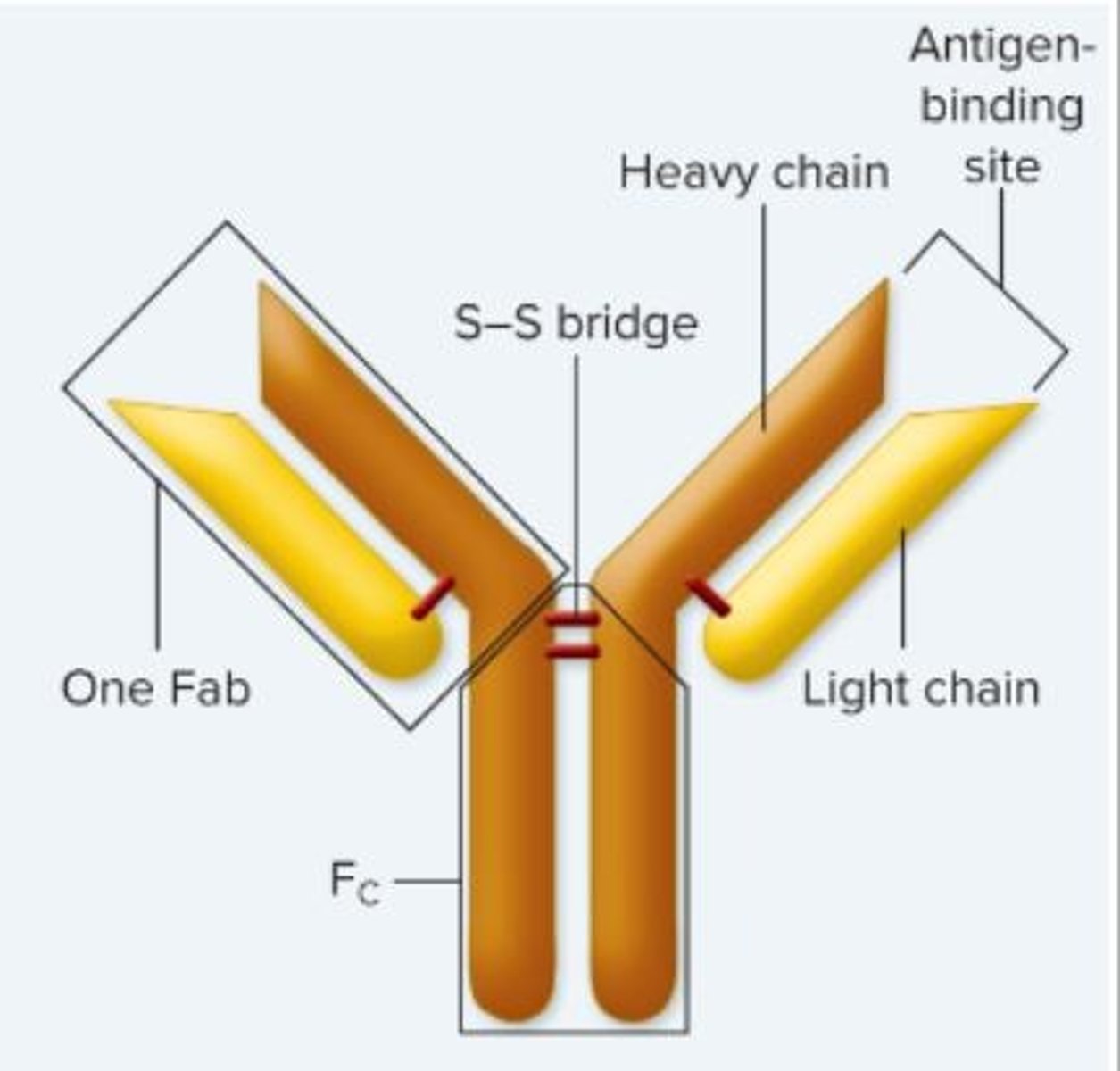
What is the difference between antibodies and B cell receptors?
Antibodies are soluble, while BCRs are membrane-bound.
What are the five classes of immunoglobulins?
IgG, IgD, IgM, IgA, and IgE.
Which immunoglobulin is the major one found in blood serum?
IgG.
Which immunoglobulin can cross the placenta?
IgG.
What is the first immunoglobulin produced in immune responses?
IgM.
What characterizes the primary antibody response?
A lag period with low antibody titer, where IgM appears first followed by IgG.
What is the secondary antibody response characterized by?
Shorter lag, more rapid log phase, longer persistence, and higher IgG titer.
What is opsonization?
The process of marking pathogens for recognition by phagocytes.
What are the two types of neutralization by antibodies?
Toxin neutralization and viral neutralization.
What is the role of IgM in agglutination?
IgM is primarily responsible for agglutination of pathogens.
What is the function of antibodies in neutralization?
To inhibit toxins or viruses from performing their functions.
What defines primary immunodeficiencies?
Genetic disorders that result in failure to recognize/respond to foreign antigens.
What defines acquired immunodeficiencies?
Immunodeficiencies resulting from infections by immunosuppressive microbes.
What is HIV's effect on T cells?
It attacks and kills CD4 (helper) T cells.
What is the threshold for T cell concentration to be classified as AIDS?
Less than 200 cells/microliter.
What is the role of complement components in viral neutralization?
They help prevent viruses from binding and entering target cells.
What is class switching in the context of antibody response?
The process of switching from one antibody class to another during an immune response.
What is innate immunity?
Innate immunity is the natural, first line of defense against pathogens, resistant to any microbe, and lacks memory.
How does innate immunity respond to pathogens?
Innate immunity responds at the same intensity regardless of the type of foreign invader.
What is adaptive immunity?
Adaptive immunity is acquired, resistant to specific foreign agents, and has memory, increasing effectiveness with each encounter.
What are the characteristics of innate immunity?
Innate immunity is the first line of defense, takes minutes/hours to activate, is nonspecific, and lacks memory.
What are the characteristics of adaptive immunity?
Adaptive immunity has memory, is specific to particular foreign agents, includes B and T cells, and takes days to activate.
What is immunity?
Immunity is the ability to resist a particular disease or infection.
What are the physical barriers in the immune system?
Physical barriers include skin and mucous membranes that inhibit pathogen entry.
How does skin function as a barrier?
Skin consists of stratified epithelial cells that produce keratin, effectively blocking invaders when intact.
What role do mucous membranes play in immunity?
Mucous membranes line internal structures and trap microbial invaders, providing both innate and adaptive immunity.
What is the mucociliary escalator?
The mucociliary escalator is a mechanism in the respiratory system that moves particles upwards away from the lungs.
What is gut-associated lymphoid tissue (GALT)?
GALT is a component of the GI tract that helps protect against pathogens that survive stomach acidity.
How does the genitourinary tract contribute to innate immunity?
The genitourinary tract maintains sterility through mechanisms like urine's low pH and the presence of normal microbiota.
What are chemical mediators in innate immunity?
Chemical mediators include antimicrobial peptides and proteins that serve as primary defense mechanisms.
What is lysozyme and its function?
Lysozyme is an enzyme that lyses bacteria by hydrolyzing glycosidic bonds, found in tears and mucous secretions.
What is lactoferrin?
Lactoferrin is an iron-binding glycoprotein that reduces iron availability to pathogens.
What are cationic antimicrobial peptides (CAMPs)?
CAMPs are positively charged peptides that exhibit broad-spectrum antimicrobial activity.
What are bacteriocins?
Bacteriocins are antimicrobial peptides produced by bacteria that inhibit or kill other bacterial strains.
What is the role of cathelicidins in innate immunity?
Cathelicidins are broad-spectrum antimicrobial peptides activated by proteolytic cleavage.
What are defensins?
Defensins are antimicrobial peptides released as precursor proteins, found in neutrophils and epithelial cells.
How do histatins function?
Histatins are found in saliva and have antifungal activity by targeting mitochondria.
What is the significance of the 'self' vs. 'non-self' distinction in immunity?
This distinction helps the immune system identify and respond to foreign invaders while ignoring the body's own cells.