L23a: surgical approaches to the abdominal cavity (small animal)
 Call Kai
 Learn
Learn Practice Test
 Spaced Repetition
 Match
Match Flashcards
 Knowt Play
1/40

There's no tags or description
Looks like no tags are added yet.
Name | Mastery | Learn | Test | Matching | Spaced | Call with Kai | Chat |
|---|
No analytics yet
Send a link to your students to track their progress
41 Terms
MCQ: after a routine ventral midline celiotomy in a dog, which tissue layer provides the greatest tensile strength and is considered the primary holding layer for abdominal closure?
external rectus sheath
celiotomy
surgical incision into the abdominal cavity
laparotomy
flank approach to the abdominal cavity
where do you make the incision for a ventral midline approach?
linea alba
what is the most used abdominal approach in small animal?
ventral midline
what are characteristics of the ventral midline approach?
minimal bleeding
exposure of all abdominal organs
easiest and quickest approach
where do you incise on a paramedian approach?
ventral abdominal incision parallel to the midline
what are the characteristics of the paramedian approach?
increased exposure to organs on one side
increased bleeding
increased closure time
where do you incise on the flank approach?
lateral incision between last rib and tuber coxae
what are the characteristics of the flank approach?
limited access to entire abdomen
excellent exposure of one kidney, one adrenal gland, and one ovary
how do you position a cat for a flank approach?
right lateral recumbency with the pelvic limbs extended caudally
what are the the points of the triangle in a flank approach in cats?
greater trochanter
wing of ilium
midpoint of the proposed incision
where do you incise in the paracostal approach?
caudal and parallel to the last rib
what are the combined abdominal approaches?
ventral midline plus median sternotomy
ventral midline plus paracostal
which abdominal approach has increased exposure of the cranial abdomen?
ventral midline plus median sternotomy
what abdominal approach requires assisted ventilation?
ventral midline plus median sternotomy
what abdominal approach has increased exposure of the gallbladder and liver lobes?
ventral midline plus paracostal
how long should the skin incision be for a ventral midline approach?
should be extended 1 cm cranial and caudal to the anticipated body wall incision
where is the linea alba in dogs most easily recognized?
cranial to the umbilicus
what vessels run parallel to the linea and cranial to the umbilcus?
cranial superficial epigastric vessels
what structure may be displaced or removed with the ventral midline approach?
falciform ligament
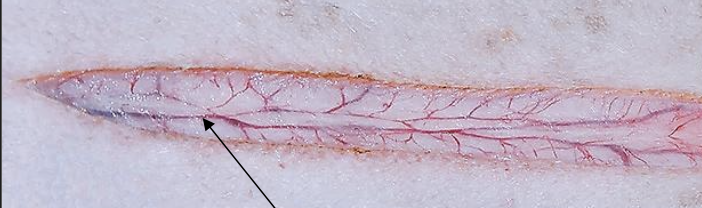
what is the arrow pointing to?
caudal superficial epigastric vessels
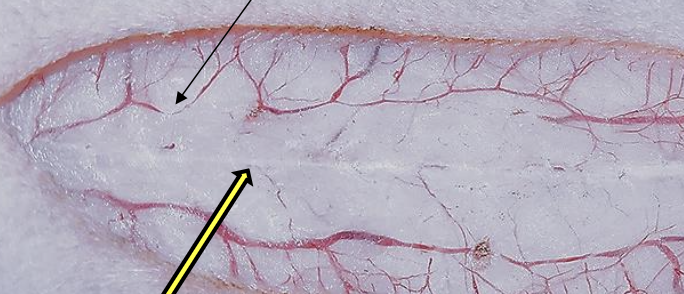
what is the yellow arrow pointing to?
linea alba

green box
linea alba
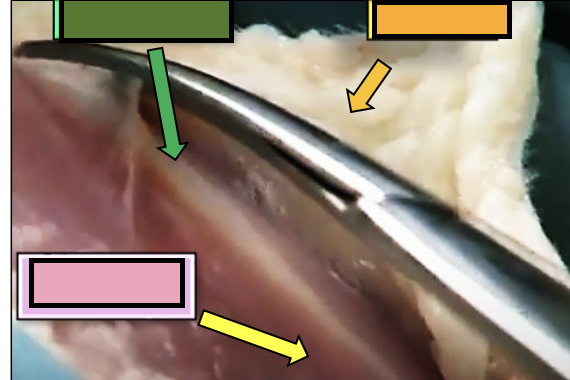
pink box
abdominal fascia

yellow box
subcutaneous layer
what muscle must be severed in half and ends tagged later for reattachment in male dogs during the ventral midline approach?
preputialis muscle
where do you push the omentum during the ventral midline abdominal approach?
pushed cranially

1
pancreas

2
mesocolon
what are the “anatomical retractors” in the abdomen?
mesocolon
what size suture do you use in a ventral midline closure in an animal below 5 kg?
3/0
what size suture do you use in a ventral midline closure in an animal between 5-20 kg?
2/0
what size suture do you use in a ventral midline closure in an animal 20-40 kg?
0
what size suture do you use in a ventral midline closure in an animal above 45 kg?
1
what is the holding layer of the ventral body wall?
external rectus fascia
where are sutures placed in the closure in a ventral midline approach?
placed 3-5mm apart and must incorporate 3-5mm of tissue
MCQ: when closing the linea alba following a routine ventral midline celiotomy in a dog, which type of suture needle is most appropriate to minimize tissue trauma while providing adequate penetration?
taper-cutting needle tip with a round body
what suture patterns do you use to close the abdomen in a ventral midline approach?
simple interrupted
simple continuous
how tight must sutures be in the closure of the ventral midline?
must achieve adequate apposition of the incised edges
how do you close the subcutaneous layer?
simple continuous or simple interrupted pattern, using 2/0 to 4/0 synthetic absorbable suture