TSA2 - struggle topics - TB3
 Call Kai
 Learn
Learn Practice Test
 Spaced Repetition
 Match
Match Flashcards
 Knowt Play
1/172

There's no tags or description
Looks like no tags are added yet.
Name | Mastery | Learn | Test | Matching | Spaced | Call with Kai | Chat |
|---|
No analytics yet
Send a link to your students to track their progress
173 Terms
What is hanging drop crystallisation?
Protein solution droplet is mixed with precipitant and equilibrates against a reservoir → water evaporates → protein concentration increases → crystals form.
What drives crystal formation in hanging drop crystallisation?
Vapour diffusion → water leaves the drop → increases supersaturation.
What are the main regions of a solubility phase diagram?
Undersaturated (no crystallisation), metastable (growth only), nucleation zone (crystals form), precipitation zone (amorphous solid).
What is supersaturation?
Condition where solute concentration exceeds solubility → required for nucleation.
Difference between nucleation and growth zones?
Nucleation zone forms new crystals; metastable zone allows growth of existing crystals only.
Why do atoms scatter X-rays?
X-rays interact with electron clouds → electrons oscillate and re-radiate electromagnetic waves (scattering).
Do scattered X-rays lose energy?
No, wavelength stays the same → only direction changes (elastic scattering).
Why do heavier atoms scatter more strongly?
They have more electrons → stronger re-radiated signal.
What produces diffraction patterns in crystals?
Interference of scattered X-rays from regularly arranged atoms.
What is Bragg diffraction?
Constructive interference of waves scattered from crystal planes at specific angles.
What is d-spacing?
Distance between parallel planes of atoms in a crystal.
What defines crystal planes?
Miller indices (h, k, l).
State Bragg’s Law
nλ = 2d sinθ
What does smaller d-spacing correspond to?
Larger diffraction angles → higher resolution.
Effect of higher Miller indices on d-spacing?
Higher indices → smaller d-spacing.
What determines position of diffraction spots?
D-spacing (plane spacing).
Why do small d-spacings give high resolution?
They correspond to finer structural detail.
What is autoindexing?
Process of determining unit cell, lattice type, and assigning Miller indices to diffraction spots.
What is reconstructed during autoindexing?
Reciprocal lattice.
What information is needed for autoindexing?
Spot positions, detector geometry, wavelength, detector distance.
What is data integration?
Measuring intensity of each diffraction spot and assigning it to Miller indices.
Why is intensity important?
It relates to structure factor amplitudes → needed for electron density.
How is spot intensity calculated?
Sum of pixel values − background.
What is the output of integration?
Table of reflections (hkl, intensity, error).
What is the phase problem?
Diffraction gives amplitudes but not phases → phases are needed for electron density.
What is a difference map?
Map showing difference between observed and calculated structure factors.
What do positive peaks in difference maps indicate?
Missing atoms.
What do negative peaks indicate?
Incorrectly placed atoms.
How are difference maps used?
Iteratively improve model → improve phases → improve electron density.
What is a Patterson map?
Map calculated from squared structure factor amplitudes (intensities) without phases.
What does a Patterson map show?
Vectors between atoms, not atomic positions.
What does each peak represent in a Patterson map?
Interatomic vector.
Why are heavy atoms prominent?
They scatter strongly → dominate peaks.
What is the origin peak?
Vector of atoms with themselves (always present).
How are Patterson maps used?
Locate heavy atoms → estimate phases.
Main limitation of Patterson maps?
Very complex → peaks overlap in large structures.
What is solvent flattening?
Set solvent region density to a constant low value to reduce noise.
What is solvent flipping?
Invert density in solvent regions to improve phases.
Why does solvent flattening work?
Solvent regions should have uniform density.
What is the purpose of density modification?
Improve phase estimates and electron density maps.
What is non-crystallographic symmetry (NCS)?
Symmetry between molecules not imposed by crystal lattice.
How is NCS used?
Averaging electron density between copies to reduce noise.
Why does NCS averaging improve maps?
Reinforces true signal and removes random noise.
What is anomalous scattering?
Wavelength-dependent scattering causing differences in Friedel pairs.
What are Friedel pairs?
Reflections related by inversion (normally equal intensities).
What is SAD?
Single wavelength anomalous diffraction → uses anomalous differences to estimate phases.
What is MAD?
Multi-wavelength anomalous diffraction → uses multiple wavelengths near absorption edge.
Advantage of MAD over SAD?
Removes phase ambiguity and improves accuracy.
Why are heavy atoms used in SAD/MAD?
They produce strong anomalous scattering.
What is molecular replacement?
Using a known similar structure to estimate phases.
What are the two main searches in molecular replacement?
Rotation search and translation search.
What is the goal of rotation search?
Find correct orientation of model.
What is the goal of translation search?
Find correct position in unit cell.
Why does molecular replacement work?
Similar sequences → similar structures.
What is the CTF?
Function describing how spatial frequencies are transferred by a microscope.
What does the envelope function do?
Dampens high-resolution signal.
What causes envelope decay?
Beam incoherence, motion, instability.
Why apply defocus in cryo-EM?
Convert phase contrast into intensity contrast.
Why use multiple defocus values?
Recover missing spatial frequencies.
What are Thon rings?
Rings in power spectrum showing CTF oscillations.
What determines resolution in cryo-EM power spectra?
Highest visible Thon ring.
What does astigmatism look like in power spectra?
Elliptical rings.
What is spherical aberration?
Outer rays focus differently than central rays → blur.
What is chromatic aberration?
Different energy electrons focus differently.
What is astigmatism?
Different focus in x and y directions.
What is coma?
Off-axis distortion causing asymmetric blur.
What improves cryo-EM map quality?
Averaging many aligned particles → improves SNR.
What is 2D classification?
Group similar particle images and average them.
What is Fourier shell correlation (FSC)?
Measure of resolution in cryo-EM.
What happens to nuclei in a magnetic field?
Align with or against field → net magnetisation (Mz).
What does an RF pulse do?
Tips magnetisation into transverse plane (Mxy).
What is T1 relaxation?
Recovery of longitudinal magnetisation.
What is T2 relaxation?
Decay of transverse magnetisation (dephasing).
What determines peak width in NMR?
T2 (short T2 → broad peaks).
What is the FID?
Signal from precessing spins in transverse plane.
What does Fourier transform do in NMR?
Converts FID (time) → frequency spectrum.
What does NOE measure?
Through-space interactions (~<5 Å).
What does COSY detect?
Through-bond (J-coupling) interactions.
What does TOCSY show?
Entire spin system via J-coupling.
What does NOESY show?
Spatially close nuclei via dipolar interactions.
What is HSQC?
Correlates 1H with directly attached heteronucleus (e.g. 15N).
What is TROSY?
Technique that reduces relaxation → sharper peaks for large proteins.
What are residual dipolar couplings (RDCs)?
Partial dipolar interactions observed when molecules are weakly aligned.
Why are dipolar couplings normally not observed?
Rapid tumbling averages them to zero.
What do RDCs measure?
Orientation of bond vectors relative to magnetic field.
What type of structural information do RDCs provide?
Long-range orientational constraints.
How do RDCs improve NMR structures?
Reduce ambiguity and improve global fold accuracy.
What is the effect of RDCs on structural ensembles?
Reduce RMSD → tighter clustering.
Does NMR have a single resolution value?
No, resolution is assessed using multiple metrics.
What is RMSD in NMR?
Measure of how similar structures in an ensemble are.
What does low RMSD indicate?
High precision (better resolution).
What improves NMR resolution?
More restraints (NOEs, RDCs), better data agreement.
What is the role of RDCs in resolution?
Improve accuracy by adding global constraints.
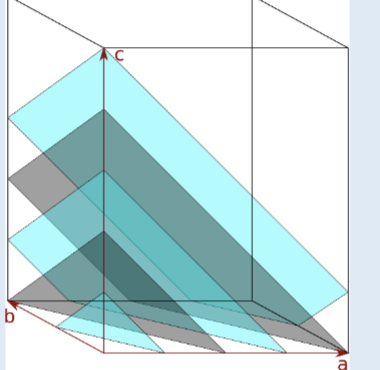
What are the miller indices for the lattive planes shown?
4,2,5
What do we mean by a substructure in crystallography?
A subset of atoms that can be solved separately from the bulk of the structure in order to calculate the phase contribution for a small, specific group of atoms (eg. by isomorphous replacement or anomalous scattering
What is non-crystallographic symmetry and how does it allow us to improve electron density maps?
Non-crystallographic symmetry occurs when more than one copy of a molecule occurs in the asymmetric unit of a crystal
The transformation required to map these molecules onto each other can be calculated and applied to the electron density, allowing averaging to be carried out improving signal and weighting down noise in the map
What relationship between pairs of reflections is described by Friedel’s Law?
The amplitudes of these reflections will be equal. The phases will have equal magnitude but opposite sign
When solving a structure by Molecular Replacement what do we mean by a search model?
A known structure sufficiently similar to the structure we are attempting to solve that it can provide a reasonable estimate for phase information once correctly positioned and oriented in the experimental unit cell
Which nuclear isotope used in protein NMR spectroscopy is the most sensitive to detect? Briefly explain why.
1H
It has the largest gyromagnetic ratio
Name two key differences in refinement of X-ray structures and cryo-EM structures
X-ray in reciprocal space, cryo- EM in real space.
X-ray phases/map improve during refinement, cryo-EM map does not (model just interprets map)