Unit 4: Electrons and Light
 Call Kai
 Learn
Learn Practice Test
 Spaced Repetition
 Match
Match Flashcards
 Knowt Play
1/33

There's no tags or description
Looks like no tags are added yet.
Name | Mastery | Learn | Test | Matching | Spaced | Call with Kai | Chat |
|---|
No analytics yet
Send a link to your students to track their progress
34 Terms
Energy Level
a region of an atom in which electrons of the same energy are likely to be found (the energy levels 1, 2, 3)
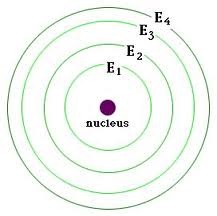
Subshell
A subdivision of an energy level in an atom. They are divided into orbitals. Subshell s, p, d, f
Orbital
In which the subshells are divided and are slots
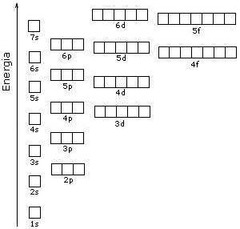
Subshell s
1 orbital, maximum # of 2 electrons
Subshell p
3 orbitals, maximum # of 6 electrons
Subshell d
5 orbitals, maximum # of 10 electrons
Subshell f
7 orbitals, maximum # of 14 electrons
Energy level 1 (1st row)
Has subshell s and up to 2 electrons
Energy level 2 (2nd row)
Has subshell s (2 e-) and p (6 e-)
Energy level 3
Has subshell s (2 e-), p (6 e-), and d (10 e-)
Energy level 4
Has subshell s (2 e-), p (6 e-), d (10 e-), and f (14 e-)
Electron configuration
On the surface, showing the arrangement of the energy levels, subshell, and how many electrons in each subshell telling us, where a specific element is located.
Orbital notation
Another way of telling us where a specific element is located through a diagramic representation that uses arrows to show the specific location of each electron in its orbitals that is in each subshell and energy level.
Wavelength
Horizontal distance between the crests or between the troughs of two adjacent waves
Symbol: λ, which is called lambda
Common units: Meters, nanometers (nm)
Frequency
The number of complete waves that pass a given point in a certain amount of time
Symbol: nu (ν, f)
Common units: hertz (hz)
Relationship between wavelength and frequency
inversely proportional: increasing wavelenth, decreasing fequency; decreasing wavelength, increasing frequency
Relationship between energy and frequency
directly proportional: energy increases, frequency increases; energy decreases, frequency decreases
Visible light
electromagnetic waves that are visible to the human eye
Order of colors of visible lights based on its wavelength large to small
Red, Orange, Yellow, Green, Blue, Indigo, Violet
All electromagnetic radiation travels at the same speed of.....
light (c) which equals 3x10^6
Relationship between speed and wavelength/frequency
As wavelength gets shorter, the frequency increases, while the speed stays the same
Speed of light equation
c=λv
How does an element emit light
In an atom, the electrons absorb energy which makes them get excited allowing them to move up the energy rings. Then the excited electron falls back down, because of its attraction to the protons, releasing energy as light.
Columbic Attraction
The attraction between oppositely charged particles (+/-)
Why does the columbic attraction work the way it does?
The protons are positive and the electrons are negative, so the protons in the nucleus of an atom have attraction for the electrons surrounding the nucleus
How does the attractive forces vary
The attractive forces can be weak or strong depending on 2 things: the distance between the oppositely charged particles and the number of protons
The distance between the particles affect the attractive force
The farther the particles, the weaker the attractive force
The closer the particles, the stronger the attractive force
The number of protons affect the attractive force
The more the protons the stronger the attraction it has on the electrons
The fewer the protons the weaker the attraction it has on the electrons
Atomic radius
the (half) distance from the nucleus to the outer most electrons
Periodic trends on atomic radius
Atomic radius increases going down a group
- There are more rings at each energy level
Atomic radius decrease across a period
- The energy level stays the same but there are more protons which means there is a tighter hold on the electrons from the nucleus, making the distance between the two smaller
Diagnally up the atomic radius decreases and diagnally down it increase
Ionization energy
The amount of energy required to remove an electron from an atom
Periodic trends on Ionization energy
Ionization energy decreases down a group
- the atom is becoming larger --> the nucleus is furhter from the electrons, requiring less energy to overcome the force of attraction
Ionization energy increases across a period
- Since the atomic radius is getting smaller, the electrons are closer to the nucleus where the protons have a stronger force of attraction, more energy needed to overcome
Electronegativity
An atoms ability to attract an electron from a DIFFERENT atom
Periodic trends on Electronegativity
Electronegativity decreases down a group
- a greater distance between the nucleus and a different atom, causing a lower force of attraction, higher ability to pull an electron
Electronegativity increases across a period
- Since the atomic radius is getting smaller, the electrons are closer to the nucleus where the protons have a stronger force of attraction, making it be a lower ability to pull an electron off of a different atom