PSYSOCI Modules 6-13
 Call Kai
 Learn
Learn Practice Test
 Spaced Repetition
 Match
Match Flashcards
 Knowt Play
1/73

There's no tags or description
Looks like no tags are added yet.
Name | Mastery | Learn | Test | Matching | Spaced | Call with Kai | Chat |
|---|
No analytics yet
Send a link to your students to track their progress
74 Terms
Social Facilitation
Psychological tendency to perform better on simple or well-practiced tasks, and worse on complex or unfamiliar tasks, when in the presence of others
Who Discovered Social Facilitation?
Norman Triplett
Who Expanded on Social Faciliation?
Robert Zajonc (dominant response)
Triplett’s Experiment
Represented one of the first attempts to apply laboratory methods to social behavior and first laboratory experiment
Triplett’s 1898 Model
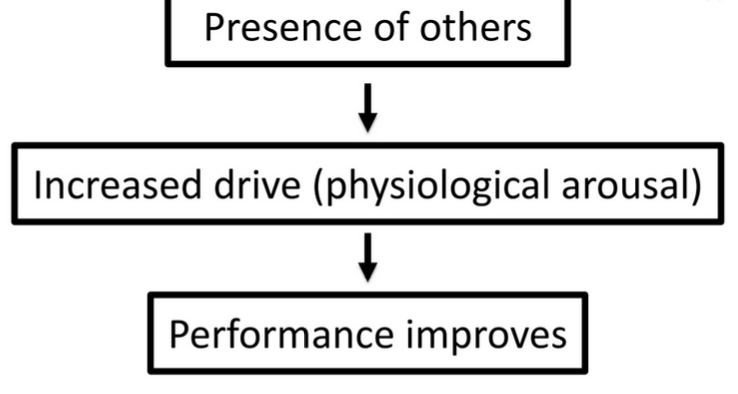
Robert Zajonc’s Drive Theory of Social Facilitation
Explains why the presence of others improves performance on well-learned tasks but can impair performance on novel or difficult tasks
Zajonc’s Drive Theory (1965)
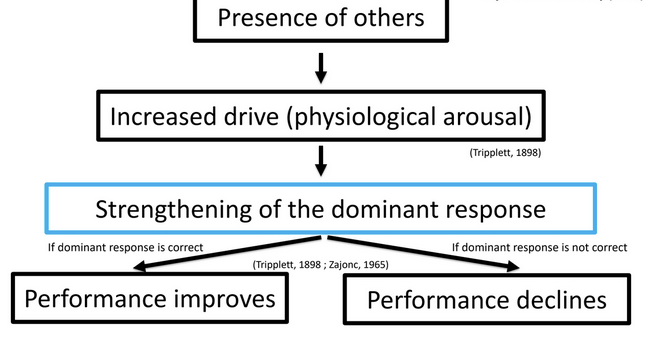
Allport (1920s)
Co-Action vs. Competition
Co-action
Doing the same action with others (no direct competition)
Competition
Doing the same action with others in competition
Action with the audience
Doing the performance while others who are not doing the same action are observing
Mere Presence Effect
The physical presence of other people naturally increases a person’s physiological arousal
Cottrell’s Evaluation Apprehension Theory (1968)
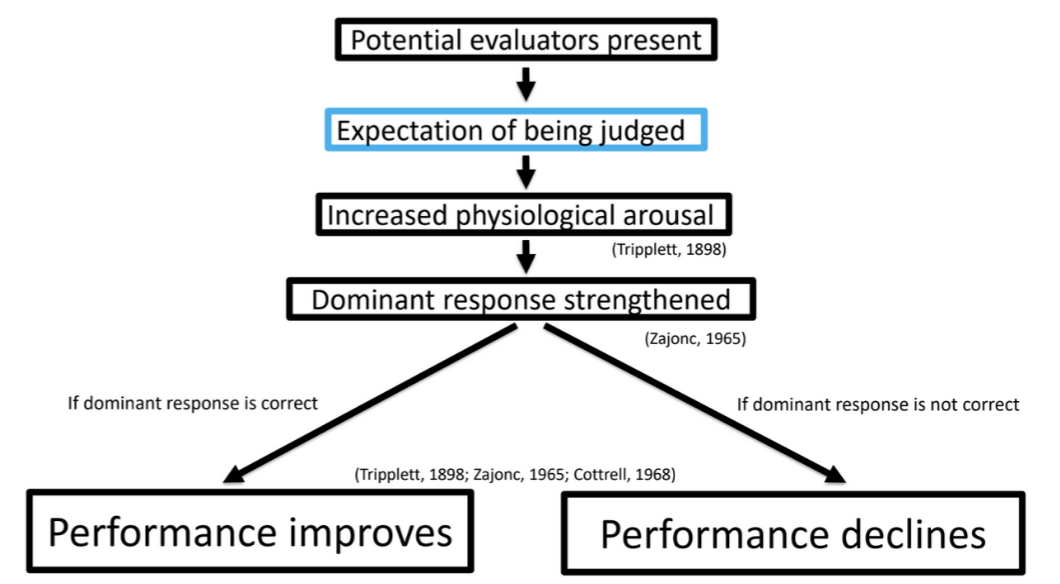
Evaluation Apprehension Theory
We become aroused because we anticipate judgment; type of audience is important
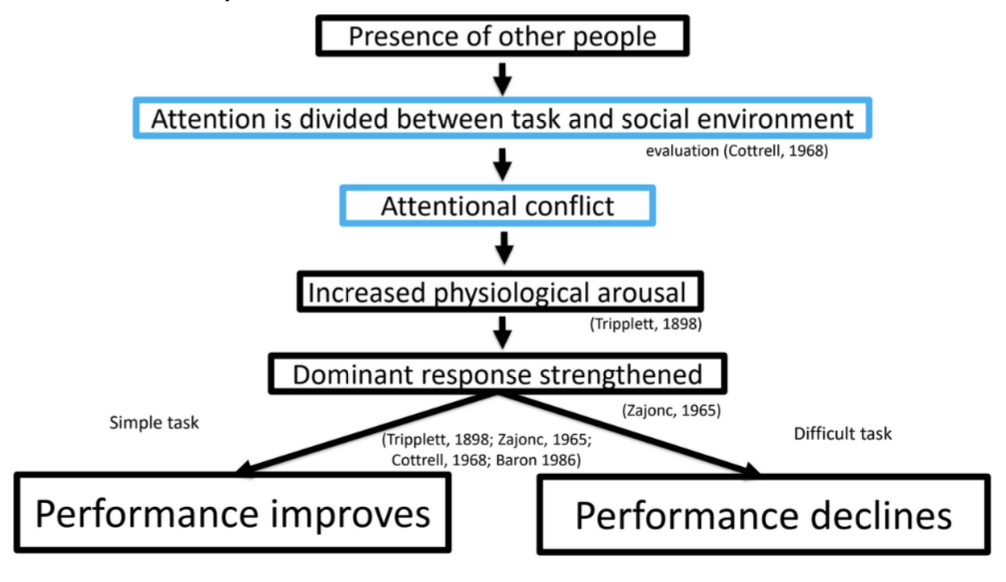
Distraction Conflict Theory
The presence of others creates an attentional conflict between focusing on a task and monitoring the audience → The divided attention increases physiological arousal, which subsequently improves performance on simple tasks but impairs it on complex tasks
Baron’s Distraction-Conflict Theory (1986)
Triplett
Competition matters; showed that performing with others can change behavior
Allport
Competition is not necessary; co-action
Zajonc
Mere presence matters
Cottrell
Evaluation matters; arousal comes from the belief that other people are evaluating you
Baron
Distraction matters; attentional conflict can also generate necessary arousal
Social Influence
The process by which individual thoughts, feelings, and behaviors are shaped by the real or imagined presence of others, operating primarily through conformity, compliance, and obedience
Sherif’s International Social Influence Model (1935)
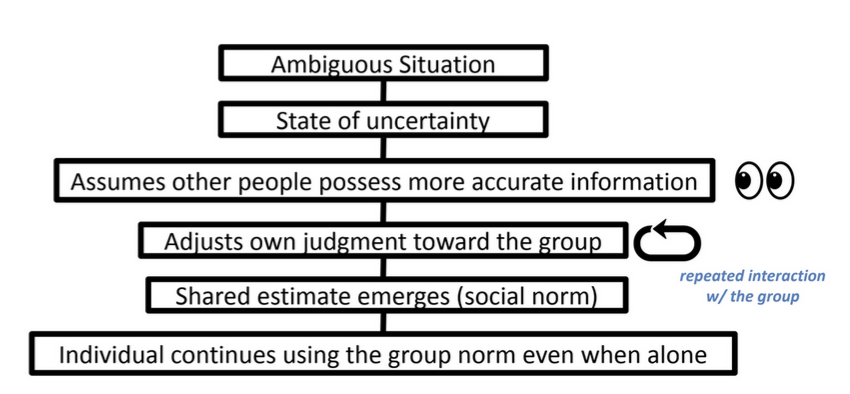
Outcomes from Sherif’s Experiment
Social norms emerge naturally, ambiguity increases social influence, and perception is socially constructed
Informational Social Influence (Sherif, 1935)
Conforming because others are perceived as a valuable source of information
Normative Social Influence (Asch, 1951)
Conforming to gain approval or avoid disapproval
Ambiguity in Social Influence
The less objective evidence people have, the more they rely on others
Expertise in Social Influence
Later research showed that people are even more likely to accept information from individuals perceived as knowledgeable
Uncertainty in Social Influence
Modern research in judgment and decision making shows that uncertainty often increases reliance on social cues; universal
Culture in Social Influence
Collectivistic culture often show stronger conformity
Key Takeaways from Social Influence
Uncertainty leads people to seek information from others & the desire for social acceptance can outweigh the desire to be correct
Social Modeling / Social Learning Theory
People acquire new behaviors, attitudes, and emotional reactions by observing and imitating others within a social context
Albert Bandura
Social Modeling
The Bobo Doll Experiment
1961 study by psychologist Albert Bandura that proved children learn aggressive behaviors by watching and copying adults. The study used 72 children, an inflatable toy, and different adult behaviors
Learning
Acquiring knowledge; children may learn things but may not immediately use them
Performance
Displaying Behavior; may depend upon opportunity, motivation and expected consequences
Self-Efficacy
Belief in one's ability to perform successfully; behavior results from continuous interaction among personal factors, behavior, & environment
Social Modeling Key Takeaways
Children can acquire aggressive behaviors by observing others, even without direct reinforcement and people can learn simply by observing others (vicarious learning)
Cognitive Dissonance
Individuals experience psychological discomfort (dissonance) when they simultaneously hold two or more inconsistent cognitions. Individuals attempt to reduce the resulting discomfort through various cognitive and behavioral strategies
Example of Cognitive Dissonance
Smoking: Knowing tobacco causes cancer yet smoking to relieve stress. People cope by telling themselves it helps them relax or that everyone dies of something anyway.
Leon Festinger and Carlsmith (1959)
Cognitive Dissonance Theory
Self-Affirmation Theory (Steele, 1988)
People can reduce dissonance by affirming valued aspects of the self rather than changing their attitudes
Cognitive Dissonance Key Takeaway
People are motivated not only by external rewards but also by a desire for internal consistency; when attitudes, beliefs, and behaviors conflict, individuals experience psychological discomfort and employ various strategies to reduce that discomfort
Bystander Effect
Individuals are less likely to offer help to a victim when other people are present. The likelihood of intervention decreases as the number of onlookers increases
Diffusion of Responsibility (Darley & Latané, 1968-1970)
Individuals often fail to help not because they lack compassion, but because responsibility becomes psychologically diffused across multiple witnesses
Five-Step Decision Model of Helping
Notice the event → Interpret it as an emergency → Accept personal responsibility → Know how to help → Decide to implement assistance (failure at any stage reduces the likelihood of intervention)
Darley & Latané (1968) Key Takeaways
The presence of other people can paradoxically reduce the likelihood that anyone will help during an emergency.
Intergroup Competition
Many social conflicts stem not from individual personalities or inherent hostility, but from competition over valued yet limited resources
Realistic Conflict Theory (Sherif, 1966)
Prejudice, hostility, and discrimination between groups arise from competition over scarce or limited resources, such as jobs, land, power, or money.
Groups Naturally Form Social Identities
Resources Are Limited
Competition Produces Conflict
Cooperation Reduces Conflict
Cooperation Reduces Conflict
When groups must cooperate to achieve a shared objective, hostility gradually decreases. This occurs because both groups recognize that success depends upon mutual cooperation
Competition Produces Conflict
Conflict becomes increasingly likely
Resources Are Limited
Many resources cannot be shared equally. Competition emerges when groups pursue the same limited resource
Groups Naturally Form Social Identities
People naturally categorize themselves into groups. These identities become psychologically meaningful
Zero-Sum Competition
One group's success appears to require another group's loss
Ingroup Favoritism
People begin favoring their own group. There is greater trust, preferential treatment & positive stereotypes
Outgroup Derogation
Negative beliefs develop about competitors.
Intergroup Competition Key Takeaways
The Robbers Cave Experiment demonstrated that intergroup conflict is not an inevitable consequence of personality or cultural differences but can emerge from competition over valued resources.
Social Identity Theory (Tajfel & Turner, 1979)
A person's self-concept is derived not only from their personal identity but also from their membership in social groups. Individuals strive to maintain a positive social identity because belonging to valued groups contributes to self-esteem and psychological well-being
Basic Assumptions of Social Identity Theory
People Possess Multiple Social Identities
Group Membership Contributes to Self-Esteem
People Seek Positive Distinctiveness
Intergroup Comparisons Are Inevitable
Intergroup Comparisons Are Inevitable
Groups rarely exist in isolation. “Us” vs “Them” divide
People Seek Positive Distinctiveness
Individuals want their own group to compare favorably with relevant outgroups
Group Membership Contributes to Self-Esteem
People derive psychological value from belonging to groups they perceive as successful, respected, prestigious, morally good, & competent
People Possess Multiple Social Identities
Individuals simultaneously belong to many groups. Each identity becomes more or less important depending on the social context
Cognitive Processes of Social Identity Theory
Social Categorization, Social Identification, Social Comparison
Social Categorization
People simplify the social world by placing themselves and others into categories
Social Identification
Individuals adopt the identity of the group to which they belong
Social Comparison
People compare their own group with relevant outgroups
In-Group Favoritism
People preferentially evaluate members of their own group. Ingroup favoritism does not always require outgroup hostility
Outgroup Bias
People may evaluate members of other groups less favorably. Outgroup bias often emerges from ordinary cognitive categorization rather than personal animosity
Tajfel’s Minimal Group Paradigm
Simply dividing people into groups is enough to produce ingroup favoritism, even when there is no competition, conflict, or prior relationship
Role
Social roles influence expectations and behavior (ex: Stanford Prison Experiment sought to test how deeply these roles could shape actions in a realistic institutional setting)
Stanford Prison Experiment
Suggested that ordinary people quickly conform to assigned social roles and power dynamics; Prison environment fostered deindividuation, role conformity, dehumanization, diffusion of responsibility, & obedience to institutional norms
Deindividuation
Previous research suggested that anonymity and group membership reduce personal accountability (ex: uniforms, mirrored sunglasses, and institutional settings would facilitate deindividuation among guards)
Social Identity Theory (Reicher & Haslam, 2006)
Abusive behavior depends not merely on role assignment but also on identification with group norms and authority