Chem Gas
 Call Kai
 Learn
Learn Practice Test
 Spaced Repetition
 Match
Match Flashcards
 Knowt Play
1/6

There's no tags or description
Looks like no tags are added yet.
Name | Mastery | Learn | Test | Matching | Spaced | Call with Kai | Chat |
|---|
No analytics yet
Send a link to your students to track their progress
7 Terms
explain qualitatively in terms of intermolecular forces and molecular size:
(i) the conditions necessary for a gas to approach ideal behaviour
(i) low pressure and high temperature
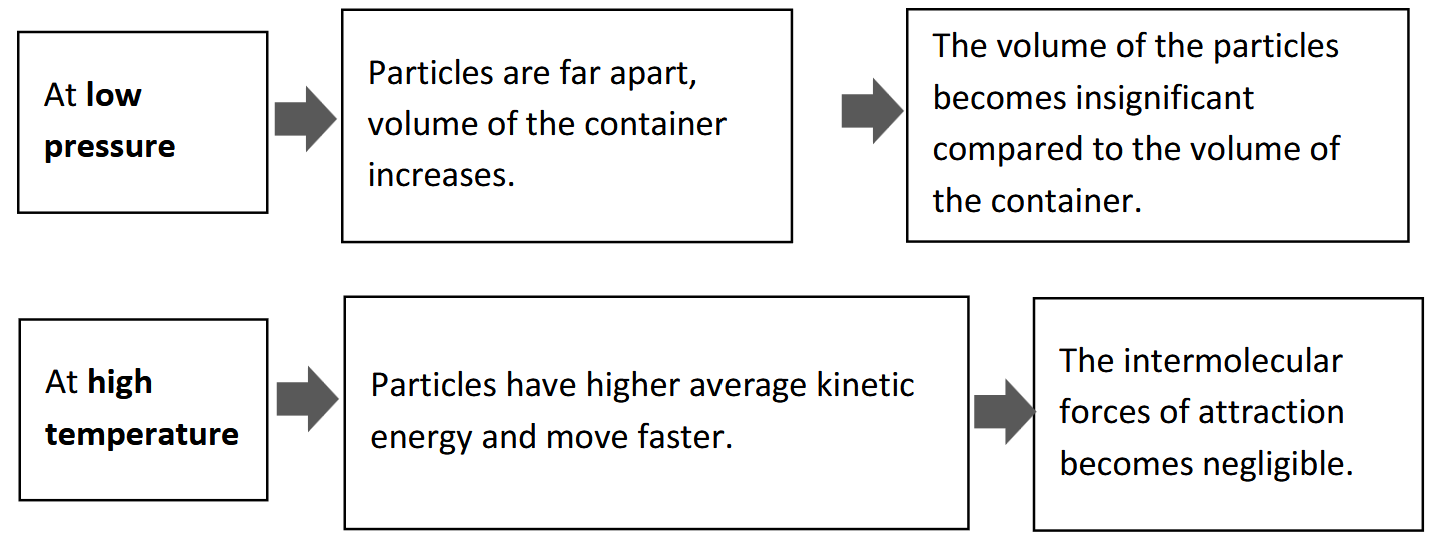
why do gases deviate from ideality more at higher pressure?
Gases deviates from ideal behaviour more at a higher pressure, because
o volume of container decreases and the particles are packed closer together,
o so the volume of the particles become significant compared to the volume of container.
why do gases deviate from ideality more at lower temperature?
Gases deviates from ideal behaviour more at a lower temperature because
o the particles have less average kinetic energy and will move slower, hence collide
with one another with less force.
o This makes the intermolecular forces of attraction more significant compared to the forces of intermolecular collisions.
state the basic assumptions of the kinetic theory as applied to an ideal gas
** 1. There are no intermolecular forces of attraction between the particles of an ideal gas.
** 2. The volume of the ideal gas particles is negligible as compared to the volume of the container.
* 3. Collisions between particles of an ideal gas are perfectly elastic, i.e. there is no loss of kinetic energy upon collision.
4. Gas particles (atoms, molecules) are in rapid, continuous and random motion.
5. The average kinetic energy of the particles is proportional to its absolute temperature measured in Kelvin.
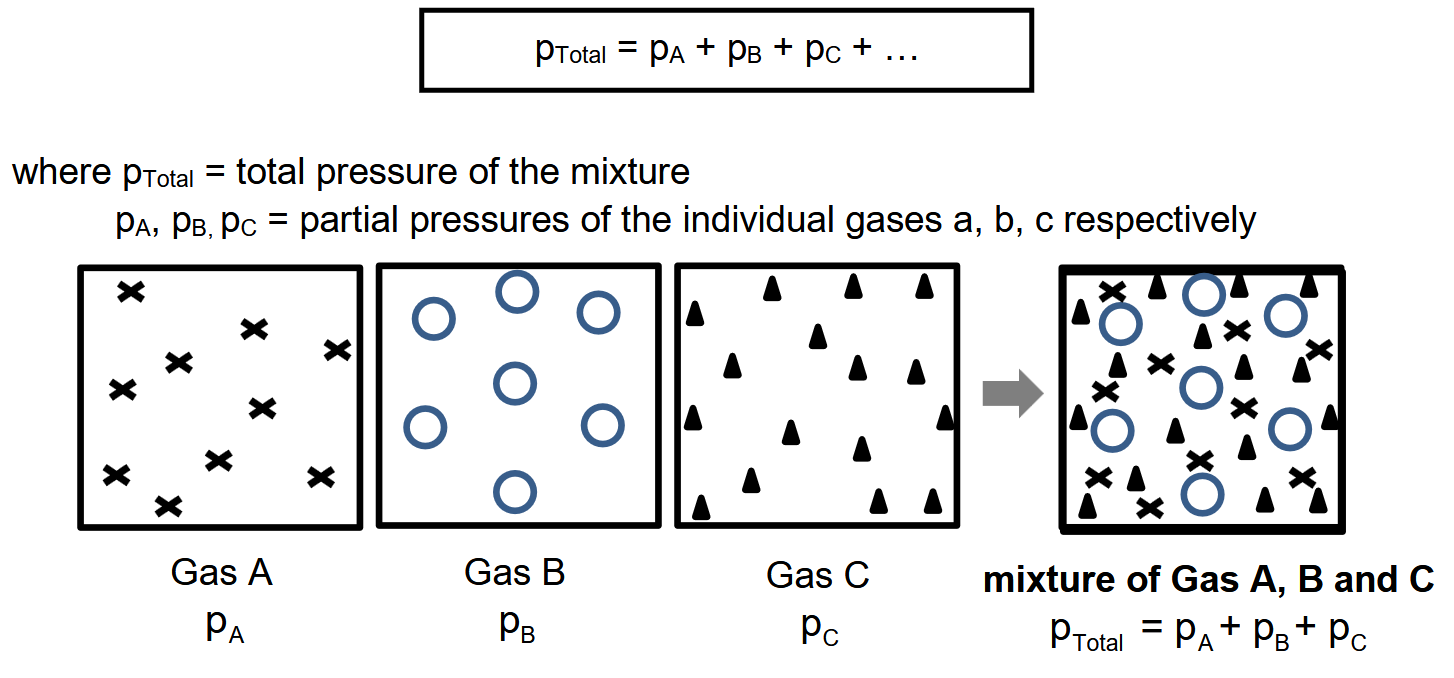
use Dalton’s Law to determine the partial pressures of gases in a mixture (see also Chemical Equilibrium)
When a mixture of gases that do not react with each other is confined into a container, the
gas behaves as if it were the only gas present. Partial pressure of a gas is the pressure
that each gas would exert if it alone occupied the container.
• Dalton’s law of partial pressure states that the total pressure of a mixture of gases that do
not react chemically with one another is the sum of the partial pressures of the constituent
gases.
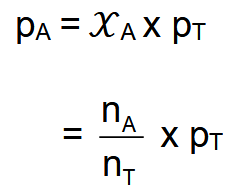
how to calculate partial pressure using moles?
what is the ideal gas law?
pV = nRT
p is pressure in Pa
V is volume in m³
R is molar gas constant = 8.31 J K-1
T is temperature in K