HTL 1.1-1.2
 Note
Note Call Kai
 Learn
Learn Practice Test
 Spaced Repetition
 Match
Match Flashcards
 Knowt Play
1/52

There's no tags or description
Looks like no tags are added yet.
53 Terms
Which of the following terms describes glyoxal?
a. aliphatic hydrocarbon
b. aromatic hydrocarbon
c. aldehyde
d. alcohol
C.
Glyoxal is an aldehyde that may be used as a fixative. Both aliphatic and aromatic hydrocarbons are used as clearing agents. Xylene is an aromatic hydrocarbon; many of the aliphatic hydrocarbons are proprietary. Alcohols end in “ol”, as in ethanol, and not in “al”
Paraformaldehyde is a polymer of which of the following?
a. paraldehyde
b. formaldehyde
c. acetaldehyde
d. glutaraldehyde
B.
Paraformaldehyde can be depolymerized to yield formaldehyde solutions that do not contain methanol.
Paraldehyde is a controlled substance used in the preparation of aldehyde fuchsin. Acetaldehyde which is not a controlled substance may be used to prepare aldehyde fuchsin instead of paraldehyde.
Glutaraldehyde is a dialdehyde also used as a fixative
What amount of commercial stock formaldehyde solution is present in 450 mL of 10% formalin?
45 mL of commercial stock formaldehyde solution is present in 450 mL of a 10% formalin solution. 10% formalin is a 1:10 dilution of commercial stock formaldehyde solutions
What is the real percentage of formaldehyde in the 10% formalin solution?
The real percentage of formaldehyde in the 10% formalin solution is 3.7%-4% as commercial stock solutions of formaldehyde contain 37-40% formaldehyde; a 1:10 dilution would then give you a 3.7%-4% actual formaldehyde solution
Tissue that is well-fixed in 10% neutral buffered formalin will demonstrate:
a. good fixation of lipids
b. lysis of red blood cells
c. stabilization of proteins
d. increased enzyme activity
C.
The main purpose of fixation is the stabilization of proteins. The other answers are incorrect as formaldehyde does not fix lipids, does not lyse RBC’s, but it does stop enzyme activity. If the fixation and preservation of lipids is desired, then an osmium tetroxide fixative should be used. Fixatives containing acetic acid will lyse red cells, but NBF does not contain acetic acid. One of the purposes of fixation is to prevent autolysis, the result of enzymatic activity
If microwave fixation is used, the maximum temperature must be no higher than:
a. 48°C
b. 58°C
c. 68°C
d. 78°C
C.
If the temperature is allowed to go above 68°C the tissue will show pyknotic, overstained nuclei. There may also be a loss of antigenicity an lysis of red cells
Non-coagulant describes which of the following fixative ingredients?
a. mercuric chloride
b. picric acid
c. formaldehyde
d. zinc salts
C.
Formaldehyde is a non-coagulant, but mercuric chloride, picric acid, and zinc salts are all coagulants
Describe the effect on cells of:
a hypotonic fixative
a hypertonic fixative
an isotonic fixative
water from a hypotonic fixative will be drawn into the cell in an effort to equalize the tonicity; this will cause swelling and possible rupture of the cell membrane
water will be drawn from the cell by hypertonic fixatives in an attempt to equalize the tonicity; this will cause shrinkage of the cll
isotonic fixatives will neither shrink nor swell the cell
If desired, formalin pigment may be removed from tissue sections by treating with:
a. running water
b. potassium permanganate
c. alcoholic iodine
d. alcoholic picric acid
D.
An alcoholic solution saturated with picric acid is commonly used to remove formalin pigment. Iodine followed by sodium thiosulfate is used to remove mercury pigment, and potassium permanganate is used to bleach melanin pigment. Running water will not remove any of these pigments
A fresh tumor specimen is sampled for electron microscopy (EM) and put into fixative for transportation to the laboratory early the next morning. To what thickness should the tumor sample be cut for good fixation for EM?
For good fixation, tissue specimens for EM should be cut no more than 1 mm in thickness or diced into very small 1 mm cubes
What is the choice of fixative for EM specimens to be held overnight before transportation to the EM lab?
If not supplied by the electron lab, an optimal choice of fixative for transport to the lab would be the Modified Millonig fixative, commercially available and a fixative that can be used for both light and electron microscopy studies. Also Zamboni PAF fixative, consisting of phosphate buffered paraformaldehyde, penetrates rapidly and stabilizes proteins and organelles. Glutaraldehyde should not be used for primary fixation for longer than 2-4 hours. Osmium tetroxide should not be used as a primary fixative but rather as a secondary fixative for retention of phospholipid in cell membranes
Michel Transport Medium, used for transporting unfixed biopsies, especially for immunofluorescence studies, consists of a buffered solution saturated with:
a. magnesium sulfate
b. ammonium sulfate
c. N-ethylmaleimide
d. citric acid
B.
1L of Michel Transport Medium contains 412.3g of ammonium sulfate. Magnesium sulfate, N-ethylmaleimide, and citric acid are all components of Michel but are used in very small quantities. The large amount of ammonium sulfate in the solution is useful for fixing or immobilizing tissue immunoglobulins. N-ethylmaleimide limits proteolytic activity. Michel medium should be kept at a pH of 7.0-7.2 for best results
List 3 non-additive fixative ingredients
acetone
acetic acid
alcohols
The recommended ratio of fixative to tissue is:
a. 1:2
b. 1:20
c. 20:1
d. 2:1
C
15-20 volumes of fixative should be used to adequately fix tissue; this is a ratio of 15:1 or 20:1. 1 volume of fixative to 2 volumes of tissue, 1 volume of fixative to 20 volumes of tissue, and 2 volumes of fixative to 1 volume of tissue would not provide enough fixative to fix the tissue
Which of the following fixatives does not contain an aldehyde?
a. Bouin
b. Zamboni
C. Helly
d. Zenker
D.
Bouin, Zamboni, and Helly fixatives all contain formaldehyde, but Zenker fixative does notLis
List the ingredients in Bouin fixative
formaldehyde
picric acid
acetic acid
Which of the following fixative solutions does NOT contain mercuric salts?
a. Helly
b. B-5
c. Orth
d. Zenker
C.
Orth solution does not contain any mercuric salt; it contains only potassium dichromate, sodium sulfate, and formaldehyde. Helly, B-5, and Zenker solutions all contain mercuric chloride and are very hazardous
Methyl alcohol is often substituted for ethyl alcohol in which of the following fixative solutions?
a. Carnoy
b. Clark
c. Bouin
d. Hollande
A.
Methyl alcohol is often substituted for ethyl alcohol in Carnoy solution. It is known as methacarn. Clark fluid contains absolute ethyl alcohol and acetic acid, and it is not common to substitute methyl alcohol in this solution. Bouin and Hollande solutions do not contain alcohol
How are Helly and Zenker solutions alike? How do they differ?
Helly and Zenker solutions are alike in that both contain potassium dichromate and mercuric chloride, but they differ in that Helly contains formaldehyde and Zenker contains acetic acid.
H&E-stained sections show marked lysis of the red blood cells. Fixation in which of the following could cause this:
a. 10% neutral buffered formalin
b. Bouin solution
c. zinc formalin
d. B-5
B
The acetic acid in Bouin solution will cause lysis of the red blood cells. None of the other fixatives contains acid, so the red blood cells will not be lysed with their use.
A specimen suspected of gout is brought to the laboratory. The fixative of choice for some of the tissue sections is:
a. Orth solution
b. 10% neutral buffered formalin
c. absolute alcohol
d. Hollande solution
The demonstration of urate crystals is desired for a diagnosis of gout. Urate crystals are soluble in aqueous fixatives, so absolute alcohol should be used for fixation and preservation of these crystals. The other fixatives listed are aqueous fixatives and would not preserve urate crystals.
Acetic acid is added to some fixatives because of which of the following effects on tissue?
a. softening
b. swelling
c. shrinkage
d. additive
B.
Acetic acid swells tissue and is added to some fixatives to counteract the shrinking effect of another ingredient. Acetic acid is not added because of its softening effect, and it is not an additive fixative.
List the 3 ingredients in Carnoy solution. How does this differ from methacarn?
Carnoy solution contains ethyl alcohol, acetic acid, and chloroform. Methacarn contains methyl alcohol, acetic acid, and chloroform.
Which of the following ingredients is common to Bouin, Hollande, Gendre, and Zamboni solutions?
a. acetic acid
b. copper acetate
c. picric acid
d. alcohol
C
Picric acid is in Bouin, Gendre, Hollande, and Zamboni solutions. Zamboni solution does not contain acetic acid; only Hollande solution contains copper acetate; and only Gendre solution contains alcohol.
H&E sections of liver reveal marked shrinkage. Which of the following primary fixatives could have caused this?
a. alcohol
b. neutral buffered formalin
c. Bouin solution
d. glyoxal
A
Alcohol, if used alone, will cause marked shrinkage; neutral buffered formalin, Bouin solution, and glyoxal will not.
Overhardened tissue is noted when embedding and sectioning.Which of the following should be investigated as the cause?
a. delay in beginning fixation
b. prolonged time of fixation
c. shortened time of dehydration
d. incomplete clearing
B
Tissue may become overhardened if the process is prolonged, especially with some fixatives. A delay in beginning fixation will cause autolysis, but not overhardening of the tissue. Prolonged dehydration may cause overhardening, but shortened dehydration will not. Incomplete clearing will not cause overhardening.
Formaldehyde primarily adds on to tissue proteins at which of the following groups?
a. -COОН
b. -SH
с. -ОН
d. -NH
D
Formaldehyde primarily reacts with tissue proteins at the amino (–NH2) group, with the eventual formation of a methylene bridge. The heavy metals (eg, chromium and mercury) add on, or react, with the -COOH, -OH, and-SH groups.
Breast biopsies to be used for HER2 testing must be fixed for:
a. 4 hours minimum and 24 hours maximum
b. 6 hours minimum and 36 hours maximum
c. 4 hours minimum and 48 hours maximum
d. 6 hours minimum and 48 hours maximum
D
In a 2007 guideline released through a collaboration between the American Society of Clinical Oncology and the College of American Pathologists, incisional and excisional biopsies used for HER2 testing should be fixed in 10% neutral buffered formalin for a minimum of at least 6 hours and a maximum of 48 hours.
Define the following and relate them to formaldehyde
1. PEL
2. STEL
3. Action level
1. PEL is the permissible exposure limit over an 8-hour period and is 0.75 ppm for formaldehyde
2. STEL is the short-term exposure limit and is 2 ppm over a 15-minute period for formaldehyde
3. Action level may be defined as the working level over an 8-hour period and is 0.5 ppm for formaldehyde with no further monitoring required
List 3 fixative ingredients that can cause pigment formation during fixation or processing. How is each removed?
Pigments may be formed during fixation by formaldehyde and mercuric salts. Black acid hematin (formalin pigment) is removed by a saturated alcohol solution of picric acid or 100 ml 70% alcohol containing 3 ml of ammonium hydroxide; mercuric pigments can be removed by iodine followed by sodium thiosulfate. Chromate pigments, caused by contact with alcohol following incomplete washing after fixation, can be prevented by thorough washing before alcohol contact; it cannot be removed.
Tissue fixed in Bouin solution and stored for months reveals very poor staining. The most likely cause of this problem is that the picric acid:
a. used in solution preparation contained too much water
b. was not neutralized before the tissue was processed
c. added to the tissue
d. coagulated the tissue proteins
B
If the excess picric acid is not neutralized before sections are processed, the staining characteristics will change over time. Picric acid can be washed out and neutralized with alcohol containing lithium carbonate. A saturated picric acid solution is used in the preparation of Bouin solution, so water in the stock picric acid would not matter. Picric acid is an additive fixative and a coagulant of tissue proteins, and this will not cause longterm problems.
One of the major uses of acetic acid in fixatives is the precipitation and preservation of:
a. nucleoproteins
b. lipids
c. erythrocytes
d. carbohydrates
A
Acetic acid precipitates and preserves nucleoproteins and also precipitates DNA. The reaction with lipids and carbohydrates is nil, and erythrocytes are lysed by acetic acid.
Identify the preferred fixative for each of the following:
1. trichrome stains
2. pheochromocytoma
3. urate crystals
4. РТАН
5. enzyme stains on muscle biopsies
1. Bouin
2. Orth
3. absolute alcohol
4. Zenker
5. none, frozen sections should be used
Microwave fixation is an example of:
a. a physical method of fixation
b. a chemical method of fixation
c. desiccation
d. using enzymes for fixation
A
Microwave fixation occurs by heat, a physical method of fixation. Chemical methods of fixation employ chemical reagents to stop the enzymatic processes. Desiccation is a physical method of fixation but does not employ microwaves. Enzymes are not used for fixation; the purpose of fixation is to stop enzymatic activity
Which of the following is a coagulant fixative ingredient?
a. formaldehyde
b. glyoxal
c. zinc salts
d. osmium tetroxide
C
Zinc compounds are coagulants, while formaldehyde, glyoxal, and osmium tetroxide are non-coagulants
Which of the following cellular elements is most affected by fixation in 10% neutral buffered formalin (NBF):
a. nucleic acids
b. lipids
c. proteins
d. carbohydrates
C
NBF affects proteins more than any other cellular element. It is both an additive and noncoagulant fixative, binding primarily to the side chains of amino acids that contain reactive hydrogen. It has a negligible, yet poorly understood, effect on DNA and RNA, but will stabilize nuclear proteins. Lipids are preserved by NBF but not rendered insoluble and are completely removed by subsequent exposure to alcohols and xylenes during processing. Formalin has no effect on carbohydrates, but fixes and stabilizes the proteins surrounding them and, in essence, traps the tissue carbohydrate content.
Which of the following is a coagulant fixative ingredient?
a. formaldehyde
b. glyoxal
c. zinc salts
d. osmium tetroxide
C
Zinc compounds are coagulants, while formaldehyde, glyoxal, and osmium tetroxide are non-coagulants.
Frozen section slides cut from fresh, unfixed tissue specimens are optimally fixed in which of the following solutions?
a. 37%- 40% formaldehyde
b. cold acetone
c. acetic acid alcohol
d. alcoholic formalin
A
All of the solutions above are good fixatives for frozen sections; however, concentrated formaldehyde for 20 – 30 seconds yields morphologic preservation more like that seen in permanent sections. Cut frozen sections should be placed into any of the fixative solutions "immediately." Delay in doing so will result in poor morphology and staining.
Is zinc sulfate or zinc chloride preferred for use in zinc formalin? Explain your answer.
Zinc sulfate is preferred. Zinc chloride is very corrosive and its use in zinc formalin may void the warranties on processors.
Pathologists are most familiar with the morphology and staining patterns produced by formalin fixation. TRUE or FALSE.
TRUE. Most staining procedures were optimized for formalin-fixed tissues, and most pathologist were trained in laboratories using formalin solutions for fixation. Fixation really produces artifacts in the tissue, and any change in fixative may change the morphological and staining patterns characteristic of the tissue.
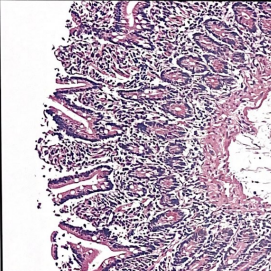
The problem seen in this image most likely could have been prevented by which of the following?
a. earlier contact with the fixative
b. shorter dehydration time
c. decreased heat in the paraffin
d. prolonged time on the flotation bath
A
This section of GI tract should have been opened, pinned out, and submerged in fixative as soon after surgical removal as possible. Since the problem is delayed fixation, none of the other solutions would help.

The problem shown in this image is most likely the result of:
a. delayed fixation
b. poor choice of fixative
с. excess removal of water
d. decreased enzyme activity
A
The loss of epithelium is indicative of delayed fixation; the choice of fixative would not cause this. Water is removed during the dehydration step and excessive shrinkage, not the loss of tissue structures, occurs if the tissue is overdehydrated. The changes seen in this image indicate increased enzymatic activity due to prolonged delay in placing the tissue in fixative.

The problem seen in this photomicrograph was caused primarily by:
a. enzymatic activity
b. bacterial action
c. aqueous fixation
d. overfixation
A
Autolysis is seen in this photomicrograph resulting from delayed fixation. Autolysis is caused by enzymatic activity that continues after the blood supply is interrupted; bacterial action will cause putrefaction. If applied promptly after interruption of the blood supply and the specimens makes good contact with an adequate volume of fixative, aqueous fixation is capable of good fixation; overfixation will not cause autolysis.
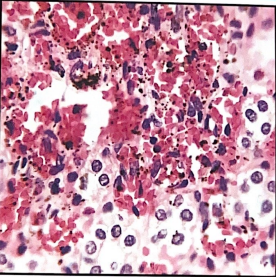
The problem seen in this formalin-fixed tissue most likely will NOT occur if the:
a. tissue is washed after fixation
b. formalin pH is kept at neutrality
c. time of fixation is less than 12 hours
d. concentration of formalin is increased
B
Formalin pigment forms when the pH of the solution drops below 6. Other acidic fixatives containing formaldehyde, such as Bouin solution, may also produce formalin pigment. The pigment is the result of the action of an acidic solution of formaldehyde acting on tissues rich in blood; it has been noted also in tissues containing large amounts of blood even with fixation in more neutral formalin solutions. Less than 12 hours of fixation, washing after fixation, and increased formalin concentration will not decrease the formation of this pigment.
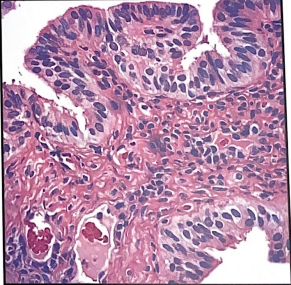
That fixation was most likely incomplete is indicated in this image by the: a. 3 shades of eosin b. smudgy nuclei c. bright pink collagen d. pale epithelial cytoplasm
B
Incomplete fixation is often indicated by the appearance of smudgy nuclei in H&E-stained sections. 3 shades of eosin are indicative of correct staining, with red cells the most intense, and either the collagen or muscle the intermediate shade of pink. Epithelial cytoplasm is normally the paler of the 3 eosin shades seen.

Observe the image and:
1. Identify the pigment
2. Justify your answer
3. Could this pigment be prevented?
4. If yes, how?
5. Classify the pigment as to exogenous, endogenous, hematogenous, non- hematogenous, or artifact
1. The pigment is hematin or formalin pigment.
2. The pigment is laying over blood and is not seen in the non-bloody areas; thus, it is not mercury pigment.
3. This pigment can be prevented.
4. By formaldehyde fixation in solutions with a pH kept above 6.0 and preferably near neutrality.
5. This pigment is artifactual, formed during fixation by the reaction of acidic formalin with tissue rich in blood.

The pigment seen in this image could most likely be removed by treating the microscopic section with:
a. running water
b. alcoholic iodine
c. alcoholic picric acid
d. dilute formic acid
C
The pigment is most likely formalin pigment as it is located primarily over the red blood cells. It is most commonly removed by treating the sections with an alcoholic solution of picric acid. It cannot be removed by running water. Mercury pigment, not formalin pigment, is removed by alcoholic iodine. Dilute formic acid will not remove formalin pigment.

1. The nuclei in this image demonstrate what problem?
2. What is the most common cause?
1. The problem is known as nuclear bubbling - the nuclei have a soap-suds appearance.
2. The most common cause is incomplete fixation before going into the alcohols used in processing.

1. Identify the tissue seen in this image.
2. What tissue component is missing as a result of autolysis?
1. The tissue seen in this image is small intestine.
2. The epithelium, a mucosal component, is absent as a result of severe autolysis.

The pigment seen in this image most likely would result following fixation in a solution of:
a. paraformaldehyde buffered to pH 7.2
b. modified Millonig formalin
c. buffered zinc formalin
d. aqueous 10% formalin
D
Aqueous solutions of formalin tend to become acidic and formalin pigment forms if the solution pH drops below 6.0, although it may sometimes form in tissues containing large amounts of blood even though the pH is closer to neutral. Pigment should not form in paraformaldehyde solutions buffered to pH 7.2, in modified Millonig formalin solutions (which have a pH of 7.2 –7.4), or in buffered zinc formalin solutions.

The problem with the nuclei seen in the image is most likely due to:
a. incomplete fixation
b. old hematoxylin
c. section thickness
d. incomplete deparaffinization
A
The nuclei are smudgy; no chromatin pattern can be seen in the epithelial nuclei. This is commonly a problem with incomplete fixation; delayed fixation would affect the morphology of the tissue. Old hematoxylin would stain the nuclei reddish-brown, not blue. Section thickness will not cause smudgy nuclear. Incomplete deparaffinization would most likely affect only some nuclear staining and also some cytoplasmic staining; the cytoplasmic staining is excellent in this section, and the nuclei are uniformly affected.
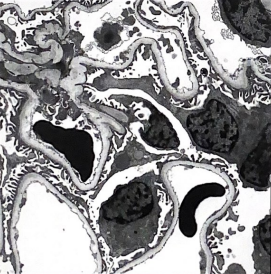
1. Following paraformaldehyde fixation, what secondary fixative is used for the image shown?
2. Why is this secondary fixative used?
3. Identify the tissue shown.
1. Osmium tetroxide is used as a secondary fixative following primary aldehyde fixation.
2. The aldehydes will not preserve lipids; up to 93% of the lipids can be extracted after aldehyde fixation. Osmium tetroxide allows only 7% extraction after fixation.
3. The tissue is a kidney glomerulus.
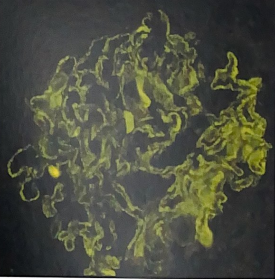
1. Identify the fixative for procedure shown.
2. Identify the tissue
1. No fixative is used - the tissue must be unfixed and frozen for the procedure shown (ie, immunofluorescence).
2. The tissue is kidney; a glomerulus is shown.