Erythropoiesis (RBC Maturation)
 Call Kai
 Learn
Learn Practice Test
 Spaced Repetition
 Match
Match Flashcards
 Knowt Play
1/97

There's no tags or description
Looks like no tags are added yet.
Name | Mastery | Learn | Test | Matching | Spaced | Call with Kai | Chat |
|---|
No analytics yet
Send a link to your students to track their progress
98 Terms
What are the stages of normoblastic maturation, in order?
1. Multipotential stem cell
2. Pronormoblast
3. Basophilic normoblast
4. Polychromatophilic normoblast
5. Orthochromic normoblast
6. Reticulocyte
7. Erythrocyte
Once the ______ stage is reached, division stops.
orthochromic normoblast
As an RBC matures, what aspects become smaller?
Cell size, nuclear size
What is this due to?
"Loss" of nucleoli, condensation of chromatin, possible shape change and/or ejection
As an RBC matures, nucleoli ______.
disappear
As an RBC matures, the nuclear chromatin pattern becomes more ______.
condensed
As an RBC matures, the cytoplasm turns from a ______ color to ______.
blue, red
This is due to a decrease in ______ and an increase in the amount of ______.
basophilia, cytoplasm
In a blue-stained RBC stage, the ______ components of the cell attract the ______ stain (blue).
acid, basic
The blue color of the cytoplasm is due to a higher amount of ______.
rRNA
In a pink-stained RBC stage, the ______ components of the cell attract the ______ stain (pink).
basic, acid
When an RBC appears pink, there is an accumulation of ______.
Hgb
A pink RBC is known as ______.
eosinophilia/acidophilia
What is the N:C ratio?
The nuclear:cytoplasmic size ratio
The entire RBC maturation process takes ______ days.
7-8
A mature RBC is ~______um in diameter.
6
1. Pronormoblasts are about ______ times the size of an RBC.
2-3
Pronormoblasts have the largest ______.
nucleus (N:C ratio)
Pronormoblasts have 1-2 ______ that are slightly lighter in color.
nucleoli
Pronormoblast cytoplasm is very ______ and ______ along the outside.
blue, irregular
Pronormoblast mitosis can occur ______ time(s).
>1
The pronormoblast stage lasts ______.
~24 hours
Pronormoblast

2. Basophilic normoblasts are slightly ______ than pronormoblasts.
smaller
Basophilic normoblasts have a smaller ______ than pronormoblasts.
nucleus (N:C ratio)
The basophilic normoblast cytoplasm is deeper, richer ______ than pronormoblasts.
blue
Basophilic normoblast stage lasts ______.
~24 hours
Both pronormoblasts and basophilic normoblasts are found in the ______.
bone marrow
Basophilic normoblast
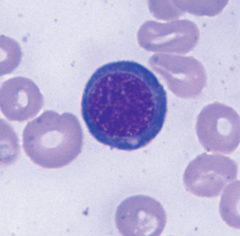
All RBC stages after this point are found in the ______.
peripheral blood
3. Polychromatophilic normoblasts are around the same size/slightly smaller than ______.
basophilic normoblasts
The nuclear size of polychromatophilic normoblasts can vary from ______ to ______.
4:1, 1:1
Polychromatophilic normoblasts do not have ______ present.
nucleoli
Polychromatophilic normoblasts cytoplasm is varying color, trending into ______.
pink
Polychromatophilic normoblasts are the last stage to undergo ______.
mitosis
How many mitotic divisions do basophilic and polychromatophilic normoblasts undergo?
1
Polychromatophilic normoblast

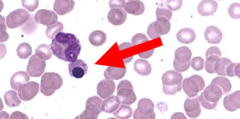
4. Orthochromatophilic normoblasts are ______ than the three previous RBC stages.
smaller
The N:C ratio of orthochromatophilic normoblasts is ______.
1:1
The orthochromatophilic normoblast nucleus is ______ and ______ at the end of the stage.
pyknotic, extruded
The orthochromatophilic normoblast cytoplasm is what color?
Pinkish/red with a slight bluish hue
Orthochromatophilic normoblast
5. Reticulocytes are the same size as ______.
orthochromatophilic normoblasts
Reticulocytes are also called ______.
polychromatic erythrocytes
Reticulocytes have no ______.
nucleus
Reticulocytes can be stained with what stains?
Wright and supravital/New Methylene Blue
Wright stain produces reticulocytes with ______.
polychromasia (pink/blue/purple)
Supravital stain/New Methylene Blue stains aggregated ______ what color?
RNA, blue
Reticulocyte
Wright stain
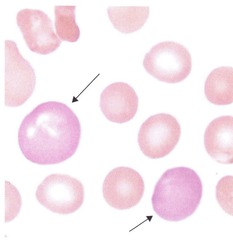
Reticulocyte
New Methylene Blue
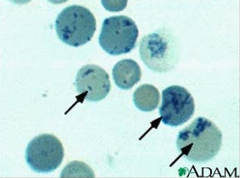
The reticulocyte goes from the blood to the ______.
spleen
What occurs here?
The reticulocyte is "polished" by macrophages, giving the biconcave discoid shape of a mature RBC
A mature erythrocyte has a surface:volume ratio that enables for optimal ______.
gaseous exchange
The function of erythrocytes is to deliver ______.
oxygen
Erythrocytes live for ______.
120 days
Erythrocyte

The term "erythron" encompasses all stages of ______ throughout the body.
RBCs
RBC mass is the ______ in blood.
circulating RBCs
______ of the kidney sense hypoxia.
Peritubular fibroblasts
This hypoxia causes peritubular fibroblasts to release ______.
erythropoietin (EPO)
EPO release from Peritubular fibroblasts is ______ so there is continuous replacement of dying RBCs.
constant
EPO release is increased during what scenarios?
Hemorrhage, increased RBC destruction, defective Hgb
______ in the liver also produce EPO.
Hepatocytes
EPO is a thermostable, glycoprotein ______.
hormone
EPO has a carbohydrate unit that binds to a receptor on ______.
RBCs
EPO has a sialic acid unit that has ______ activity.
biological
EPO is produced in the ______ and acts at the ______.
kidney, BM
EPO allows early release of ______ from the BM.
reticulocytes
EPO does this my increasing the width of space between the ______ cell layer so RBCs can get through.
adventitial
EPO also downregulates the expression of ______ molecules on RBCs that keep it in the BM.
adhesion
EPO prevents ______ of RBCs.
apoptosis
EPO does this through removing ______ from the surface of RBC precursors.
Fas
When Fas binds to FasL, ______ is induced.
apoptosis
EPO also induces expression of ______ molecules.
anti-apoptotic (Bcl-XL)
EPO reduces time necessary for RBCs to ______ in the BM by 2 days.
mature
EPO does this through increasing synthesis of ______ and ______.
RNA, Hgb
EPO also decreases ______ molecule expression and increases ______-promoting surface molecules to speed up RBC maturation.
adhesion, egress
EPO also stops cell ______ and reduces the time spent between ______.
division, mitoses
RBCs lack a nucleus so it cannot generate new ______.
proteins/enzymes
This causes RBC ______ to decline, eventually causing death.
functions
Since RBCs have no mitochondria, ______ is the only source of ATP.
glycolysis
Loss of glycolytic enzymes = cellular ______ = senescence.
aging
RBCs can also die via _______ in the spleen.
phagocytosis (by macrophages)
Extravascular hemolysis occurs when decreased ATP causes failure of RBC ______.
membrane
What are the consequences of this?
- Oxidation of proteins and lipids
- Inability to pump out Na+
- Loss of selective permeability
- Water enters the cell and it becomes spherical
Spherical RBCs cannot leave the ______.
spleen
When this happens, splenic ______ trapped RBCs.
macrophages phagocytose
This accounts for ______ of RBC loss.
~90%
Intravascular hemolysis occurs when RBCs ______ within blood vessels.
rupture
Stress on the RBC causes ______ of the cell and loss of intracellular contents.
fragmentation
What organs release EPO?
kidneys and liver
What is the order of maturation for hematopoiesis?
Pluripotent, progenitor, precursor
What is the primary site of hematopoiesis in a 4 month fetus?
Liver
An infant's thymus is ______ than an adult's.
larger
CFU-GEMM stem cell cannot become a ______.
lymphocyte
Stromal cells in the BM help to form ______.
extracellular matrix
Leukocytosis
Too many leukocytes
CD34 is expressed on ______ cells.
stem