Chemical And Physical Properties and Changes
 Call Kai
 Learn
Learn Practice Test
 Spaced Repetition
 Match
Match Flashcards
 Knowt Play
1/25

There's no tags or description
Looks like no tags are added yet.
Name | Mastery | Learn | Test | Matching | Spaced | Call with Kai | Chat |
|---|
No analytics yet
Send a link to your students to track their progress
26 Terms
Matter
Something with mass and takes up space.
Physical Properties
Characteristic of a substance that does not involve the formation of a new substance
Physical apperance and composition
Qualitative or quantitative
Colour
Physical Property
Appearance of an object based on wave lengths being reflected
Clarity
Physical Property
Ability of light to pass through a substance
transparent, translucent or opaque
Lustre
Physical Property
The level of reflection or the shininess of an object.
Malleability
Physical Property
Ability to be hammered or rolled into shape without breaking apart.
Ductility
Physical Property
Ability to be stretched, pulled or drawn into a thin wire without breaking.
Texture
Physical Property
The feel or shape of a surface or substance
smooth or rough
Viscosity
Physical Property
The flow of a liquid and its resistance
High viscosity(thick&less flow) or Low viscosity(runny&more flow)
Solubility
Physical Property
The ability of a substance to dissolve in a liquid
Soluble(dissolves) or insoluble(doesn’t dissolve)
Conductivity
Physical Property
The ability of a substance to conduct heat or electricity.
Odour
Physical Property
A property of a substance that someone can experience with the sense of smell.
States of Matter
Physical Property
Can either be in the form of a solid, liquid or a gas.
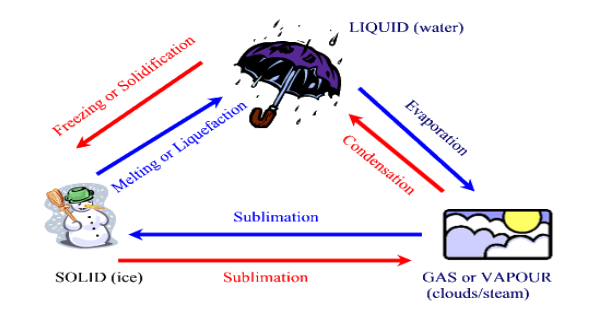
Boiling & Condensation Point
Physical Property
Tem of boiling or condensation, usually the same
Melting & Freezing Point
Physical Property
Temp of melting or freezing, usually the same
Shape
Physical Property
apperance or shape a substance takes on
Eg. salt is crystallune and slime is amorphous
Qualitative Physical Properties
descriptive data based on observations
5 senses
Quantitative Physical Properties
numerical data
counting & measurable
Chemical Properties
The properties and abilities of a substance when it changes into a new substance(s) during a chemical reaction.
How a substance behaves with others
Combustibility
Chemical Property
Being capable of igniting into a flame, burning and producing heat/light
requires a vigorous ignition source
Reaction with Acid
Chemical Property
The ability of a substance to react with acid.
Flammable
Chemical Property
being able to easily catch fire under minimal ignition (spark)
Reaction with light
Chemical Property
ability of a substance to react with light
e.g hydrogen peroxide converted to water
Physical Change
A change that does not result in the formation of a new substance.
Chemical Change
A change a substance undergoes which results in the formation of a new substance.
Signs of Chemical Change
Colour Change
Formation of precipitate
Heat or light is produced
Gas formation (bubbles observed from new gas)
Generally difficult to reverse.