Exam 2 (Summer Genetics) - DNA Replication and Recombination
 Call Kai
 Learn
Learn Practice Test
 Spaced Repetition
 Match
Match Flashcards
 Knowt Play
1/30

There's no tags or description
Looks like no tags are added yet.
Name | Mastery | Learn | Test | Matching | Spaced | Call with Kai | Chat |
|---|
No analytics yet
Send a link to your students to track their progress
31 Terms
The amount of DNA that is replicated from a single origin of replication is referred to as a(n) ________.
replicon
DNA replication occurs by adding ________.
dNTPs to the 3' end of the daughter strand
Which terms accurately reflect the nature of replication of the chromosome in E. coli?
bidirectional and fixed point of initiation
DNA Pol III is believed to be responsible for removing the primer.
False
DNA Pol I, II, and III all possess 3' to 5' exonuclease activity.
True
DNA polymerases can all perform 5' to 3' polymerization.
True
DNA Pol I, II, and III all possess 5' to 3' exonuclease activity.
False
DNA polymerases are important in various aspects of DNA repair.
True
DNA polymerases can all initiate DNA synthesis on a template on their own.
False
Which activity of E. coli DNA polymerase I is responsible for proofreading the newly synthesized DNA?
3' to 5'; exonuclease
The protein responsible for the initial step in unwinding the DNA helix during replication of the bacterial chromosome is coded for by the ________ gene.
dnaA
During DNA replication, ________ are 1000-2000 nucleotide long strands synthesized on the ________ strand to maintain the ________ of replication.
Okazaki fragments; lagging; bidirectionality
Which enzyme is responsible for relieving the tension ahead of the fork that results when the DNA unwinds to form the replication "bubble" or "eye"?
DNA gyrase
Which of the following statements about DNA replication is true?
DNA synthesis is continuous on the leading strand and discontinuous on the lagging strand.
As unwinding of the helix occurs during DNA replication, tension referred to as ________ is created ahead of the replication fork. This tension is relieved by the action of ________.
supercoiling; DNA gyrase
DNA replication in eukaryotes ________.
initiates at multiple origins
Chromatin is defined as ________.
DNA complexed with protein
Continuous on one strand and discontinuous on the other strand.
Prokaryotic and eukaryotic replication
The only replication origin in a chromosome
Prokaryotic replication
Euchromatin and heterochromatin replicate at different times
Eukaryotic replication
Long Okazaki fragments (about 1000 nucleotides)
Eukaryotic replication
Multiple replication origins
Eukaryotic replication
Bidirectional
Prokaryotic replication
Short Okazaki fragments (about 100 nucleotides)
Prokaryotic replication
The process of making DNA from an RNA template is referred to as ________.
reverse transcription
Which term describes a genetic exchange between two DNA molecules with substantial DNA sequence homology?
homologous recombination
Kornberg showed that nucleotides are added to the 3'-end of each growing DNA strand.
In what way does an exposed 3'-OH group participate in strand elongation?
It directly participates in the formation of a covalent bond with the nucleotide being added
Can you distinguish between (a) unidirectional and bidirectional synthesis, and (b) continuous and discontinuous synthesis of DNA?
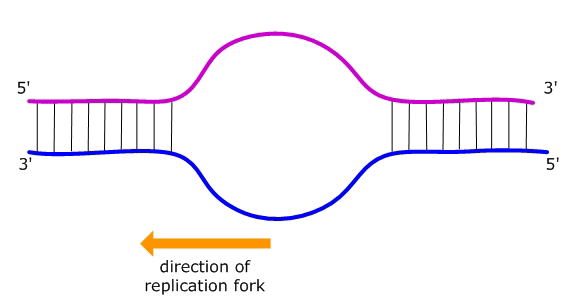
This diagram depicts an origin of replication, with the direction of the movement of the replication fork indicated. What type of DNA synthesis is shown?
unidirectional
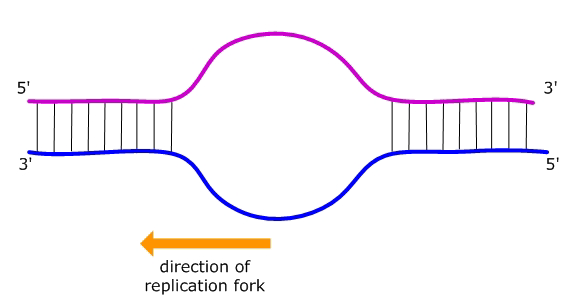
Given the direction of replication and the orientation of the two DNA strands, which of the following is true?
Select the two true statements.
The bottom strand (blue) is the lagging strand; it is being synthesized discontinuously
The top strand (pink) is the leading strand; it is being synthesized continuously
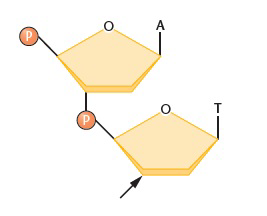
Consider the drawing of a dinucleotide below. Is it DNA or RNA ?
DNA
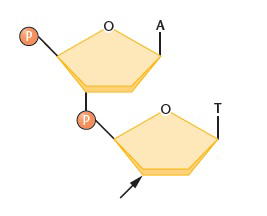
Consider the drawing of a dinucleotide below. Is the arrow closest to the 5' or the 3' end?
3’