Lab 5: Affinity Protein Purification of His-tagged Recombinant Proteins
 Call Kai
 Learn
Learn Practice Test
 Spaced Repetition
 Match
Match Flashcards
 Knowt Play
1/36

There's no tags or description
Looks like no tags are added yet.
Name | Mastery | Learn | Test | Matching | Spaced | Call with Kai | Chat |
|---|
No analytics yet
Send a link to your students to track their progress
37 Terms
Lab objectives
Understand the basics of expression vectors and why we might want to purify a protein
Understand how proteins are tagged
Understand how a protein tag can be used for purification
Understand the pET vector expression system
Describe differences in bacterial strains that affect how we use them
What are we doing in this lab?
We’re purifying our expressed spider silk proteins out of a “lysate” that contains a mixture of all the other expressed bacterial proteins
Expression vector
A plasmid designed not only to carry and copy DNA, but to make the cell produce the protein encoded by that DNA
Is able to replicate within bacterial cells, but also has unique features that make it specifically useful for actually expressing different proteins in bacteria
Contains an inducible bacterial promoter
Inducible bacterial promoter
A DNA sequence that acts like a controllable on/off switch for a gene in bacteria
Promoter is recognized by the bacterial transcription machinery
What does it mean for the promoter to be inducible?
We want to be able to control when the promoter is active (and the gene is being transcribed)
Why do we want the promoter to be inducible?
When bacteria express a gene from another organism, the bacteria can get sick and start to die
If we control when gene expression happens, we can transform bacteria with our clone, keep the clone from being expressed, and know that we will not harm the bacteria
We can grow large quantities of transformed bacteria, then induce expression of our gene of interest
Even if protein produced by gene makes bacteria sick, we will have them make enough protein for us to collect before they die
What type of promoter does the pETBlue-1 vector contain?
A T7 promoter that controls the expression of our gene of interest
T7 promoter
Originally identified from a bacteriophage
Recognized by the RNA polymerase called T7 RNA polymerase
T7 RNA polymerase
A very simple RNA polymerase, containing only one subunit
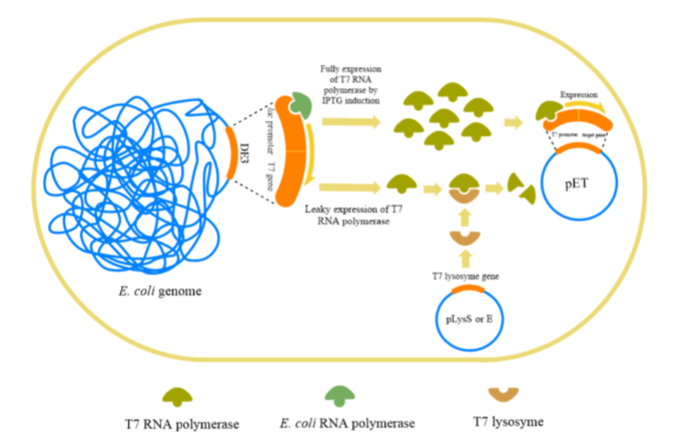
Gene that codes for T7 RNA polymerase has been inserted in the host E. coli chromosome
Under the control of the lactose promoter and operon
What is the region that the T7 RNA polymerase-encoding gene has been inserted into?
DE3 region
What controls the expression of the T7 RNA polymerase gene?
Lac repressor protein
Lac repressor protein
Binds to a regulatory sequence (“LacO”) on the host chromosome
Blocks transcription of the T7 RNA polymerase gene, preventing its expression until lactose is present
How can we induce expression of our gene of interest?
By growing our transformed bacteria in media that contains an analog of the sugar lactose (IPTG)
How does lactose (IPTG) play a role in inducing expression of our gene of interest?
Lactose binds to the lac repressor protein
Causes the protein to change shape and fall off the DNA
Allows initiation of transcription of the T7 RNA polymerase gene and subsequent expression
What happens after T7 RNA polymerase is made?
It diffuses within the cytoplasm of the bacterial cell and binds to the T7 promoter on your plasmid
Transcribes spider silk gene
Translated into the recombinant protein
Why do we want to purify the expressed spider silk proteins?
We want to study the biochemical properties of a protein
Might want to see if a protein can bind to a specific sequence of DNA, so we could purify it to test for DNA binding
Might want to see if our protein has a specific enzymatic activity, ex. can it act as an ATPase, kinase, or protease?
Might want to make an antibody that recognizes it if we want to visualize the protein inside a cell
Can we purify proteins directly from the cells/tissue/organisms that produce them?
Yes, but it takes a lot of time and effort to figure out the unique properties of a protein that will allow you to purify it away from all the other proteins made in the cell or organism
This type of purification can take a lot of time to figure out and many steps
If proteins are expressed at very low levels, it can be challenging to get enough of it to work with. How does our protocol work around that?
By expressing our spider silk proteins in bacteria, which are easy to culture, we can grow up significant amounts of the protein in our labs
How are we going to purify our specific protein of interest away from all the bacterial proteins?
We will use the 6xHis tag attached to the end of the spider silk protein
Protein tags
Tags are made from DNA sequences encoding various polypeptides that will be transcribed along with our gene and added to either the 5’ or 3’ ends of the transcript, or both
Tags either the N- or C-terminal ends of our protein
Many expression vectors encode the information needed to add protein tags to our protein of interest
6xHis tag
Tag is added by a reverse primer during PCR, using a similar approach to adding restriction sites to the 5’ termini of the amplified product
PCR primers used to amplify the spider silk gene were designed so it was amplified to incorporate a 6xHis tag into the 3’ end of the gene in-frame with the spider silk gene codons (corresponds to the C-terminus of the protein)
Reads as spider-silk codons | His codon | His codon | His codon …
Researchers built the His tag into the PCR product itself rather than adding it later
What happens after the spider silk cDNA was inserted into the pET24a cloning vector?
Placed adjacent to a Shine-Dalgarno sequence (bacterial ribosomal-binding site)
Shine-Dalgarno sequence is short sequence on bacterial mRNA that tells the ribosome, “bind here, then start translating at the nearby start codon”
Next to the ribosome binding site (RBS) will be your start codon (ATG) that will be used to begin translation
What happens when the spider cDNA gets expressed?
Translation of the mRNA will start at the AUG and read into the spider silk codons and finally into the 6 histidines in the C-terminus
Your protein has been “tagged” with 6xHis tag
Tag does not interfere with the structure or function of the purified protein
What are some examples of protein tags?
6xHis
myc
HA
FLAG
All of these are small sequences of amino acids (some taken from sequences of other proteins, like HA-tag which contains part of the hemagglutinin protein)
Some vectors allow you to attach small functional proteins to your polypeptide—what does that do?
Can help increase protein stability in case your protein proves to be very unstable
Ex. thioredoxin
What is the main reason why we want to tag a protein?
To help us visualize our protein in order to confirm that we are actually expressing it because we can purchase reagents that will allow us to visualize if our protein is actually being transcribed and translated
Can also use tags to help us purify the protein for later experiments
What is the significance of the 6xHis tag we added to our spider silk proteins?
Helps us quickly purify large amounts of spider silk proteins from the bacterial cells without having to discover the unique properties of each protein
Without a tag, your spider silk protein would look like just one protein among thousands of bacterial proteins
You intentionally give your spider silk protein a feature that is easy to recognize, rather than finding a natural feature that makes it different from all the others to isolate it
Affinity chromatography
A purification technique that separates a target protein because it has a specific binding interaction with something attached to a solid support
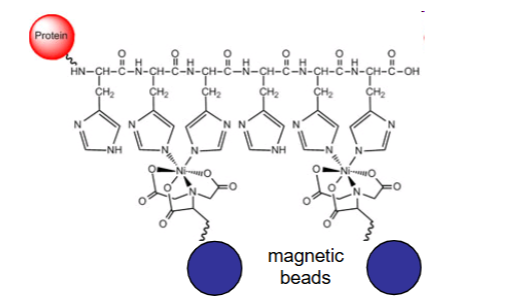
6xHis tag has affinity for certain metal ions (ex. nickel and cobalt) and will bind to the metal ion (causing entire protein to stick)
Most other proteins are not attracted to these metals, so they will not stick (and it’s really rare to naturally find 6 histidines in a row in a polypeptide)
What’s the significance with affinity chromatography and 6xHis tag?
The 6 histidines can bind to nickel ions, and the nickel ions can be attached to a number of different kinds of substances that help us capture our protein of interest
We will be using nickel ions attached to magnetic beads
Explain the idea behind the mechanism of our protein purification
Our protein of interest binds to the nickel ions
The nickel ions are attached to magnetic beads
We can use the magnet to grab the beads and pull our protein away from all the bacterial proteins present in the bacterial cell extract
Essentially: Bind target protein to beads —> magnet keeps target protein while you remove junk —> wash —> release target protein into a clean tube
What do we first do in purification? What comes after?
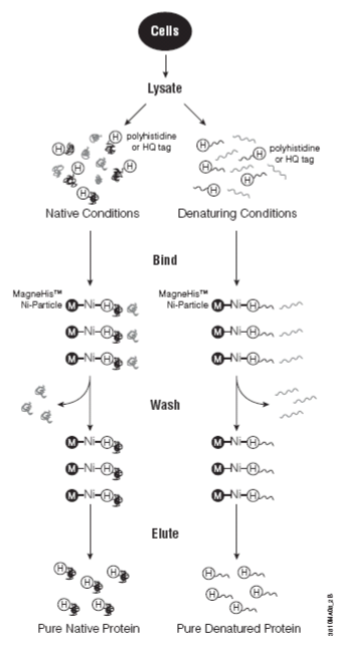
Lyse our bacteria to release their proteins (the “lysate”) and then add our bacterial lysate to the nicke beads
6xHis-protein binds to the nickel, and then we wash the beads to remove unbound bacterial proteins
We need to elute our protein from the beads
How do we elute our protein from the beads?
Using the compound imidazole, which competes with the 6xHis tag for binding to the nickel
Excess imidazole binds to the nickel and displaces the tagged protein
We can now collect the purified protein
What do you do when your protein unfolds in the bacteria and clumps together, or is made at such high levels that it clumps together?
You lyse the bacteria in a buffer that is very strong and denatures your protein along with everything else in the bacterial cell
You can still purify it, but it is probably not going to be functional
That’s why we would add a thioredoxin tag to prevent this
We want to study the function of our protein, so what should we do?
Lyse the bacteria very gently and collect your protein in a buffer that allows you to keep the protein in its native (non-denatured) form
What is the strain of E. coli that we used in Lab 4?
JM109 cells
Good for replicating plasmid DNA
What is the strain of E. coli that we’re using for Lab 5?
BL21 DE3 pLysS
Good for purifying our protein
Cells don’t contain mutations in the endA or recA genes, but instead have a mutated, inactive version of the RNase E enzyme, which protects the mRNA encoding your gene from being degraded
Contains mutant, inactive forms of cellular proteases (ex. lon and OmpT proteases) which helps to limit the amount of degradation of our own protein of interest when we induce its expression
How were the E. coli strains transformed from one to another?
Took some of the DNA from a positive clone identified via restriction digestion (last lab) and transformed DNA back into BL21 DE3 pLysS bacterial cells
Next day, transformed cells were added to liquid LB broth + ampicillin
Allowed to grow for 6-8 hours
After, cells were treated with fake lactose (IPTG) to induce expression from promoter