L17-24: Modern concepts
 Studied by 0 people
 Call Kai
 Learn
Learn Practice Test
 Spaced Repetition
 Match
Match Flashcards
 Knowt Play
1/58

Earn XP
Description and Tags
W9 L17 + 18 Phenotypic Plasticity W10 L19,20 Mass extinctions W11 L21 Evo-devo W11 L22 Epigenetics W11 L23 Creationism W12 L24 Horizontal Gene Transfer (HGT)
Name | Mastery | Learn | Test | Matching | Spaced | Call with Kai |
|---|
No study sessions yet.
59 Terms
Define Phenotypic Plasticity
The ability of a single genotype to alter its phenotype in response to different environmental conditions.
(only gene expression changes - dna sequence no mutations)
What is environment (GxE) interactions?
= the "best" phenotype depends on the specific environment the organism is in
Genotype (G): The underlying genetic instructions.
Environment (E): The external conditions (temperature, food, predators).
Interaction (x): the effect of the gene is not constant; it changes depending on the environment.
What is a reaction norm?
Visualize (GxE) interactions.
x = Environment gradient
y = Phenotypic Value
Slope → plasticity
No slope → no plasticity
Genotype lines:
→ Parallel lines = NO (GxE) [even with slope]
→ Non-parallel/crossing lines = HAVE (GxE)
![<p>Visualize (GxE) interactions.</p><p>x = Environment gradient</p><p>y = Phenotypic Value</p><p><span style="color: blue;"><strong>Slope → plasticity</strong></span></p><p>No slope → no plasticity</p><p><strong><u>Genotype lines:</u></strong></p><p>→ <strong>Parallel</strong> lines =<span style="color: red;"> NO (GxE) [even with slope]</span></p><p>→ Non-parallel/<strong>crossing lines</strong> = <span style="color: green;">HAVE (GxE)</span></p>](https://knowt-user-attachments.s3.amazonaws.com/482d72aa-2cc5-4631-aaa1-3df7c7fffcad.png)
Comparing Polyphenisms (Discontinuous Variation) and Reaction Norms (Continuous Variation) [2 Categories of phenotypic plasticity]
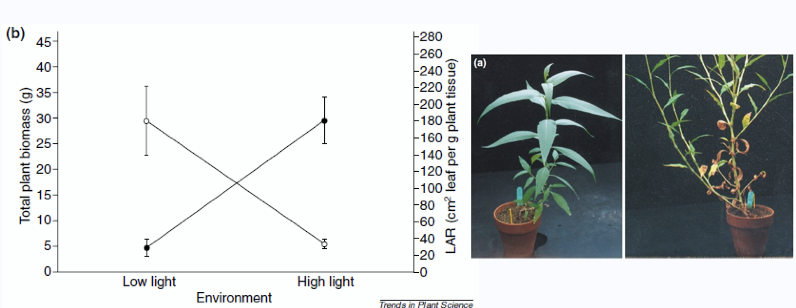
Reaction Norms (Continuous Variation)
Describe the phenotypic expression changes of a genotype across a range of environments.
Continuous Variation: Phenotype changes gradually as the environmental variable (e.g., temperature, light) changes
Graph Visualization: x = environmental gradient, y = phenotype; sloped = plasticity, flat = a fixed (canalized) trait.
Example: Replicates of Polygonum lapathifolium growing in low and high light for 8 weeks show a continuous range of stem lengths or leaf surface areas to optimize light capture (Sultan, 2000).
Polyphenisms (Discontinuous Variation)
Occurs when the environment triggers the development of distinct, discrete morphs (forms) from the same genotype.
Discontinuous Variation: NO intermediate forms; an organism is either "Form A" or "Form B."
Threshold Effect: involves a physiological "switch" or threshold that must be met before the alternative form is expressed.
Example:
Environmental sex determination
Blue-headed wrasse (female → male)
Sea turtle (warmer → female, colder → male)
Bonellia verdis (Pure seawater → female, Seawater with proboscis fragment → male)
Caste canalisation
Social insects → Honeybees exhibit polyphenism, where larvae develop into either a "Worker" or a "Queen" based on whether they are fed royal jelly (alter developmental cascades)
Cost and limitations of phenotypic plasticity
A. The Costs of Plasticity
→ fitness penalties incurred by the organism for being plastic
1. Maintenance: Energy for sensory/regulatory machinery.
2. Production: Excess energy to build the plastic trait.
3. Information Acquisition: Costs of monitoring the environment.
4. Developmental Instability: Risk of "errors" during development.
5. Genetic Costs: Linkage with deleterious genes or epistasis.
B. The Limitations of Plasticity
→ prevent plasticity from reaching a "perfect" or optimal match with the environment.
1. Information Reliability: Wrong or "noisy" cues lead to a mismatch.
2. Lag-time: Delay between sensing the cue and growing the trait.
3. Developmental Range: Genetic boundaries of possible forms.
4. Epiphenotype problem: The plastic trait is less effective than a fixed one.
Define adaptive plasticity
Plasticity maintained by natural selection:
Behavior—Variation in behaviour between individuals (inter-individual differences) → Behavioural trait syndromes (AKA personality)
Physiology—e.g. training improves physical performance
Morphology
Life history
Demography
What are behavioral reaction norms?
A highly flexible and reversible type of plasticity
An individual adjusts its actions based on the immediate environment.
Example (Damselfish; Pomacentrus spp.):
Small temperature change effects on coral reef fish predicted (food intake behaviours)
Personality traits: activity, boldness, aggressivenes
Adaptive v.s.Non-adaptive plasticity and why do they matter?
Adaptive: The change increases fitness → reaction norm moves toward the new optimal value favored by selection
Non-adaptive: A passive, often deleterious response to environmental stress → decrease fitness
Significance:
Adaptive plasticity allows populations to "tolerate then adapt" to abrupt changes.
Non-adaptive plasticity can reveal "cryptic variation" in new environments—hidden genetic variation exposed under stress—which then becomes subject to selection (e.g., carotenoid use in Kokanee salmon)
Discuss the role of phenotypic plasticity in ecology and evolution
Ecological Role: Plasticity allows individuals to survive and maintain fitness in heterogeneous or fluctuating environments by matching their phenotype to current conditions.
Predicting Realized Patterns: It is the first step in predicting how a population will express traits across different environmental encounters.
Evolutionary Role: If genetic variation for the amount of plasticity exists, it can evolve via natural selection.
"Buying Time": In the short term, plasticity allows a population to persist in a new or changing environment (HIREC), providing time for slower genetic adaptation to occur.
Diversification: It facilitates "peak shifts" on the adaptive landscape, allowing populations to cross fitness valleys to reach new evolutionary peaks.
How can phenotypic plasticity facilitate speciation?
Concept: suggests that environmentally induced traits can become genetically fixed over time.
Process:
A population first moves into a new environment and survives via plastic shifts (buying time)
Trait becomes "fixed" through Genetic Assimilation, where the phenotype is expressed regardless of the environment due to the cost of maintaining plasticity, random drift, or new mutations.
Peak Shifts: Plasticity allows a population to jump across a "fitness valley" on the adaptive landscape to reach a new adaptive peak, facilitating diversification that eventually leads to reproductive isolation.
What is the role of plasticity in responding to Human-Induced Rapid Environmental Change (HIREC)?
Buying Time: Plasticity acts at the individual level (not generational), allowing a rapid response that can prevent immediate extinction.
→ e.g. Great tits adjusted their laying dates in response to rising spring temperatures via a plastic response
Ecological Traps: A major risk is that plasticity can lead to "ecological traps," where an organism follows a reliable ancestral cue that no longer leads to a high-fitness outcome in a human-altered environment (e.g., choosing a poor habitat).
Limits: If HIREC is too fast, even highly adaptive plasticity might be too costly or slow to save the population.
Discuss how phenotypic plasticity interacts with the "Evil Quartet" of biodiversity loss.
Over-exploitation: Large-scale loss of individuals reduces genetic diversity, which in turn decreases the population's "species-level capacity" for plasticity and overall resilience.
Introduced Species: Invasive species are often "generalists" with high levels of plasticity, outcompete native "specialists" (lower levels of plasticity as adjusted to env. pressure)
Habitat Destruction: Limits the availability of environmental cues and creates ecological traps.
Linked Extinctions: A loss of plasticity in one species can trigger trophic cascades, leading to further co-extinctions.
What are transgenerational effects, and when are they adaptive?
Mechanism: Plasticity is heritable. Parental (usually maternal) effects occur when a parent's environment or behavior influences the offspring's phenotype.
Adaptive Value: These effects are adaptive if the cue the parent receives accurately predicts the environment the offspring will face.
→ Parents can control seed dormancy to ensure germination occurs during optimal conditions.
The Mismatch: If the environment is unpredictable (low stability), parental effects can be negative
(e.g., offspring being smaller than expected due to parental CO2 exposure in Bromus rubens (Huxman et al. 1998) ).
What is Evo-Devo?
It studies how development evolves and also determines the relationship between species based on their development?
What can we get from studying evo-devo?
Evolution alters developmental process → create new and novel structures
Unrelated organisms with similar developmental programs are CONSERVED → make the same phenotype
What is the "Genetic Toolkit"?
A small subset of ancient, highly conserved genes (like HOX or MADS-box) → control the embryonic developmental programs of diverse organisms
Function: act like "master controllers" (mostly transcription factors and signaling proteins) that regulate when and where other genes are turned on.
Key Idea: Evolution creates diversity not by inventing new genes, but by "tinkering" with how this shared toolkit is used (changes in the timing, location, or combination of gene expression)
What does HOX gene do?
Control the identity of segments along the anterior-posterior (head-to-tail) axis of the animal body plan.
BUT NOT CREATING features of segments
What is a homeotic transformation?
HOX mutants cause one organ/body part to transform into another (such as legs growing where antennae should be)
Explain how the evolution of HOX genes can give rise to animals with different body plans.
Positional Identity: HOX genes specify the identity of segments along the anterior-posterior (head-to-tail) axis.
Diversification via Duplication: Early animals had few HOX genes → genes duplicated; copies to diverge and evolve new, specialized roles in patterning complex segments.
Changes in Expression: Different body plans (e.g., a bird vs. a monkey) can arise from changes in the timing and spatial domain of where specific HOX genes are expressed.
Segment Modification: Shifting the boundaries of HOX gene expression can transform one type of segment into another (homeotic transformation), e.g., changing a thoracic vertebra into a cervical one
MADS box gene (plant’s HOX) breakdown, and what does it do?
M = MCM1 (yeast)
A = AGAMOUS (Arabidopsis)
D = DEFICIENS (snapdragon)
S = SRF (humans)
Floral initiation
Floral development (know your ABCs)
Root, pollen and seed development, vernalisation, response to hormones
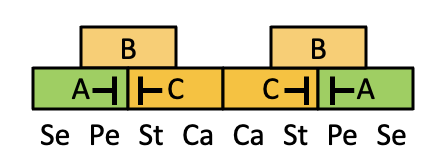
Explain the ABC model of floral evolution.
By MADS box genes
It identifies three classes of homeotic genes (A, B, and C) that work in combination to determine the identity of the four floral organs.
Combinations:
A alone: Sepals (se)
A + B: Petals (pe)
B + C: Stamens (st)
C alone: Carpels (ca)
Antagonism:
Class A and C genes inhibit each other
A is mutated → C spreads to the outer whorls
C is mutated → A spreads to the inner whorls
Homeotic Mutations: Mutations in these genes cause organs to develop in the wrong place (e.g., petals instead of stamens in "C" mutants).
Give examples of ‘genetic toolkits’ that have been recruited multiple times to give rise to the same phenotype (convergent evolution).
p.s : WT (wildtype) = zygomorphic, Mutant = actinomorphic
Pax6 and Eye Development:
the "master gene" for eye formation
Use a pigment cell to control the assembly of a photosensitive cell
present in a common ancestor and recruited in almost all animals (vertebrates and invertebrates)
e.g. mut (knockout Pax6)
Human | Aniridia: Absence of the iris, opaque cornea, degenerate retina, and cataracts. | Usually caused by PAX6 haploinsufficiency (having only one working copy). |
Drosophila | ey-/- (eyeless): Complete absence of the compound eye. | The fly version of Pax6 is called eyeless (ey). Without it, the "eye field" never develops. |
CYCLOIDEA and Flower Symmetry:
Bilateral symmetry (zygomorphy) has evolved many times in plants—all with CYCLOIDEA
mostly in flower with selection on insect pollinators , e.g., Asteraceae, Orchidaceae, Fabaceae
→ e.g., Sunflower:
WT = 6 actino + 1 zygo (big petal),
CYCLOIDEA knockout = 7 actino (Chapman et al. 2012)
What is the definition of Epigenetics?
Processes "above the genome" that alter gene transcription (turning genes on or off) without changing the actual DNA sequence
robust yet flexible
allowing organisms to change gene expression in response to their environment
What are the two main physical nature of epigenetics?
1. DNA Methylation: Chemical tags (methyl groups) added to DNA to silence genes
HIGH methylation = low transcription (gene activity repressed/silent)
in Gene promoters (vertebrates)
higher CpG (C-phosphate-G) frequency
2. Histone Modification: Changes to the "spools" DNA wraps around, affecting how tightly it is packed.
Heterochromatin and Euchromatin
What is the difference between Heterochromatin and Euchromatin?
Heterochromatin is densely packed and generally not expressed (gene is OFF)
Euchromatin has an open, uncoiled structure and is often expressed (gene is ON)
How does epigenetics affect the phenotype of Calico cats?
X-inactivation: In females, one X chromosome is randomly silenced (forming a Barr body) in every cell
X carries the gene for fur color
Different patches of fur express different colors depending on which X was silenced, creating a mosaic pattern.
What is the epigenetic mechanism behind Vernalisation in plants?
It is a "molecular memory" of winter.
Flowering in Arabidopsis:
FLC gene acts as a repressor to stop flowering
Long-term cold exposure → the FLC gene to be packed into heterochromatin (silenced),
Plant then to flower in spring
Give examples of transgenerational inheritance of epigenetically-induced phenotypes
Herbivore damage in Mimulus
Predator defence in Daphnia
Inherited fear in mice
Coat colour (Agouti gene) of mice
Transgenerational inheritance Case study: Herbivore damage in Mimulus
The Stimulus: Herbivore damage (insects eating the leaves).
The Plastic Outcome: plant starts growing more trichomes (tiny defensive hairs).
The Epigenetic Mechanism: This happens through the down-regulation of a specific gene (MgMYBML8) via epigenetic changes.
Transgenerational Note: Even if the children (progeny) of these plants are never bitten by insects, they are born with more hairs because the "alert" was passed down epigenetically
Transgenerational inheritance Case study: Daphnia (Water Fleas): The "Helmet" Defense
The Stimulus: Sensing chemical signals from predators in the water.
The Plastic Outcome: They grow protective helmets and long spines to make themselves harder to eat.
The Epigenetic Mechanism: The presence of predators triggers epigenetic marks that activate the "build a helmet" developmental pathway.
Transgenerational Note: Offspring grew helmets even if raised in a predator-free environment, as mothers have them
Transgenerational inheritance Case study: Inherited Fear (Dias & Ressler, 2014)
The Setup: Male mice (F0) were trained to fear a cherry blossom scent (acetophenone) by pairing it with a mild shock.
The Result: Both children (F1) and grandchildren (F2) were born fearing that specific smell, despite never being shocked themselves.
The "How": The father's sperm showed decreased DNA methylation on the specific odor receptor gene (Olfr151).
Key Lesson: Life experiences (stress/fear) can be passed down via chemical "tags" on sperm
Transgenerational inheritance Case study: Agouti gene in mice and fur colour
The Setup: Mice with the exact same DNA at the Agouti gene can look completely different.
The Phenotypes:
Yellow/Obese: Low methylation (gene is ON).
Brown/Lean: High methylation (gene is OFF).
The Result: A mother’s coat color influences her pups. The effect is even stronger if the grandmother was also dark (highly methylated).
Key Lesson: Diet and environment can change your physical traits and your children's traits without changing a single letter of DNA.
Epigenetics and cancer
Global Change: Cancer tissues often show an overall reduction in DNA methylation across the genome.
Specific Change: Some specific genes in cancer tissue become very highly methylated
The Result: This high methylation silences tumor-suppressor genes (genes that stop tumors from forming)
Outcome: Allow the cancer to grow rapidly and uncontrollably
Why Epigenetics is a Major Evolutionary Force?
Rapid Variation: It produces novel variation almost instantly in response to the environment without "waiting" for a random DNA sequence mutation to occur.
Heritable Phenotypes: Because these induced traits can be inherited, natural selection can act upon them.
Interaction with DNA: While epigenetic marks can act independently, they are also affected by DNA sequences (e.g., CpG methylation cannot occur if the underlying sequence is mutated), allowing for a complex layer of evolutionary "tinkering".
What is the shared foundation of all "flavours" of creationism?
The core belief that life did not originate through natural causes (i.e., it required supernatural intervention)
What is the "Creation-Evolution Continuum"?
A spectrum of beliefs ranging from extreme literalism (Flat Earthers/Young Earth) to those who accept science but maintain a religious role for life's origin
What defines Intelligent Design (ID) creationism?
The claim that certain features of the universe and living things are best explained by an intelligent cause rather than undirected processes like natural selection.
Why is ID considered a "dogma" rather than a science?
Science attempts to falsify hypotheses, while ID starts with a pre-determined answer ("!") and only seeks confirmation for it
How does ID fail the scientific method?
It is not open to falsification
It ignores existing evidence
It relies on "revelation" rather than testable, physical evidence
ID in science education
Attempts to bring Intelligent Design on a par with evolution in school science curricula.
BUT In Kitzmiller v. Dover (2005), the judge ruled ID is a religious view (creationism re-labeled), not science, and cannot be taught in science classes.
What are the three criteria for a mass extinction?
1. Scale: Over 60% of species must go extinct.
2. Range: It must affect a broad range of species globally.
3. Time: It must occur within a "short" geological timeframe (typically <1 million years).
What is the difference between Background and Mass extinction?
Background extinction =low-level, steady rate of species loss over time.
Mass extinction = rare, sudden spike in extinction rates that wipes out the majority of life.
List the "Big Five" mass extinctions in geological order
1. Ordovician (~450 mya)
>60% of marine invertebrates
2. Devonian (~364 mya).
50% of all genera, mostly marine
3. Permian (~251 mya).
70% of terrestrial species and 96% of marine species, go extinct
The "Great Dying”
4. Triassic (~200 mya).
50% of all genera
Affect: conodonts (gone), amphibians, reptiles
5. Cretaceous (~65 mya)
75% of all species
Affect: ammonites (gone), belemnites (gone),
dinosaurs (gone except birds), pterosaurs (gone),
plesiosaurs (gone), plants
Why was the Permian extinction known as "The Great Dying"?
It was the most severe mass extinction, wiping out approximately 96% of marine species and 70% of land species.
How do mass extinctions affect the future of life on Earth?
They act as "restarts."
By clearing dominant lineages, they create ecological space for surviving groups to rapidly diversify (e.g., mammals radiating after dinosaurs went extinct)
Explain the "Press and Pulse" model of extinction.
Press: Long-term environmental stress (e.g., climate change, sea-level shifts)
Pulse: Short-term, catastrophic shocks (e.g., asteroid impact, massive volcanic eruptions)
What is a "Golden Spike" in geology?
A physical marker preserved in rock layers—
such as an Iridium layer or a change in fossil deposits that demarcates the transition between geological time periods.
What defines the "Anthropocene" epoch?
A new geological era where human activity is the primary driver of global environmental change and biodiversity loss.
What physical "marks" are humans leaving in the geological record?
Industrialization: Rapid change in atmospheric composition
Nuclear Age: Radioactive isotopes from atomic testing
Plastics: Millions of tons fragmenting and entering the global food chain
Deforestation: Massive habitat loss leading to biodiversity decline
What are the primary drivers of the current 6th mass extinction?
Climate change (e.g., coral bleaching)
habitat destruction (deforestation)
pollution (plastics)
over-exploitation of species
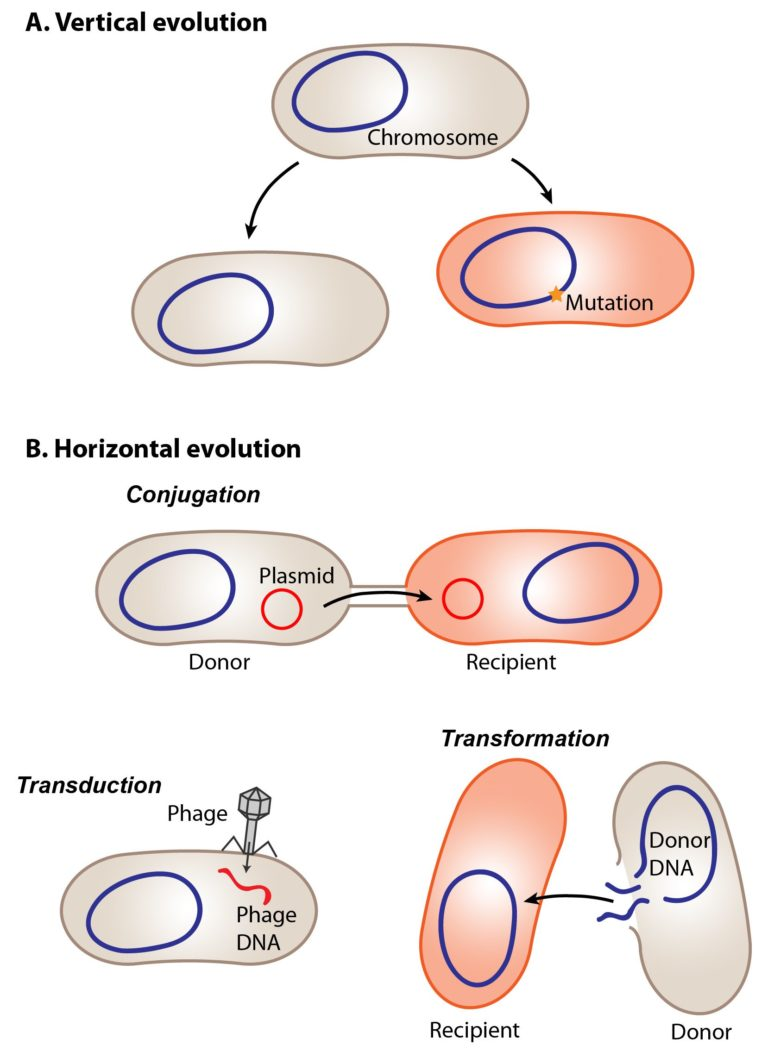
What is the traditional view of speciation and phylogenetic relationships according to?
through bifurcation (splitting into 2 branches) which relies on Vertical gene transfer
What is Horizontal Gene Transfer (HGT)?
The transfer of genetic material between individuals other than by the transmission of DNA from parent to offspring.
Common in bacteria
Less common in eukaryotes
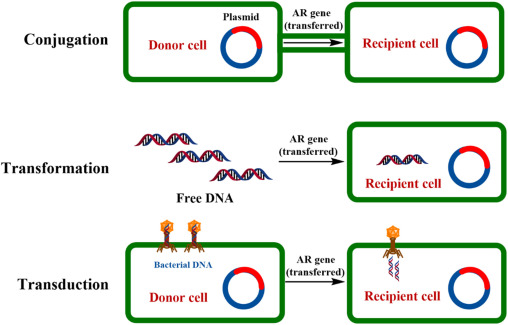
Name the 3 bacterial HGT mechanisms.
Transformation (environment) = take naked dna fragments from environment e.g. dead bacteria
Transduction (viruses) = A phage picks up and package bacterial DNA and injects into host (another bacterium)
Conjugation (direct contact) = Using a pilus (tube) to pass a plasmid (small, circular DNA) directly to another
Why is HGT important in the early evolution of life on earth?
The Net of Life: Early, simple life forms exchanged genes so frequently that the base of the evolutionary tree is better described as a "tangled web" rather than a single trunk
Endosymbiosis: Origin of chloroplasts and mitochondria
→ One of the most critical events in early evolution was the origin of eukaryotes.
Through endosymbiosis, an ancestral prokaryote (free-living archaea/DNA virus)
engulfed an aerobic heterotrophic prokaryote that eventually became the mitochondrion
engulfed a photosynthetic prokaryote that became a chloroplast
Over time, many bacterial genes were transferred to the host's nucleus via HGT.
Rapid Adaptation: HGT allowed early organisms to acquire complex, helpful traits (such as metabolic pathways)
almost instantly from unrelated species, rather than waiting for slow, gradual mutations
Why is HGT more difficult in multicellular eukaryotes than in bacteria?
The “germ-soma barrier” in multicellular eukaryotes prevents most foreign DNA from reaching the germ-line cells (reproductive), prevent inheritance of a gene
Give 2 example of HGT in insects (eukaryotes)
Pea aphids acquired genes from fungi to biosynthesize carotenoids. These pigments allow them to change color (red/green) for camouflage against predators
Cell wall degradation in plant-parasitic nematodes and beetles (from bacteria)
Moran and Jarvik, 2010; Pauchet and Heckel 2013
How did Whiteflies use HGT to survive?
They "stole" a plant gene (BtPMAT1) that allows them to neutralize phenolic glycosides (toxins) produced by plants for defense
Contrast horizontal and vertical gene transfer
Compare both by definition: HGT is the transfer of genetic material between individuals within a generation, whereas VGT is the transfer of genetic material from parent to offspring.
Explain HGT and give examples: HGT is common in bacteria and can occur through transduction, transformation, and conjugation. It can also occur between eukaryotes (rare), for example, between a parasitic plant and its host.
+ a Diagram