IONIC EQUILIBRIUM 🧪🧑🏻🔬
 Call Kai
 Learn
Learn Practice Test
 Spaced Repetition
 Match
Match Flashcards
 Knowt Play
1/52

There's no tags or description
Looks like no tags are added yet.
53 Terms
What are electrolyte
What are two types of electrolytes
Any substance which get dissociated into its ion in its solution is called electrolyte
2 type
1 strong electrolyte : 100 percent dissociation into ions
2 weak electrolyte : not 100 percent dissociation into ions

Background details for knowing why ionic equilibrium will be establish only by weak electrolyte
Strong electrolyte don't exist equilibrium
Cause reactants get over
Weak electrolyte reaction will not completel over reactants
Do equilibrium establish hence reversible reaction
It is involving ions so it is ionic equilibrium
Hence weak electrolyte will only establish ionic equilibrium

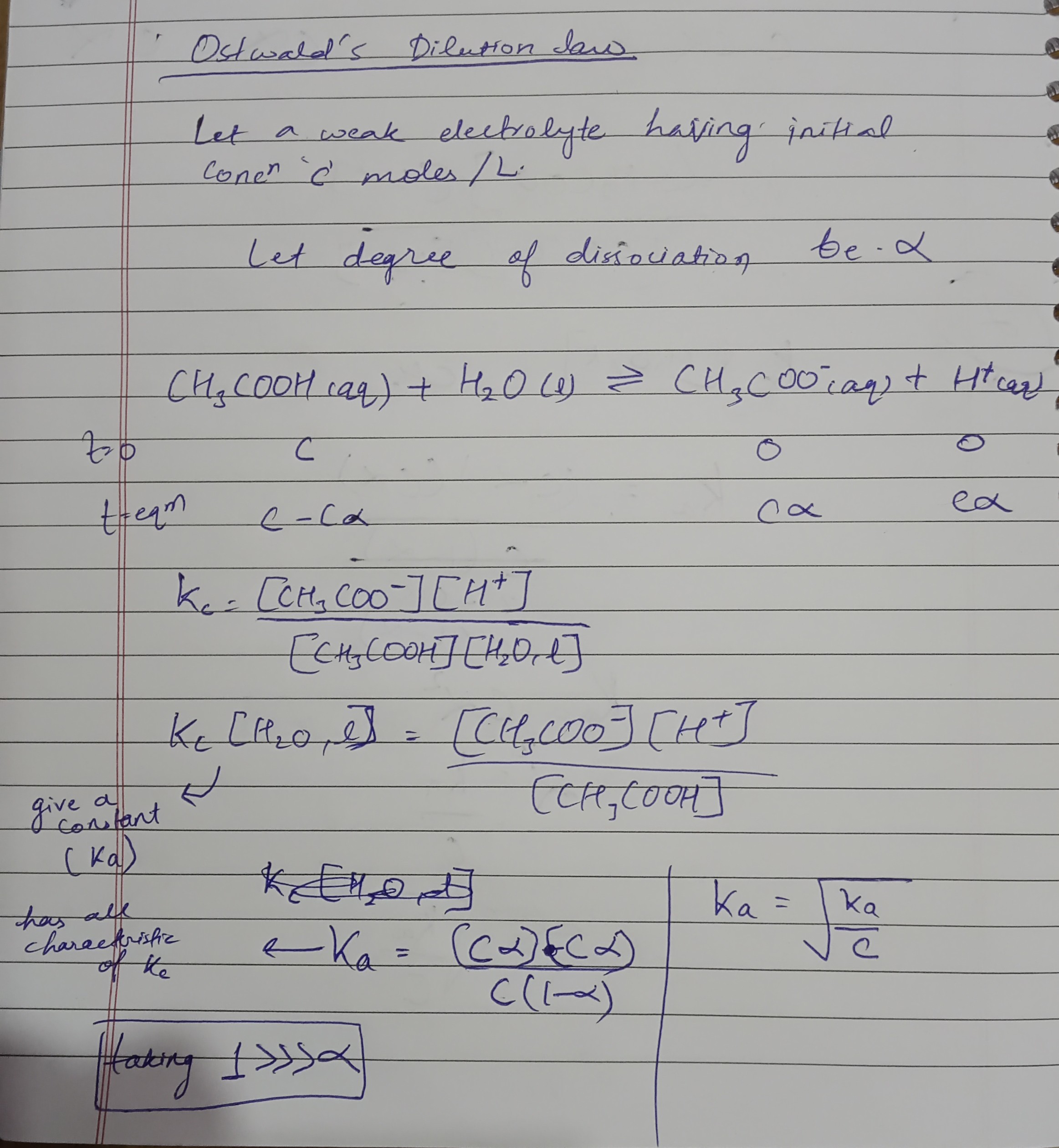
Ostwalds dilution law

Common ion effect
If a strong containing atleast one common ion is added to a solution of weak electrolyte then degree of weak electrolyte then degree of dissociation of weak electrolyte decreases

Approximations
Concentration of common ion at equilibrium to be considered coming only from strong electrolyte
Equilibrium concentration of weak electrolyte to be considered equal to its initial concentration
Now solve the given question

Just solve it 💅🏻 🫰🏻
Just solve it 💅🏻 🫰🏻
Ionic product of water (Kw)
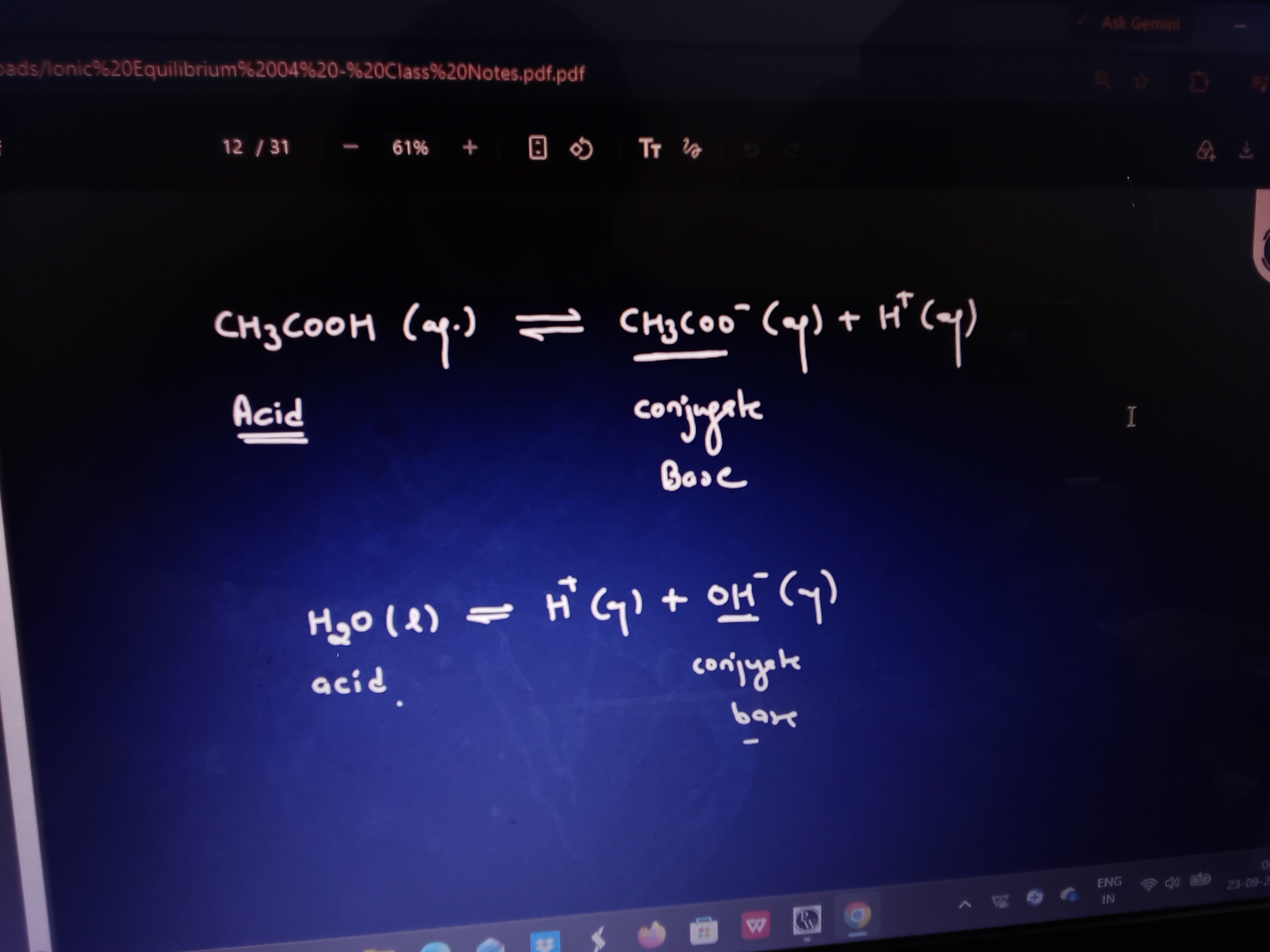
Water is a very weak electrolyte
Water undergoes self ionisation
Kw is just like expression of eqm constant of dissociation water
At 25 degree celcius 10^-14
Pure water at 25 degree celcius ionizes into equals no. Of OH- AND H +
LIKE 1MOLECULE OF WATER WILL DISSOCIATE INTO 1 OH MINUS AND H PLUS
H PLUS IS OF ACIDIC NATURE AND OH MINUS IS OF BASIC NATURE HENCE PURE WATER US ALWAYS NEUTRAL
OH MINUS AND H PLUS CONCN LIKELY TO SAY ACTIVE MASS IS 10 TO THE POWER MINUS 7

pH scale
It is a way of representing molar concn oh H plus

Is solutions are always neutral on pH 7 ???
No solution are not neutral because of pH it is neutral when [OH-] = [H+]
14=pH +pOH (FOR ANY AQUEOUS SOLUTION SUM OF H AND OH IS ALWAYS EQUALS TO 14 AT 25 DEGREE CELCIUS)
![<p>No solution are not neutral because of pH it is neutral when [OH-] = [H+]</p><p class="has-focus">14=pH +pOH (FOR ANY AQUEOUS SOLUTION SUM OF H AND OH IS ALWAYS EQUALS TO 14 AT 25 DEGREE CELCIUS)</p>](https://assets.knowt.com/user-attachments/a060ce2a-ea74-41f2-9724-42b508c48fca.jpg)
Calculate pH of 0.01M HNO3 solution at 25 degree

Calculate pH of 0.05 M H2SO4 solution at 25 degree celcius
If some ion comes from two electrolyte and their concn difference is more than 10¹ then ignore smaller one
If concentration are equal or differ just by 10¹ then don't ignore any of the concentration
Calculate pH of 10-⁸bM HCl solution at 25 degree celcius
PKw equalsto minuslogKw
At any temperature concentration of proton in water is HPLUS EQUALS TO UNDER ROOT OF Kw
Calculate pH of 10^-12 M HCl solution at 25 degree celcius

Calculate the pH of 0.001M KOH. (aq) solution at 25 degree celcius
Option 2
Ionic product if water increases idpf
1 pressure is reduced
2 Hplus is added
3 OH minus is added
4 Temperature increases
Option 4
Calculate the pH of 0.001 KOH (aq) solution at 25 degree celcius

The ionic product if water is 10^-14. The Hplus ion concentration in o.o1 M NaOH. Solution is
And 10 to the power minus 12
The number of H plus ions in 1ml of a solution having pH equals to 13 is
Ans 6.023 × 10⁷
pOH of 0.002 M HNO3 is
Ans 11 plus log 2
The concentration of an acid is 10 –9 The pOH if the solution is
Ans almost 7
If pH. of solution of NaOH is 12.0 the pH of H2SO4 solution of same molarity will be
Ans 1.7

Answer 0.4g per litre
Calculate [H+] in a solution having pH 3.7
Calculate Hplus concentration in a beer having pH. 2.3
Pehle usko next integer me lao 3.7 ko jo ki milega 4 toh ab usko 10 ki power minus 4 kr de uske baad dekh ki kitna subtract krne par 4 me se 3.7 aayega aur woh hoga 0.3 auryeh aata hai log 2 ke wjh se toh ab answer hogya 2 into 10 to the power minus 4
pH calculation of weak acid and weak base
Calculate the pH of 0.01 NH4OH (Kb = 10–⁶) solution at 25 degree celcius
Answer 10


A solution of pH. 9.0 is 1000 times more basic as a solution The pH of this solution is
The pH of 1 M aqueous solution of a a weak acid HA is 6.0 It's dissociation constankt is
Answer 10-¹²
The concentration of a monoprotic acid is C moles per litre and ionisation constant ka The pH of the solution is


Calculate pH of 0.1 M NH4OH (aq) solution at 25 degree celcius
You may have forgot that NH4OH is a weak electrolyte😐🫡
Calculate pH of 0.1M NH4OH (aq) solution at 25degree celcius
(Ka(NH4+) = 10-⁹ )
You may have forgot that ka or kb is not the concentration it's is equilibrium constant


pH mixture idpf acids
Calculate pH of a solution obtained by mixing 1L of 0.01M HCl with 1L of 0.02 M NaOH solution
Answer 11.7
How many grams of caustic potach required to completely neutralise 12.6 g HNO3
Answer 11.2 g
Caustic potash is KOH.
At wt if K is 39

pH of mixture of weak acid
Calculate (HPLUS ) (HCOOMINUS) APand (OCN MINUS) in a solution that contains 0.1 M HCOOH (Ka equals to 2.4 into 10 to the minus 4 ) and 0.1 M ( Ka equals to 4 into 10 to the power minus four )
Answer
For H PLUS. 8 into 10to the power minus 3
3 into 10 to the power minus 3
5 to the power minus 3


You may have forgot when we add two reactions then their equilibrium constant get multiplied to give equilibrium constant of the resultant reaction

Salt hydrolysis
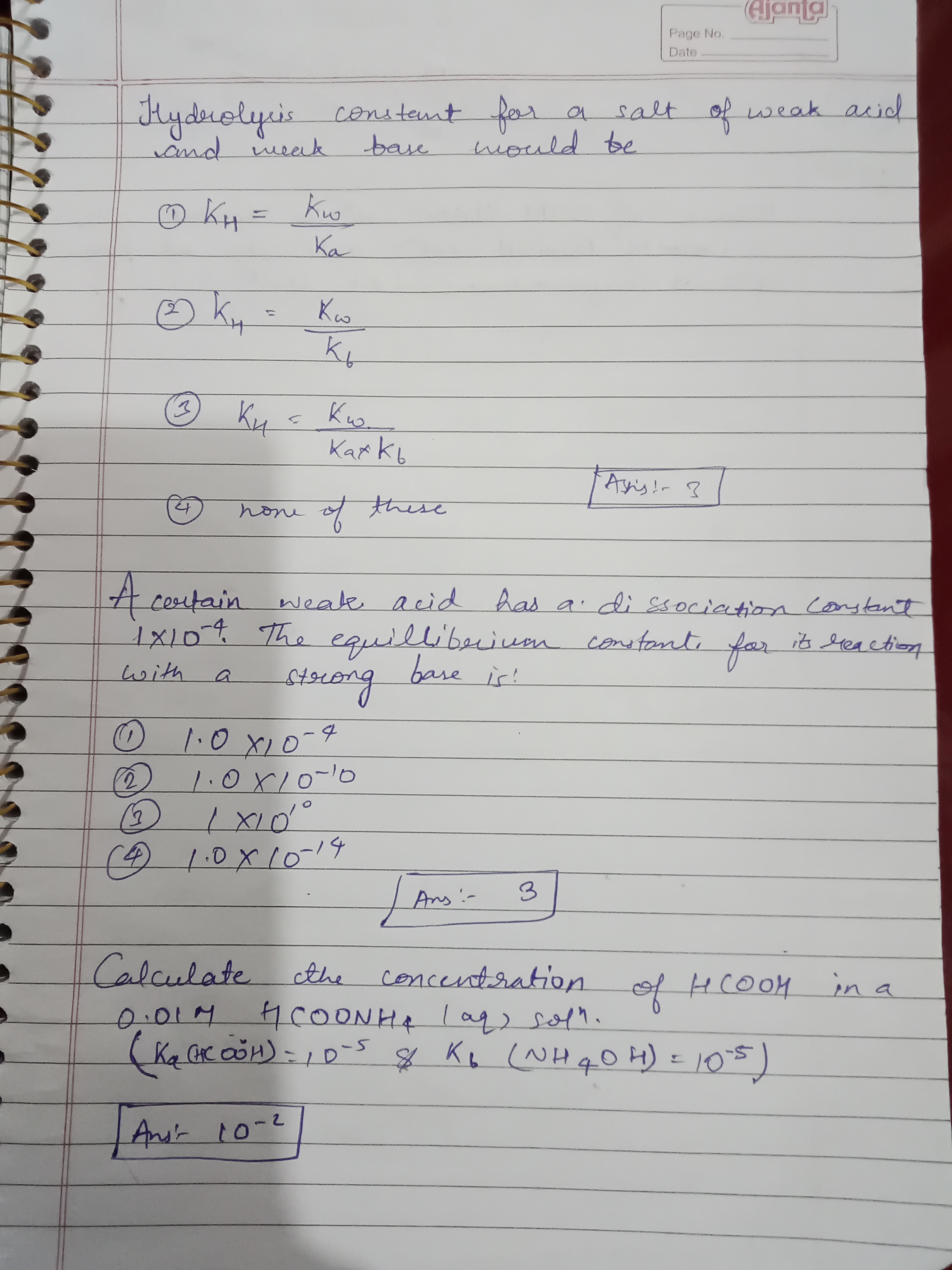
Reverse reaction of neutralisation is called salt hydrolysis
It is the breaking up of salt in presence to regenerate respective acid or base
Only acid or only base or both can be regenerated
Types of salts
Salts are of 4 types
Salt of strong acid and strong base
NaCl KNO3. Na2SO4
Salt of strong acid and weak base
NH4Cl (NH4)2SO4.
Salt of weak acid and strong base
NaCN CH3COONa
Salt of weak acid and weak base
CH3COONH4. NH4CN
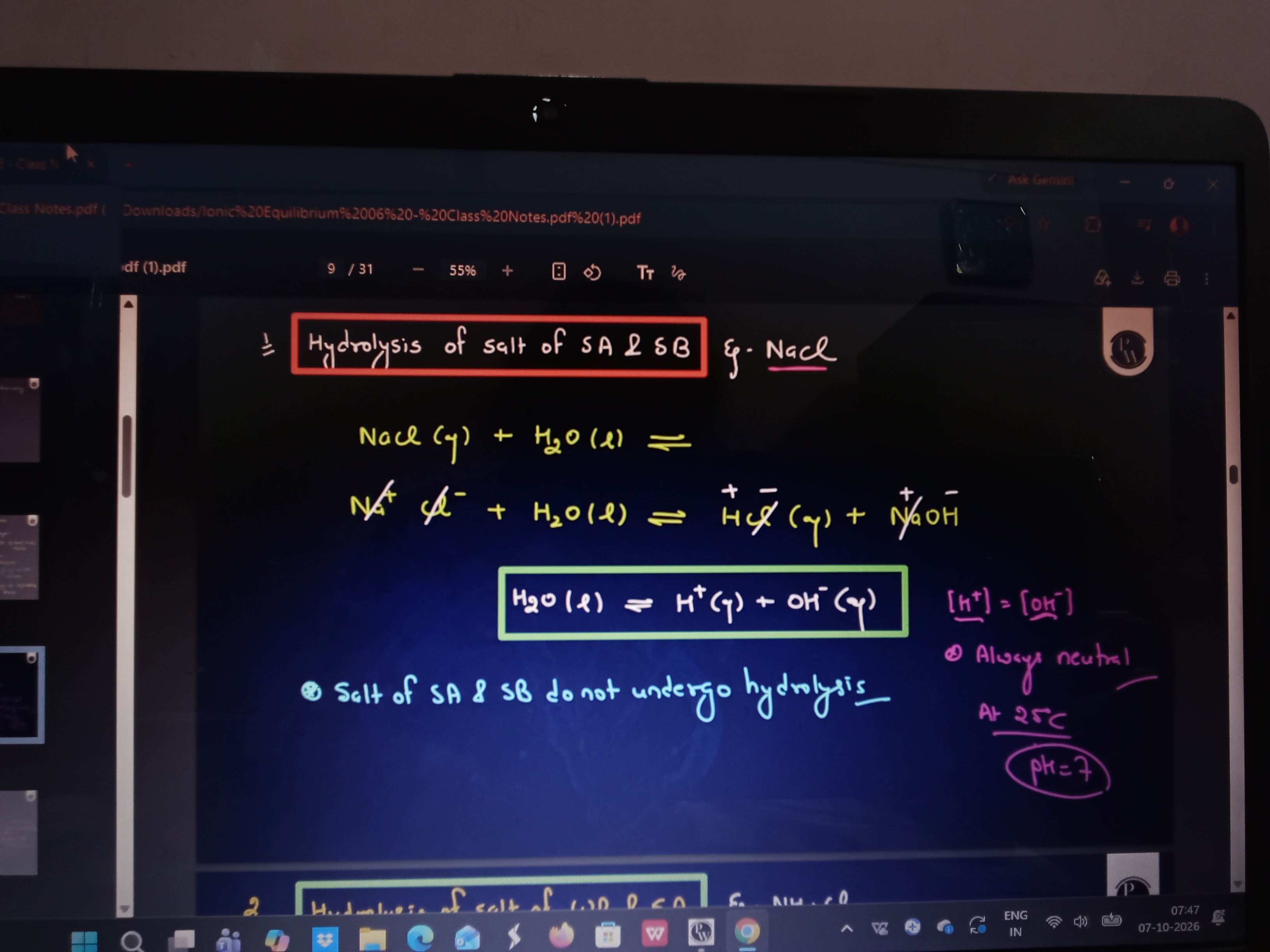
Hydrolysis of salt of SA and SB
Hydrolysis of WB and SA


Hydrolysis of SB and WA
Learn the examples of strong weak acids strong bases and weak bases and then only try to solve the given. questions
Here are the formatted questions.
The aqueous solution of HCOONa, C6H5NH3+Cl-, and KCN are respectively:
Option 1: Acidic, Acidic, Basic
Option 2: Acidic, Basic, Neutral
Option 3: Basic, Neutral, Neutral
Option 4: Basic, Acidic, Basic
Which of the following salts on being dissolved in water gives pH greater than 7 at 25 degrees Celsius?
Option 1: NH4CN
Option 2: NH4Cl
Option 3: KNO3
Option 4: KCN
Aqueous solution of sodium cyanide is:
Option 1: Acidic
Option 2: Amphoteric
Option 3: Basic
Option 4: Neutral
The pH of 0.1M solution of the following salts increase in the order:
Option 1: NaCl < NH4Cl < NaCN < HCl
Option 2: HCl < NH4Cl < NaCl < NaCN
Option 3: NaCN < NH4Cl < NaCl < HCl
Option 4: HCl < NaCl < NaCN < NH4Cl
The salt solution of strong acid and weak base FeCl3 is:
Option 1: Acidic
Option 2: Basic
Option 3: Neutral
Option 4: None of this

pH calculation if strong acid and strong base f
No hydrolysis
H2O


pH of salt of weak base and strong acid


If we dissolve a salt whose pH is basic into water then it is 100 percent sure that the weak one is acid and the strong one is base and VICE VERSA


pH calculation of salt of weak acid and strong base


### Questions on Salt Hydrolysis
Question 1. A 0.1 M sodium acetate solution is prepared. The of acetic acid is . Which of the following statements is correct?
* The degree of hydrolysis is .
* The concentration of ions is .
* The pH is approximately 8.88.
* All of the above.
Ans 4
Question 2. HX is a weak acid with . It reacts with caustic soda (NaOH) to form the salt NaX, having a concentration of 0.1 M. What is the degree of hydrolysis of NaX?
* 0.01%
* 0.0001%
* 0.1%
* 0.5%
Answer 1
Question 3. What is the pH of a 0.001 M sodium acetate solution? Given that the of acetic acid () is .
* Approximately 11
* Approximately 6.5
* Approximately 14
* Approximately 8
Question 4. The pH of a 0.1 M NaCN solution is 11. What is the percentage of hydrolysi
s?
* 0.1%
* 1%
* 0.01%
* 10%
Answer 1


Buffer solution


Questions related to buffer solution
The solution of string acid and weak base is (FeCl3)
1 acidic
2basic
3 neutral
4 none

Mechanism of buffer action


Solve these questions
A )For preparing a buffer solution of pH 6 by mixing sodium acetate and acetic acid, the ratio of the concentrations of salt and acid should be (Ka = 10⁻⁵).
Options:
(1) 1:10
(2) 10:1
(3) 1:100
(4) 100:1
Ans 2
Question: Two buffer solutions A and B, each made with acetic acid and sodium acetate, differ in their pH by one unit. Solution A has a salt-to-acid ratio of X:Y, while solution B has a salt-to-acid ratio of Y:X. If X > Y, then the value of X/Y is:
Options:
(1) 10,000
(2) 3.17
(3) 6.61
(4) 2.10
Ans 2
Question 2: How many moles of HCOONa must be added to 1 liter of 0.1 M HCOOH to prepare a buffer solution with a pH of 3.4, given that for HCOOH is ?
Options:
(1) 0.01 mol
(2) 0.05 mol
(3) 0.1 mol
(4) 0.2 mol
Ans 0.05
Question 3: To 1 liter of a solution containing 0.1 mole each of NH₃ and NH₄Cl, 0.05 mole of HCl is added. The change in pOH will be:
Given: for NH₃ = 4.74
Options:
(1) +0.30
(2) −0.30
(3) +0.48
(4) −0.48
Ans solve it and get it


pH of basic buffer solution
Question 4: The pH of a buffer solution containing NH4OH and NH4Cl is given by:
Options:
(1) pH = pKb
(2) pH = 1/2 pKb − 1/2 log (Salt/Base)
(3) pH = 14 − pKb − log (Salt/Base)
(4) pH = pOH − pKb + (Salt/Base)
Ans solve it and get it
Question 6: 0.1 mole of CH₃NH₂ (Kb = 4.5 × 10⁻⁴) is mixed with 0.08 mole of HCl, and the solution is diluted to 1 liter. The H⁺ ion concentration in the solution will be:
Options:
(1) 1.6 × 10⁻¹¹
(2) 8 × 10⁻¹¹
(3) 5 × 10⁻⁵
(4) 8 × 10⁻²
Ans solve it and get it

Buffer capacity
It is equal to no. Of moles of acid required to be added into 1L buffer solution in order to change its pH by one unit
Higher the buffer capacity better is buffering action
Question 7: Calculate the buffer capacity of an acidic buffer solution having a volume of 2 liters and a pH of 5. If 2 moles of HCl are added, its pH changes to 1.
Options:
(1) 0.5
(2) 0.25
(3) 0.125
(4) None of these
Ans 2
Solubility
Solubility (s) of a substance is equal to no. of moles of that substance that dissociates into its ions in 1L solution
Unit of solubility equals to moles per L
Question: The solubility in water of a sparingly soluble salt AV2 is 1 × 10⁻⁵ mol/L. Its solubility product (Ksp) will be:
Option 1: 4 × 10⁻¹⁵
Option 2: 4 × 10⁻¹⁰
Option 3: 1 × 10⁻¹⁵
Option 4: 1 × 10⁻¹⁰
Question 1: Which is the correct representation of the solubility product constant (Ksp) of Ag2CrO4?
Option 1: \[Ag+\]²\[CrO4²⁻\]
Option 2: \[Ag+\]\[CrO4²⁻\]
Option 3: \[2Ag+\]\[CrO4²⁻\]
Option 4: \[2Ag+\]²\[CrO4²⁻\]
Q. Given that the solubility product (Ksp) of A₃B₂ is 2 × 10⁻³⁰, what will be its solubility in moles per liter?
Options:
(1) (1.85 × 10⁻³²)^(1/5)
(2) (2 × 10⁻³⁰ / 108)^(1/5)
(3) (10⁻²⁸ / 5400)^(1/5)
(4) All of the above
8

Question: The Ksp of Cr(OH)₂ is 1.6 × 10⁻³⁰. The molar solubility of this compound in water is:
Options:
(1) √(1.6 × 10⁻³⁰)
(2) (1.6 × 10⁻³⁰)^(1/4)
(3) (1.6 × 10⁻³⁰ / 27)^(1/4)
(4) (1.6 × 10⁻³⁰) /27
Question: The solubility of CaF₂ in water at 20°C is 15.6 mg/dm³. What will be the solubility product (Ksp) of CaF₂?
Options:
(1) 4 × 10⁻⁴
(2) 8 × 10⁻⁸
(3) 32 × 10⁻¹²
(4) None of these
Question: The solubility product of AgCl is 2.8 × 10⁻¹⁰ at 25°C. Calculate the solubility of the salt in 0.1 M AgNO₃ solution.
Options:
(1) 2.8 × 10⁻⁹ mol/L
(2) 2.8 × 10⁻¹⁰ mol/L
(3) 3.2 × 10⁻⁹ mol/L
(4) 3.2 × 10⁻¹² mol/L
Question: The molar solubility of a sparingly soluble salt MX₄ is S. Thus, the corresponding solubility product (Ksp.s) is given in terms of S by the relation:
Options:
(1) S = (Ksp/128)^(1/4)
(2) S = (Ksp/256)^(1/5)
(3) S = (256 Ksp)^(1/5)
(4) S = (128 Ksp)^(1/4)
Question: The pH of an aqueous solution of Ba(OH)₂ is 10. If the Ksp of Ba(OH)₂ is 1 × 10⁻⁹, then the concentration of barium ions in the solution, in mol/L, is:
Options:
(1) 1 × 10⁻² mol/L
(2) 1 × 10⁻⁴ mol/L
(3) 1 × 10⁻¹ mol/L
(4) 1 × 10⁻⁵ mol/L
Question: The solubility product (Ksp) of a sparingly soluble salt MX₂ is 4 × 10⁻¹². The concentration of M²⁺ ions in the aqueous solution of the salt is:
Options:
(1) 2 × 10⁻⁶ M
(2) 1 × 10⁻⁴ M
(3) 1.6 × 10⁻⁴ M
(4) 4 × 10⁻¹⁰ M
![<p></p><p>Question: In a 1 L vessel, [Ca²⁺] = 0.01 M and [F⁻] = 0.01 M. Will CaF₂ precipitate? Given that the Ksp of CaF₂ is 4 × 10⁻⁵.</p><p>```</p><p class="has-focus">Question: A precipitate of AgCl is formed when equal volumes of the following solutions are mixed. The Ksp of AgCl is 10⁻¹⁰. Which of the following combinations will form a precipitate?</p><p class="has-focus is-empty">Options:</p><p class="has-focus is-empty">(1) 10⁻⁴ M AgNO₃ and 10⁻⁷ M HCl</p><p class="has-focus is-empty">(2) 10⁻⁵ M AgNO₃ and 10⁻⁷ M HCl</p><p class="has-focus is-empty">(3) 10⁻⁵ M AgNO₃ and 10⁻⁴ M HCl</p><p class="has-focus is-empty">(4) 10⁻⁶ M AgNO₃ and 10⁻⁶ M HCl</p><p class="is-empty has-focus"></p><p>Question: Solid BaCO₃ is gradually dissolved in a 1 × 10⁻⁴ M Na₂CO₃ solution. At what concentration of Ba²⁺ will the precipitate begin to form?</p><p class="has-focus is-empty">Given: Ksp of BaCO₃ = 5.1 × 10⁻⁹</p><p class="has-focus is-empty">Options:</p><p class="has-focus is-empty">(1) 4.1 × 10⁻⁵ M</p><p class="has-focus is-empty">(2) 5.1 × 10⁻⁵ M</p><p class="has-focus is-empty">(3) 8.1 × 10⁻⁶ M</p><p class="has-focus is-empty">(4) 8.1 × 10⁻⁷ M</p><p class="is-empty has-focus"></p><p class="is-empty has-focus"></p>](https://assets.knowt.com/user-attachments/04711afe-9bfc-4bf1-8c32-73e2a72f21b4.jpg)
Question: In a 1 L vessel, [Ca²⁺] = 0.01 M and [F⁻] = 0.01 M. Will CaF₂ precipitate? Given that the Ksp of CaF₂ is 4 × 10⁻⁵.
```
Question: A precipitate of AgCl is formed when equal volumes of the following solutions are mixed. The Ksp of AgCl is 10⁻¹⁰. Which of the following combinations will form a precipitate?
Options:
(1) 10⁻⁴ M AgNO₃ and 10⁻⁷ M HCl
(2) 10⁻⁵ M AgNO₃ and 10⁻⁷ M HCl
(3) 10⁻⁵ M AgNO₃ and 10⁻⁴ M HCl
(4) 10⁻⁶ M AgNO₃ and 10⁻⁶ M HCl
Question: Solid BaCO₃ is gradually dissolved in a 1 × 10⁻⁴ M Na₂CO₃ solution. At what concentration of Ba²⁺ will the precipitate begin to form?
Given: Ksp of BaCO₃ = 5.1 × 10⁻⁹
Options:
(1) 4.1 × 10⁻⁵ M
(2) 5.1 × 10⁻⁵ M
(3) 8.1 × 10⁻⁶ M
(4) 8.1 × 10⁻⁷ M
Question: The Ksp of Mg(OH)₂ is 10⁻⁶. At what minimum pH will Mg(OH)₂ start precipitating from a 0.01 M MgCl₂ solution?
Options:
(1) 2 + log 2
(2) −log 2
(3) 12 + log 2
(4) 12−log 2
Question: At what pH will Cu(OH)₂ start precipitating in a 0.01 M CuSO₄ solution? Given: Ksp of Cu(OH)₂ = 10⁻¹⁹.
Options:
(1) 5
(2) 13
(3) 10
(4) None of these
Question: A 0.1 M NaOH solution is added to 2 L of 0.1 M CH₃COOH (acetic acid). Given that Ka = 10⁻⁵, calculate the pH of the mixture when half of the acid has been neutralized.
Options:
(1) 5
(2) 4
(3) 6
(4) None of these
