Solar System
 Call Kai
 Learn
Learn Practice Test
 Spaced Repetition
 Match
Match Flashcards
1/21

There's no tags or description
Looks like no tags are added yet.
Name | Mastery | Learn | Test | Matching | Spaced | Call with Kai | Chat |
|---|
No analytics yet
Send a link to your students to track their progress
22 Terms
Nebular Theory
Explains the formation of the solar system from a giant rotating cloud of gas and dust, called a solar nebula, which collapsed under its own gravity and formed the Sun and planets.

Protostar
An early stage in the formation of a star, formed from the gravitational collapse of a region within a molecular cloud. As it gathers mass, it heats up and may eventually ignite nuclear fusion, becoming a main sequence star.

Accretion Disc
A disklike flow of gas, plasma, dust, or particles around any astronomical object in which the material orbiting in the gravitational field of the object loses energy and angular momentum as it slowly spirals inward.
Planet
A celestial body that orbits a star, is spherical in shape, and has cleared its orbit of other debris, typically consisting of rock or gas.
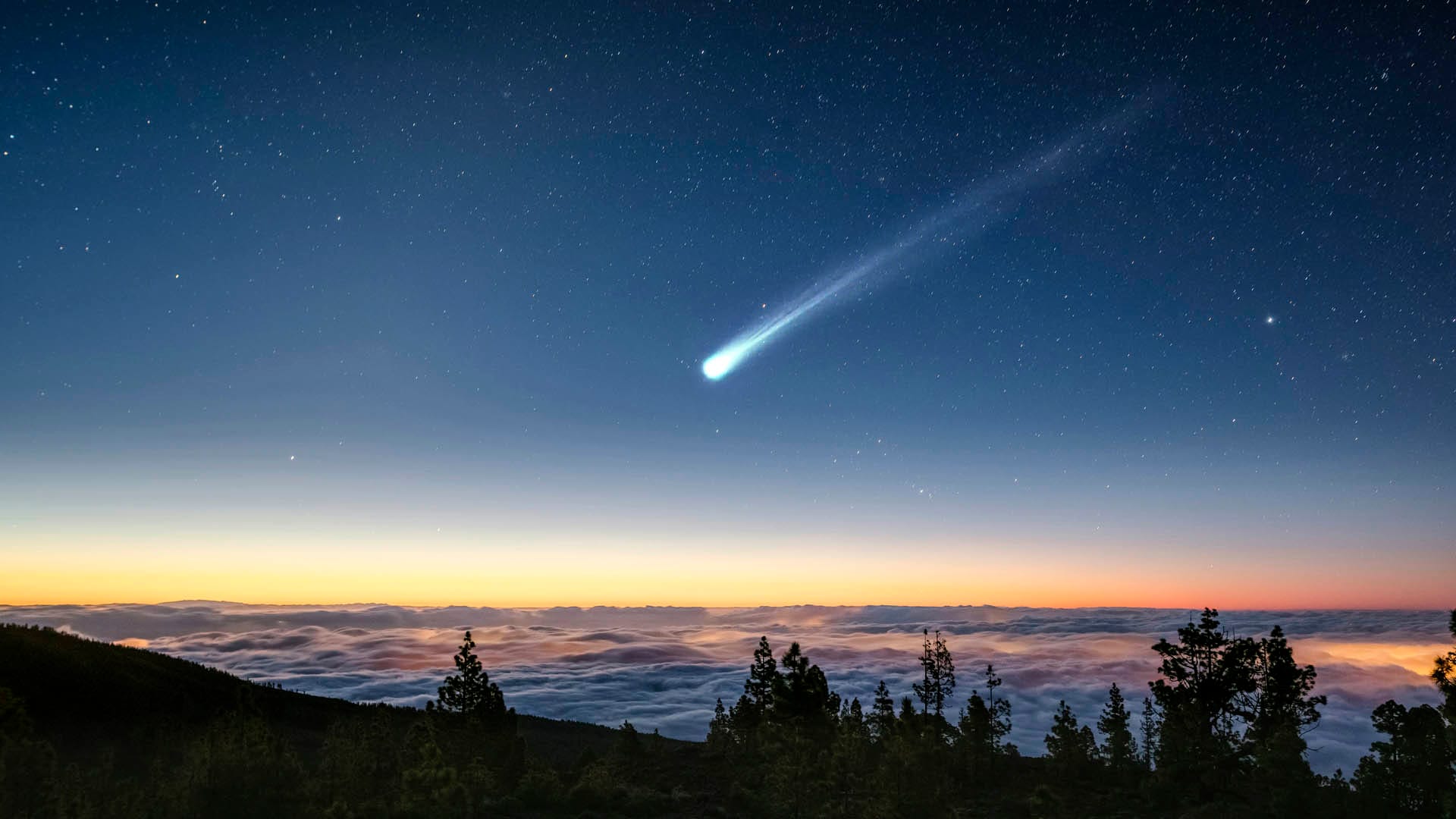
Comet
A small icy body that, when close to the Sun, exhibits a visible atmosphere and sometimes a tail due to solar radiation and the solar wind.
Asteroid
A small rocky body that orbits the Sun, primarily found in the asteroid belt between Mars and Jupiter.
Kuiper Belt
A region of the Solar System beyond Neptune that contains many small icy bodies and is the source of some comets.

Oort Cloud
A theoretical vast, distant region of the Solar System that is believed to be a source of long-period comets, located far beyond the Kuiper Belt.
Galaxy
A massive system of stars, stellar remnants, interstellar gas, dust, and dark matter, bound together by gravity.

Meteor
A small celestial body that enters Earth's atmosphere from space, often burning up to produce a visible streak of light, known as a meteor or shooting star.

Dwarf Planet
A celestial body that orbits the Sun, is spherical in shape, but has not cleared its neighboring region of other objects. Examples include Pluto and Eris.

Terrestrial Planets
The four inner planets of the Solar System, which are primarily composed of rock and metal, include Mercury, Venus, Earth, and Mars.
Jovian Planets
The gaseous planets located in the outer solar system, characterized by their large sizes and thick atmospheres. Examples include Jupiter, Saturn, Uranus, and Neptune.
Kepler’s 1st Law
The law of elliptical orbits stating that planets move in elliptical paths around the Sun, with the Sun at one focus.

Kepler’s 2nd Law
The law of equal areas, which asserts that a line segment joining a planet and the Sun sweeps out equal areas during equal intervals of time, meaning that planets move faster when they are closer to the Sun.

Kepler’s 3rd Law
The law of harmonies, which relates the square of the orbital period of a planet to the cube of the semi-major axis of its orbit, expressing how the distance of planets from the Sun influences their orbital periods.

Perihelion
The point in the orbit of a planet where it is closest to the Sun.
Aphelion
The point in the orbit of a planet where it is farthest from the Sun.
Star
A luminous celestial object composed of plasma, undergoing nuclear fusion and providing light and heat.
Photosphere
The visible surface layer of the Sun, from which light is emitted.
Corona
The outermost layer of the Sun's atmosphere, characterized by its high temperature and low density. It extends millions of kilometers into space and is visible during a solar eclipse.
H-R Diagram
A graphical representation of stars, illustrating the relationship between their luminosity and temperature. It helps classify stars and understand their evolution.
