Intro to Human A&P
 Call Kai
 Learn
Learn Practice Test
 Spaced Repetition
 Match
Match Flashcards
 Knowt Play
1/56

There's no tags or description
Looks like no tags are added yet.
Name | Mastery | Learn | Test | Matching | Spaced | Call with Kai | Chat |
|---|
No analytics yet
Send a link to your students to track their progress
57 Terms
Anatomy
studies the structure of body parts and their relationships to one another
-ex: Heart
Physiology
concerns the function of the body, in other words, how do they work and carry out their life sustaining activities
-ex: pumps and circulates blood
Chemical Level
atoms, molecules, and organelles

Cellular level
single cell ; the basic structural and functional units of life.

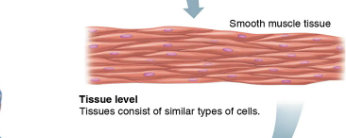
Tissue level
groups of similar cells, which work together toward a specific function (they also have a common embryological origin) examples include blood, muscle, nerves, etc.
examples include blood, muscle, nerves, etc.
Organ level
contains two or more types of tissues

Organ system level
organs that work closely together

Organismal level
all organ systems combined to make the whole organism

Atoms like carbon, hydrogen, and oxygen; molecules like water H2O and DNA
Chemical Level
Muscle cells, nerve cells (neurons), and red blood cells.
Cellular level
Epithelial tissue (lining), connective tissue (bone/fat), muscle tissue, and nervous tissue.
Tissue level
The heart, brain, stomach, and skin.
Organ level
The cardiovascular system (heart and blood vessels) and the respiratory system (lungs and airways).
Organ system level
why is the skin determined as a organ and not a tissue?
because it is comprised of more than two tissues
An entire human body
Organismal level
Separation between internal and external environments must exist
Plasma membranes separate cells
Skin separates organism from environment
Maintaining boundaries
Muscular system allows movement
Of body parts via skeletal muscles
Of substances via cardiac muscle (blood) and smooth muscle (digestion, urination)
Movement
Control of breathing rate, which must change in response to different activities
Responsiveness
Ability to sense and respond to stimuli
Responsiveness
Withdrawal reflex prevents injury
Responsiveness
Breakdown of ingested foodstuffs, followed by absorption of simple molecules into blood
Digestion
All chemical reactions that occur in body cells
Metabolism
Sum of all catabolism (breakdown of molecules) and anabolism (synthesis of molecules)
Metabolism
Removal of wastes from metabolism and digestion
Excretion
Urea (from breakdown of proteins), carbon dioxide (from metabolism), feces (unabsorbed foods)
Excretion
At the cellular level, reproduction involves division of cells for growth or repair
Reproduction
At the organismal level, reproduction is the production of offspring
Reproduction
Increase in size of a body part or of organism
Growth
how many organ systems are there and what are they named
There are 11 organ systems that work together to maintain life
Integumentary system (skin, hair, nails)
Skeletal system (bones, cartilage)
Muscular system (muscles)
Nervous system (brain, spinal cord, nerves)
Endocrine system (hormone-producing glands)
Cardiovascular / Circulatory system (heart, blood vessels)
Lymphatic / Immune system (lymph nodes, spleen, lymph vessels)
Respiratory system (lungs, airways)
Digestive system (stomach, intestines, liver)
Urinary / Excretory system (kidneys, bladder)
Reproductive system (organs for reproduction)
Forms the external body covering
Integumentary System

protects deeper tissues from injury.
Integumentary System
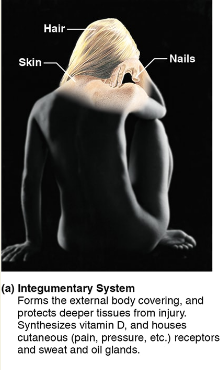
Synthesizes vitamin D
Integumentary System

houses cutaneous (pain, pressure, etc.) receptors and sweat and oil glands.
Integumentary System

Protects and supports body organs
Skeletal System

provides a framework the muscles use to cause movement
Skeletal System
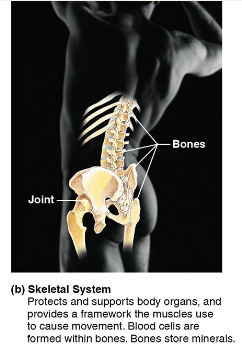
Blood cells are formed within bones. Bones store minerals.
Skeletal System
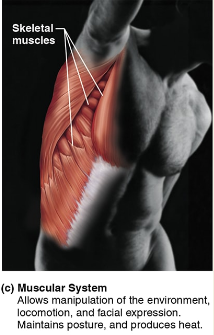
Allows manipulation of the environment
Muscular System
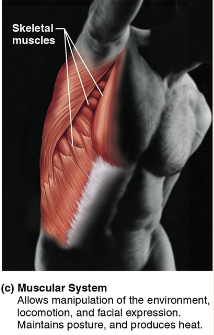
locomotion, and facial expression
Muscular System

Maintains posture, and produces heat.
Muscular System
Nervous System
fast-acting control system of the body,

it responds to internal and external changes by activating appropriate muscles and glands.
Nervous System

Glands secrete hormones that regulate processes such as growth
Endocrine System

reproduction, and nutrient use (metabolism) by body cells.
Endocrine System

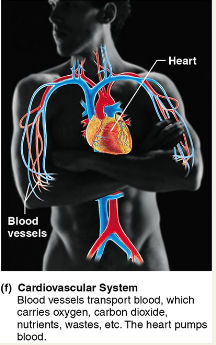
Blood vessels transport blood, which carries oxygen, carbon dioxide, nutrients, wastes, etc. The heart pumps blood.
Cardiovascular System
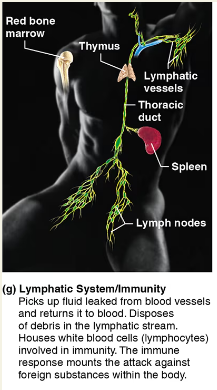
Picks up fluid leaked from blood vessels and returns it to blood.
Lymphatic system/Immunity

Disposes of debris in the lymphatic stream. Houses white blood cells (lymphocytes) involved in immunity.
Lymphatic system/Immunity

The immune response mounts the attack against foreign substances within the body.
Lymphatic system/Immunity
Keeps blood constantly supplied with oxygen and removes carbon dioxide.
Respiratory System
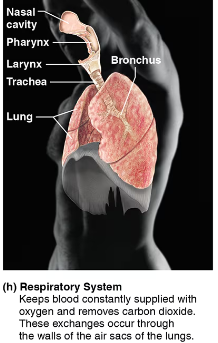
The gaseous exchanges occur through the walls of the air sacs of the lungs.
Respiratory System

Breaks down food into absorbable units that enter the blood for distribution to body cells.
Digestive System
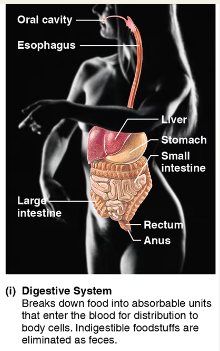
Indigestible foodstuffs are eliminated as feces.
Digestive System

Eliminates nitrogenous wastes from the body,
Urinary System

Removes and filters excess fluid from tissues.
Urinary System

overall function is to produce offspring
Reproductive System

Testes produce sperm and male sex hormone, and male ducts and glands aid in delivery of sperm to the female reproductive tract.
Reproductive System

Ovaries produce eggs and female sex hormones.
Reproductive System

the remaining female structures serve as sites for fertilization and development of the fetus. Mammary glands of female breasts produce milk to nourish the newborn.
Reproductive System
