Infinite series, Divergence tests + formulas
 Call Kai
 Learn
Learn Practice Test
 Spaced Repetition
 Match
Match Flashcards
 Knowt Play
1/32

There's no tags or description
Looks like no tags are added yet.
Name | Mastery | Learn | Test | Matching | Spaced | Call with Kai | Chat |
|---|
No analytics yet
Send a link to your students to track their progress
33 Terms
when does an infinite series diverge
-when limit does not exist
-if limit is infinite
when do you use telescoping series
when consecutive terms cancel, usually requires partial fractions
first step for telescoping series
-partial fractions if necessary
-find the first couple terms and Sn
how to finish telescoping series
find Sn and compute the limit
general geometric series formula
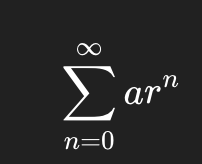
when does geometric series converge
|r|<1
formula for sum of geometric series
a/1-r
what if for geometric series |r|≥1
series diverges
Divergence test
if Σan is convergent then lim an =0;
why is it called divergence test
because it tells you if limit an does NOT equal 0 then Σan is DIVERGENT
using divergence test, what is
lim an=0
Nothing, it is inconclusive
can divergence test prove convergence?
no, only divergence
conditions for integral test
let an=f(n)
f is
-positive
-decreasing
-continuous
for all x≥1
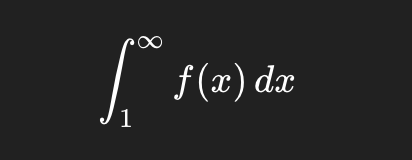
if this converges then Σan ___?
converges
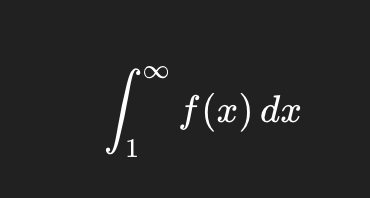
if this diverges then Σan ___?
diverges
general p-series formula
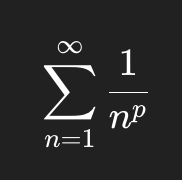
if p>1 for p-series
it converges, otherwise it diverges
conv/div?
Σ1/n
diverge, because using the p-series, it must be p >1 and here p=1
conv/div
Σ1/√n
diverge, because using p-series it must be p>1 and here p=1/2
conv/div?
Σ1/n2
converge, because using p-series p>1 and here p=2
conditions for direct comparison test
Σan,Σbn are positive series
Direct comparison test
if Σbn converges then Σan
converges provided 0≤an≤bn
Direct comparison test
if Σan diverges then Σbn
diverges provided 0≤an≤bn
what series are mostly used in comparison tests?
p-series and geometric
limit comparison test conditions
Σan,Σbn are positive series let it be (photo)
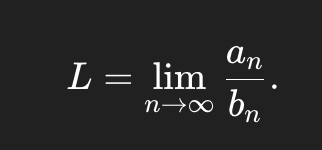
case 1 for limit comparison
if 0<L<∞, then Σan,Σbn both converge or both diverge
case 2 for limit comparison
if L=0 and Σbn converges, then Σan also converges
case 3 for limit comparison
if L=∞ and Σbn diverges, then Σan diverges
Theorem 1 (Limits of sequences
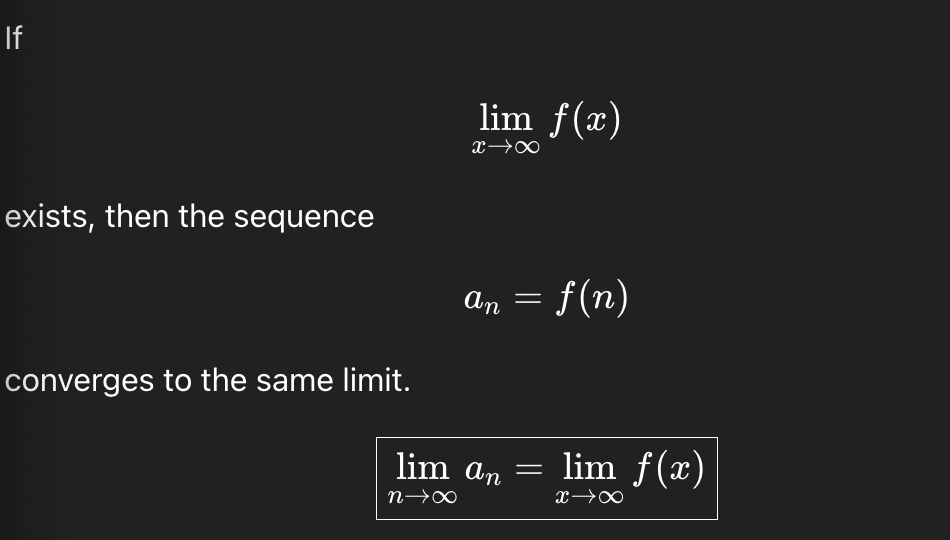
Theorem 2 (squeeze theorem for sequences)
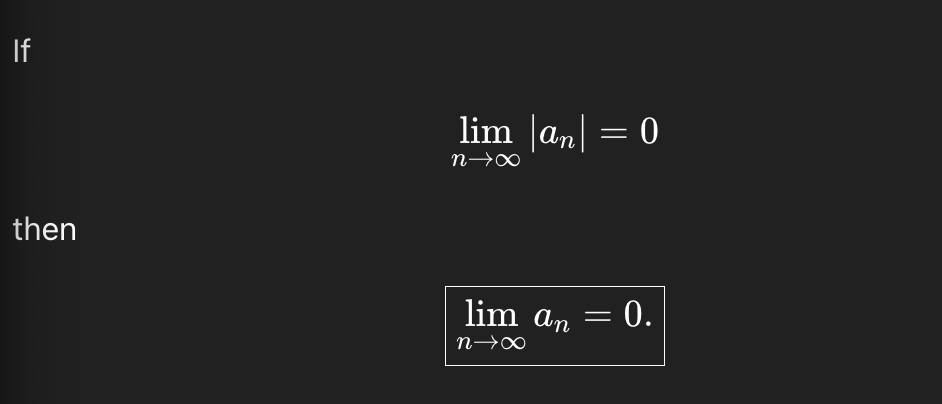
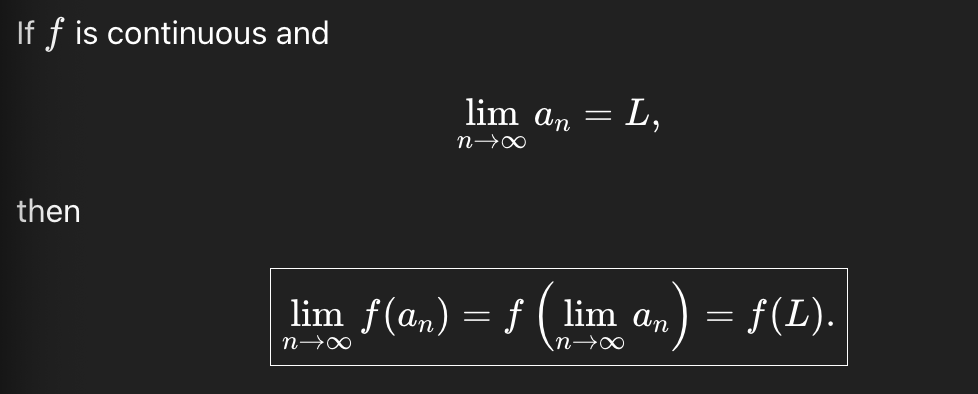
theorem 3 (continuous functions)
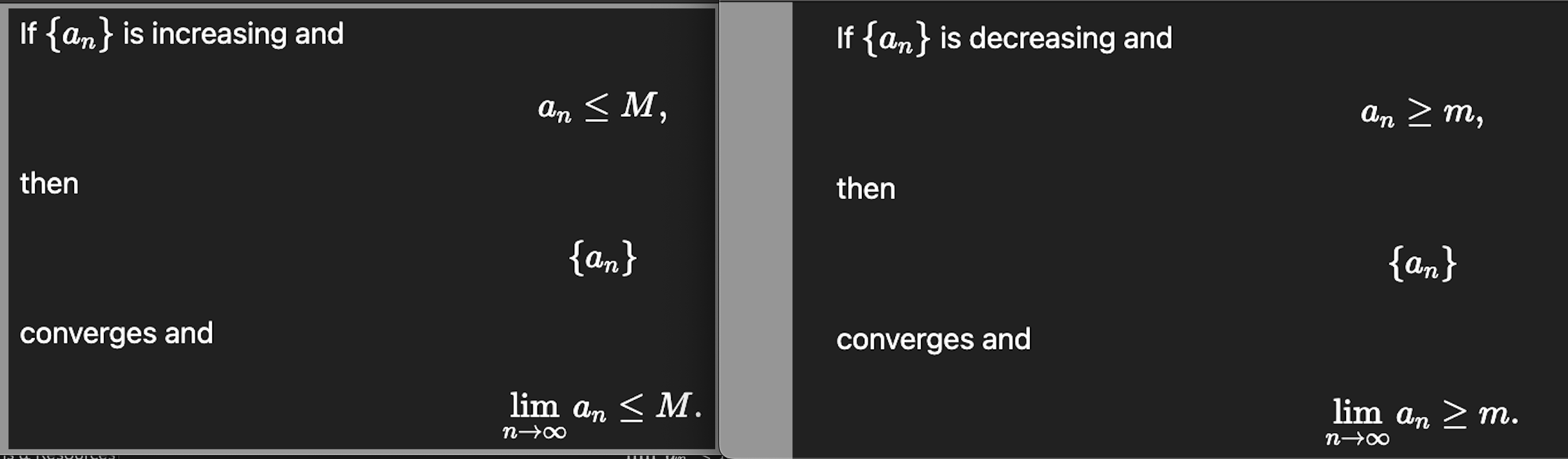
Theorem 4 (Bounded Monotonic Sequences)