Unit 2: Research Methods in I-O Psychology
 Call Kai
 Learn
Learn Practice Test
 Spaced Repetition
 Match
Match Flashcards
 Knowt Play
1/18

Earn XP
Description and Tags
Exam 1
Name | Mastery | Learn | Test | Matching | Spaced | Call with Kai | Chat |
|---|
No analytics yet
Send a link to your students to track their progress
19 Terms
What is the scientist-practitioner model
Give an example of how its is used when: A call center has a 3 week training program for new employees. The average employee quits after 3 months.
Scientist-practitioner model: interaction of scientific knowledge and application
Ex: A call center has a 3 week training program for new employees. The average employee quits after 3 months.
Science: Turnover Theories & Past Empirical Studies
Practitioner: Create Plan
Why is research important in IO psych?
Research helps us answer questions and make decisions
Our intuitions are often wrong
Research is important for both science and practice
Research is the way IO psychologists understand issues associated with people at work
Understanding research helps organizations solve problems, apply results of studies, and assess the accuracy of claims made about new practices
Knowledge of research methods used in IO and how to interpret findings are important for understanding the field
How applied research is used in psych
Investigating effective treatment approaches
Researching motivational strategies
Studying keyboard designs for efficiency
Finding out what makes people most productive
Examples of applied research jobs
People Analytics Researcher
Head of Assessment and Test Development
Applied Research Scientist
Principal Investigator, etc
Empirical Research Cycle - 5-step sequence
Statement of the problem → design of research study → measurement of variables → analysis of data → conclusions from research → REPEAT
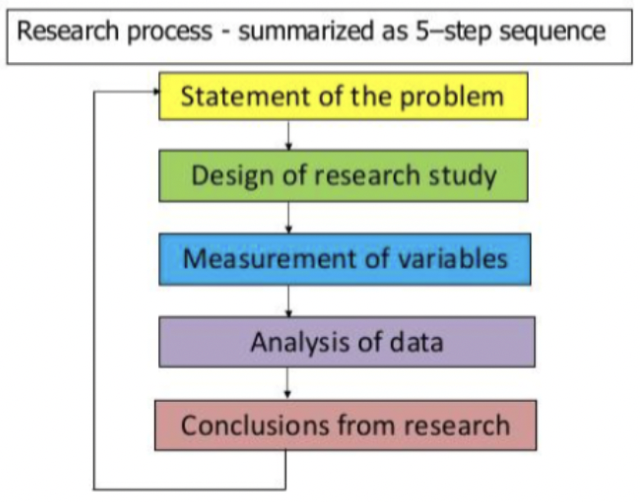
Statement of the Problem: research ideas in IO often come from…
scientific theories either by the inductive method or deductive method
theory
statement that proposes to explain relationships among phenomena
inductive method vs deductive method
Inductive method: researcher starts with data and the reaches theory
Deductive method: researcher first forms theory and then tests the theory by collecting data
Design of Research Study: internal validity vs external validity
Internal validity: degree to which relationships among variables in a study are accurate
External validity: degree to which the relationships among variables in a study are generalizable or accurate in other settings
Name and define primary research methods *ON TEST*
True experiment: involves IV & DV, random assignment, and manipulation
Quasi-experiment: similar to true experiment but does NOT involve random assignment
Non-experiment: NO manipulation or assignment of participants
Name and define secondary research methods *ON TEST*
Archival research: involves extraction of information from existing records (eg attendance records)
Meta-analysis: statistical procedure that combines the results of many individual, independently conducted empirical studies into a single result or outcome
Data mining: looks for patterns among measured items in very large data sets (aka “big data”)
qualitative research *ON TEST*
the use of non-quantitative data
name and define the different sources of data
Organizational records: collected and maintained by the organization for reasons other than research
Questionnaires: data in which subjects respond to written questions
Observation: where investigator collects data by monitoring subjects
Interviews/Focus groups: small but diverse group of people who participate in a facilitated discussion around questions related to the topic of interest
What is the relationship between control, realism, internal validity, and external validity in a research context?
Generally speaking:
High control offers higher internal validity
High realism offers higher external validity
No method is high on both control and realism
Important to recognize the pros and cons of each method
quantitative variables vs categorical variables
Quantitative variables: objects in a study that have a numerical number associated to them
Categorical variables: objects in a study that do not have a numerical number associated to them
name and define the variables used in IO psych rsearch
independent variable (IV): variable that is manipulated to influence the DV (experiments)
dependent variable (DV): a variable that is influenced by the IV (experiments)
Predictor variables: variable used to predict a criterion variable
Ex: Taking the SAT (predictor) to predict success of 1st year at college (criterion)
Criterion variables: variable that is the primary object of a research study; is forecasted by predictor
Ex: Taking the SAT (predictor) to predict success of 1st year at college (criterion)
Ex: Leadership style (IV) → Employee performance (DV)
Ways to analyze data
mean
median
mode
variability
standard deviation
correlation
a statistical technique that shows how strongly a pair of variables are related
Positive: X & Y move in same direction
Negative: X & Y move in opposite directions
Experimental research is good at identifying ___ relationships, but the most common IO research is ___
causal
non-experimental