11 Classification
 Call Kai
 Learn
Learn Practice Test
 Spaced Repetition
 Match
Match Flashcards
 Knowt Play
1/14

There's no tags or description
Looks like no tags are added yet.
Name | Mastery | Learn | Test | Matching | Spaced | Call with Kai | Chat |
|---|
No analytics yet
Send a link to your students to track their progress
15 Terms
Classification
Is the way in which living organisms are divided into groups

Taxonomy
The scientific practice of grouping organisms based on shared characteristics

Hierarchal
Consists of:
- smaller groups within larger groups
- no overlap between groups
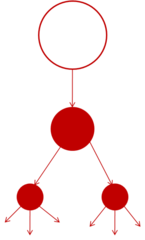
Phylogenetic
Based on the evolutionary history of organisms, i.e. their common ancestry.
The closer the branches, the closer the evolutionary relationship, therefore the more recently they shared a common ancestor

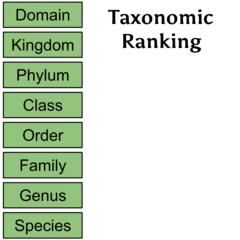
8 main taxonomic ranks (hierarchical)
· Domain
· Kingdom
· Phylum
· Class
· Order
· Family
· Genus
· Species
Largest to smallest
What is the binomial name?
Genus species
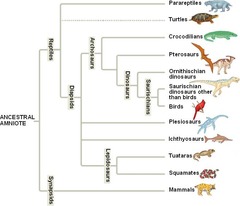
Phylogenic tree
This reflects the evolutionary relationship between organisms. ,
Looks at similarities and differences in structure and function (represented by phylogenetic tree)
Each branch represents where divergence occurred (i.e. where a common ancestor evolves to become new species).
The closer the branches, the closer the evolutionary relationship, therefore the more recently they shared a common ancestor
Species
A group of organisms with similar characteristics that can interbreed to produce fertile offspring

Courtship behaviour
Courtship behaviour is innate- genetically determined, allows for fertile mating
All members of the same species are genetically programmed to show exactly the same courtship behaviour as they share the same genes.

Courtship behaviour allows...
Species recognition - ensures fertile offspring produced
Synchronising reproductive behaviour - max chance of fertilisation
Identify a mate that is capable of breeding
Formation of a pair bond - keeps male + female together - increases survival chances of offspring
Stimulating production of gametes

Examples of courtship behaviour
A display of breeding colours
A dance
A song - especially in nocturnal animals
4 different ways of investigating genetic diversity
1. The frequency of measurable or observable characteristics
2. The base sequence of DNA
3. The base sequence of mRNA
4. The amino acid sequence of the proteins encoded by DNA and mRNA.

What do the base / amino acid sequence coded for / of mRNA and DNA tell us about genetic diversity?
The more similar the base sequence of mRNA/DNA / amino acid sequence, the more closely related the organisms and they share a more recent common ancestor
Samples should be:
Large: (20), more representative of the population and minimise the influence of chance on the results
Random: this avoids bias and ensures that every member of the population has an equal chance of being included in the sample
Standard deviation
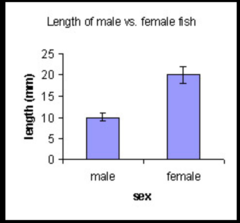
Standard deviation is a measure of the spread of values about the mean and thus indicates the extent of variation a population shows
The standard deviations overlap so no significant difference between the two means.
No overlap so difference is likely to be significant, i.e. is not likely to be due to chance.
If no overlap of the 2 x SD, you can be much more confident about concluding that there is a significant difference between the means
If they ask for 2SD, multiply SD by 2
Reduce the impact of extreme data points