CHAPTER 1: INTRO TO ARGUMENTATION
 Call Kai
 Learn
Learn Practice Test
 Spaced Repetition
 Match
Match Flashcards
 Knowt Play
1/29

There's no tags or description
Looks like no tags are added yet.
Name | Mastery | Learn | Test | Matching | Spaced | Call with Kai | Chat |
|---|
No analytics yet
Send a link to your students to track their progress
30 Terms
Communication
The process by which verbal and nonverbal messages are used to create and share meaning
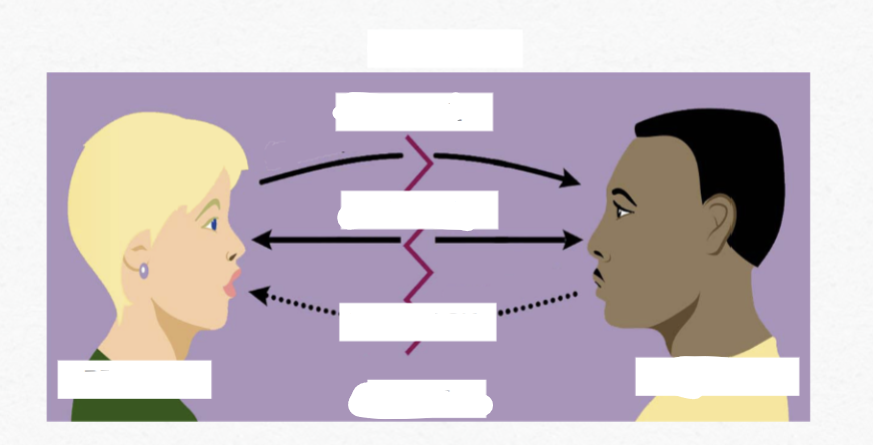

(HCM) Channel
The means in which the message is moved
(HCM) Message
the information, idea, thought, or feeling being communicated
(HCM) Feedback
the receiver’s response to the message, which lets the speaker know how the message was interpreted
(HCM) Speaker
the person who creates and sends the message.
(HCM) Receiver
the person who receives and interprets the message.
(HCM) Feedback
the receiver’s response to the message, which lets the speaker know how the message was interpreted.
(HCM) Noise
anything that interferes with the message being sent or understood correctly. Noise doesn't have to literally be sound.
(HCM) Context
the situation or environment in which communication happens. It can affect how a message is understood.
Argumentation
A form of instrumental communication. It relies on ethos, pathos, and logos.
Persuasion
An attempt to move an audience to accept or identify w/ a particular POV
Elaboration Likelihood Model (ELM)
How we process persuasive messaging:
Central Processing: Reasoning and logic
Only possible when people WANT to and are ABLE to reason and understand
Peripheral Processing: simple cues or shortcuts instead of carefully thinking about the argument and evidence.
What to keep in mind when making an argument
Demographics: age, gender, race, etc.
Psychographics: attitude, common bonds, emotion
You must adapt to the audience
The Sophists
Taught normal citizens how to public speak
Traveling teachers in Athens
Disliked by great philosophers
Protagoras
A sophist
Known as the father of debate
He denied objective reality → NO “THIS IS THE RIGHT WAY”
Anti-Logic
Look at the grey area
Resolve debate by examining both sides of the argument
Aristotle
Plato’s student who initially agreed w/ his ideas
Eventually broke off and began to study the art of rhetoric later on
Pragmatic (not fixed) and scientific
(3 Theoretical Perspectives) Rhetoric
How we use communication to influence others
Relates to context and focuses on audience
Purpose: persuasion
Perspective
Who is the audience? What are the circumstances for the argument? What is the arguer’s intent? How does this appeal to the reader?
(3 Theoretical Perspectives) Dialectic
discussion and back-and-forth questioning to examine different sides of an issue and reach a better understanding.
In forms of questions until you find the answer
Participants are EQUAL → Must have respect for others
Perspective
Have all isues been examened? What is the best conclusion?
(3 Theoretical Perspectives) Logic
Context + Proof
Purpose: judging an argument based on whether it uses good reasoning and strong evidence.
DOESN”T CONSIDER CONTEXT
Formal logic
Turn ideas into math symbols, a=b=c so a=c
Absolute truth
using strict rules and structures to determine whether an argument is logically valid.
Informal logic
Using reasoning and evidence in everyday arguments to decide whether a conclusion makes sense.
Doesn’t neccessarily lead to conclusions
Ethics
The moral choices a person makes regarding his/her morals.
Teleological ethics
Judging whether an action is right or wrong based on its consequences or results.
Deontological Ethics
Judging whether an action is right or wrong based on rules, duties, or moral principles, regardless of the outcome.
4 Guidelines for Ethical Argumentation
Clarity: explain to the audience
Honesty: say the truth
Efficiency: be efficient but don’t take short cuts
Relevance: connect to the audience
Discourse ethics
The idea that ethical decisions should be made through fair and open discussion between everyone affected.
Not about WINNING or LOSING
Guidelines:
Audience/Opponents aren’t objects or things
Never silence your oponent
Trace your argument
Invitational Rhetoric
Communicating by inviting others to understand your point of view rather than trying to persuade or change them.
Influenced by FEMINISM thought
Guidelines:
Equality/safety
Everyone is =
Freedom