Task 6 summary
 Call Kai
 Learn
Learn Practice Test
 Spaced Repetition
 Match
Match Flashcards
 Knowt Play
1/13

There's no tags or description
Looks like no tags are added yet.
Name | Mastery | Learn | Test | Matching | Spaced | Call with Kai | Chat |
|---|
No analytics yet
Send a link to your students to track their progress
14 Terms
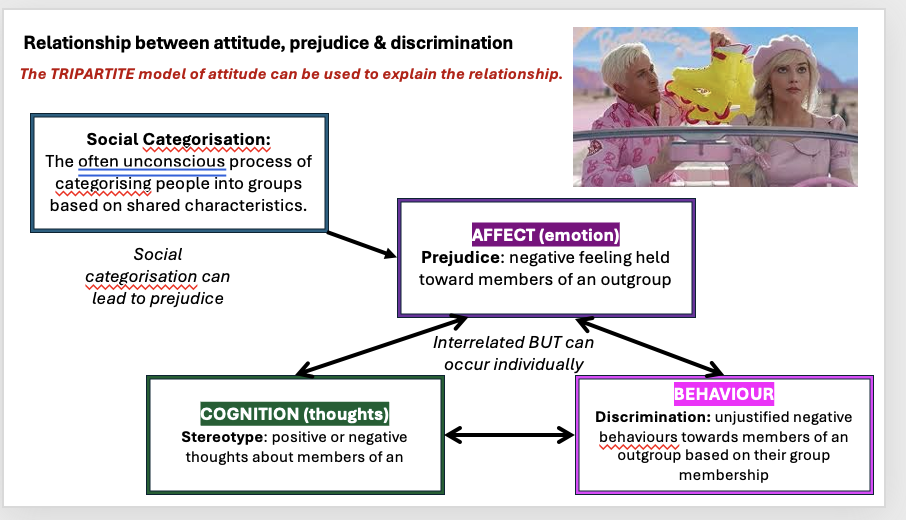
Define social categorisation
Classifying people as part of a group
based on shared attributions such as ethnicity, physical features
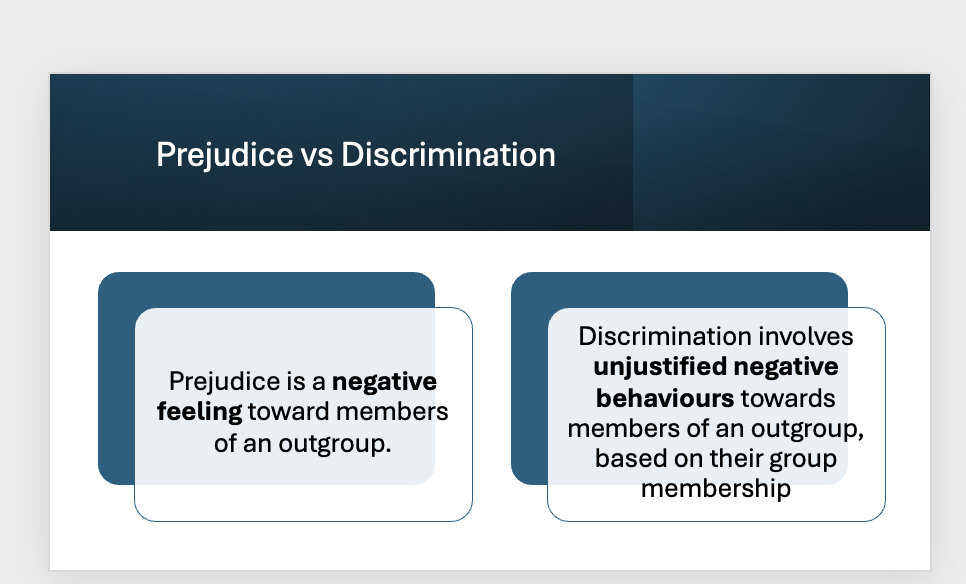
Distinguish between prejudice and discrimination (give two examples in society)
Prejudice: negative feeling towards members of a particular group
Discrimination: unjustified negative behaviour toward a person based on their membership to a group or social category
Examples include the basis of race, gender and ethnicity
three causes of prejudice explained
Social influence: learnt from family, peers, friends, media. if the prejudice learnt is shown to be negative it can be taken on board by an individual
Intergroup competition: competing for scarce but valued resources lead to seeing others as a threat and creating prejudice
Social categorisation: unconsciously identifying people as being part of the in or out group leads to prejudice for those in the outgroup
Just world phenomenon: assumptions that everything happens for a reason. dispositional attributions for outcomes of other people or make us feel people deserve bad things happen to them because the world is fair.
three ways to reduce prejudice
intergroup contact: contact between opposing groups allows people to see the outgroup individuals
superordinate goals: having goals both groups want to achieve but can only be achieved together
mutual interdependance: when groups have to depend on one another to meet their goals -creates a co-dependant relationship
Equal status contact: people from both groups who are of similiar status interacting in a situation where they are of equal footing
social identity theory
suggests how people develop a sense of self in terms of group membership
identify three mental processes for evaluating other according to tajfel and turners (1975) theory
social categorisation
social identity
social comparison
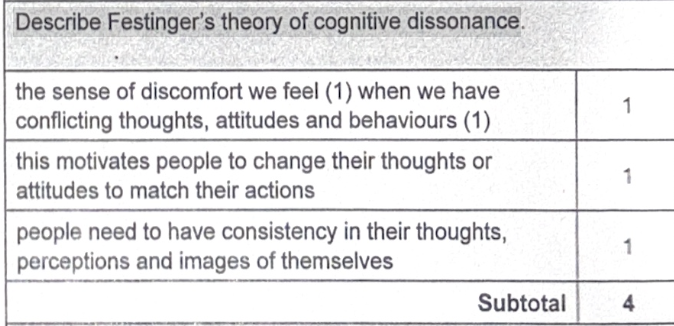
Cognitive dissonance
Mental discomfort Due to inconsistency between attitudes, beliefs and behaviours
Resulting in the altering of in either attitude, belief or
behaviour to reduce the discomfort
Festinger and Carlsmith (1959) investigated cognitive dissonance. Outline the difference in the procedure used for participants in the control group and the experimental groups
The control group were not asked to tell the waiting student that the experimental tasks were enjoyable/ lots of fun.
(Both/$1 and $20) experimental groups were instructed to tell the student/confederate in the waiting room that 1 the experiment was a lot of fun/enjoyable/interesting
Explain the limitations of the study with reference to generalisability to the population.
Results are not generalisable to the population/the study has low generalisability (1) The sample was made up of only males (1) From a single/first year course (1) The population would include females from other courses
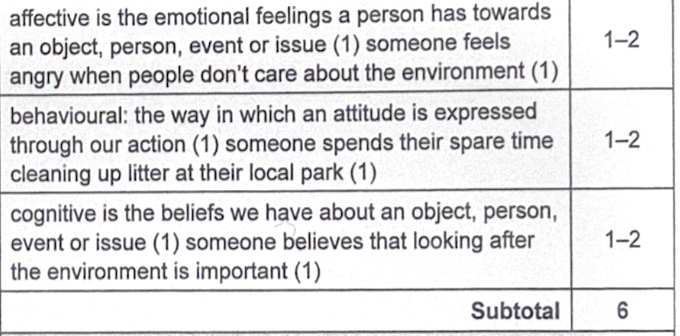
Outline the tripartite model of attitude structure and provide an
example of each part related to environmental issues
Describe Festinger's theory of cognitive dissonance
define belief
the mental acceptance of or conviction in the truth, reality, or validity of something, regardless of whether it has absolute factual proof