Biochemistry Exam 2 Questions
 Call Kai
 Learn
Learn Practice Test
 Spaced Repetition
 Match
Match Flashcards
 Knowt Play
1/199

There's no tags or description
Looks like no tags are added yet.
Name | Mastery | Learn | Test | Matching | Spaced | Call with Kai | Chat |
|---|
No analytics yet
Send a link to your students to track their progress
200 Terms
B. Km for methanol binding will be increased
Methanol poisoning happens because liver alcohol dehydrogenase converts methanol into formaldehyde. If timely intervened, (IV infusion of low dose ethanol), it binds to the enzyme-displacing methanol. Which of the following will be correct?
A. Km for methanol binding will be decreased
B. Km for methanol binding will be increased
C. Vmax for methanol binding will be increased
D. Vmax for methanol binding will be decreased
reaction rates
Enzymes are biological catalysts that increase __________ _____.
A and B
Enzymes are able to do their job and
A. Not be used up
B. Not affect equilibrium
C. Shift equilibrium
D. Then are not able to be used again
C. Proteins (in proper configuration, some RNA also catalyzes reactions)
Most enzymes are:
a. Sugars
b. Nucleic acids
c. Proteins
d. Ribozymes
Fe2+, Mg2+, Zn2+ ions, organic or organometallic coenzyme, holoenzyme, apoenzyme, or prosthetic groups
Some enzymes require a cofactor. What are examples of cofactors?
Holoenzyme is with the cofactor
Apoenzyme is without the cofactor
With regard to enzymes, they can be a holoenzyme or an apoenzyme. What is the difference between these?
A. Prosthetic groups
cofactors are both loose or tight
Some cofactors are tightly bound with their enzymes and others are loosely bound. What are tightly bound cofactors called?
A. Prosthetic groups
B. Holoenzymes
C. Coenzymes
D. Chaperones
C. Coenzymes
cofactors are both loose and tight
Some cofactors are tightly bound with their enzymes and others are loosely bound. What are loosely bound cofactors called?
A. Prosthetic groups
B. Holoenzymes
C. Coenzymes
D. Chaperones
Ribosome= makes proteins (site for protein synthesis)
Ribozyme= enzyme that speeds up protein synthesis
What is the difference between a ribosome and ribozyme?
A, B, and C
Which of the following are functions of ribozymes?
A. Catalyzes peptide bond formation between amino acids
B. RNA splicing
C. tRNA synthesis
Enzymes are named after their substrates/function
What are enzymes named after?
B. No. Enzymes cannot affect the overall delta G (free energy)
Do enzymes affect equilibrium?
A. Yes
B. No

B. Decreasing
Enzymes increase reaction rates by ______________ delta G activation energy.
A. Increasing
B. Decreasing
False. Enzymes do facilitate and allow biological reactions to take place at our body temp, but it is by lowering the activation energy.
T/F Enzymes facilitate biochemical reactions to proceed at body temperature by increasing the activation energy.
Look at graph
Explain what a reaction coordinate graph looks like (substrate, product, activation energy, transition state, delta G)
By organizing reactive groups into close proximity and proper orientation. Enzymes bind transition states best
How do enzymes lower activation energy?
It is when the substrate is activated and activation energy has been reached.
What is the transition state?
A. Unfavorable
Uncatalyzed molecular reactions are energetically ______________.
A. Unfavorable
B. Favorable
True
T/F Both a single restricted transition state (bimolecular) and a rigid transition state (unimolecular) are energetically unfavorable.
bimolecular: 2 free reactants to a single restricted transition state
unimolecular: flexible reactant to a rigid transition state
The energy cost is paid during binding. The enzyme uses the binding energy of substrate to organize the reactants to a fairly rigid ES complex.
When is the energy cost paid during catalyzed reactions?
True
T/F When there is no enzyme there is nothing to stabilize the transition state, so you have less product formation.
Linus Pauling (1946)
Who discovered that enzymes bind transition states best rather than substrates?
B. Calcium
Which cofactor is also part of our skeletal system?
A. Magnesium
B. Calcium
C. Iron
Fe2+, Fe3+
Which inorganic ions serve as cofactors for cytochrome oxidase, catalase, and peroxidase?
Mg2+
Which inorganic ions serve as cofactors for hexokinase, glucose 6-phophatase, pyruvate kinase?
D. Coenzymes are actually organic molecules.
Which of the following is NOT true about coenzyme?
A. They are generally synthesized from the dietary precursor of vitamins.
B. They are generally carrier of chemical groups in a biochemical reaction.
C. They are loosely attached to the enzyme.
D. They are inorganic molecule generally required for optimal enzymatic activity.
C. The recommended daily allowance is 400 mcg per day.
Which of the following information about the folic acid is NOT TRUE?
A. It is indicated for prevention of neural tube defects in pregnancy.
B. It is indicated for the treatment of megaloblastic anemia.
C. The recommended daily allowance is 400 mg per day.
D. It is a water-soluble vitamin that has antidepressant, antiproliferative, anti-teratogenic, gingival and anti-inflammatory effects.
E. Erythema, pruritus, urticaria, irritability, nausea, bloating and flatulence are reported side effects of the vitamin.
What is coenzyme Biocytin an example of chemical groups transferred and dietary precursor?
example of chemical group transferred- CO2
dietary precursor in mammals- biotin
What is the coenzyme A an example of chemical groups transferred and dietary precursor?
example of chemical group transferred- acyl groups
dietary precursor in mammals- pantothenic acid B5/ other compounds
What is the coenzyme Flavin adenine dinucleotide an example of chemical groups transferred and dietary precursor in mammals
example of chemical group transferred- electrons
dietary precursor in mammals- riboflavin (vitamin B12)
What is the coenzyme Nicotinamide adenine dinucleotide an example of chemical group transferred and dietary precursor in mammals
example of chemical group transferred- hydride ion H-
dietary precursor in mammals- nicotinic acid (niacin) B3
What is the coenzyme tetrahydrofolate an example of chemical group transferred and dietary precursor in mammals
example of chemical group transferred- one carbon groups
dietary precursor in mammals- folate (vitamin B9)
A. Oxioreductases
This type of enzyme transfers electrons? (hydride ions or H atoms)
A. Oxidoreductases
B. Transferases
C. Hydrolases
D. Lyases
E. Isomerases
F. Ligases
B. Transferases
This type of enzyme does group transfer reactions?
A. Oxidoreductases
B. Transferases
C. Hydrolases
D. Lyases
E. Isomerases
F. Ligases
C. Hydrolases
This type of enzyme is involved in hydrolysis reactions?(transfer of functional groups to water)
A. Oxidoreductases
B. Transferases
C. Hydrolases
D. Lyases
E. Isomerases
F. Ligases
D. Lyases
This type of enzyme cleaves C-C, C-O, C-N or other bonds by elimination, leaving double bonds or rings, or addition of groups to double bonds?
A. Oxidoreductases
B. Transferases
C. Hydrolases
D. Lyases
E. Isomerases
F. Ligases
E. Isomerases
This type of enzyme transfers groups within molecules to yield isomeric forms?
A. Oxidoreductases
B. Transferases
C. Hydrolases
D. Lyases
E. Isomerases
F. Ligases
F. Ligases
This type of enzyme forms C-C, C-S, C-O, and C-N bonds by condensation reaction coupled to cleavage of ATP or similar cofactor?
A. Oxidoreductases
B. Transferases
C. Hydrolases
D. Lyases
E. Isomerases
F. Ligases
Nucleophile
Nucleophile= electron rich
Electrophile= electron poor Ex. H+
Is H- an electrophile or a nucleophile?
A. Proton transfers (H+)
Acid-base catalysis involves:
A. Proton transfers
B. Electron transfers
C. Electrostatic interactions
B. Electron transfers (e-)
Covalent catalysis involves:
A. Proton transfers
B. Electron transfers
C. Electrostatic interactions
C. Electrostatic interactions (mg2+)
Metal ion catalysis involves:
A. Proton transfers
B. Electron transfers
C. Electrostatic interactions
False Enzymes can have multiple catalytic mechanisms Ex. Chymotrypsin
T/F Enzymes can only have one catalytic mechanism.
Proximity and orientation effects for the catalytic mechanisms of enzymes
facilitate increased physical collision in the right orientation
DNA polymerase using Mg2+ to stabilize and build DNA
What is an example of a metal ion catalysis reaction?

B. Acid-base catalysis
A majority of enzymatic reactions are:
A. Covalent catalysis
B. Acid-base catalysis
C. Metal-ion catalysis

A transient covalent bond forms between the enzyme and the substrate. It changes the reaction pathway. It requires a nucleophile on the enzyme which could be a reactive serine, thiolate, amine, or carboxylate.
pathway can be uncatalyzed or catalyzed
Describe what happens in covalent catalysis
It involves a metal ion bound to an enzyme. It stabilizes negative charges of substrate. It participates in oxidation reactions.
Describe metal ion catalysis
A. Apoenzyme
One of the enzymes involved in glycolysis, aldolase, requires Zn2+ for catalysis. Under conditions of zinc deficiency, when the enzyme may lack zinc, it would be referred to as the:
A. apoenzyme.
B. coenzyme.
C. holoenzyme.
D. prosthetic group.
C. They can increase the reaction rate for a given reaction by a thousand-fold or more.
Which statement is TRUE of enzyme catalysts?
A. Their catalytic activity is independent of pH.
B. They are generally equally active on D and L isomers of a given substrate.
C. They can increase the reaction rate for a given reaction by a thousand-fold or more.
D. They can increase the equilibrium constant for a given reaction by a thousand fold or more.
E. To be effective, they must be present at the same concentration as their substrate.
B. Cut peptide bonds at specific locations on the peptide backbone
Chymotrypsin is a serine protease who's main job is to:
A. Create peptide bonds between serine and other proteins
B. Cut peptide bonds at specific locations on the peptide backbone
C. Form a variety of proteins
Ingestion, dissolve fibrotic tissue, break blood clots, clear blockage in GI tract
For what medical conditions could chymotrypsin be used?
How does the chymotrypsin serine protease work?
the protease cleaves to the peptide bond adjacent to the aromatic amino acids
Acid base catalysis (serine) and covalent catalysis (histidine)
Chymotrypsin uses 2 types of catalysis when doing its job as an enzyme. What are these 2 types?
Basic (histamine) and acidic (serine)
-the transient covalent bonds are formed between the substrate and enzyme
What 2 functional groups on chymotrypsin act in general acid-base catalysis?
Tyrosine, phenylalanine, tryptophan
Chymotrypsin cleaves peptide on the carboxyl side of these 3 amino acids because they contain aromatic rings, which fit into the hydrophobic pocket of the enzyme. What are these amino acids?
Hydrophobic pocket
Tyrosine, phenylalanine, and trypotophan are able to be cleaved by chymotrypsin because they are able to bind to it. This is because their armatic rings can fit into chymotrypsin' a _____________ _________.
Aspartate, Histidine, Serine. These are present at the catalytic site so they can produce proximity and orientation effect on substrate that lowers activation energy.
Which 3 amino acids form the chymotrypsin triad?
CoA, FAD, FAD, NAD, NADP, THF; protons (H)
What are examples of coenzymes and what chemical group do they transfer?
Describe the mechanism of chymotrypsin
-step 1: is substrate binding, when the substate binds(polypeptide), the side chain of the residue adjacent to the peptide bond to be cleaved nestles in hydrophobic pocket on the enzyme, positioning the peptide bond for attack
-step 2: nucleophilic attack, interaction of the Ser195 and his57 generates a strong nucleophilic alkoxide ion on ser195… ion attacks the peptide carbonyl group forming a tetrahedral acyl-enzyme. This accompanied by formation of the short lived negative charge on the carbonyl oxygen of the substrate, which is stabilized by hydrogen bonding in the oxyanion hole
-step 3: substrate cleavage, instability of the negative charge on the substrate carbonyl oxygen leads to collapse of the tetrahedral intermediate, re-formation of a double bond with carbon displaces the bond between carbon and amino group of the peptide linkage, breaking the peptide bond. the amino leaving group is protonated His57, facilitating its displacement
-step 4: water comes in, incoming water molecule is deprotonated by general base catalysis, generating a strongly nucleophilic hydroxide ion. attack of the hydroxide on the ester linkage of the acyl-enzyme generates a second tetrahedral intermediate, with oxygen in the oxyanion hole again taking on a negative charge.
-step 5: water attacks, collapse of the tetrahedral intermediate forms the second product, a carboxylate anion, displaces the ser195
-step 6: break-off from the enzyme, collapse of the tetrahedral intermediate forms the second product, carboxylate anion, displaces ser195
-step 7: product dissociates, dissociation of the second product from the active site regenerates free enzymes
The transient cell-enzyme intermediate (tetrahedral intermediate)
Which part of chymotrypsin mechanism is covalent catalysis?
It is a beta-lactam antibiotic which means it prevents formation of bacterial cell walls in G+ and G- bacteria.
How does Amoxicillin work?
To treat bacterial infections when patient does not respond to amoxicillin.
What is Augmentin used for?
Clavulanic acid makes bacteria more susceptible to amoxicillin when they have built up some resistance. It is a beta-latamase INHIBITOR enzyme which means it cleaves the bacteria beta-lactamase so it cannot degrade amoxicillin.
What is the function of clavulanic acid in Augmentin?
Tetrahedral intermediate
What is common in MOA for chymotrypsin, amoxicillin, and clavulanic acid?
Kinetics
___________ is the study of the rate a which compounds react.
Enzyme, subtracted, effectors, temp
The rate of enzymatic reactions are affected by:
Why study enzyme kinetics?
quantitative description of bio catalysis, understand catalytic mechanism, find effective inhibitors, understand regulation of the activity
It is determined by the enzyme-substrate (ES) complex, not on the concentration of substrate.
What is product concentration directly determined by?

the total enzyme concentration is _
constant, the mass balance equation for enzymes is Etot= [E]+[ES]
It is also implicitly assumed that Stot= [S]+[ES]~[S]
What is the steady state assumption?
d[ES]/dt= rate of formation of ES- rate of breakdown of ES= 0
What is observed rate
the rate of product formation is the rate of ES breakdown to product

True
T/F The rate of product formation is the rate of [ES] breakdown to product.
It is substrate concentration when velocity is 1/2 of maximum. Km unit is a concentration unit.
What is Km?
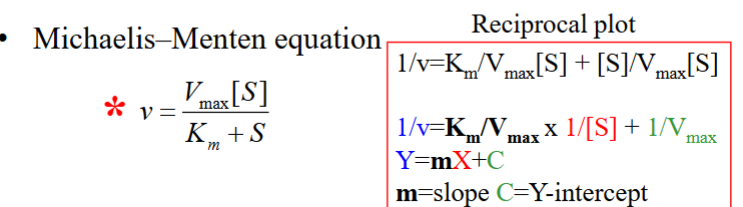
The Michaelis-Menten equation is?
v=Vmax[S]/ Km + s
the deviations of the effect of substrate conc are…
-limitations of measurements
-substrate inhibition
-substrate prep containing inhibitors
-enzyme prep containing inhibitors
The shape of the line will stay the same.
How will the substrate concentration graph look if you vary only [E]?
![<p>How will the substrate concentration graph look if you vary only [E]?</p>](https://assets.knowt.com/user-attachments/140ca5bb-09f9-4490-bd34-b11cb11f0155.png)
nonlinear michealis-menton plot should be used to _
calculate parameters Km and Vmax

a linearized double-reciprocal plot is good for analysis of _
two-substrate data or inhibition
High; is not
In saturation kinetics, there is a _______ (high or low)[S] and velocity ______(is or is not) proportional to [S].
enzyme activities can be regulated by:
-noncovalent modification (allosteric), covalent modification, irreversible, reversible
noncovalent modification: allosteric regulators
allosteric effectors or modulators are_
allosteric effectors can be _
allosteric effectors can be _
-generally small chemicals
-positive or improve enzymatic catalysis
-negative, reduce enzymatic catalysis

allosteric regulator-1, aspartate transcarbamoylase (ATCase)’s primary role is _
initiate the de novo pathway for pyrimidine nucleotide biosynthesis
ATCase catalyzes the condensation of aspartate and carbamoyl phosphate to from N-carbamoylaspartate in pyrimidine.

Amoxicillin, clavlanic acid (clavulanate), aspirin, powerful toxins are usually irreversible
There are 2 types of enzyme inhibition, irreversible and reversible. What is an example of irreversible inhibitors?
Reversible inhibitors bind to and can dissociate from the enzyme. Irreversible do not dissociate from enzyme. Ex. statin drugs (ACE inhibitor)
How are reversible inhibitors different from irreversible inhibitors?
Competitive bind to the free enzyme and prevent substrate binding. Noncompetitive bind to [ES] and prevent the reaction.
Reversible inhibitors of enzymes can be competitive or noncompetitive. Where do each of these bind?
zymogens are activated by irreversible_
covalent modification

some enzymes use_
multiple types of regulation

Competitive- no change in Vmax; apparent increase in Km
Noncompetitive- decrease in Vmax; apparent decrease in Km (lines are parallel and decreasing)
Mixed- decrease in Vmax; change in Km (lines intersect left of y-axis)
What do competitive and noncompetitive inhibitors do to graph? What about mixed inhibition?
B. Km for methanol binding will be increased (increase Km means less binding)
Methanol poisoning happens because liver alcohol dehydrogenase converts methanol into formaldehyde. If timely intervened, (IV infusion of low dose ethanol), it binds to the enzyme-displacing methanol. Which of the following will be correct?
A. Km for methanol binding will be decreased
B. Km for methanol binding will be increased
C. Vmax for methanol binding will be increased
D. Vmax for methanol binding will be decreased
True
T/F Carbohydrates fulfill a variety of functions including energy source and energy storage, structural component of connective tissue in animals, and informational molecule.
influenza virus and the Tamiflu CLINICAL INSIGHT
the moment of infection, carbohydrate component from host cell+ protein component from virus
oligosaccharides in recognition

influenza virus has the protein component _
lection, which is essential for the viral entry to the host cell
lectin interacts with_
oligosaccharides displayed on the host cell
virus will ___ and ______ and _____
replicate, bud out of the cell, wrapped in a portion of its plasma membrane
a viral enzyme sialidase/neuroaminidase _
trims the terminal sialic acid residue from host cells oligosaccharide and helps in release of viral particles
tamiflu the sugar analog
antiviral drugs oseltamivir (Tamiflu) and zanamivir (Relenza) are sugar analogs that prevents the release of viruses from the infected cells, which causes viral particles to aggregate and block another cycle of infection
which component of the influenza virus is derived from host cell?
carbohydrate component
tamiflu (oseltamivir) is best described as a
sugar analog