The chemistry of water
 Call Kai
 Learn
Learn Practice Test
 Spaced Repetition
 Match
Match Flashcards
 Knowt Play
1/30

There's no tags or description
Looks like no tags are added yet.
Name | Mastery | Learn | Test | Matching | Spaced | Call with Kai | Chat |
|---|
No analytics yet
Send a link to your students to track their progress
31 Terms
Four emergent properties of water
Cohesion
Temperature moderation - high specific heat capacity
Expansion upon freezing
Universal solvent
Cohesion (of water)
Water molecules sticking to each other via hydrogen bonds
Adhesion (of water)
Water clinging to other polar/charged substances e.g. Walls of plant cells
Surface tension
A water measure of how hard it is to stretch or break the surface of a liquid; high in due to hydrogen bonding
How does water rise to the top of tall trees?
Evaporation from leaves pulls water upwards; cohesion between water molecules and adhesion to cell wall keep water in a column
Thermal energy
The total kinetic energy of all the molecules in a body of matter; depends on volume
Temperature
The average kinetic energy of molecules in a substance, regardless of volume
Heat
Thermal energy in transfer from a warmer object to a cooler one
Specific heat capacity
The amount of heat that must be absorbed or lost for 1g of a substance to change its temperature by 1°C
Why does water have a high specific heat capacity?
Heat must first break hydrogen bonds before water can move faster (raise temp) , so water resists temperature change
Why is water's high specific heat important for life?
Moderates temperature fluctuations in bodies of water, the atmosphere, and organisms
Heat of vaporization
The amount of neat needed to convert 1g of a liquid into a gas
Evaporative cooling
As the highest-energy molecules evaporate from a liquid's surface, the remaining liquid cools down
Why does ice float on liquid water?
Hydrogen bonds lock water molecules into a spaced-out crystal lattice, making ice less dense than liquid water
Solution
A homogenous mixture of two or more substances
Solvent vs solute
Solvent: dissolving agent
Solute: substance being dissolved
Aqueous solution
A solution where water is the solvent
Hydrophilic substance
A substance that has an affinity for water
Hydrophobic substance
A substance that doesn't have an affinity for water
Molecular mass
The sum of the masses of all atoms in a molecule
Mole
An exact number of particles: 6.02 × 10²³ (Avogadro's number).
Molarity
The number of moles of solute per litre of solution
Acid
A substance that increases the H⁺ concentration of a solution
Base
A substance that reduces the H⁺ concentration of a solution (directly or indirectly)
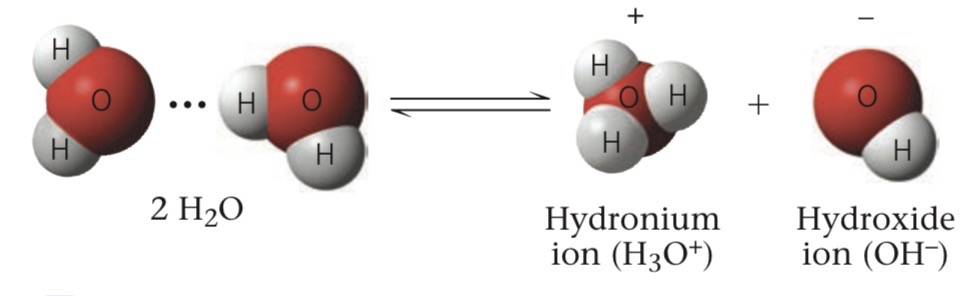
Dissociation of water
Water molecules occasionally split into a hydrogen ion (H⁺) and a hydroxide ion (OH⁻); the H⁺ joins another water molecule to form hydronium (H3O⁺)
pH formula
pH = –log[H⁺]
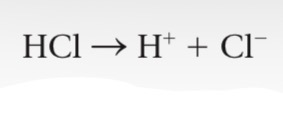
Strong acid/base
One that dissociates completely in water (e.g. HCl, NaOH)
Weak acid/base
One that only partially/reversibly dissociates in water (e.g. carbonic acid, ammonia)
Buffer
A substance that minimises changes in H⁺/OH⁻ concentration by accepting or donating hydrogen ions
Main buffer system in human blood
The carbonic acid–bicarbonate buffer, which keeps blood pH close to 7.4.