2 - Anti-Hypertensive Pharmacoloy- CNS, RAAS- acting drugs
 Call Kai
 Learn
Learn Practice Test
 Spaced Repetition
 Match
Match Flashcards
 Knowt Play
1/99

There's no tags or description
Looks like no tags are added yet.
Name | Mastery | Learn | Test | Matching | Spaced | Call with Kai | Chat |
|---|
No analytics yet
Send a link to your students to track their progress
100 Terms

What is the equation for blood pressure?
BP = CO × TPR
BP → Blood pressure
CO → Cardiac output
TPR → Total peripheral resistance

What are the main systems that regulate blood pressure?
SNS → sympathetic nervous system
RAAS → renin-angiotensin-aldosterone system
Local modulators

What is the baroreflex and what does it do?
Is the body's automatic response to changes in BP
It adjusts HR, cardiac output, and blood vessel constriction to help maintain normal BP
Sympathomimetic agents?
“Mimics” the endogenous ligand
Are agonists of α/β adrenergic receptors
Increases sympathetic activity
Sympatholytic agents?
Blocks or reduces α/β adrenergic receptors
Decreases sympathetic activity
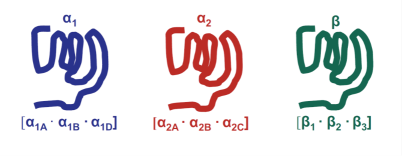
What do adrenergic receptor subtypes have in common?
All α and β adrenergic receptors are linked to G-proteins
Cytosolic-localized GTPase enzymes that activate signaling pathways inside the cell
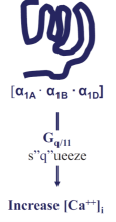
What G-protein is α1 coupled to, and what is its effect?
“squeeze”
Gq/11 → increases Ca²⁺
Contractibility, increases blood pressure

What G-protein is α2 coupled to, and what is its effect?
Inhibitory
Gi/o → decreases adenylyl cyclase
Decreased adenylyl cyclase in the heart, decreased cAMP and Ca²⁺ overall decreasing heart rate and contractility

What G-protein are β receptors coupled to, and what is their effect?
Stimulatory
Gs → increases adenylyl cyclase
Increased adenylyl cyclase, increased cAMP and Ca²⁺ → increased heart rate and contractility
How do β receptors differ in smooth muscle vs. cardiac muscle?
Smooth muscle → β2 activation relaxes blood vessels and lowers BP
Cardiac → β1 activation increases heart rate and contractility and raises BP

What is the effect of β receptor activation on NE release at the sympathetic nerve terminal?
It creates POSITIVE FEEDBACK, INCREASING NE RELEASE
NE is released → binds β receptor → signals the nerve terminal to release MORE NE
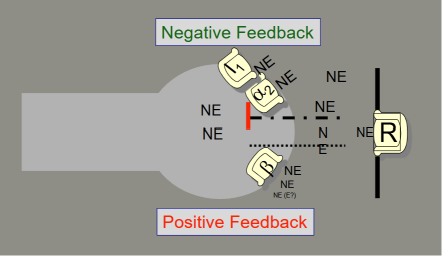
What is the effect of α2 receptor activation on NE release at the sympathetic nerve terminal?
It creates NEGATIVE FEEDBACK, DECREASING NE RELEASE
NE is released → binds α₂ receptor → signals the nerve terminal to release LESS NE

How does sympathetic activity increase cardiac output?
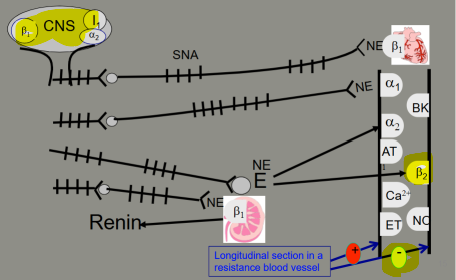
SNA releases NE, which activates β₁ receptors
Increasing heart rate and contractility and therefore increasing cardiac output and BP
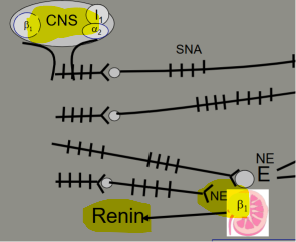
How does sympathetic activity affect renin?
Sympathetic activity activates β₁ receptors in the kidneys
Increasing renin release and activating RAAS, which raises blood pressure.
How does β2 activation affect blood vessels?
β₂ activation increases cAMP
Causing vasodilation and decreased vascular resistance and BP
What controls vascular resistance and helps determine blood pressure?
Neural and local mechanisms control vascular resistance (TPR)
Which along with cardiac output (CO) determines blood pressure

What is the basic RAAS pathway?
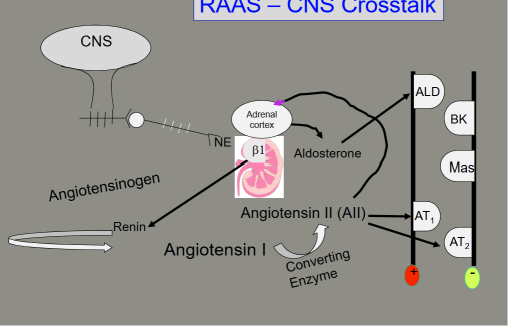
β₁ stimulation causes renin release →
Renin converts angiotensinogen to Ang I →
ACE converts Ang I to Ang II →
Ang II activates AT1, causing vasoconstriction and aldosterone release →
Aldosterone increases sodium and water retention, raising BP →

What does Ang II do to increase BP?
Ang II activates AT₁ receptors
Causing vasoconstriction and aldosterone release, which increases BP
How does aldosterone increase BP?
Aldosterone increases sodium and water retention
Which increases blood volume and raises blood pressure

How does RAAS interact with the CNS/SNS?
Ang II increases sympathetic activity, which increases NE release and β₁ stimulation
Promoting more renin release and creating a cycle that raises BP

What happens when antihypertensive drugs inhibit SNA?
It decreases NE and epinephrine release
Reducing vascular resistance and lowering blood pressure
Examples of centrally acting sympatholytics?
Agonists of a2 and I1
1st gen → alpha-Methyldopa (prodrug), Clonidine, Guanfacine
2nd gen → Rilmenidine, Moxonidine
Difference between 1st and 2nd sympatholytics?
2nd gen have a getter affinity for I1 »»than a2
What receptors does centrally acting α₂ and I₁ agonists act on?
α₂ and I₁ receptors in the CNS
Second generation → high affinity for I1 » over A2
How do sympatholytics lower BP?
Decreases SNA
Reducing heart activity, renin release, and vascular resistance
How do Sympatholytics indirectly suppress RAAS?
They reduce NE stimulation of renal β₁ receptors
Decreasing renin release and RAAS activity, which lowers blood pressure.
How do centrally acting α₂ and I₁ agonists lower BP?
Sympatholytics
Reducing sympathetic activity and NE release, which lowers vascular resistance and BP.
Sympatholytic at central/presynaptic vs. vascular α₂ receptors?
The agonists activates both
Central/presynaptic α₂A → decreases vascular resistance → decreases BP
Vascular α₂A → increases vascular resistance → opposes the BP-lowering effect
Even though its opposing ….. the vascular effects do not negate the central / presynaptic effects
What are the therapeutic uses of centrally acting drugs?
Hypertension
Autonomic Failure → Extensive hypertension
What is the drug of choice for hypertension in pregnancy?
α-Methyldopa
Is clonidine a good choice for treating pheochromocytoma-induced hypertension?
No
Clonidine is used diagnostically, not as the primary treatment
If clonidine FAILS to suppress catecholamine levels, this supports a diagnosis of pheochromocytoma
How is ethanol a “double edged sword” to sympathetics?
It counteracts clonidine evoked hypotension → by activating CNS activity
It also enhances clonidine-evoked sedation
Ethanol is double-edged → less hypotension, more sedation
Side effects of sympatholytics?
Sedation!
Rebound phenomenon
What centrally acting agonist side effects are more evident with Alpha-Methyldopa?
Hemolytic anemia
Hepatitis
What is the rebound phenomenon with clonidine?
Sudden discontinuation of clonidine causes a surge in NE release
Activating α1 and β1 receptors and causing a rapid increase in BP
Clonidine → do NOT stop abruptly → risk of severe rebound hypertension!!
Adrenergic neuron blockers?
Peripherally acting → Guanethidine
Peripherally and Centrally acting → Reserpine
MOA of Guanethidine?
It gets taken up into the presynaptic nerve terminal by NET
Then enters presynaptic vesicles and displaces catecholamines/NE→ reducing their availability for release
I.e. → Displaces NE from presynaptic vesicle → decrease sympathetic activity
Side effects of peripherally acting adrenergic neuron blocker, Guanethidine?
Orthostatic Hypotension
Drug-drug interactions with peripherally acting adrenergic neuron blocker, Guanethidine?
Phenylephrine/cold medicines → α1 vasoconstriction → can oppose BP lowering
Cocaine and TCAs → inhibit NE uptake → interfere with guanethidine
Ethanol → enhances guanethidine-induced hypotension

How does tyramine reverse guanethidine-induced hypotension?
Tyramine displaces guanethidine and releases stored NE
Causing α1-mediated vasoconstriction that raises BP and reverses hypotension
MOA of Reserpine?
Blocks VMAT, a transporter, preventing NE from being stored in presynaptic vesicles
Causing NE depletion and decreasing sympathetic activity, decreasing BP
Side effects of peripherally and centrally acting adrenergic neuron blocker, Reserpine?
Sedation
Depresion
G.I Ulcerations
Sides effects are less evident with lower (0.05-0.1mg/d) vs prescribed (0.75-10mg/d) doses
Precautions and DDIs with Reserpine?
Migraine → avoid/use caution because reserpine can worsen or trigger migraines.
Cold medicines / vasoconstrictors → can oppose BP-lowering effects by causing vasoconstriction
Examples of alpha-blockers?
Selective A1 → Prazosin, Doxazosin
Non selective A1+A2 → Phentolamine
How does α1 blockade by phentolamine lower BP?
α1 blockade causes vasodilation
Why can phentolamine cause tachycardia?
α2 blockade increases NE release
Which stimulates β1 receptors and increases HR and contractility
How does prazosin / doxazosin lower BP?
They block α₁ receptors
Causing vasodilation and lowering vascular resistance and BP.
Why does prazosin / doxazosin cause less tachycardia than phentolamine?
They selectively block α₁ receptors
While phentolamine also blocks α₂ receptors, negative feedback… which increases NE release and causes more reflex tachycardia
Side effects of alpha receptor blockers?
Orthostatic hypotension
Sexual dysfunction
Exaggerated tachycardia → non-selective
What side effects of alpha receptor blockers is more evident with selective blockers?
First dose effect phenomenon → can cause a sudden, exaggerated drop in BP
Increase risk of developing CHF
What is a selective β1-blocker?
Atenolol → mainly blocks β1 receptors in the heart
What is a nonselective β-blocker?
Propranolol → blocks both β1 and β2 receptors
Which β-blocker is β1-selective and also generates NO?
Nebivolol → β1-selective and promotes NO generation → vasodilation
Which β-blocker is a partial agonist due to intrinsic sympathomimetic activity (ISA)?
Pindolol
It has (+) ISA → meaning it partially activates β receptors while also blocking them
What is the role of β-blockers in hypertension treatment?
NOT first-line for hypertension → because they have a greater risk of developing diabetes compared with other antihypertensives
They are mainly used when there is a compelling indication → such as heart failure or post-MI
How do β-blockers lower BP?
They block β₁ receptors → reducing heart rate, contractility, and renin release
What is a unique effect of nebivolol?
Is β₁-selective and increases NO, causing vasodilation
Adverse effects of Beta blockers?
Adverse lipid profile → in non ISA
Hyperglycemia
Excessive bradycardia
Hyperkalemia!!!
Fatigue
Contraindications with Beta Blockers?
Asthma or diabetes
Peripheral arterial disease (PAD) traditionally → but was recently challenged because nebivolol and metoprolol did not worsen PAD in studies
What is the rebound phenomenon with β-blockers, and how can it be avoided?
Abruptly stopping a β-blocker can cause rebound tachycardia, hypertension, and other cardiac effects
Avoid it by gradually tapering the dose
Why should β-blockers not be used alone in pheochromocytoma?
Pheochromocytoma releases excess NE, which strongly stimulates α1 receptors and causes vasoconstriction
Blocking β receptors first leaves the α1 vasoconstriction unopposed → which can dangerously increase BP!!!
Why can β-blockers be a concern during exercise?
Can limit the normal increase in heart rate and cardiac output during exercise
Which can reduce exercise tolerance
What happens during a hyper-adrenergic state (“adrenaline rush”)?
Increased NE and epinephrine stimulate adrenergic receptors
This can occur with exercise, pheochromocytoma, hypoglycemia, or cocaine overdose
What can happen during an adrenaline rush from β2 activation?
Muscle fasciculations → involuntary twitches
Hypokalemia
Why can β-blockers cause hyperkalemia?
β2 normally moves K⁺ into cells → blocking β2 reduces this effect, increasing blood K⁺
What can happen if a β-blocker is given during a hyper-adrenergic state?
Paradoxical hypertension can occur!!!
Because β2 blockade removes β2-mediated vasodilation → leaving α1-mediated vasoconstriction unopposed
Drug-drug interactions of Beta Blockers?
Potassium-sparing diuretics → increased risk of hyperkalemia
NSAIDs
Precautions with beta blockers?
New onset diabetes → particularly in older more obese patients and in those with existing metabolic syndrome
Mixed α- and β-blockers?
Labetalol and Carvedilol
Block α1, β1, and β2 receptors
Advantages of mixed α- and β-blockers?
α1 blockade prevents vasoconstriction and β1 blockade prevents reflex tachycardia
Making them useful in hyper-adrenergic states!!!
Which peripherally acting vasodilators primarily target the arteries?
Hydralazine
Minoxidil
CCB
Fenoldopam
Aprocitentan / Tryvio
Diazoxide
Which peripherally acting vasodilators target both arteries and veins?
Nitrates → direct vasodilator
MOA of increases NO, causing arterial vasodilation and lowering BP.and side effects?
Increases NO, causing arterial vasodilation
Side effects → Lupus like syndrome!
What is the MOA of minoxidil and diazoxide?
Open K⁺ channels, causing hyperpolarization, less Ca²⁺ entry, and vasodilation
What is Minoxidil a prodrug of?
Minoxidil N-O Sulfate
Side effects of Minoxidil and Diazoxide?
Water retention
Hair growth
Increased cardiac output
What adjunctive therapy is added to hydralazine, minoxidil, or diazoxide, and why?
Diuretic → reduces fluid retention
β-blocker → reduces increased cardiac output
What is the role of Ca²⁺ in vascular smooth muscle?
Ca²⁺ promotes smooth muscle contraction
How do CCBs affect cardiac muscle?
CCBs block L-type Ca²⁺ channels → causing decreased contractility (negative inotropy) → therefore decreased O₂ demand → decreased CO
Which CCBs also slow SA/AV node activity?
Verapamil and diltiazem
Block Ca²⁺ channels in the SA and AV nodes → causing slower conduction and HR and decreased contractility/CO
What are the 3 major families of calcium channel blockers and their prototypes?
Dihydropyridines (DHPs) → nifedipine, amlodipine, nicardipine, felodipine — act mainly on vascular L-type Ca²⁺ channels
Phenylalkylamine → verapamil → non-selective block of cardiac and vascular Ca channels
Benzothiazepine → diltiazem → non-selective block of cardiac and vascular Ca channels
MOA of Calcium Channel blockers?
Block voltage-gated L-type Ca²⁺ channels → reducing Ca²⁺ entry into cells → decrease contraction → decreased CO
Advantages of calcium channel blockers?
Well tolerated in diabetes and asthma
Effective in low-renin hypertension
No reflex tachycardia → EXCEPT NIFEDIPINE!!!!!
What are important precautions with CCBs?
Verapamil → increases serum digoxin levels and toxicity, and with quinidine → can cause substantial hypotension
Nifedipine → avoid in ischemic heart disease
MOA of sodium nitroprusside?
Releases NO → causing arterial and venous vasodilation
What is sodium nitroprusside used for?
Drug of choice → for hypertensive emergencies
Given by titrated IV infusion with direct BP monitoring
Precautions with sodium nitroprusside?
Monitor thiocyanate levels → due to risk of cyanide/thiocyanate toxicity → especially with kidney failure
MOA of aprocitentan / Tryvio ?
Blocks endothelin A and B receptors → reducing the vasoconstricting effects of ET-1
What is aprocitentan / Tryvio used for?
Treatment-resistant hypertension
Was approved in March 2024
Is the first new therapeutic target for systemic hypertension in over 30 years
What is neprilysin?
An enzyme involved in breaking down natriuretic peptides and other vasoactive substances → including Ang II
What is the overall result of Ang II acting at AT1 receptors?
Rapid pressor response → meaning a rapid increase in blood pressure
How does Ang II cause the rapid pressor response?
Ang II activates AT1 receptors
Causing vasoconstriction and increased sympathetic/NE activity
Which rapidly raises BP
How does Ang II cause the slow pressor response?
Ang II activates AT1 receptors
Causing Na⁺/water retention, aldosterone release, and renal vasoconstriction
Which increases blood volume and sustains higher BP
How does Ang II cause cardiovascular remodeling?
Ang II activates AT1 receptors
Increasing cardiac afterload and vascular wall tension
Leading to cardiac and vascular hypertrophy and remodeling over time

What drugs inhibit the renin-angiotensin system at the renin step?
β-blockers inhibit renin release
While aliskiren directly inhibits renin activity!
Why does Ang II increase with an ARB?
ARB blocks AT₁ → less AT₁ signaling → increased renin → increased Ang I → increased Ang II
What is the important combination-therapy warning for aliskiren?
Do NOT combine aliskiren with an ACE inhibitor or ARB in patients with diabetes
It can cause renal failure!!!!
Side effects of ACE inhibitors?
Cough → iron supplement dampens this
Hyperkalemia → also applies to BBs, ARBs, DRIs
Rash
Angioneurotic edema
Precautions of ACE inhibitors?
Fetal harm → exposure during the first trimester should be avoided
Acute renal failure → in presence of renal artery stenosis
What is the significance of centrally active ACE inhibitors?
They cross the BBB and may reduce dementia risk
Captopril, Fosinopril, Ramipril, Lisinopril, Perindopril, Trandolapril, Trandolapril