C9 -
 Call Kai
 Learn
Learn Practice Test
 Spaced Repetition
 Match
Match Flashcards
 Knowt Play
1/14

There's no tags or description
Looks like no tags are added yet.
Name | Mastery | Learn | Test | Matching | Spaced | Call with Kai | Chat |
|---|
No analytics yet
Send a link to your students to track their progress
15 Terms
Reaction rate
Change in concentration of a reactant or product over time
Amount of reactant used up or product form / time
Measuring rate of reaction
Measuring a decrease in mass
For reactions that produce gases
As gas releases the mass decreases
Measuring volume of gas released
Gas syringe
Timing how long a precipitate takes to form
When the product of a reaction is a precipitate
Measure how long it takes for a mark to become obscured by the precipitate
Calculating rates from graphs
Time vs amount of reactant used means gradient represents reaction rate
Collision theory
States that two conditions must be met for reaction
Orientation
Particles must collide in the correct orientation
Energy
Colliding particles need at least the minimum amount of KE (Ea)
Means that a lot of collisions do not cause reaction
5 Factors that affect rate of reaction
Surface area of solids
More particles on the surface are available to collide and reaction
Higher frequency of effective collisions
Concentration of solutions
Particles will on average be closer
Particles will collide more frequently so more effective collisions
Pressure of gases
Particles will pushed closer together
Increases the number of effective collisions
Temperature
Increases the KE and speed of particles
Move faster and collide more frequently
More particles will have the necessary energy to overcome Ea
Catalysts
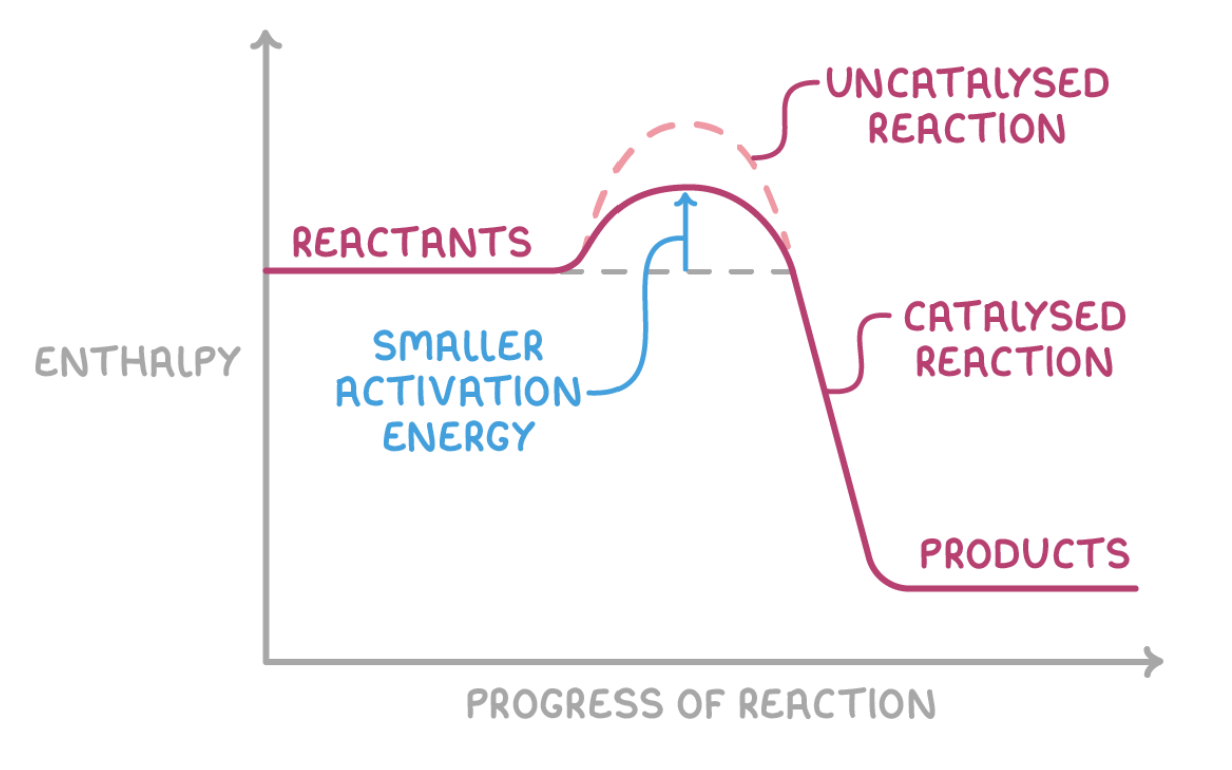
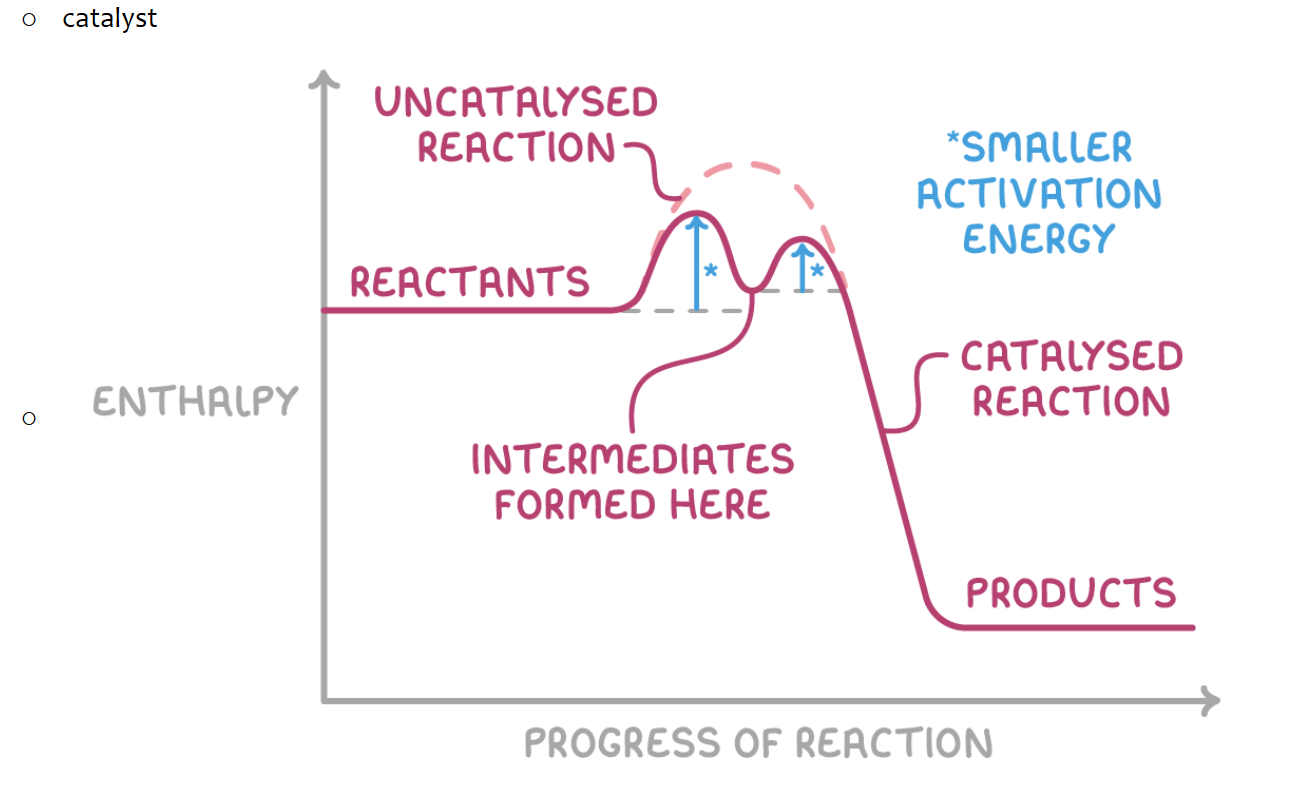
Provides alternate pathway
Lower activation energy means particles require less KE to react
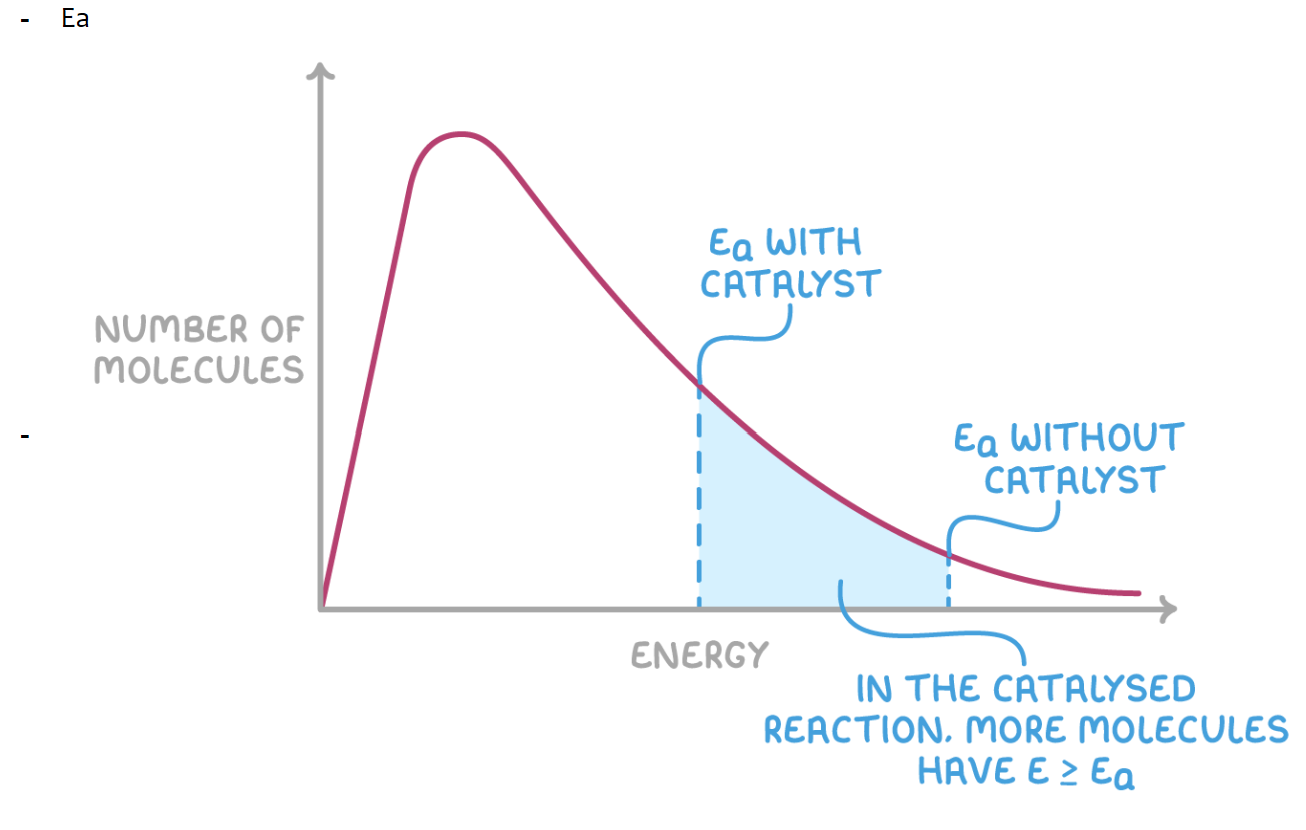
Greater proportion of particles will have Ea
More effective collisions
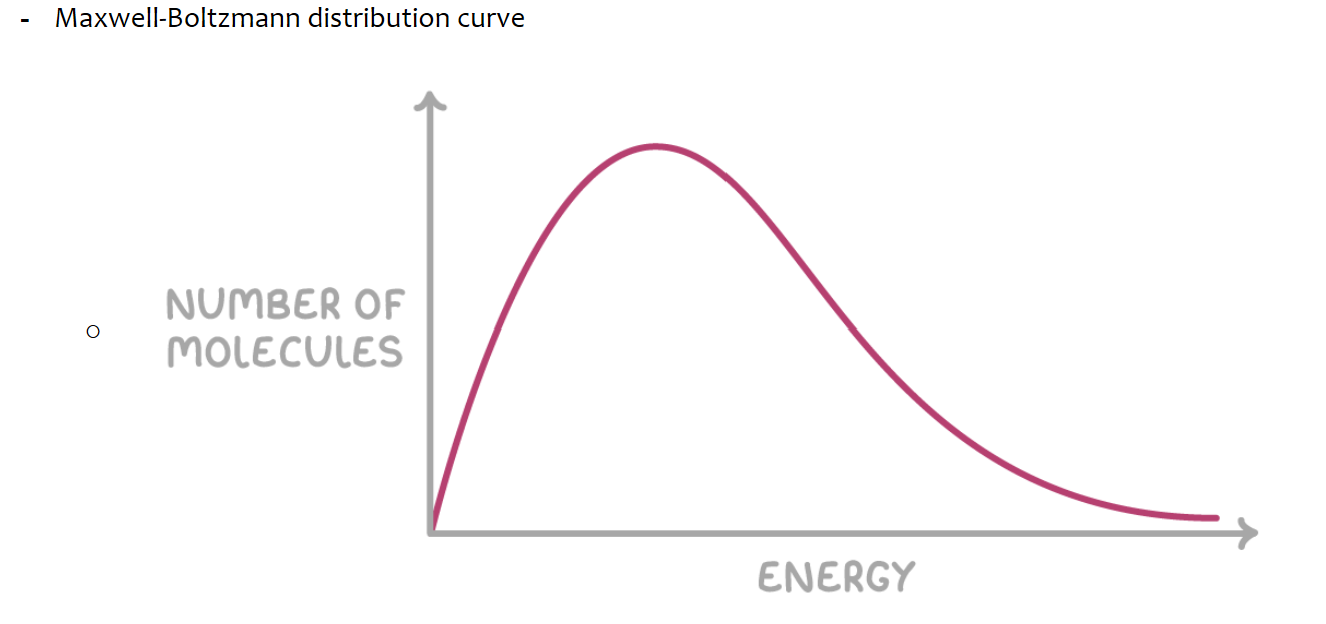
Maxwell-Boltzmann distribution curve
Some molecules move slowly because they have low KE
Others move very fast due to high KE
Majority have moderate KE and speeds
Only molecules with KE greater than or equal to Ea have enough energy to react when they collide
Features of a Maxwell-Boltzmann distribution
Key features
Curve originates at the origin - no molecules have zero KE
Rises sharply to a peak that represents the most common KE
Total area under the curve is equal to the total number of molecules
Peak of the curve shows the most probable KE
On average, KE of all molecules is a bit higher than peak energy

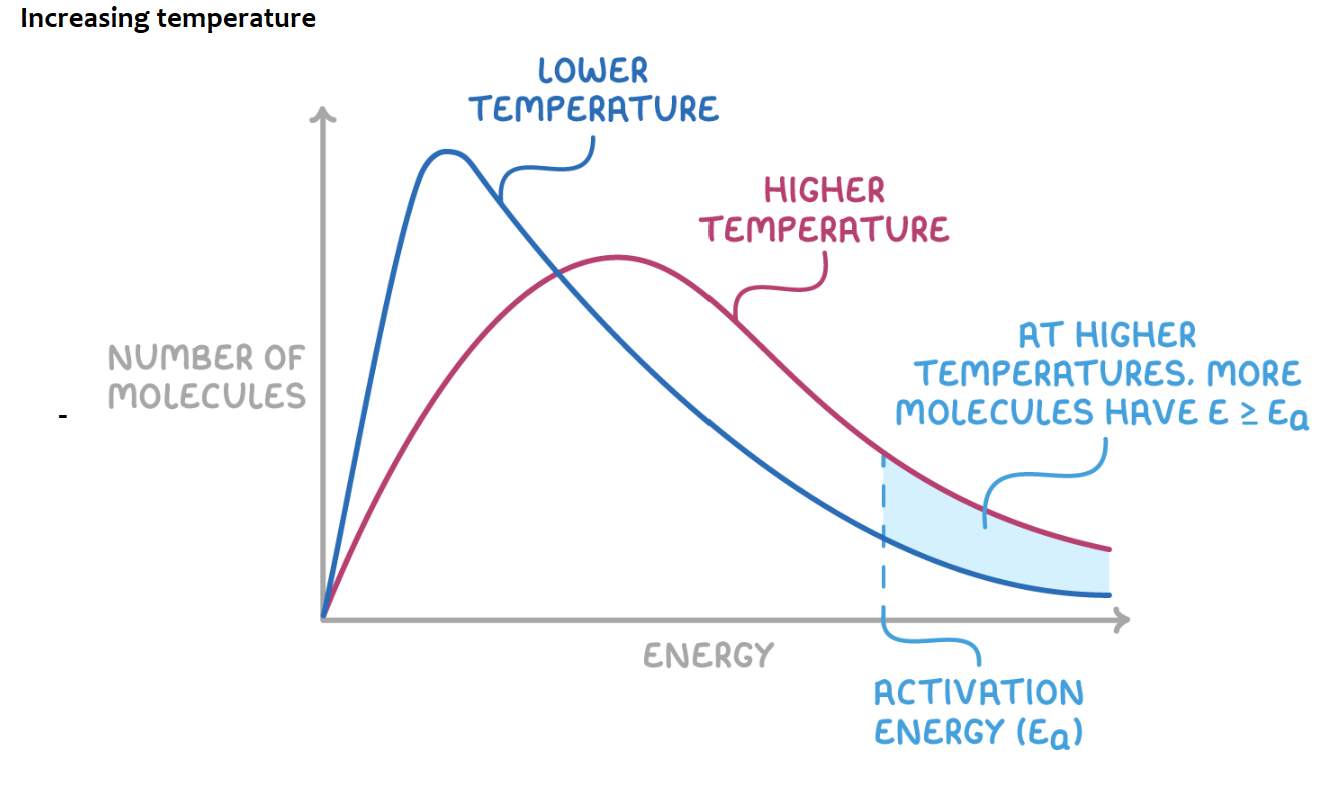
Increasing temperature
As the temperature rises, a greater number of molecules attain the KE needed to surpass the Ea
Curve shifts to the right
More molecules have sufficient KE
Despite the number of molecules being constant
Area under the curves is unchanged
Catalysts
Substance that accelerates rate of chemical reaction without being permanently altered
Achieve this by providing an alternate pathway
Key features
Highly efficient
Usually very specific
Participate in the reaction
Heterogeneous catalysts
Is in a different phase from the reactants
Often involves a solid catalyst with gaseous or liquid reaction
Occurs on the catalysts surface
e.g. Haber process
Homogeneous catalysts
In the same phase as the reactants
Involves an aqueous catalyst in a solution of aqueous reactants
Reaction occurs throughout the mixture
e.g. sulfuric acid in H2O2 and K
Heterogeneous catalysis
Heterogeneous catalysis
Absorption
Reactant molecules attach to the catalyst surface
Activation
Bonds in the reactants weaken and break forming reactive species
Reaction
New bonds form between the reactive species
Desorption
Product molecules detach from the catalyst surface
Mechanism

Homogeneous catalysis
Reactants combine with the catalysts to form an intermediate species
Intermediate reacting to form products and regenerate the catalyst
Catalysts and M-B distributions
Effects of catalysts can also be understood using Maxwell-Boltzmann distribution curves
By lowering the Ea catalysts increase the proportion of molecules with sufficient Ea
Economic benefits of catalysts
Lower production costs
Allow reactions to occur at lower temperatures
Lower energy consumption
Increased efficiency
Faster reaction rates mean more product can be produced in a shorter amount of time
Improved product quality
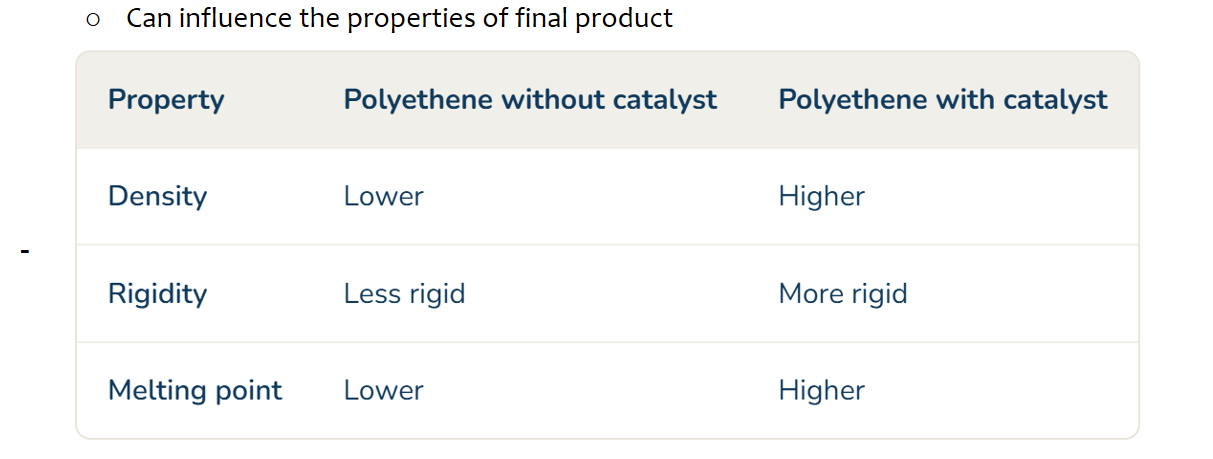
Can influence the properties of final product