Ch. 5
 Studied by 0 people
 Call Kai
 Learn
Learn Practice Test
 Spaced Repetition
 Match
Match Flashcards
 Knowt Play
1/67

There's no tags or description
Looks like no tags are added yet.
Name | Mastery | Learn | Test | Matching | Spaced | Call with Kai |
|---|
No analytics yet
Send a link to your students to track their progress
68 Terms
Patient Care
Caring for the patient
Patient Care is an
Active endeavor
Patient Care is making
Decisions that are right for this specific patient and their own circumstances
Patient Care is
Preventing harm to the patient while treating them
Differences
Age
Gender
Culture
Language
Religion
Sexual orientation
Educational background
Economic status
Infants: fears
Falling
Loud noise
Reflexes for infants: unlearned automatic responses
Grasping, stretching
Facial expressions as
Communication
Preventing physical harm to infants by
Careful handling and watching exposure levels radiation
Law of Bergonie and Tribondeau
Sensitivity of cells to ionizing radiation (limit exposure to radiation due to effects on cells in an infant's body because this law states the most sensitive cells are the ones that are rapidly dividing)
How does our care change with an infant?
Careful handling
Protection and support of the head
Extra careful hand washing / disease prevention and radiation exposure levels
Swaddling will soothe the baby
Low soft voice
Adolescents
Teenage years: intense, troubling, emotional imbalances
Children: 1-3 years
Sense of
Right and wrong developing
1-3 years
Sense of
Property
1-3 years
Sense of
Appropriate behavior
And may not be consistent but at this age they know that some of the actions they do that are “bad” will result in consequences
1-3 years
Speak, make sentences and
Follow instructions
However they may choose not to do so which is common in healthcare setting
1-3 years
nvolve parent if
Necessary
How do we change our care from infant to child?
Use small sentences that they may understand
Use happy but calm faces and words
Gestures
Taking time to interact to gain trust
Talking with parent and showing a relationship with parent
= Gaining trust
3-12 years
Development of self during this time frame
3-12 years
____ & ____ is important
Doing a good job
Love & esteem
3-12 years
_______ at their school and in the world
Socialized
3-12 years
Concept of
Time
3-12 years
________ is much easier with this age group
Since they have a sense of self and worth, the best way to communicate with this age is to treat them like they can make their own decisions and ask for their help to get the exam done
Communication
Child abuse
You were required to report any indication or thought abuse.
There are many ways to report it and there are many professionals that work to help with this
Adolescents are
Longing for independence, but not yet mature enough
Adolescents want
To identify and to be treated as an adult
An adult approach to communication with an adolescent will be the most likely way to generate a response or cooperation from this age group
Legal guardian is the
Responsible party
Close relationship with
Peer group
Young adults
21-45 years
Young adults have moved past
The need for Independence and likely have chosen a partner and started a family
21-45 years
Responsibilities and obligations
Financial
family
career
21-45 years
_____-______ ______ may result in being overly concerned
Life-threatening illness
45-65 years
Middle age
45-65 year olds are
Settled in life, normally sharing their lives with others
Pattern activity
Middle age people experience
Empty nest syndrome in which they decide to travel, or do community involvement to help with that
Middle-aged people have a
Well defined value system
Middle-aged people are
Concerned with maintaining Independence and retirement
Senior citizens
65 or older
Fastest growing population in the United States is over
85 years
Senior citizens suffer from
Diseases
Senior citizens may
Continue working and volunteering
Senior citizens require
Gentle, respectful care
Senior citizens may need
Additional assistance
Senior citizens expect
Death and dying process
Senior citizens may experience
Elder abuse: often neglect, must be reported
Senior citizens need
Patient consent: legal consent to treat or do a procedure
Diverse conditions and populations
Culture
Respect patients beliefs
Interpreter, if necessary
Patience with addictive diseases
Alcohol, drug, communicable diseases
Diverse conditions and populations
Trauma patients
patients with medical devices
here's where the need to be a critical thinker and learning to adapt to patient comes into play because every patient is different
be
respectful
courteous
professional
Basic principles of patient care
Practice radiographic techniques for radiation safety
Prevent spread of disease and injury to others
Prevent complications of injuries or illness
Alleviate suffering by comforting patient
Provide services economically and timely well maintaining quality
Verification of patient identification and procedures requested
You must ensure you are verifying the patient identity with the proper patient, as well as doing the proper procedure
Internal policies: date of birth, ID band
Procedures for patient request of records can be established by administrator and or physician
Radiology physician director can cancel or terminate the procedure at any time
Patient transfer
Not all of our patients come directly to the radiology department for our care. Inpatients are inside the hospital and other areas and require transport to get to our department
Imaging staff must be CPR certified
We must transport equipment
Wheelchairs
Stretchers
Beds
We deal with ancillary equipment
IVs
Pumps
Monitors
Communication and proper transfer techniques are the only way you and the patient will remain safe
Patient transfer techniques
Body mechanics: action the and producing motion or posture
Center of gravity when standing is at center of pelvis
Gravity line: imaginary vertical line passes through the center of gravity, must be maintained
Base of support
Bend knees, not waste
Hold object close to body
Use legs, not back
Vital signs
Blood pressure, pulse, respiration, temperature (bodies homeostasis)
Stethoscope
Sphygmomanometer
Pulse oximeter
Done in accordance with institutional policy
What is a sphygmomanometer
an instrument for measuring blood pressure, typically consisting of an inflatable rubber cuff which is applied to the arm
Important to note
Changes in patient condition because this may affect patient care
Emergency carts
Isolation techniques
Hospital acquired infections- infections that are required while patients under care at the hospital - also called nosocomial infections
How do you prevent nosocomial infections
Cleaning of equipment, standard precautions, isolation unit, protective equipment, disinfectants, antiseptics
What are the standard precautions for cleanliness in healthcare?
Hand washing
Gloving
Personal protective equipment (PPE)
No needle recapping
Bios
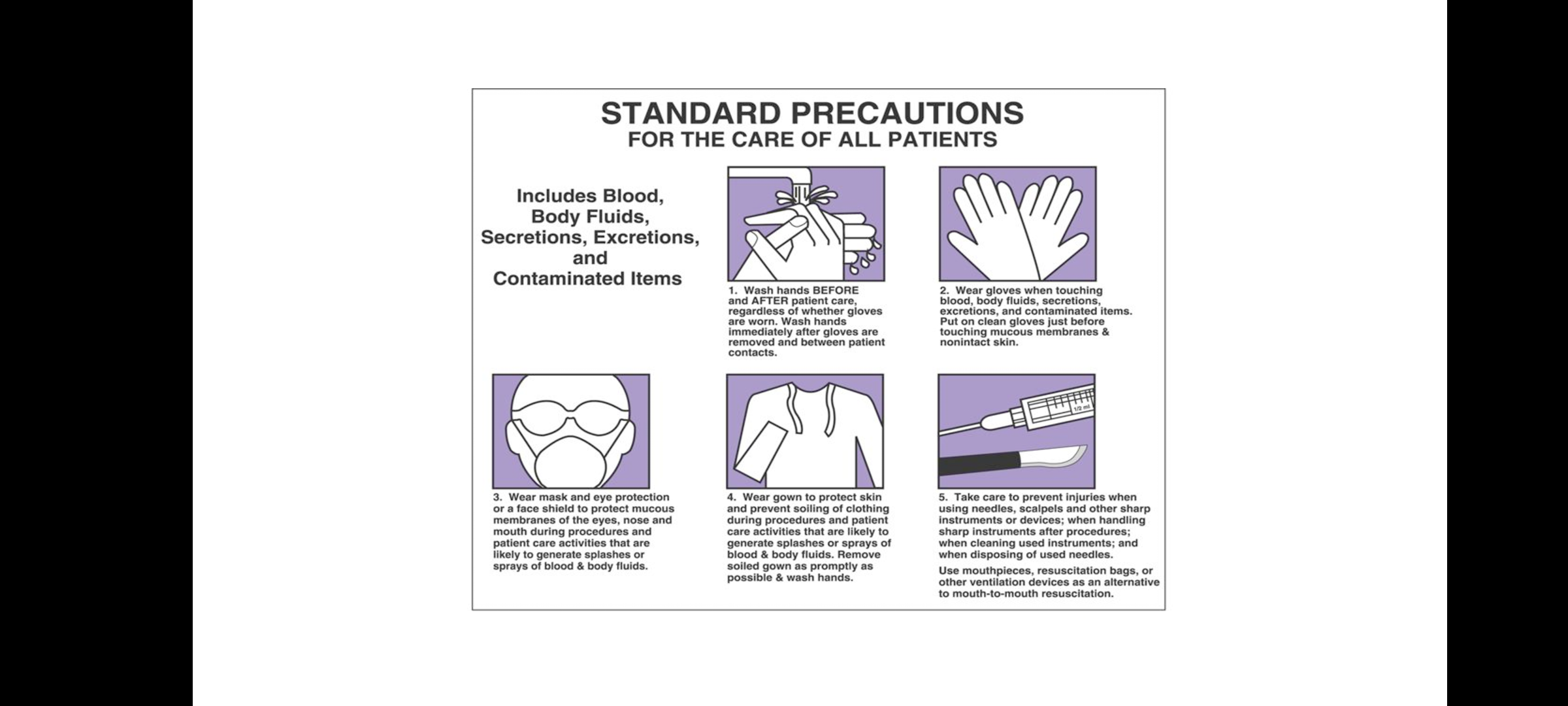
Standard precautions for the care of all patients
Medical asepsis
Involves reducing the property of infectious organisms in transferred to a susceptible individual
Three levels:
Hand hygiene and other cleanliness
Disinfection- destroys pathogens
Sterilization - the tree items heat, gas, or chemicals
How can you fight the spread of infection?
Stay home when you are ill
Use tissue to cover your mouth when you sneeze or cough - the tissue isn't available use your elbow to sneeze into
We're clean uniform or hospital scrubs daily and remove them before you leave the hospital
Perform hand hygiene
He's established precautions and handling patients, linens, or items contaminated with body substances
How can you fight the spread of infection? Part 2
Change your contaminated gloves after handling patients
Practice good housekeeping methods in your work area
When you doubt the cleanliness of an object - don't use it
If linens touch the floor get a clean one. The floor is always considered contaminated.
Ask patients who are coughing or sneezing to cover their mouth with a tissue or a mask.
Hand hygiene
Medically aseptic hand washing is the easiest most effective method to control the transmission of infections
Alcohol-based hand rubs
Require less time
Convenient
More effective for standsrd hand washing than soap
More accessible than sinks
Reduce bacterial counts on hands
Improve skin condition
Sterile or aseptic technique
Sterilization- the complete removal or destruction of microorganisms
Sterile or non sterile
It's one or the other - any doubt it's considered non
Kept wrapped until use
Only outside cover touched when opening
Sterile article handled with sterile instrument or gloves
Sterile or aseptic technique part 2
After removed from sterile container, not returned
Use forceps to remove sterile object
Dispose of contaminated containers
Avoid of reaching over the sterile field
Edges of sterile field are contaminated
Keep instrument handles out of sterile fields
Poor sterile solutions so that there is no contact with non-sterile surface
 Note
Note  Flashcards (105)