223 definitions
 Studied by 9 people
 Call Kai
 Learn
Learn Practice Test
 Spaced Repetition
 Match
Match Flashcards
 Knowt Play
1/76

There's no tags or description
Looks like no tags are added yet.
Name | Mastery | Learn | Test | Matching | Spaced |
|---|
No study sessions yet.
77 Terms
the pivot of a row matrix is
the left most non zero entry in that row
a matrix is in row echelon form if
all rows consisting only of 0’s are at bottom
pivot if each non zero is in a column to the right of the pivot in the row above it
a matrix is in reduce row echelon form if
the matrix is in row echolon form
the pivot in each row is equal to 1
each pivot is the only non zero entry on its column
we say xi is a basic variable for the system if
the ith column of rref(c) has a pivot
we say the xi is a free variable for the system if
the ith column of the rref(c) does not have a pivot
the system if inconsistent if and only if
the last column of rref(A) has a pivot
The system has exactly one solution if and only if
the last column does not have a pivot and every other column of rref(c) has a pivot
the system has infinitely many solutions if and only if
the last column of the rref(c) does not have a pivot and rref(A) has a column without a pivot
a linear combination of vectors v1, v2,…,vn in Rn is a vector of the form
c1v1, c2v2,…,cnvn
the span of vectors of v1, v2,…,vn in Rm is the set
span (v1, v2,…,vn) = {c1v1+…+cnvn| c1, c2…,cn ∈ R}
a set of vectors {v1, v2,…,vn} in Rm
At least one of the vectors is a linear combination of others: that is vi ∈ span(v1, v2,…,vi-1, vi+1,...vn)
a vector space (over the real numbers) is any set of vectors V in Rn that satisfies all of the following properties:
V is non empty
V is closed under scalar multiplication
V is closed under vector addition
let V be a vector subspace of Rn. A spanning set (also known as a Generating Set) for V is
any subset B of V so that V = span(B)
a subset B of a vector space V is called a Basis if
B is a spanning set and
B is linearly independent
Let V be a nonzero vector subspace of Rn. Then the dimension of V, denoted dimV, is
the size of any basis for V
the standard basis for R is the set E :={e1, e2 , . . .,en } where ei is
the vector in n dimensional space where 1 in the ith coordinate and 0 in all other coordinate
Let A be an mxn matrix with column vectors A = (v1 v2 · · · vn). Then, for a vector x in Rn the matrix-vector product of A and x is the vector in Rm defined by
Ax = x1v1 + x2v2+ … + xnvn
Let A be an mxn matrix. Then, the matrix transformation associated to A is the function
TA : Rn → Rm defined by TA(x) = Ax
A function F: Rn → Rm is called linear if it satisfies the following two properties for all vectors v,w ∈ Rn and scalars c ∈ R
F(v + w) = F(v) + F(w)
F(cw) = cF(w)
Let F: Rn → Rm be a linear transformation. Then, the defining matrix of F is the mxn matrix M satisfying
F(x) = Mx
A function f: X →Y is called one-to-one (or injective) if the following property holds
for all y ∈ Y there is at most one input x ∈ X so that f(x) = y
A function f: X →Y is called onto (or surjective) if the following property holds
for all y ∈ Y there is at least one input x ∈ X so that f(x) = y
A function f : X → Y is called bijective if
f is both injective and surjective
Let V be a subspace of Rn and W a subspace of Rm. An isomorphism between V and W is
any linear bijective function F: V → W
The kernel of F is the subset ker(F) ⊆ Rn defined by
ker(F) := {x ∈ Rn: F(x) = 0} ⊆ Rn
The image of F is the subset im(F) ⊆ Rm defined by
im(F) := {F(x): x ∈ Rn} ⊆ Rm
The Rank of F is
the dim of im(F)
The Nullity of F is
the dim of ker(F)
The column space of A is the subspace of Rm given by
Col(A) := Span(v1, v2,…,vn)
The Null space of A is the subspace of Rn given by
Nul(A) := {x∈ Rn : Ax = 0}
The nullity of A is
the dimension of Nul(A)
The Rank of A is
the dimension of Col(A)
A system of linear equations is called homogeneous if
the constatnt coeff in every equation is 0
The sum of A and B is the mxn matrix given by
A + B:= (v1+w1 v2+w2 … vn+wn)
The scalar product of A with C is the mxn matrix given by
cA: = (cv1 cv2 … cvn)
Let A be an mxk matrix and B = (b1 · · · bn)
be a kxn matrix. Then, the matrix product of A and B is the mxn matrix
AB:= (Ab1 Ab2 … Abn)
the identity matrix In is
nxm In = (x1 x2 …xn)
that is In = [(1 0 … 0), (0 1 … 0), (0 0 …1)]
Let A be an nxn matrix. The inverse of A, if it exists, is
the matrix B such that AB = In and BA = In (not always the same though)
An n x n matrix is called elementary if
it can be obtained by performing exactly one row operation to the identity matrix
The unit square is the subset of R2 given by
S := {α1e1 + α2e2 : 0 ≤ α1, α2 ≤ 1}.
An ordered basis {b1,b2} for R2 is called positively oriented if
we can rotate b1 counterclockwise to reach b2 without crossing the line spanned by b2. Otherwise, the basis is called negatively oriented.
Let F: R2 → R2 be a linear transformation. Then, the determinant of F, denoted by det(F), is the oriented area of F(S). That is,
det(F) :=
area(F(S)) if {F(e1), F(e2)} is positively oriented
−area(F(S)) if {F(e1), F(e2)} is negatively oriented
0 if area(F(S)) = 0.
If A is a 2 × 2 matrix, the determinant of A, denoted by det(A),
det(A) := det(TA)
The unit cube is the subset of R3 given by
C := {α1e1 + α2e2 + α3e3 : 0 ≤ α1, α2, α3 ≤ 1}.
For an n × n matrix A =(aij)
the ij-minor of A is defined to be the (n − 1) × (n − 1) matrix A(ij) with the ith row and jth column deleted.
Let A be the n × n matrix with ij-entry equal to aij . Then we define the determinant of A by the following cofactor expansion formula:
det(A) := a11 det(A11) − a12 det(A12) + · · · + (−1)n+1a1n det(A1n)
Let A be an n×n matrix. A non-zero vector v is an eigenvector
of A if
Av = λv where
Let A be an n × n matrix with eigenvalue λ.
(1) The λ-Eigenspace of A is the vector subspace of R
n defined by
Eλ := Nul(A − λIn).
The geometric multiplicity of λ
the dimension of the λ-eigenspace Eλ.
For an n × n matrix A, the characteristic polynomial of A is called
χA(x) = det(A − xIn).
Let B = {v1, v2,…, vn} be an ordered basis for a vector space V.
Recall that every vector x in V can be written in the form
x = x1v1 + · · · + xnvn
The B-coordinates of x is the vector in Rn given by
[x]B :=
(x1
.
.
.
xn)
Let C and B be bases for a vector space V . Then, the change
of basis matrix MC←B is the matrix satisfying
MC←B[x]B = [x]C
Let C be a basis for a vector space V . Then, for any x, y ∈ V and scalar k ∈ R we have
[x + y]C = [x]C + [y]C and [kx]C = k[x]C.
Let {b1, . . . ,bn} be a linearly independent subset of a vector space V .
Then, for any basis C of V , the set {[b1]C, . . . , [bn]C}
is linearly independent
Let F: Rn→Rn be a linear transformation, and B be any basis for R^n. Then, the defining matrix of F with respect to the basis B is the matrix M so that…
[F(x)]B = M[x]B
we use the notation M = MF,B
Twon×nmatrices B and C are called similar if they represent the same function, but in possibly different bases.That is
there is a single linear transformation F:Rn→Rn so that MF,B = B and MF,C =C where B and C are bases for Rn
An n×n matrix D is called diagonal if
the only non zero entries in the matrix appear on the diagonal. That is
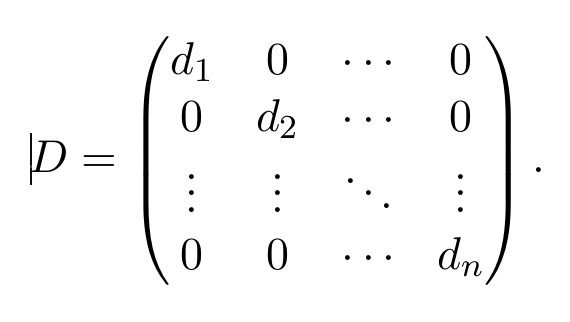
In this case we write D = diag(d1, d2,…dn)
An n×n matrix is called diagonalizable if
it is similar to a diagonal matrix
Suppose that A is an n×n diagonalizable matrix with eigenvalues λ1,...,λn and corresponding linearly independent eigenvectors v1,...,vn. We call the equality
A = CDC-1
the EIGENDECOMPOSITION of the matrixA. By the Diagonalization Theorem, we know that
D=diag(λ1,...,λn) and C= (vector)v1 ··· (vector)vn
The dot product of vector u and v is the scalar
u (dot) v = u1v1 + u2v2 + …+ unvn
Let vector uand v be vectors in Rn
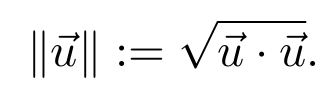
The distance between vectors u and v is

We say that u and v are orthogonal if
u (dot) v = 0
A basis B={v1,v2,...,vn} is orthogonal if
vector ui (dot) vj for every i ≠ j
An basis B is called orthonormal if it’s orthogonal and
||vi|| = 1 for every vi in B
We call an n×n matrix Q orthogonal if
its column vectors form an orthonormal basis for Rn
Equivalently, Q is called orthogonal if QT = Q-1
For vectors x, y in Rn, the orthogonal projection of x onto y is
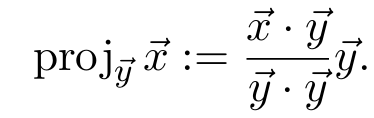
An n×n matrix A is called orthogonally diagonalizable if
there exists an orthogonal matrix Q and a diagonal matrix D so that Q⊤AQ = D
Suppose that A is an n×n symmetric matrix with eigenvalues λ1,...,λn and orthonormal basis of eigenvectors{v1,...,vn}. We call the equality
A = QDQT
a SPECIAL DECOMPOSITION of A, where
D = diag{λ1,...,λn} and Q = (v1 … vn)
Let A be an m×n matrix and {v1,...,vn} be an orthonormal basis for Rn of eigenvectors for A⊤A, as above. The singular values of A are
the scalars σi = ||Avi|| for i = 1,…,n