L3 - Transport
 Call Kai
 Learn
Learn Practice Test
 Spaced Repetition
 Match
Match Flashcards
 Knowt Play
1/39

There's no tags or description
Looks like no tags are added yet.
Name | Mastery | Learn | Test | Matching | Spaced | Call with Kai | Chat |
|---|
No analytics yet
Send a link to your students to track their progress
40 Terms
Passive transport/facilitated diffusion facilitates movement
down a concentration gradient, increasing transport rate.
Active Transport moves substrates across a membrane
against a concentration gradient or an electrical potential.
Primary active transport
against electromagnetic gradient, driven by ATP
Secondary active transport
against electrochemical gradient, driven by ions moving down its gradient
Ion channel
down electromagnetic gradient; may be gated by a ligand or ion
Ionophore-mediated ion transport
Down electromagnetic gradient
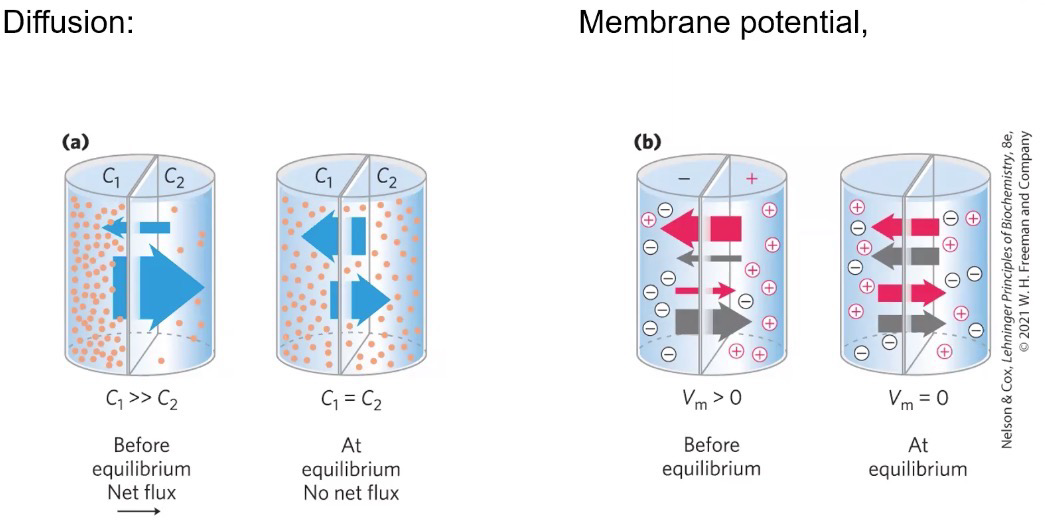
Movement of molecules through a membrane may be due to
Diffusion or Membrane potential (Charge)
Channels vs transporter
Channels can only mediate facilitated diffusion. Non saturatable
Transporters can mediate both facilitated diffusion and active transport (pumps). Saturatable
GLUT1 transporter
Ubiquitous, down its concentration gradient, all tissues, basal glucose uptake
GLUT2
Liver, pancreatic islets, intestine. In liver and kidney, removal of excess glucose from blood. In pancreas, regulation of insulin release
GLUT3
Brain, testis, basal glucose uptake
GLUT4
Muscle, fat and heart. Activity increased by insulin. Mediate glucose uptake. Very different from GLUT 1, 2, and 3
GLUT1, 2, and 3 are embedded in
the membrane
GLUT1 transporter is saturateable or is not saturateable
saturateable
1/2Vmax =
Kt
Kt indicates the
specificity of the transporter
GLUT4 transporter is kept inside a ___________. When the pancreas releases insulin, the insulin will signal the translocation to the membrane and embed itself. Insulin dependent. Works the same way as 1, 2, and 3.
vesicle in the cytosol
In respiring tissues, carbon dioxide produced by catabolism enters the erythrocyte and is converted to bicarbonate by carbonic anhydrase. This allows CO2 to be transported via the bloodstream. Bicarbonate can enter the bloodstream. Chloride-bicarbonate exchange protein allows bicarbonate to leave as a chloride goes into the cell. This is a ______ and __________. No net change of charge because although a negatively charged HCO3- leaves the tissue, a _____ enters to balance the charge.
cotransporter and antitransporter; Cl-
In the lungs, bicarbonate is taken in the cell, carbonic anhydrase converts it to CO2 and the CO2 leaves. Chloride ion leaves to maintain ion neutrality. Everything is going…
down their electron gradient.
In voltage-gated K+ channel, change in voltage causes
K+ channel to open
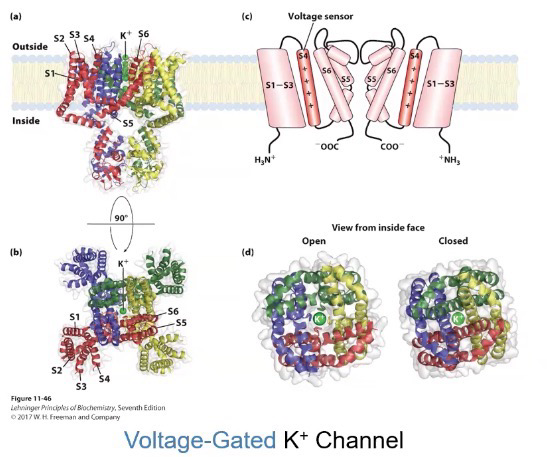
In ligand-gated channel: I P3 Gated Calcium Channel, a ______ binding will cause the channel to open
ligand
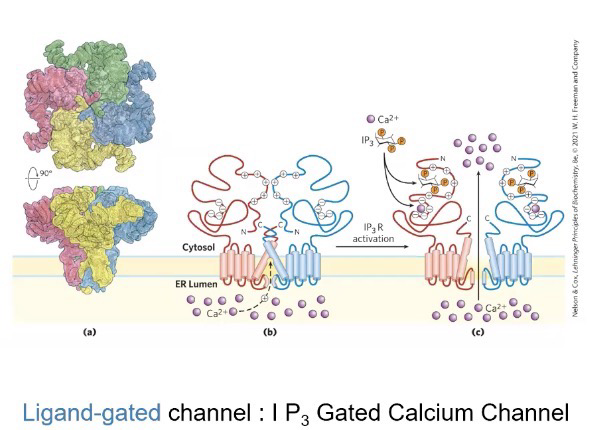
Similarly to transporter, channels are also very ______ in the molecule they move
specific/selective
Aquaporins
provide quick channel movement of water and are faster than osmosis. Is selective to only water. Only allows water to pass. Hydronium and hydroxide ions are not allowed to pass through. Residues contribute to selectivity. Asn residues prevent proton hopping via H-bonds. Arg allows positively charged ions to be expelled
Aquaporins are important in
sweat glands, urine, etc.
Primary active transport
solute accumulation is coupled directly to an exergonic chemical reaction
Secondary active transport
endergonic transport of one solute is coupled to the exergonic flow of a different solute that was originally pumped uphill by primary active transport
Primary Active Transporter P-type ATPases need ___, integral membrane proteins, 8-10 predicted membrane spanning regions, large conformation changes in ion pumping cycle
ATP
P-type ATPases have 3 domains:
nucleotide binding domain (N): ATP binding site
phosphorylation domain (P): Site of phosphorylation
actuator domain (A): Opens post energy release when ATP is now ADP
Sodium Potassium ATPase; Helps establish what?
Moves Sodium out and potassium in; relatively similar mechanisms and structure all around for ATPases; Helps establish a electrochemical gradient (“-” inside and “+” outside)
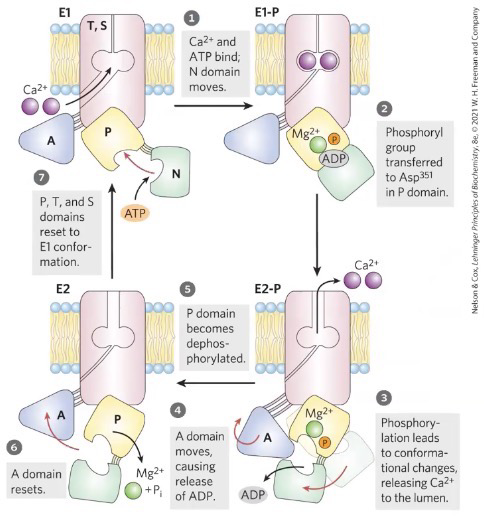
SERCA pump is located on the membrane of the_______________. Pumps ions from the cytosol into a subcellular organelle
ER or sarcoplasmic reticulum;
SERCA pump; Gradient of ____ is important for ____ _________
Moves 2 Ca2+ ions across membrane and converts an ATP to ADP and Pi; Two conformations: E1 and E2, interconverts; Ca gradient is important for signal transduction
SERCA PUMP steps
1. Ca2+ and ATP bind; N domain moves
2. Phosphoryl group transferred to Asap351 in P domain
3. Phosphorylation leads to conformational changes, releasing Ca2+ to the lumen
4. A domain moves causing release of ADP
5. P domain becomes dephosphorylated
6. A domain resets
7. P, T, and S domains reset to E1 conformation
Also has an A P and N domain
ATP-Binding Cassette (ABC) Transporters
pumps out of cell against a concentration gradient; Two ATPs bind to two Nucleotide binding domain, hydrolysis of ATP allows molecule to move; Commonly used to move toxic materials outside of cell
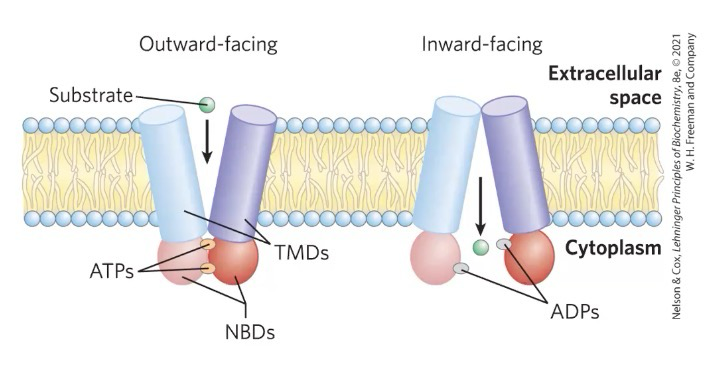
Multi-drug transporter (MDR1) confers drug resistance to
anti-tumor drugs
Overexpression of MDR1 is associated with
treatment failure in cancers of the liver, kidney, and colon
Cystic Fibrosis Transmembrane Conductance Regulator (CFTR)
an ATP gated ion channel that regulates fluid and salt balance; Although a channel, it’s classified as an ABC protein because it has two ATP binding cassettes, in this case ATP is used only to open the channel, not to transport, functions as an ion transport once opened; specific to Cl- but can also transport bicarbonate (HCO3-) (Leaky channel); particularly important for epithelial cells
CFTR operation
When CFTR is closed: R domain phosphorylated, No ATP bound to NBD
When CFTR is open: R domain phosphorylated, ATP bound to NBDs
To close CFTR after opening: R domain dephosphorylated and no ATP bound to NBDs
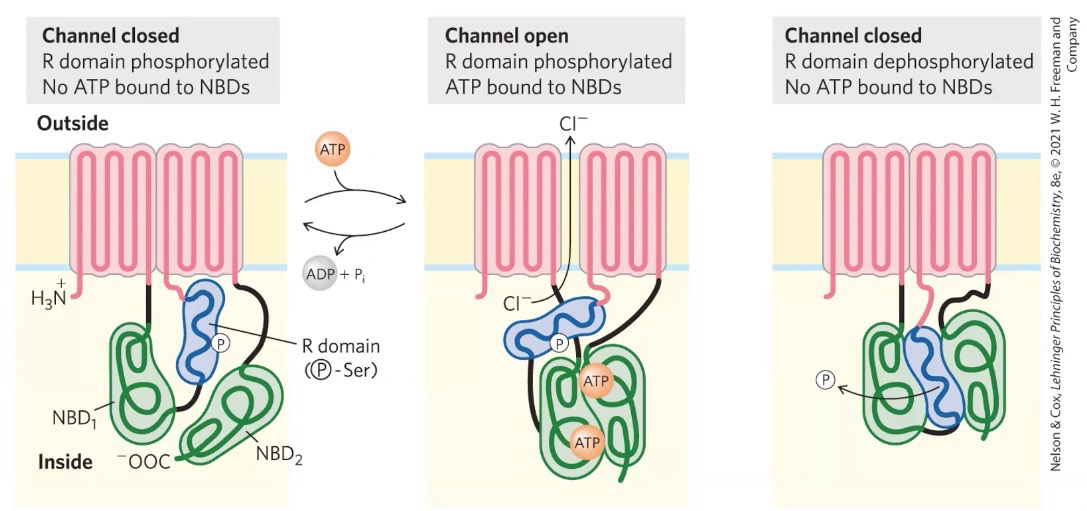
CFTR is a _____ channel
chlorine
Na+-Glucose Symporter; How it works within the stomach lining; What other transporters are utilized in this process
uses Na+ going down its gradient from the intestinal lumen to the epithelial cell which allows glucose to enter against its gradient
Glucose exits the epithelial cell into the blood via Glucose uniporter GLUT2 (facilitated diffusion)
Na+K+ ATPase establishes the sodium gradient for Na+-Glucose symporter
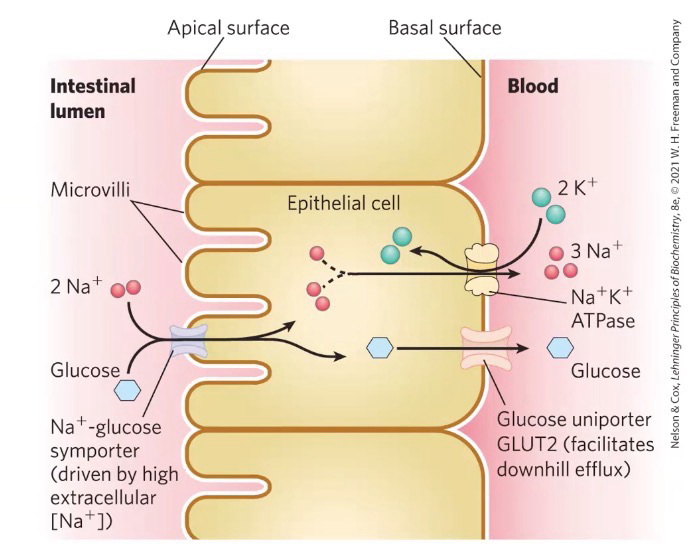
Secondary active transporters use transport down a gradient to provide energy for transport…
against a gradient