Global inequality
 Call Kai
 Learn
Learn Practice Test
 Spaced Repetition
 Match
Match Flashcards
 Knowt Play
1/26

Earn XP
Description and Tags
Test 2, set 3
Name | Mastery | Learn | Test | Matching | Spaced | Call with Kai | Chat |
|---|
No analytics yet
Send a link to your students to track their progress
27 Terms
Global inequality definition
SYSTEMATIC DIFFERENCES IN WEALTH, INCOME,
AND WORKING/LIVING CONDITIONS ACROSS COUNTRIES
Absolute poverty
CONDITIONS THAT DO NOT MEET THE MINIMUM
REQUIREMENTS NECESSARY TO SUSTAIN HEALTH/LIFE
Relative poverty
CONDITIONS RELATIVE TO THE OVERALL STANDARD OF LIVING IN A GIVEN SOCIETY
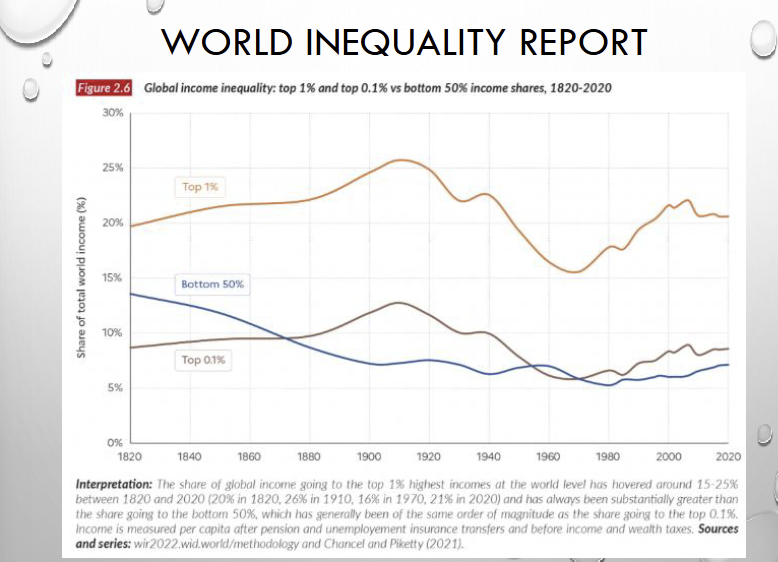
What is this graph saying about global income inequality?
The top 1% has always held far more income than the bottom 50%
The top 0.1% often holds a share similar to the entire bottom half
The elite share stays high, the bottom share stays low
Inequality remains persistent and extreme over time
What is the best predictor of life chances? What are different reasons kids may die at a very young age?
Place of birth remains best predictor of life chances
Children die from hunger due to drought/climate, war, economic crises, etc
In developed countries there is an excess of food. What are some of the consequences?
Food is wasted
Obesity, diabetes, strokes, etc
What are different ways of measuring inequality?
GDP – GROSS DOMESTIC PRODUCT, OR ALL GOODS
AND SERVICES ON RECORDGNI – GROSS NATIONAL INCOME, INCLUDING
INTERNATIONAL REVENUE.HDI – HUMAN DEVELOPMENT INDEX MEASURES
ACHIEVEMENTS IN HEALTH, EDUCATION, STABILITY,
ECONOMIC ACTIVITY, AND STANDARDS OF LIVING.THE WORLD BANK IS A MAJOR TRACKER OF GLOBAL
INEQUALITY.
- HIGH, UPPER MIDDLE, LOWER MIDDLE, AND LOW
INCOME, BASED ON GNI.
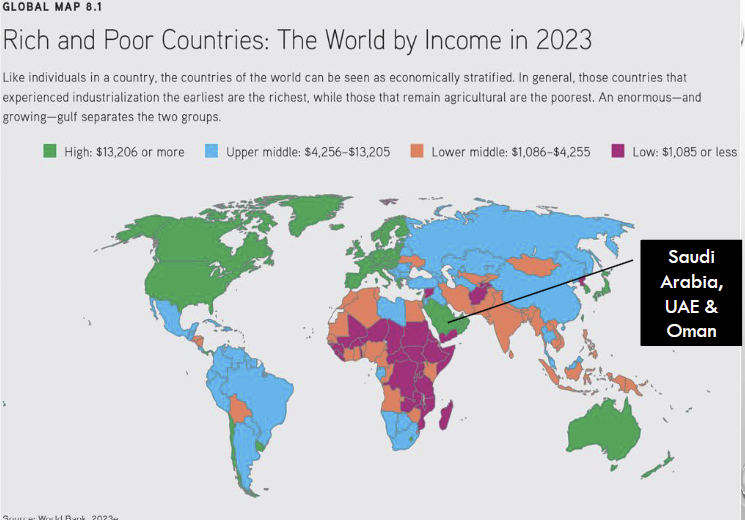
What does the global income map show?
Countries are grouped by income level
High‑income countries = early industrialization
Low‑income countries = economies still largely agricultural
Reveals global economic stratification and uneven development
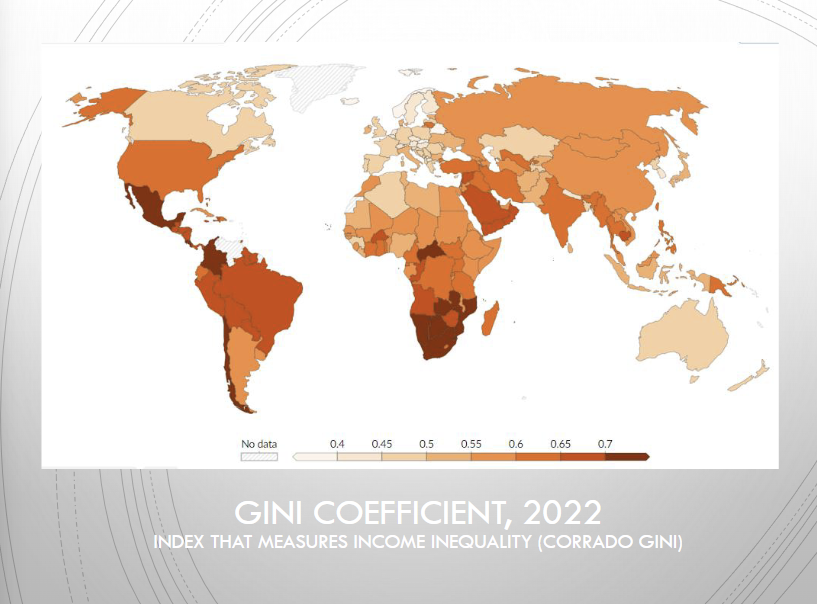
What does the Gini Coefficient map show?
It measures income inequality across countries
Darker areas = higher inequality
Lighter areas = lower inequality
Reveals global patterns of uneven income distribution
What pattern can be seen between low income-high income?
Low income: More infant deaths life expectancy is lower, lower GNI
Vice versa for high income
What do trends show about the average global citizen?
Illiteracy + infant mortality decreasing
Life expectancy increasing
Higher incomes worldwide
What do trends show about income levels in low‑income countries?
Low‑income countries’ average incomes rising
High‑income = early industrialization → better housing, food, water
Since 2000: low‑income population fell, low/middle grew, upper/middle grew
What do trends show about lower-income countries?
Lower‑income countries have higher fertility rates
Early 21st century: low‑income countries grew 3× faster than high‑income
~150 million child labourers
~30% work in unsafe conditions, mostly in agriculture
Global child labour rates are decreasing
Has global child labour been increasing or decreasing?
Both age groups show a clear decline over time
Rates for 5–14 and 15–17 have steadily decreased
Overall trend = global reduction in child labour
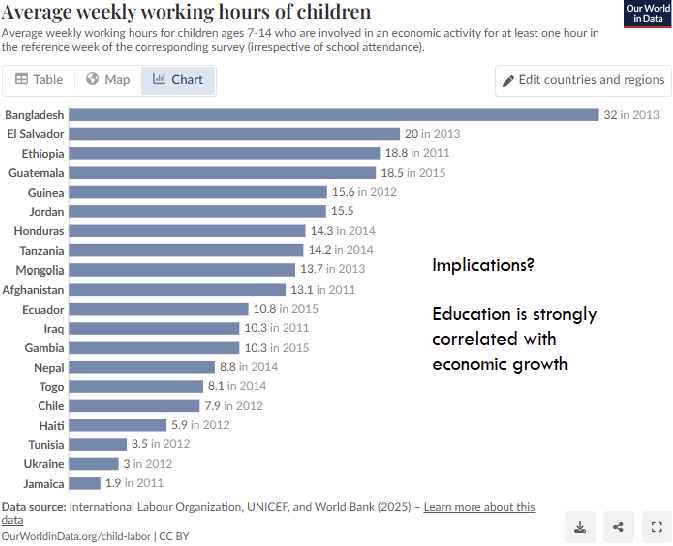
What does the chart on average weekly working hours of children show?
Children in some countries work very long hours, especially where poverty is high
Countries with lower hours tend to have better education access
Overall message: more schooling = stronger economic growth
What does THEORIES OF INEQUALITY say about neo‑liberalism?
Free markets, no government interference
Modernization theory: low‑income societies grow by adopting modern institutions, technology, and values
What does THEORIES OF INEQUALITY say about colonialism?
Colonialism has a mixed legacy
Encouraged industry, infrastructure, education, military interests, etc.
Raises the question: Is inequality just economics?
What does THEORIES OF INEQUALITY say about dependency theories?
Poverty in low‑income countries is the direct result of exploitation and colonialism
Core countries (advanced/industrial) take profits
Peripheral countries are dependent on core countries
What does THEORIES OF INEQUALITY say about development paths?
Revolution, or…
Dependent development = economic development within dependent relationships
What is World Systems Theory in THEORIES OF INEQUALITY?
A theory placing class at the global level, dividing countries into core, semi‑periphery, and periphery, shaping global power and inequality.
What are global commodity chains, semi‑peripheral countries, and state‑centred capitalism in THEORIES OF INEQUALITY?
Global commodity chains: Networks linking labour and production from raw materials → consumer
Semi‑peripheral countries: Supply core countries but still profit
State‑centred capitalism: State policies can stimulate economic growth
What is Global Capitalism Theory in THEORIES OF INEQUALITY?
A view of capitalism as transnational, spanning global markets, production, finance, and governance
Involves a transnational capitalist class with shared global economic interests, neo‑liberal outlook, and lifestyle
Has numbers of millionaires in Canada increased or decreased in 2023?
Increased
What is the main contradiction in THE FUTURE?
Inequality increases even while average income rises
Inequality erodes meritocracy (rewards idleness + inherited wealth
What other questions does THE FUTURE highlight?
More globalization?
Can we predict the future? (futurology + failed starvation forecasts)
More aid?
Name one country with a lot of humanitarian aid and one with not as much
USA
France
What does THE FUTURE say about limits of growth?
Rapid growth doesn’t eliminate extreme poverty → disparity can remain or increase
Future outcomes shaped by culture, corruption, politics, war, conflict, infrastructure