Economics Chapter 4
 Call Kai
 Learn
Learn Practice Test
 Spaced Repetition
 Match
Match Flashcards
 Knowt Play
1/39

There's no tags or description
Looks like no tags are added yet.
Name | Mastery | Learn | Test | Matching | Spaced | Call with Kai | Chat |
|---|
No analytics yet
Send a link to your students to track their progress
40 Terms
PART A: DEMAND
PART A: DEMAND
What Is a Market, buyer, and seller?
Market: A group of buyers and sellers of a particular good or service.
Buyers: Determine demand.
Sellers: Determine supply.
What is Quantity demanded:
The amount buyers are willing and able to purchase.
What is the "Law of Demand"?
Price ↑ → Quantity Demanded ↓
Price ↓ → Quantity Demanded ↑
What is a demand curve:
A graph of the relationship between the price of a good and the quantity demanded.
Which way does a demand curve slope?
Downward (inverse relationship between price and quantity demanded)
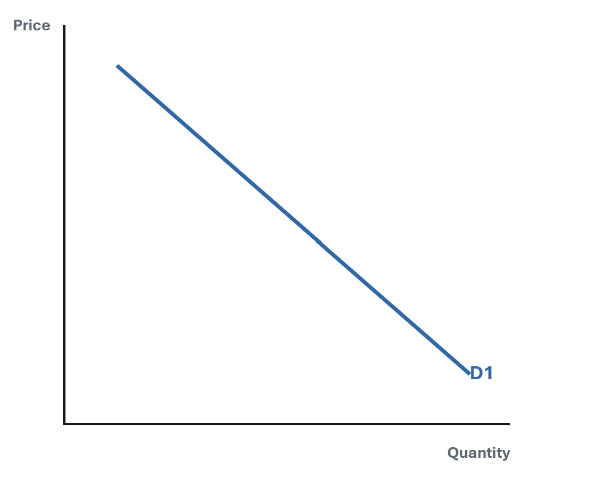
What is the difference between a "change in quantity demanded" and a "change in demand"?
Change in quantity demanded = movement along the curve (caused by a change in the good's own price)
Change in demand = shift of the curve (caused by a non-price factor)
What are the 5 factors that shift the demand curve?
Income
Prices of related goods (substitutes & complements)
Tastes/preferences
Expectations
Number of buyers
What is a normal good?
Income ↑ → Demand ↑
(Example: restaurant meals)
What is an inferior good?
Income ↑ → Demand ↓
(Example: cheaper alternatives you buy less of as income rises)
What are substitutes? Give an example.
Goods used in place of each other.
Price of one ↑ → Demand for the other ↑
(Example: Coke & Pepsi)
What are complements? Give an example.
Goods used together.
Price of one ↑ → Demand for the other ↓
(Example: cars & gasoline)
PART B: SUPPLY
PART B: SUPPLY
What is Quantity supplied?
The amount sellers are willing and able to sell.
What is the "Law of Supply"?
Price ↑ → Quantity Supplied ↑
Price ↓ → Quantity Supplied ↓
(Other things equal)
Which way does a supply curve slope?
Upward (direct relationship between price and quantity supplied)

What is the difference between a "change in quantity supplied" and a "change in supply"?
Change in quantity supplied = movement along the curve (caused by a change in the good's own price)
Change in supply = shift of the curve (caused by a non-price factor)
What are the 4 factors that shift the supply curve?
Input prices
Technology
Expectations
Number of sellers
If the price of an input (like flour) falls, what happens to supply of muffins?
Supply increases (shifts right) because production becomes less costly
If technology improves, what happens to supply?
Supply increases (shifts right) because production becomes more efficient
PART C: MARKET EQUILIBRIUM
PART C: MARKET EQUILIBRIUM
What is market equilibrium?
The point where supply and demand intersect.
At equilibrium: Quantity Demanded = Quantity Supplied

What is the equilibrium price?
The price that balances quantity demanded and quantity supplied. Also called the market-clearing price.
What is the equilibrium quantity?
The quantity bought and sold at the equilibrium price.
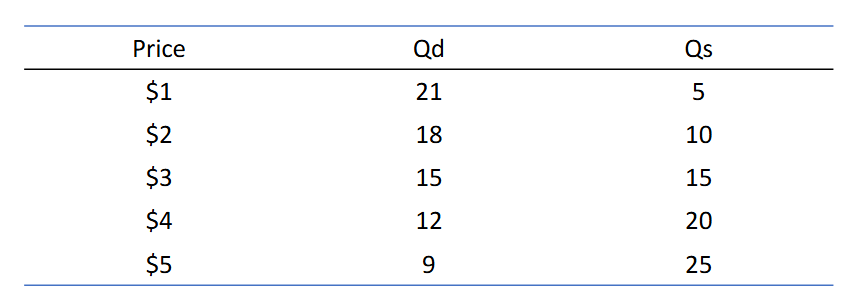
Finding Equilibrium from a table
Answer

PART D: WHEN PRICE IS NOT AT EQUILIBRIUM (Surplus and Shortage)
PART D: WHEN PRICE IS NOT AT EQUILIBRIUM (Surplus and Shortage)
What is a surplus? What happens to price?
Surplus = Quantity Supplied > Quantity Demanded (price is too high).
Sellers cut prices → Price falls toward equilibrium.
What is a shortage? What happens to price?
Shortage = Quantity Demanded > Quantity Supplied (price is too low).
Sellers raise prices → Price rises toward equilibrium.
What is the "Law of Supply and Demand"?
The price of any good adjusts to bring quantity supplied and quantity demanded into balance. Surpluses and shortages are temporary in well-functioning markets.
PART E: CHANGES IN EQUILIBRIUM
PART E: CHANGES IN EQUILIBRIUM
What are the 3 steps for analyzing changes in equilibrium?
Decide which curve shifts (demand, supply, or both)
Decide which direction (right = increase, left = decrease)
Use a diagram to see how the shift changes equilibrium P and Q
What happens to P and Q when Demand increases?
Demand shifts RIGHT + Price ↑ , Quantity ↑
What happens to P and Q when Demand decreases?
Demand shifts LEFT + Price ↓ , Quantity ↓
What happens to P and Q when Supply increases?
Supply shifts RIGHT + Price ↓ , Quantity ↑
What happens to P and Q when Supply decreases?
Supply shifts LEFT + Price ↑ , Quantity ↓
What happens when Demand increases AND Supply decreases at the same time?
Price definitely ↑ . Quantity is ambiguous (depends on which shift is larger).
What happens when Demand decreases AND Supply increases at the same time?
Price definitely ↓ . Quantity is ambiguous.
What happens when both Demand and Supply increase?
Quantity definitely ↑ . Price is ambiguous.
What happens when both Demand and Supply decrease?
Quantity definitely ↓ . Price is ambiguous.
Why do prices matter in a market economy?
Prices are signals. They allocate scarce resources by giving sellers incentives to produce more and buyers incentives to conserve when goods are scarce.