astronomy quizzes 1 and 2
 Call Kai
 Learn
Learn Practice Test
 Spaced Repetition
 Match
Match Flashcards
 Knowt Play
1/19

Earn XP
Name | Mastery | Learn | Test | Matching | Spaced | Call with Kai | Chat |
|---|
No analytics yet
Send a link to your students to track their progress
20 Terms
which of the following is the largest?
a. 1 light year
b. size of a typical galaxy
c. distance to the nearest star, proxima centauri
d. size of Pluto’s orbit
b. size of a typical galaxy
How many galaxies are there in the observable universe?
a. about as many as the number of grans of sand in all the beaches of the Earth
b. infinite number
c. about as many as the number of stars we see in the sky with our naked eyes
d. roughly (within a factor of 10) the same as the number of stars in our galaxy
d. roughly (within a factor of 10) the same as the number of stars in our galaxy
One of the hallmarks of science stands out as
a. replacement of earlier ideas
b. reproducibility, i.e., other researchers can replicate the results
c. top researchers are always involved in the research
d. relativism, meaning that there are no solid facts, but rather, everything is constantly changing
b. reproducibility, i.e., other researchers can replicate the results
In the constellation Orion, which of the following stars can be found?
a. Aldebaran
b. Castor
c. Betelgeuse
d. Sirius
c. Betelgeuse
Suppose you are driving up I35 toward Minnesota and you keep heading due north into Canada. At night, you would notice Polaris
a. to be constantly at the same altitude above the northern horizon
b. to be lower in the northern sky as you travel farther north
c. to be higher above the northern horizon as you travel farther north
d. to disappear
c. to be higher above the northern horizon as you travel farther north
Which of the following statements about the celestial equator is true at all latitudes?
a. it extends from your horizon due east, through your zenith, to your horizon due west
b. it lies along the band of the Milky Way
c. it represents an extension of Earth’s equator onto the celestial sphere
d. it cuts the dome of your local sky exactly in half
c. it represents an extension of Earth’s equator onto the celestial sphere
What is a circumpolar star?
a. a star makes a daily circle around the celestial sphere
b. a star that is close to the north celestial sphere
c. a star that is visible from the Arctic or Antarctic circles
d. a star that always remains above your horizon
d. a star that always remains above your horizon
During one night, from 6 p.m. to midnight, which of the following happens?
a. the right ascension and declination of each star does not change
b. the right ascension of each star changes by 6 hours, but the declination doesn’t change
c. the right ascension of each star doesn’t change, but the declination changes by 90 degrees
d. both the right ascension and declination of each star change
a. the right ascension and declination of each star does not change
Orion is visible on winter evenings but not summer evenings because of
a. precession of the Earth’s axis
b. interference of the full Moon
c. the tilt of the Earth’s axis
d. the location of the Earth in its orbit
d. the location of the Earth in its orbit
The season on Earth are caused by its elliptical orbit around the Sun
True or False
False
Which of the following statements about thermal radiation is always true?
a. a hot object emits light with a wavelength than a cool object does.
b. a hot object emits more radio waves than a cool object does
c. a hot object emits more X rays than a cool object does
d. a hot object emits light with higher average energy than a cool object
d. a hot object emits light with higher average energy than a cool object
If the sun rises directly east on the Vernal Equinox, then three weeks later it will rise
a. north of east
b. directly east
c. south of east
a. north of east
One method of determining the direction during the day is use a vertical pole and the shadow case by the Sun. An astronomy student places a rock at the end of the pole’s shadow every 15 minutes. The direction indicated by the arrow must be
a. north
b. east
c. south
d. west
e. none of the above
a. north
Which of the following types of light has the greatest energy?
a. radio waves
b. microwaves
c. ultraviolet
d. gamma rays
d. gamma rays
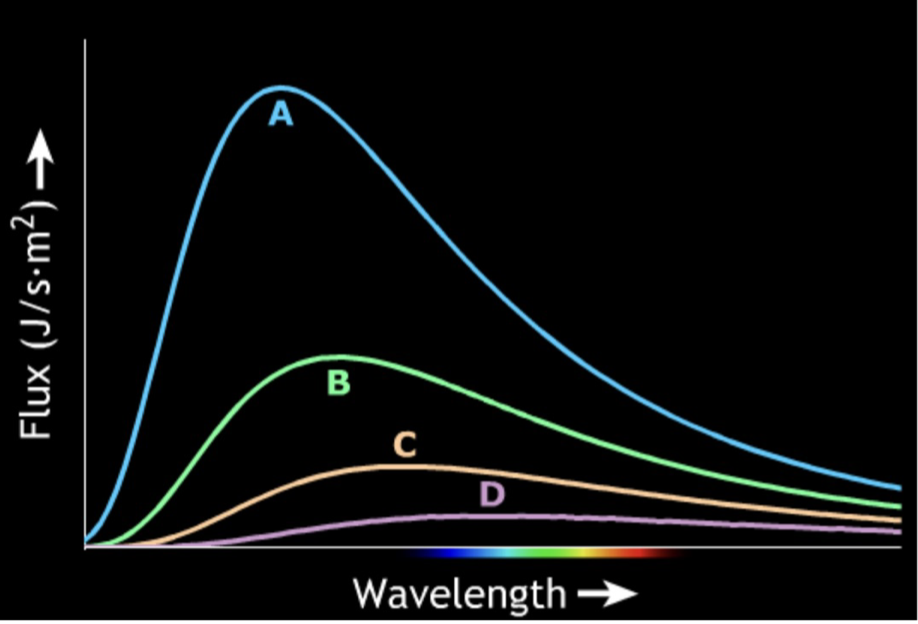
The graph below shows thermal radiation curves for stars with different surface temperatures. which of the stars has the lowest surface temperature?
A
B
C
D
D
A star’s luminosity is the
a. apparent brightness of the star in our sky
b. total amount of energy radiated into space each second
c. surface temperature of the star
d. the total amount of energy that the star will radiate over its entire lifetime
b. total amount of energy radiated into space each second
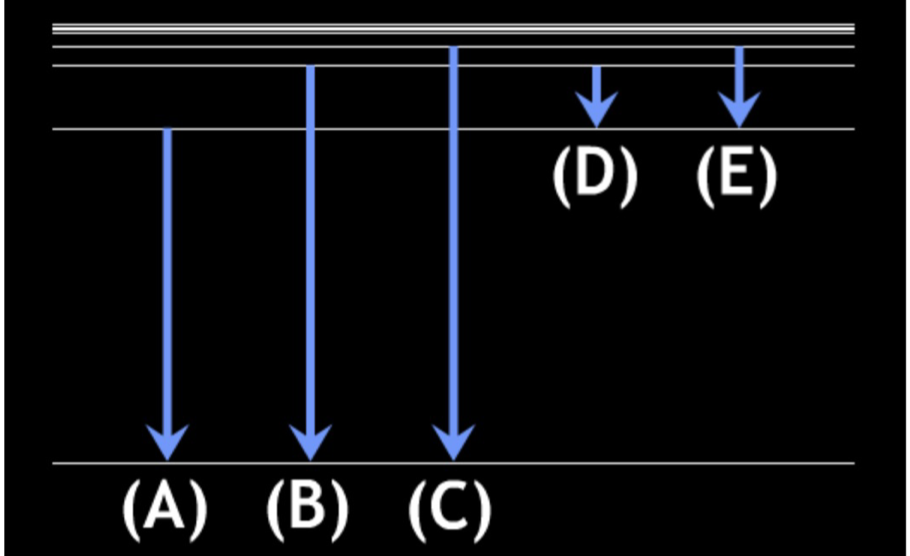
an energy level diagram for a hydrogen atom is shown. In which transition is the proton emitted with the greatest energy?
A
B
C
D
C
Which of the following optical telescopes would have the best angular resolution?
a. 5-meter, 1.2-meter focal length
b. 2-meter, 3-meter focal length
c. 1-meter, 0.5-meter focal length
d. 0.5-meter, 0.4-meter focal length
a. 5-meter, 1.2-meter focal length
The largest telescopes on Earth operate in which part of the electromagnetic spectrum?
a. visible
b. ultraviolet
c. infrared
d. radio
d. radio
Which of the following wavelength regions cannot be studies with telescopes on the ground?
a. radio waves
b. ultraviolet
c. x rays
d. Both B and C
e. Both A and C
d. Both B and C