23 - chemical energetics
 Call Kai
 Learn
Learn Practice Test
 Spaced Repetition
 Match
Match Flashcards
 Knowt Play
1/45

There's no tags or description
Looks like no tags are added yet.
Name | Mastery | Learn | Test | Matching | Spaced | Call with Kai |
|---|
No analytics yet
Send a link to your students to track their progress
46 Terms
enthalpy change (ΔH)
refers to the amount of heat energy transferred during a chemical reaction, at a constant pressure
lattice energy (ΔHlattꝋ)
The enthalpy change when 1 mole of an ionic compound is formed from its gaseous ions (under standard conditions)
is lattice energy endo or exo
The ΔHlattꝋ is always exothermic, as when ions are combined to form an ionic solid lattice there is an extremely large release of energy
The enthalpy change will always have a negative value
Because of the huge release in energy when the gaseous ions combine, the value will be a very large negative value
The large negative value of ΔHlattꝋ suggests that the ionic compound is much more stable than its gaseous ions
This is due to the strong electrostatic forces of attraction between the oppositely charged ions in the solid lattice
Gaseous ions are less stable than ions in an ionic lattice because they are not stabilized in a lattice by strong electrostatic attractions, so they have higher potential energy.
The more exothermic the value is, the stronger the ionic bonds within the lattice are
how to determine lattice energy (or how not to)
The ΔHlattꝋ of an ionic compound cannot be determined directly by one single experiment
Multiple experimental values and an energy cycle are used to find the ΔHlattꝋ of ionic compounds
The lattice energy (ΔHlattꝋ) of an ionic compound can be written as an equation
E.g. magnesium chloride is an ionic compound formed from magnesium (Mg2+) and chloride (Cl-) ions:
Mg2+ (g) + 2Cl- (g) → MgCl2 (s)
standard enthalpy change of atomisation (ΔHatꝋ)
The enthalpy change when 1 mole of gaseous atoms is formed from its element under standard conditions
is ΔHatꝋ endo or exo
The ΔHatꝋ is always endothermic as energy is always required to break any bonds between the atoms in the element into its gaseous atoms
Since this is always an endothermic process, the enthalpy change will always have a positive value
Equations can be written to show the standard enthalpy change of atomisation (ΔHatꝋ) for elements
E.g. The standard enthalpy change of atomisation for sodium is the energy required to form 1 mole of gaseous sodium atoms:
Na (s) → Na (g) ΔHatꝋ = +107 kJ mol -1
examiner tips and tricks (standard conditions)
Standard conditions in this syllabus are a temperature of 298 K and a pressure of 101 kPa
Make sure the correct state symbols are stated when writing these equations – it is crucial that you use these correctly throughout this entire topic
first electron affinity
The first electron affinity (EA1) is the enthalpy change when 1 mole of electrons is added to 1 mole of gaseous atoms, to form 1 mole of gaseous ions each with a single negative charge under standard conditions
X (g) + e– → X– (g)
EA1 is usually exothermic, as energy is released
The value for EA1 will usually be negative
EA1
X (g) + e– → X– (g)
Exothermic
second and third electron affinites
An element can also accept more than one electron, in which case successive electron affinities are used
For example, the second electron affinity (EA2) and third electron affinity (EA3) of an element represent the formation of 1 mole of gaseous ions with 2- and 3- charges respectively
The second and third electron affinities are endothermic, as energy is absorbed
This is because the incoming electron is added to an already negative ion
Energy is required to overcome the repulsive forces between the incoming electron and negative ion
The values will be positive
Only the first electron affinity is negative (exothermic) because it involves adding an electron to a neutral atom, which can attract that electron quite strongly.
EA2
X– (g) + e– → X2– (g)
Endothermic
EA3
X2– (g) + e– → X3– (g)
Endothermic
factors affecting electron affinity
The electron affinity of an element depends on how strongly the nucleus attracts an incoming electron.
The stronger the attraction between the nucleus and the incoming electron, the more energy is released, making the electron affinity more exothermic (more negative)
The factors that affect electron affinity are the same as those that influence ionisation energy:
Nuclear charge
A higher nuclear charge means a stronger pull on the incoming electron, resulting in a more exothermic electron affinity
Distance (atomic radius)
A larger distance between the nucleus and the outermost shell reduces the attractive force, making electron affinity less exothermic
Shielding
More inner electron shells increase shielding, which weakens the nuclear attraction for the incoming electron, leading to a less exothermic electron affinity
trends in electron affinity of group 16 and group 17 elements
Electron affinities of non-metals become more exothermic across a period, with a maximum at Group 17
There is generally a downwards trend in the size of the electron affinities of the elements in Group 16 and 17
The electron affinities generally become less exothermic for each successive element going down both Groups, apart from the first member of each Group (oxygen and fluorine respectively)
Electron affinity table
Electron Affinity / kJ mol–1 | |
|---|---|
Group 16 | Group 17 |
O = –141 | F = –328 |
S = –200 | Cl = –345 |
Se = –195 | Br = –325 |
Te = –190 | I = –295 |
An atom of chlorine has a higher nuclear charge than sulfur
This stronger nuclear charge results in a greater attraction between the nucleus and the incoming electron
Therefore, more energy is released when an electron is added to chlorine, making its first electron affinity (EA₁) more exothermic than that of sulfur
As you move down Group 16 or Group 17:
The outermost electrons are farther from the nucleus, so the attractive force is weaker
There are more electron shells, increasing shielding and further reducing nuclear attraction
It becomes more difficult to add an electron to the outer shell
Less energy is released, so the electron affinity becomes less exothermic
Fluorine as an exception
Fluorine has a very small atomic radius, resulting in:
High electron density around the nucleus.
Increased repulsion between the incoming electron and the existing electrons.
This repulsion weakens the overall attraction to the nucleus.
As a result, fluorine’s first electron affinity is less exothermic than expected, and it is actually lower than that of chlorine.
born-haber cycle
A Born-Haber cycle is a specific application of Hess's Law for ionic compounds and enable us to calculate lattice enthalpy which cannot be found by experiment
The basic principle of drawing the cycle is to construct a diagram in which energy increases going up the diagram
The basic principle of a Born-Haber cycle
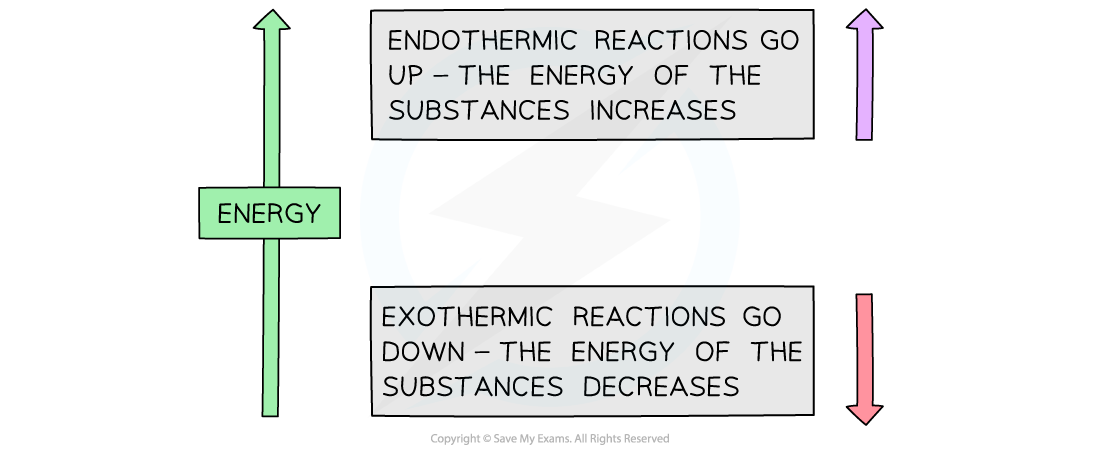
The direction of the arrows in Born-Haber cycles indicates if a reaction is exothermic or endothermic
The cycle shows all the steps needed to turn atoms into gaseous ions and from gaseous ions into the ionic lattice
The alternative route to the ionic lattice begins from the enthalpy of formation of the elements in their standard states

calculations using born-haber cycles
Once a Born-Haber cycle has been constructed, it is possible to calculate the lattice energy (ΔHlattꝋ) by applying Hess’s law and rearranging:
ΔHfθ = ΔHatθ + ΔHatθ + IE + EA + ΔHlattθ
If we simplify this into three terms, this makes the equation easier to see:
ΔHlattθ
ΔHfθ
ΔH1θ (the sum of all of the various enthalpy changes necessary to convert the elements in their standard states to gaseous ions)
The simplified equation becomes
ΔHfθ = ΔH1θ + ΔHlattθ
So, if we rearrange to calculate the lattice energy, the equation becomes
ΔHlattθ = ΔHfθ - ΔH1θ
When calculating the ΔHlattθ, all other necessary values will be given in the question
A Born-Haber cycle could be used to calculate any stage in the cycle
For example, you could be given the lattice energy and asked to calculate the enthalpy change of formation of the ionic compound
The principle would be exactly the same
Work out the direct and indirect route of the cycle (the stage that you are being asked to calculate will always be the direct route)
Write out the equation in terms of enthalpy changes and rearrange if necessary to calculate the required value
Remember: sometimes a value may need to be doubled or halved, depending on the ionic solid involved
For example, with MgCl2 the value for the first electron affinity of chlorine would need to be doubled in the calculation, because there are two moles of chlorine atoms
Therefore, you are adding 2 moles of electrons to 2 moles of chlorine atoms, to form 2 moles of Cl- ions
examiner tips and tricks
Make sure you use brackets when carrying out calculations using Born-Haber cycles as you may forget a +/- sign which will affect your final answer!
factors affecting lattice energy
charge and radius of the ions that make up the crystalline lattice
how does ionic radius affect lattice energy
The lattice energy becomes less exothermic (numerically less negative) as the ionic radius increases
In larger ions, the charge is spread over a greater volume, so charge density is lower
The ions are also further apart in the lattice, increasing the distance between their centres
As a result, the electrostatic attraction between oppositely charged ions is weaker, and less energy is released when the lattice forms
For example:
Both CsF and KF contain F⁻ ions
Cs⁺ is larger than K⁺, so the lattice energy of CsF is less exothermic than that of KF
Trends in the lattice energy of different metal halides

The lattice energies get less exothermic as the ionic radius of the ions increases
how does ionic charge affect lattice energy
The lattice energy becomes more exothermic (more negative) as the ionic charge increases.
Higher ionic charge leads to higher charge density
This results in stronger electrostatic attractions between oppositely charged ions
Consequently, more energy is released when the lattice is formed
For example:
CaO is composed of Ca²⁺ and O²⁻ ions, while KCl contains K⁺ and Cl⁻ ions
The ions in CaO have higher charges, so the electrostatic forces are stronger
Therefore, the lattice energy of CaO is more exothermic than that of KCl
Additionally, Ca²⁺ and O²⁻ ions are smaller than K⁺ and Cl⁻, further increasing the exothermic value
standard enthalpy change of solution (ΔHsolθ
the enthalpy change when 1 mole of an ionic substance dissolves in sufficient water to form a very dilute solution under standard conditions
The symbol (aq) is used to show that the solid is dissolved in sufficient water
For example, the enthalpy changes of solution for potassium chloride are described by the following equations:
KCl (s) + aq → KCl (aq)
OR
KCl (s) + aq → K+ (aq) + Cl– (aq)
ΔHsolθ can be exothermic (negative) or endothermic (positive)
Enthalpy change of hydration
The lattice energy (ΔHlattθ) of KCl is -711 kJ mol-1
This means that 711 kJ mol-1 is released when the KCl ionic lattice is formed
Therefore, to break the attractive forces between the K+ and Cl- ions, +711 kJ mol-1 is needed
However, the ΔHsolθ of KCl is +26 kJ mol-1
This means that another +685 kJ mol-1 (711 - 26) is required to break the KCl lattice
This is compensated for by the standard enthalpy change of hydration (ΔHhydθ)
The standard enthalpy change of hydration (ΔHhydθ) is the enthalpy change when 1 mole of a specified gaseous ion dissolves in sufficient water to form a very dilute solution under standard conditions
Mg2+(g) + aq → Mg2+(aq)
Hydration enthalpies are the measure of the energy that is released when there is an attraction formed between the ions and water molecules
Hydration enthalpies are exothermic
Ion–Dipole interactions during dissolution
When an ionic solid dissolves in water, it breaks into positive and negative ions
Water is a polar molecule, with a δ⁻ oxygen atom and δ⁺ hydrogen atoms
The oxygen atom is attracted to positive ions (cations)
The hydrogen atoms are attracted to negative ions (anions)
These attractions form ion–dipole bonds between the water molecules and the ions
Interactions of polar water molecules and other ions in solution

The polar water molecules will form ion-dipole bonds with the ions in solution (a) causing the ions to become hydrated (b)
Energy Cycle Using Enthalpy Changes & Lattice Energy
The standard enthalpy change of hydration (ΔHhydθ) can be calculated by constructing energy cycles and applying Hess’s law
Example energy cycle
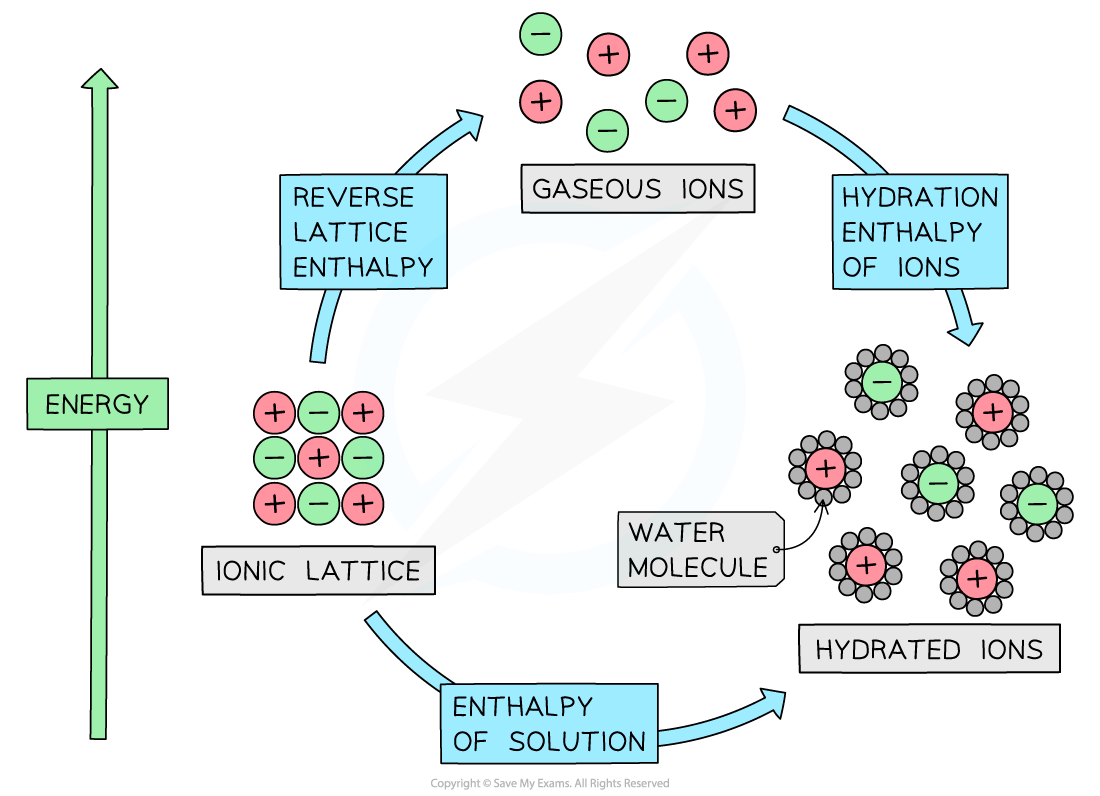
Energy cycle involving enthalpy change of solution, lattice energy, and enthalpy change of hydration
The energy cycle shows that there are two routes to go from the ionic lattice to the hydrated ions in an aqueous solution:
Route 1: going from ionic solid → ions in aqueous solution (this is the direct route)
ΔHsolθ = enthalpy of solution
Route 2: going from ionic lattice → gaseous ions → ions in aqueous solution (this is the indirect route)
-ΔHlattθ + ΔHhydθ = reverse lattice enthalpy + hydration enthalpies of each ion
Lattice enthalpy usually means Lattice formation enthalpy, in other words bond forming
If we are breaking the lattice then this is reversing the enthalpy change so a negative sign is added in front of the term (alternatively it is called latticedissociation enthalpy)
According to Hess’s law, the enthalpy change for both routes is the same, such that:
ΔHsolθ = -ΔHlattθ + ΔHhydθ
ΔHhydθ = ΔHsolθ + ΔHlattθ
Each ion will have its own enthalpy change of hydration, ΔHhydθ, which will need to be taken into account during calculations
The total ΔHhydθ is found by adding the ΔHhydθ values of both anions and cations together
Energy Cycle Calculations
The energy cycle involving the enthalpy change of solution (ΔHsolθ), lattice energy (ΔHlattθ), and enthalpy change of hydration (ΔHhydθ) can be used to calculate the different enthalpy values
According to Hess’s law, the enthalpy change of the direct and of the indirect route will be the same, such that:
ΔHhydθ = ΔHlattθ + ΔHsolθ
This equation can be rearranged depending on which enthalpy value needs to be calculated
For example, ΔHlattθ can be calculated using:
ΔHlattθ = ΔHhydθ - ΔHsolθ
Remember: the total ΔHhydθ is found by adding the ΔHhydθ values of both anions and cations together
Remember: take into account the number of each ion when completing calculations
For example, MgCl2 has two chloride ions, so when completing calculations this will need to be accounted for
In this case, you would need to double the value of the hydration enthalpy, since you are hydrating 2 moles of chloride ions instead of 1
The standard enthalpy change of hydration (ΔHhydθ) is affected by
the amount that the ions are attracted to the water molecules
The factors which affect this attraction are the ionic charge and radius
how does ionic radius affect (ΔHhydθ)
The standard enthalpy change of hydration ( ΔHhydθ) becomes more exothermic(more negative) as the ionic radius decreases
Smaller ions have a higher charge density, resulting in stronger ion–dipole attractions with water molecules
Therefore, more energy is released when these ions are hydrated
For example:
Mg²⁺ in MgSO4 is smaller than Ba²⁺ in BaSO4
As a result, ΔHhydθ of MgSO4 is more exothermic than that of BaSO4
how does ionic charge affect (ΔHhydθ)
The enthalpy of hydration becomes more exothermic as the ionic charge increases
Higher charge leads to a greater charge density, strengthening ion–dipole attractions with water molecules
This means more energy is released during hydration
For example:
Ca²⁺ and O²⁻ in CaO have higher charges than K⁺ and Cl⁻ in KCl
Therefore, ΔHhydθ of CaO is more exothermic than that of KCl
Comparing enthalpies of hydration

entropy
The entropy (S) of a given system is the number of possible arrangements of the particles and their energy in a given system
In other words, it is a measure of how disordered a system is
When a system becomes more disordered, its entropy will increase
An increase in entropy means that the system becomes energetically more stable
entropy examples
Examples
Thermal decomposition of calcium carbonate
CaCO3 (s) → CaO (s) + CO2 (g)
The entropy of the system increases
In this decomposition reaction, a gas molecule (CO2) is formed
The CO2 gas molecule is more disordered than the solid reactant (CaCO3), as it is constantly moving around
The system has become more disordered and there is an increase in entropy
Melting ice to form liquid water:
H2O (s) → H2O (l)
The water molecules in ice are in fixed positions and can only vibrate about those positions
In the liquid state, the particles are still quite close together but are arranged more randomly, in that they can move around each other
Water molecules in the liquid state are therefore more disordered
Thus, for a given substance, the entropy increases when its solid form melts into a liquid
In both examples, the system with the higher entropy will be energetically themost stable (as the energy of the system is more spread out when it is in a disordered state)
Entropy between physical states

Melting a solid will cause the particles to become more disordered resulting in a more energetically stable system
examiner tips and tricks
Make sure you don’t confuse the system with your surroundings!
The system consists of the molecules that are reacting in a chemical reaction
The surroundings are everything else such as the solvent, the air around the reaction, test-tube, etc
states and their entropies
All elements have positive standard molar entropy values
The order of entropy for the different states of matter are as follows:
gas > liquid > solid
There are some exceptions such as calcium carbonate (solid) which has a higher entropy than mercury (liquid)
Simpler substances with fewer atoms have lower entropy values than complex substances with more atoms
For example, calcium oxide (CaO) has a smaller entropy than calcium carbonate (CaCO3)
Harder substances have lower entropy than softer substances of the same type
For example, diamond has a smaller entropy than graphite
how does entropy of a substance change during a change in state - solid to liquid and liquid to gas
Solid to liquid
The entropy increases when a substance melts
Increasing the temperature of a solid causes the particles to vibrate more
The regularly arranged lattice of particles changes into an irregulararrangement of particles
These particles are still close to each other but can now rotate and slide over each other in the liquid
As a result, there is an increase in disorder
Liquid to gas
The entropy increases when a substance boils
The particles in a gas can now freely move around and are far apart from each other
The entropy increases significantly as the particles become very disordered
how does entropy of a substance change during a change in state - gas to liquid and liquid to solid
Similarly, the entropy decreases when a substance condenses (change from gas to liquid) or freezes (change from liquid to solid)
The particles are brought together and get arranged in a more regular arrangement
The ability of the particles to move decreases as the particles become more ordered
There are fewer ways of arranging the energy so the entropy decreases
Graph of entropy against temperature

The entropy of a substance increases when the tempe
how does entropy of a substance change during a change in state - dissolving and crystallisation
Dissolving
The entropy also increases when a solid is dissolved in a solvent
The solid particles are more ordered in the solid lattice as they can only slightly vibrate
When dissolved to form a dilute solution, the entropy increases as:
The particles are more spread out
There is an increase in the number of ways of arranging the energy
Crystallisation
The crystallisation of a salt from a solution is associated with a decrease in entropy
The particles are spread out in solution but become more ordered in the solid
Entropy changes during the dissolving of a solid

When a solid is dissolved in a solvent to form a dilute solution, the entropy increases as the particles become more disordered
entropy changes in reactions
Gases have higher entropy values than solids
So, if the number of gaseous molecules in a reaction changes, there will also be a change in entropy
The greater the number of gas molecules, the greater the number of ways of arranging them, and thus the greater the entropy
Examples
The decomposition of calcium carbonate (CaCO3)
CaCO3 (s) → CaO (s) + CO2 (g)
The CO2 gas molecule is more disordered than the solid reactant (CaCO3) as it can freely move around whereas the particles in CaCO3 are in fixed positions in which they can only slightly vibrate
The system has therefore become more disordered and there is an increase in entropy
The formation of ammonia in the Haber process
N2 (g) + 3H2 (g) ⇋ 2NH3 (g)
In this case, all of the reactants and products are gases
Before the reaction occurs, there are four gas molecules (1 nitrogen and 3 hydrogen molecules) in the reactants
After the reaction has taken place, there are now only two gas molecules (2 ammonia molecules) in the products
So there are fewer ways of arranging the energy of the system over the products
The system has become more ordered causing a decrease in entropy
The reactants (N2 and H2) are energetically more stable than the product (NH3)
Entropy Change Calculations
The standard entropy change (ΔSsystemθ) for a given reaction can be calculated using the standard entropies (Sθ) of the reactants and products
The equation to calculate the standard entropy change of a system is:
ΔSsystemθ = ∑Sproductsθ - ∑Sreactantsθ
(where ∑ = sum of)
For example, the standard entropy change for the formation of ammonia (NH3) from nitrogen (N2) and hydrogen (H2) can be calculated using this equation
N2 (g) + 3H2 (g) ⇋ 2NH3 (g)
ΔSsystemθ = (2 x ΔSθ(NH3)) - (ΔSθ(N2) + 3 x ΔSθ(H2))
examiner tips and tricks
Use the stoichiometry of the equation and the correct state of the compounds when calculating the entropy change of a reaction
Gibbs free energy
The feasibility of a reaction does not only depend on the entropy change of the reaction but can also be affected by the enthalpy change
Therefore, using the entropy change of a reaction only to determine the feasibility of a reaction is inaccurate
The Gibbs free energy (G) is the energy change that takes into account both the entropy change of a reaction and the enthalpy change
The Gibbs equation is:
ΔGθ = ΔHreactionθ - TΔSsystemθ
The units of ΔGθ are in kJ mol-1
The units of ΔHreactionθ are in kJ mol-1
The units of T are in K
The units of ΔSsystemθ are in J K-1 mol-1
examiner tips and tricks
Examiner Tips and Tricks
Careful: When calculating ΔGθ the value for ΔSsystemθ must be divided by 1000

The Gibbs Equation: Calculations
The Gibbs equation can be used to calculate the Gibbs free energy change of a reaction
ΔGθ = ΔHreactionθ - TΔSsystemθ
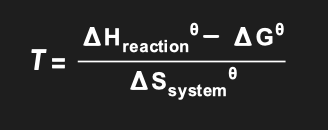
The equation can also be rearranged to find values of ΔHreactionꝋ, ΔSsystemꝋ or the temperature, T
For example, if for a given reaction, the values of ΔGꝋ, ΔHreactionꝋ and ΔSsystemꝋare given, the temperature can be found by rearranging the Gibbs equation as follows:
Reaction Feasibility
The Gibbs equation can be used to calculate whether a reaction is feasible or not
ΔGθ = ΔHreactionθ - TΔSsystemθ
When ΔGθ is negative, the reaction is feasible and likely to occur
When ΔGθ is positive, the reaction is not feasible and unlikely to occur
Reaction Feasibility & Temperature Changes - overview
The feasibility of a reaction can be affected by the temperature
The Gibbs equation will be used to explain what will affect the feasibility of a reaction for exothermic and endothermic reactions

exothermic reactions and Gibbs free energy
In exothermic reactions, ΔHreactionθ is negative
If the ΔSsystemθ is positive:
Both the first and second term will be negative
Resulting in a negative ΔGθ so the reaction is feasible
Therefore, regardless of the temperature, an exothermic reaction with a positive ΔSsystemθ will always be feasible
If the ΔSsystemθ is negative:
The first term is negative and the second term is positive
At high temperatures, the -TΔSsystemθ will be very large and positive and will overcome ΔHreactionθ
Therefore, at high temperatures ΔGθ is positive and the reaction is not feasible
The reaction is more feasible at low temperatures, as the second term will not be large enough to overcome ΔHreactionθ resulting in a negative ΔGθ
This corresponds to Le Chatelier’s principle which states that for exothermic reactions an increase in temperature will cause the equilibrium to shift position in favour of the reactants, i.e. in the endothermic direction
In other words, for exothermic reactions, the products will not be formed at high temperatures
The reaction is not feasible at high temperatures
Summary of factors affecting Gibbs free energy for exothermic reactions
If ΔH .... | And if ΔS .... | Then ΔG is | Spontaneous? | Because |
|---|---|---|---|---|
is negative < 0 exothermic | is positive > 0 more disorder | always negative < 0 | Always | Forward reaction spontaneous at any T |
is negative < 0 exothermic | is negative < 0 more order | negative at low T positive high T | Dependent on T | Spontaneous only at low T TΔS < H |
endothermic reactions and Gibbs free energy
In endothermic reactions, ΔHreactionθ is positive
If the ΔSsystemθ is negative:
Both the first and second term will be positive
Resulting in a positive ΔGθ so the reaction is not feasible
Therefore, regardless of the temperature, endothermic with a negative ΔSsystemθ will never be feasible
If the ΔSsystemꝋ is positive:
The first term is positive and the second term is negative
At low temperatures, the -TΔSsystemθ will be small and negative and will not overcome the larger ΔHreactionθ
Therefore, at low temperatures ΔGθ is positive and the reaction is less feasible
The reaction is more feasible at high temperatures as the second term will become negative enough to overcome the ΔHreactionθ resulting in a negative ΔGθ
This again corresponds to Le Chatelier’s principle which states that for endothermic reactions an increase in temperature will cause the equilibrium to shift position in favour of the products
In other words, for endothermic reactions, the products will be formed at high temperatures
The reaction is therefore feasible
Summary of factors affecting Gibbs free energy for endothermic reactions
If ΔH .... | And if ΔS .... | Then ΔG is | Spontaneous? | Because |
|---|---|---|---|---|
is positive > 0 endothermic | is negative < 0 more order | always positive > 0 | Never | Reverse reaction spontaneous at any T |
is positive > 0 endothermic | is positive > 0 more disorder | negative at high T positive low T | Dependent on T | Spontaneous only at high T TΔS > H |